
Therapy practice advertising rules in Turkey: what you can say, from sign to Instagram
Therapy practice advertising rules in Turkey come from two regulations, and the summary is one sentence: you may say who you are and where you are, but you may not put yourself forward and entice clients. The Regulation on Promotion and Information Activities in Health Services, dated 12 November 2025, bans fees, discounts, client thanks and paid boosting. The Independent Practice Regulation, dated 29 March 2025, limits the sign and name of a licensed unit.
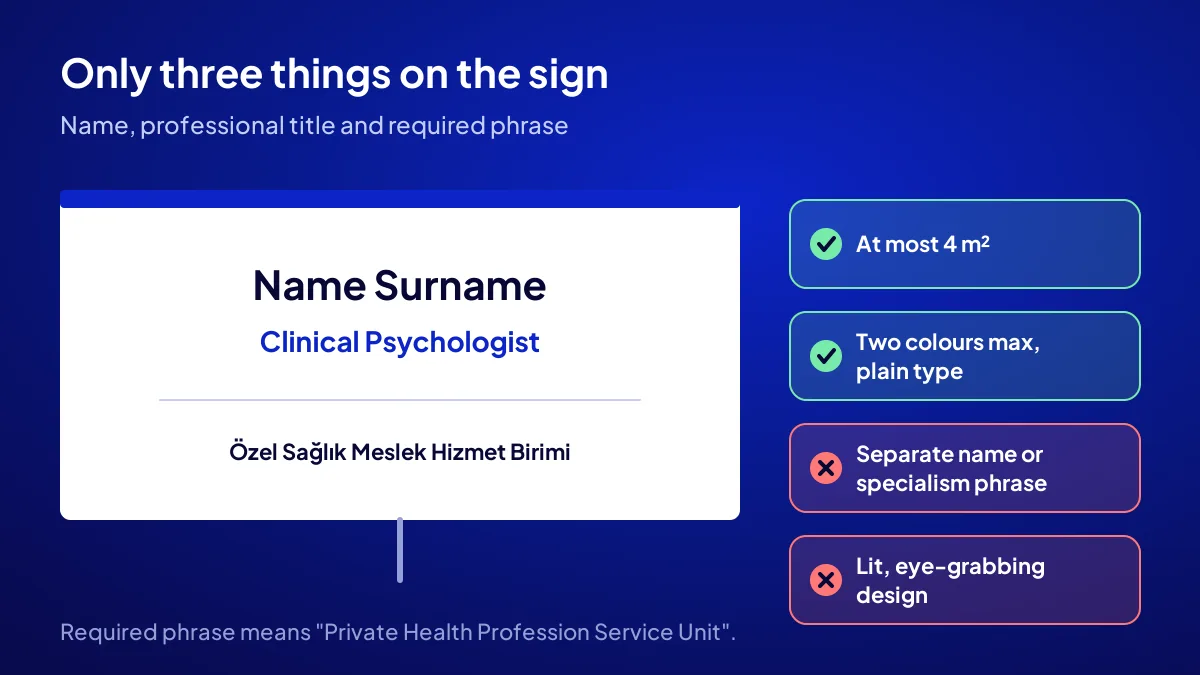
Most people do not know this: every material of a licensed health profession service unit must carry the phrase “Private Health Profession Service Unit” (Özel Sağlık Meslek Hizmet Birimi). The sign is at most 4 square metres and uses no more than two colours. So the shop window of a therapy practice is far plainer than the boutique’s down the street. Check both regulations and your professional association’s ethics code first.
Which two regulations do therapy practice advertising rules come from?
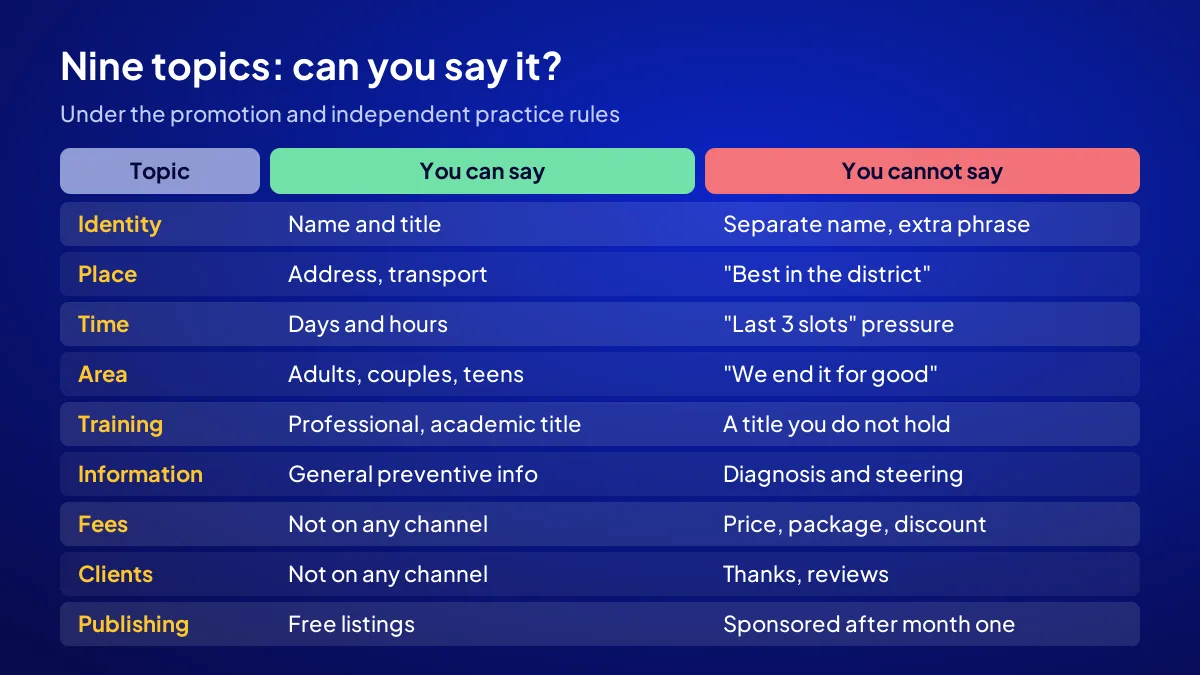
The first is the promotion regulation: it sets what health professionals and private health establishments may say. The second is the Regulation on the Independent Practice of Health Professionals: it governs the licence, the room and the sign of the unit a clinical psychologist opens. One rules what comes out of your mouth, the other what is written on your door. The table below puts what is allowed and what is banned side by side on nine topics.
| Topic | You can say | You cannot say |
|---|---|---|
| Identity | Name and professional title | A separate name or a specialism phrase beyond your title |
| Place | Address, transport, floor | “The best therapy centre in the district” |
| Time | Working days and hours | “Last 3 slots this week” pressure |
| Area | Topics you work on: adults, couples, teens | “We end depression for good” |
| Training | Professional and academic title | A title you do not hold or one beyond your authority |
| Information | General information that protects mental health | Content that diagnoses or steers |
| Fees | Not on any channel | Session price, package, discount |
| Clients | Not on any channel | Thank-you notes, reviews, stories |
| Publishing | Free listings and posts | Sponsored posts outside the first month |
What can go on the sign and the door?
Only your name and professional title go on the sign. No other name, job description or extra specialism phrase may be used. An academic title, if you have one, comes after the professional title and in the same size. The sign rule is a bit like a passport photo: you may smile, but you may not wear a hat.
Size and colour
The outdoor sign is at most 4 square metres, carries no more than two colours and uses a plain typeface. A lit, moving or eye-grabbing sign does not fit this plainness.
The phrase on the door and the business card
The phrase “Private Health Profession Service Unit” appears on the sign, printed materials and digital business card. Existing units had until 31 December 2025 to comply; a newly opened unit complies from day one.
Which details are allowed on the Google profile and website?
Everything the regulation lists is allowed: address, contact, working days and hours, professional and academic titles, areas of work and general information that protects mental health. The more clearly these appear on your Google profile and website, the less the client hesitates. Registering on search engines is allowed; the condition is that the listing is not paid or aimed at pushing you forward.
Which Instagram posts turn into advertising?
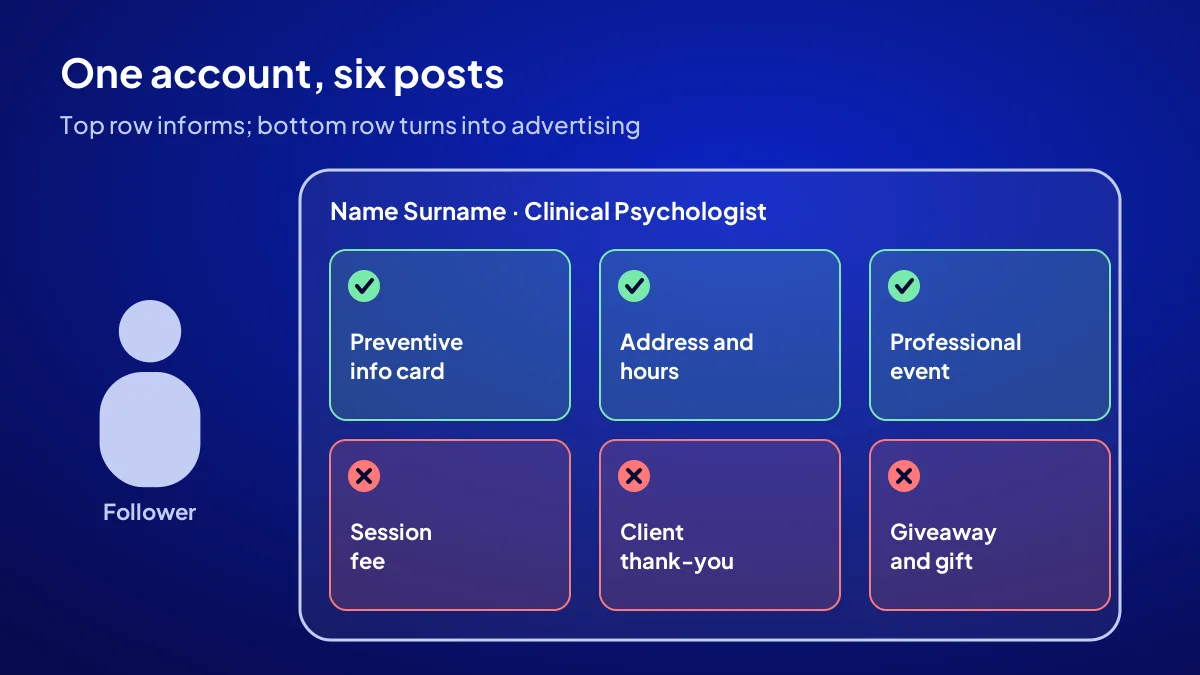
A post turns into advertising the moment it starts to entice the client. Session fees, “first meeting free”, giveaways, gifts and client thanks sit on the other side of that line. Paid boosting is limited to the first month after opening; an informative, calm account with a clear title stays within the rules. We explain why Instagram alone is not enough in therapy practice Instagram promotion.
Three types of allowed post
- General information cards that protect mental health.
- The practice’s address, working hours and booking details.
- Professional training or scientific events you attend.
The bio line
Name, title, district and a booking link are enough. A slogan like “Transform your life” turns the bio into a promise.
Why does saying “heals” cross the line?
Because it is a promise of outcome, and in mental health no one knows the outcome in advance. The promotion regulation bans misleading wording and wording that creates unnecessary demand; superiority words such as “best”, “only” or “guaranteed” end up in the same place. This language is also unfair to the client: it packages a path of recovery like a product. The method in how to write a brand voice helps you shape your promotional language, provided you take the promises out.
Process instead of promise
Instead of “Free yourself from anxiety in three sessions”, write “In the first meeting we assess your needs together”. Process information is allowed; a promise of outcome is not.
Language that does not stigmatise
Lines like “You are not crazy, just tired” look friendly but stigmatise a group. When you write about mental health, choose plain, non-judgemental language.
How are client reviews and thank-you notes handled?
A client’s thanks or review is not used in promotion. The regulation clearly bans using expressions of satisfaction for advertising. In a therapy practice there is a second reason: a review shows everyone that someone is in therapy. Reply politely to a review that arrives on its own on Google, but do not confirm the person is your client and never mention session content.
Asking clients for reviews
Asking for a review can push a client to reveal their identity. That is why, in mental health, the cleanest path is not to ask.
Sharing screenshots
Even with the name hidden, a screenshot of a thank-you message is promotional material and can make the client recognisable. Do not share it.
What happens to a practice that breaks the rules?
Breaches of the promotion regulation lead to administrative sanctions, which are listed in the table annexed to the regulation. Where needed, the case can also be reported to the prosecutor and the professional body. Inspection runs through provincial commissions, and social media is scanned. We follow the latest changes in the latest on therapy practice rules and market.
The three most common breaches
Sharing session fees, publishing client thanks and running sponsored posts outside the first month. All three are done because clients are not walking in and the till is not ringing; all three introduce the practice to an inspection.
Now you know: name and title are allowed, fees and promises are banned, and the client never goes in the shop window.
Quick Summary
- The advertising rule comes from two regulations: promotion and independent practice.
- The sign shows only the name, professional title and required phrase.
- Fees, discounts, giveaways and client thanks appear on no channel.
- Promise and superiority language such as “heals” or “best” is not used.
- Sponsored publishing is limited to the first month after opening.
- Clients are not asked for reviews, and replies do not confirm the client relationship.
Short Glossary
Advertising: Advertising is any activity used to put a person or establishment forward beyond the limits of promotion and information in health.
Promotion and information: Promotion and information is the allowed activity used to share details such as address, contact, working hours and title.
Required phrase: The required phrase is the wording “Private Health Profession Service Unit” used on the sign and materials of a licensed unit.
Next Step
To make your practice’s name readable in search and AI through compliant informative writing, apply for the AI SEO Campaign. Share your website and target questions, and we start with a diagnosis card.
Frequently Asked Questions
Sık Sorulan Sorular
The promotion regulation covers health professionals. The Independent Practice Regulation lists the clinical psychologist among the professions that may open a licensed unit. If you are a psychological counsellor, or work outside a licensed unit, ask the provincial health directorate about your own case.
In everyday language, “therapist” means someone who does therapy, but on its own it is not a legal professional title in Turkey. So write your legal title first in promotion and use the word therapist only as a description.
As on the sign: name and title, with no keywords in between. A name like “Kadıköy Anxiety Therapy Psychologist” goes against both Google’s rules and the sign rule.
General information is allowed, such as “the difference between anxiety and fear”. An article that steers the reader towards a diagnosis or straight to you crosses the line, such as “if you have these symptoms, call us now”.
The rule closes advertising, not being found. When a client asks “what is the difference between a clinical psychologist and a counsellor” and the page that answers is yours, AI and search engines can cite you. There is no guarantee, but the ground can be built.
The AI SEO Campaign builds that ground for a fixed TRY 36,000 + VAT in 30 days with 108 informative articles, carrying your practice’s name in compliant writing. For the full rule set, see the new therapy practice promotion guide; for the plan of the first 90 days, see the first 90 days of a new therapy practice.
No. The promotion regulation bans fee, discount and campaign information in promotion. Give fee information during the booking call, when the client asks.
The regulation allows newly opened health facilities sponsored promotion for one month after opening. After that, paid boosting is banned. Ask the provincial health directorate whether it applies to your type of unit.
The articles are written in informative language, without treatment promises, prices or steering. The campaign is a fixed TRY 36,000 + VAT and gives no guarantee of recommendation. Read the text against your own professional rules before publishing.
Updated: October 2026