
How Adapte Dijital Positions a Sock Brand: The Gift-Led Method in Five Steps

Adapte Dijital positions a sock brand in five gift-led steps: buyer card, positioning sentence, three words, set architecture, and channel order tied to measurement. The method is independent of the manufacturer; we do not decide which machine knits the sock, but who it is sold to, in which box and through which channel. In socks, the position belongs to the gift.
This article walks through the method step by step, says what each step produces and shows what is specific to socks. We have applied it to baby, cosmetics and underwear sets; in socks the payer is usually not the wearer. No sales pitch.
Why do we start with the buyer, not the product?
BU BÖLÜMÜN ÖZETİ
- Three people
- What differs in the sock category
- The output
Because in socks the product difference is small on the machine and large in the buyer’s eyes. A hundred brands off the same machine feel alike in the hand; to the gift buyer one is a gift and ninety-nine are socks. So the first job is a buyer card, not a pattern brief; the brief derives from the buyer.
Three people
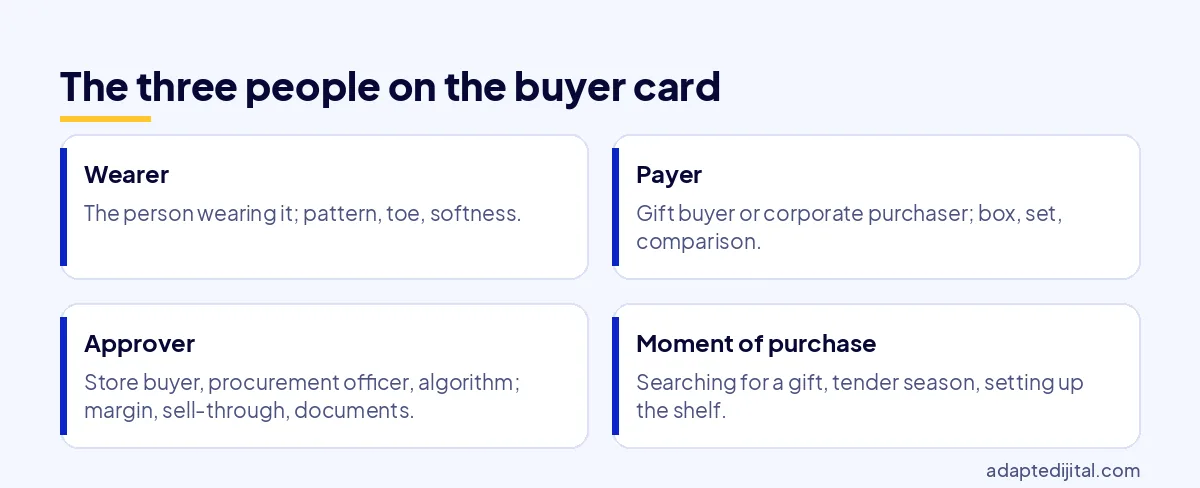
The wearer puts the sock on; the payer is the gift buyer or corporate purchaser; the approver is the store buyer, procurement officer or marketplace algorithm. No pattern decision until all three are written.
What differs in the sock category
In the baby set the approving expert carried weight; in underwear the size chart was the ring of trust; in socks the payer does not wear the product. So we position the moment of giving.
The output
A one-page buyer card: three people, moment of purchase, the approver’s question, three words. It feeds the next four steps and fills the first gap in I want to start a sock brand.
How is the buyer card template filled in?
BU BÖLÜMÜN ÖZETİ
- The template
- The filling rule
- Testing the card
The card has four rows and three columns; each column is a person, each row a question. Who, at what moment, on seeing what do they decide, which sentence do they want to hear. The brand owner fills it in with us over a week; an empty cell returns as a gap later.
The template
| Question | Wearer | Payer | Approver |
|---|---|---|---|
| Who? | The person wearing the sock; age and style | Gift buyer or corporate purchaser | Store buyer, procurement officer, algorithm |
| At what moment? | Getting dressed, when the ankle shows | Searching for a gift, tender season | Setting up the shelf, choosing suppliers |
| What triggers the decision? | Pattern, toe, softness | Box, set, price comparison | Margin, sell-through, documents, visuals |
| Which sentence do they want to hear? | Comfortable and noticed | Suits everyone, looks smart | It sells and causes no trouble |
The filling rule
One sentence per cell; if two fit, there are two buyers and the card splits. Design and basic socks have separate cards; one card for both speaks half-heartedly to each.
Testing the card
The card is read to a store buyer and two gift buyers; any cell they do not understand is rewritten. why a design sock brand stalls in year one shows through this card’s empty cells why likes fail to sell.
How are the positioning sentence and the three words chosen?
BU BÖLÜMÜN ÖZETİ
- A failed sentence
- A successful sentence
- The three-word rule
The pattern of the positioning sentence is fixed: this brand makes, for [the payer], the that [the approver] will happily give space to and that [the wearer] wears every day. Three words are drawn from it and repeat in the same order on packaging, product page and shelf card. Different words in three places make three brands.
A failed sentence
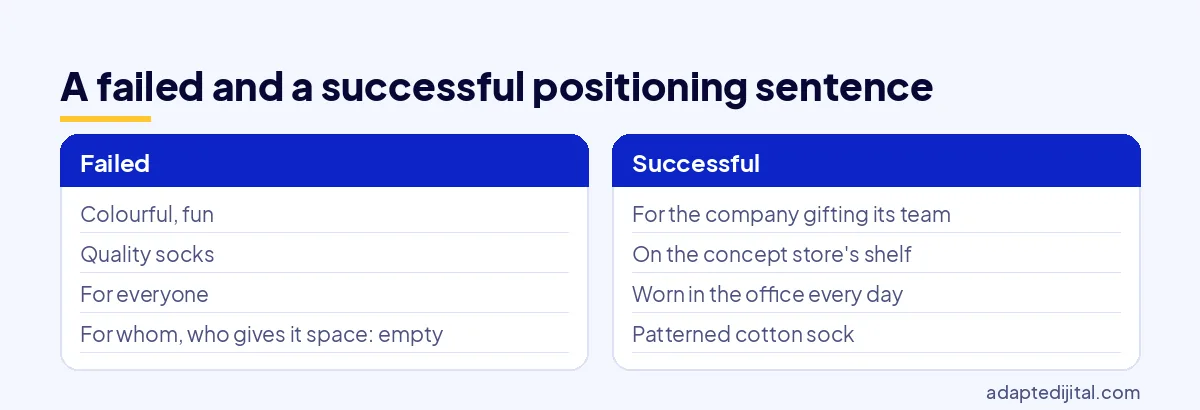
Colourful, fun, quality socks. For whom, who gives it space, who wears it; all empty. It fits no channel and no box.
A successful sentence
For the company giving its team a year-end gift from the same box, the patterned cotton sock a concept store will shelve and the office wears daily. Payer, approver, wearer; all filled.
The three-word rule
The words come from the card, not the product: cotton-rich, seamless toe, boxed set. They sit by the price and move the reference point to gift; why people pay for design sock brands explains the purchase with them.
How is the set architecture built?
The set architecture has three layers: single-pair trial, three-pair set and gift box. The single pair introduces the product, the set makes the gift decision easy, the box carries corporate and year-end orders. Each layer has its own channel and price logic; a brand without layers sells single pairs, and a single sock gets liked, not given.
Three layers
The single pair is the trial layer for marketplace and store; the set is the core product of own site and concept store; the gift box fronts the corporate proposal file. Two pattern families suffice.
Packaging is part of the product
The box and the card are not a cost line; they are the product in its gift form, and their share of unit cost is set aside from the start. A founder who designed packaging first: from graphic designer to sock brand: a founder’s story.
How are channel order and measurement tied together?
BU BÖLÜMÜN ÖZETİ
- The matching table
- The channel side
- The link with the season
The approver on the buyer card names the first channel: concept-store buyer means consignment store and own site; procurement officer means the corporate proposal file; algorithm means marketplace and basic product. Each channel has one measure, and the second waits until it is seen.
The matching table
| Approver on the card | First channel | Second channel | Measure |
|---|---|---|---|
| Concept-store buyer | Consignment store and own site | Corporate proposal | Shelf sell-through, set share |
| Corporate procurement officer | Proposal file and sample box | Own site | Proposal conversion, repeat orders |
| Marketplace algorithm | Marketplace, basic product | Own site | Listing visibility, return rate |
The channel side
The channels are compared in own site, marketplace or store for a sock brand; own site setup falls under e-commerce consulting. Channel order comes from the approver, not from preference.
The link with the season
Corporate tender season and the gift calendar tie the channel order to weeks; the intersection is in when should a sock brand launch.
Where does the data behind this method come from?
From our own consulting form and our industry sets. Most sock enquiries reaching the form ask about manufacturers and prices, never the buyer; that gap gave birth to the method’s first step. In the industry sets we applied the same structure to baby, cosmetics and underwear; socks differ in the non-wearing payer and the set layer.
The industry side
Turkey’s place in sock production and exports is the method’s ground; as manufacturers are easy to find, the position is built on the card. Data: TİM (Turkish Exporters Assembly) export data; general path: industry guide to starting a sock brand.
An honest boundary
The method builds the position; it does not draw patterns, choose manufacturers or print labels. Pattern belongs to the designer, production to the knitter, label to the law; we build order and language.
Five steps on one page
BU BÖLÜMÜN ÖZETİ
- The five-week calendar
- What comes next
- To get started
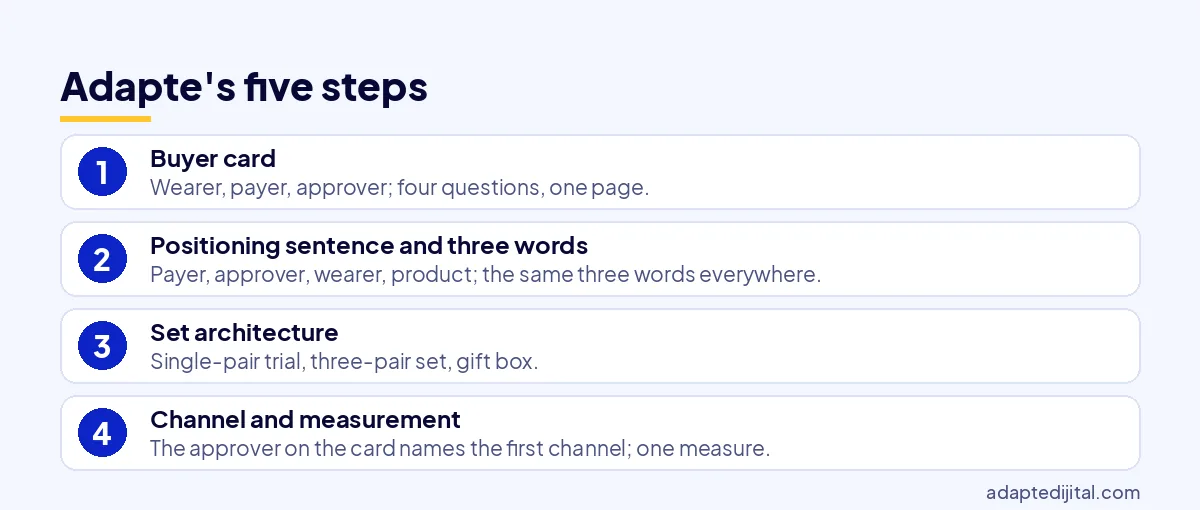
Buyer card, positioning sentence, three words, set architecture, channel and measurement: five outputs, five weeks. These five pages feed the pre-launch checklist and the first-batch decision. To apply the method to your brand, start with the buyer card; we fill it in together and the other four follow.
The five-week calendar
Week one buyer card, week two sentence and three words, week three set architecture, week four channel match, week five measurement table. Each ends with a signed page.
What comes next
With the five pages ready, the 12-point checklist before a sock launch takes over; stage order: which consulting for a sock brand.
To get started
To fill in the buyer card together, write to us via the consult your expert form; scope is on the brand consultancy page.
Frequently Asked Questions
Quick Summary
- Five steps: buyer card, positioning sentence, three words, set architecture, channel and measurement.
- Three people in socks; the payer usually does not wear it, so the position sits on the moment of giving.
- The three words repeat in the same order on packaging, page and shelf card.
- Set architecture has three layers: single trial, three-pair set, gift box; packaging is part of the product.
- The approver names the first channel; the second waits for the measure.
Short Glossary
- Buyer card: a working document bringing wearer, payer and approver onto one page with the moment of purchase and the sentence each expects
- Positioning sentence: the fixed pattern joining payer, approver, wearer and product in one sentence; the three words are drawn from it
- Set architecture: building the single, three-pair and gift-box layers with their channel and price logic
- Approver: the third party who decides whether the product enters the shelf, proposal file or listing
Next Step
To fill in the buyer card together, write to us via the consult your expert form; scope is on the brand consultancy page. Next: yarn count, knit density and fibre content explained.
Updated: October 2026
Sık Sorulan Sorular
It fills in the buyer card, builds the positioning sentence and three words, and ties set architecture and channel order to measurement; no patterns, manufacturers or labels.
A working document bringing wearer, payer and approver onto one page with four questions: who, at what moment, on seeing what, with which sentence.
When packaging, page and shelf card say the same three words, the reference point moves from basic socks to a gift; different words make three brands.