
How to Start a Sock Brand in 9 Steps: The Road from Sample to First Set
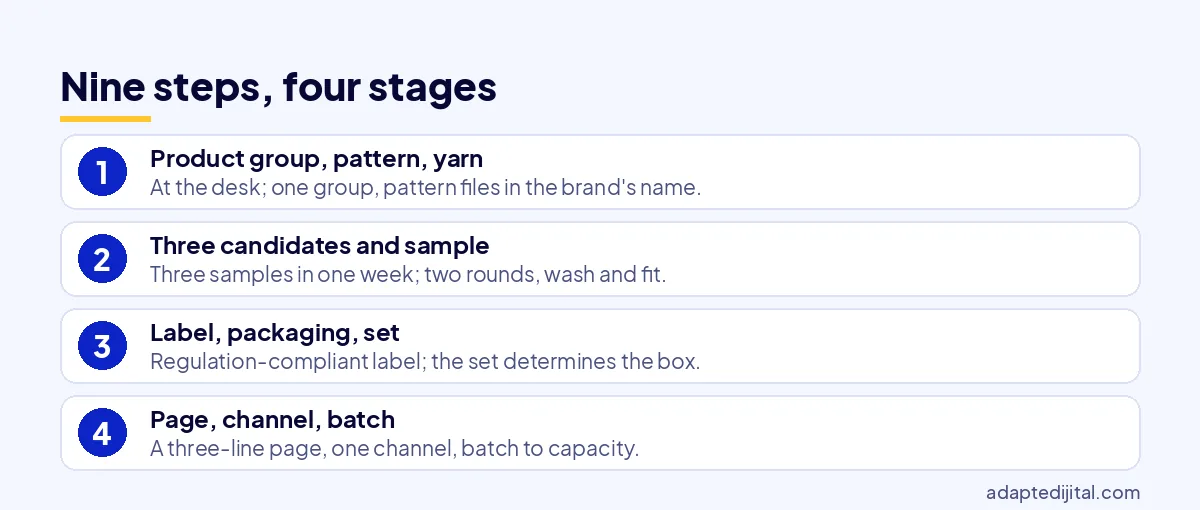
A sock brand is built in nine steps: choose the product group, decide the pattern and yarn, find three manufacturer candidates, run the sample and fit test, prepare the label and packaging, build the set, write the product page, open the first channel, produce the first batch. The order does not change; set logic before the page, the page before the batch. Most steps happen at the desk.
This guide says two things at every step: what you hold at the end and which mistake is made most often. No figures, because cost depends on manufacturer, yarn and quantity; outputs and mistakes, because those do not change. At the end is a nine-row table.
Steps 1–2: product group, then pattern and yarn
BU BÖLÜMÜN ÖZETİ
- 1. Choose the product group
- 2. Decide the pattern and yarn
- Pattern ownership
The first two steps happen at the desk. One product group is chosen: design, basic, sports or specialist; the pattern and yarn decision follows from that group. Skip them and the manufacturer meeting is held for the wrong product, and the sample round runs twice.
1. Choose the product group
Output: a one-sentence product definition and a buyer card naming wearer, payer and approver. Common mistake: launching design and basic socks together. Two groups need two channels; see I want to start a sock brand.
2. Decide the pattern and yarn
Output: the pattern files (in your own name, usage rights yours) and the yarn preference; cotton-rich blend, elastane share, toe type. Common mistake: picking yarn from the manufacturer’s stock and leaving the label for later. The yarn decides the label.
Pattern ownership
The brand must own the pattern files; a file left on the manufacturer’s machine becomes another brand’s sock tomorrow. Ownership is set in the contract.
Steps 3–4: three manufacturer candidates and the sample
The manufacturer is chosen from three candidates, not one, and all three are asked for a sample in the same week. The sample goes through fit, wash and toe tests; the first sample is not approved, a second round is compulsory. These two steps are the longest part, and done properly they shorten every step after them.
3. Find three manufacturer candidates
Output: minimum quantity, yarn options, file ownership and document list per candidate, in one table. Common mistake: starting with the first one found. The questions are in how to choose a sock manufacturer.
4. Run the sample and fit test
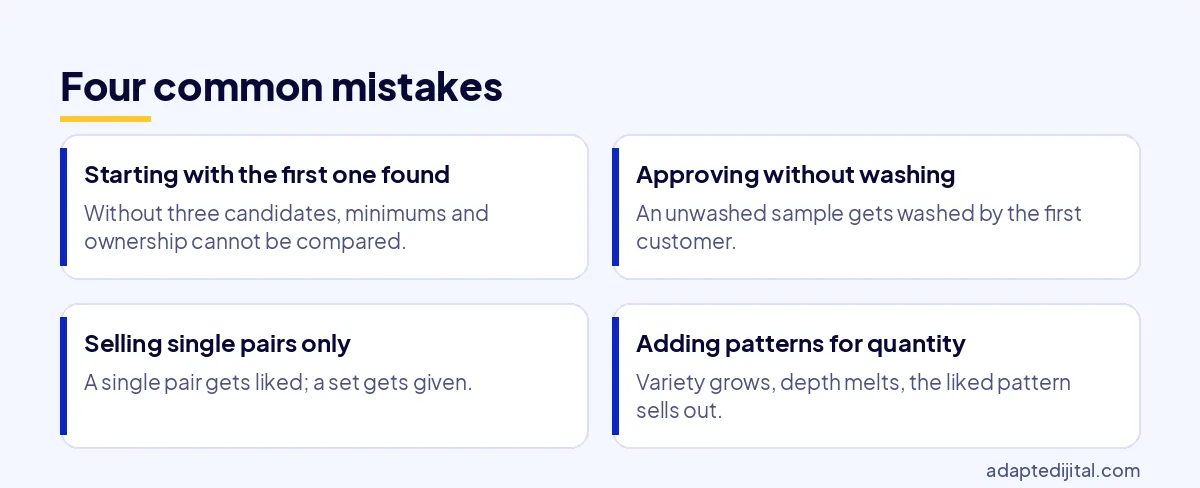
Output: a signed-off sample and a written test note on size fit, measurements after washing, toe seam and pattern sharpness. Common mistake: approving without washing; an unwashed sample gets washed by the first customer.
Steps 5–6: label, packaging and set logic
BU BÖLÜMÜN ÖZETİ
- 5. Prepare the label and packaging
- 6. Build the set
- The packaging threshold
The label is prepared after sample approval, the packaging together with the set. Fibre content, care symbols and manufacturer details go on the label; box, card and set logic go into the packaging. Socks are a gift product; the packaging is part of the product, and set logic determines packaging, not the reverse. Both steps finish at the desk.
5. Prepare the label and packaging
Output: a label draft checked against the regulation, the box and card design, and packaging’s share of unit cost. Common mistake: using the manufacturer’s standard label. The rules are in textile labelling rules and unsafe-product inspections.
6. Build the set
Output: single pair, three-pair set and gift box, and the channel each sells in. Common mistake: selling single pairs only. A single pair gets liked, a set gets given.
The packaging threshold
Box quantities carry their own minimum; the packaging supplier sets a threshold like the knitter. The cost lines and thresholds are in the cost of starting a sock brand.
Steps 7–8: product page and first channel
The product page is written before the first batch, because the page tests what will be produced. Three lines sit next to the price: fibre content, toe type, gift box. The first channel is chosen by product group and opened alone; own site and concept store for design, marketplace for basic, proposal file for corporate.
7. Write the product page
Output: a page with size chart, fibre information, care instructions, set options and return terms. Common mistake: a pattern photo only. The page setup sits under website consulting.
8. Open the first channel
Output: one channel, its shelf card or proposal file, and return and consignment terms. Common mistake: opening three channels on one day. The comparison: own site, marketplace or store for a sock brand.
Step 9: the first batch
BU BÖLÜMÜN ÖZETİ
- 9. Produce the first batch
- The second-batch rule
- The calendar
The first batch is produced to channel capacity, not to a sales forecast: for one concept store and the own site, not for ten stores. Few patterns, deep stock; set logic creates many gift options from few patterns. The second batch is set by the first channel’s sell-through.
9. Produce the first batch
Output: a batch produced to the approved sample, labels and boxes attached, a quality note kept. Common mistake: adding patterns to fill the minimum. That mistake melts stock depth in why a design sock brand stalls in year one.
The second-batch rule
The second batch grows with the first channel’s sell-through, not a forecast: bigger for the set that sells out fast, the same for the slow one. This stops stock mapping the founder’s taste.
The calendar
Sample-to-batch time varies by manufacturer and is counted backwards from the gift season; season and launch week are in when should a sock brand launch.
The step-output-mistake table
The table below shows the output at each of the nine steps and the most common mistake at a glance. If the output is missing, the step is not finished; if the mistake has been made, the step repeats. Print it, take it to the manufacturer and packaging supplier, and tick each output you hold.
The table
| Step | Output | Common mistake |
|---|---|---|
| 1 Product group | One-sentence product definition, buyer card | Launching two groups at once |
| 2 Pattern and yarn | Pattern files in the brand’s name, yarn preference | Picking yarn from the manufacturer’s stock |
| 3 Three candidates | Candidate table: quantity, yarn, ownership, documents | Starting with the first one found |
| 4 Sample and fit | Approved sample, written test note | Approving without washing |
| 5 Label and packaging | Regulation-compliant label, box design | Making do with the standard label |
| 6 Set logic | Single, three-pair, gift box; channel match | Selling single pairs only |
| 7 Product page | Size, fibre, care, set, returns | Pattern photo only |
| 8 First channel | One channel, shelf card or proposal file | Opening three channels on one day |
| 9 First batch | Batch to channel capacity, quality note | Adding patterns for quantity |
Certificates and the document trail
At steps two and five, the yarn certificate and dye test trail are requested in writing; the scope is on the OEKO-TEX website. A certificate does not replace the label.
Nine steps on one page
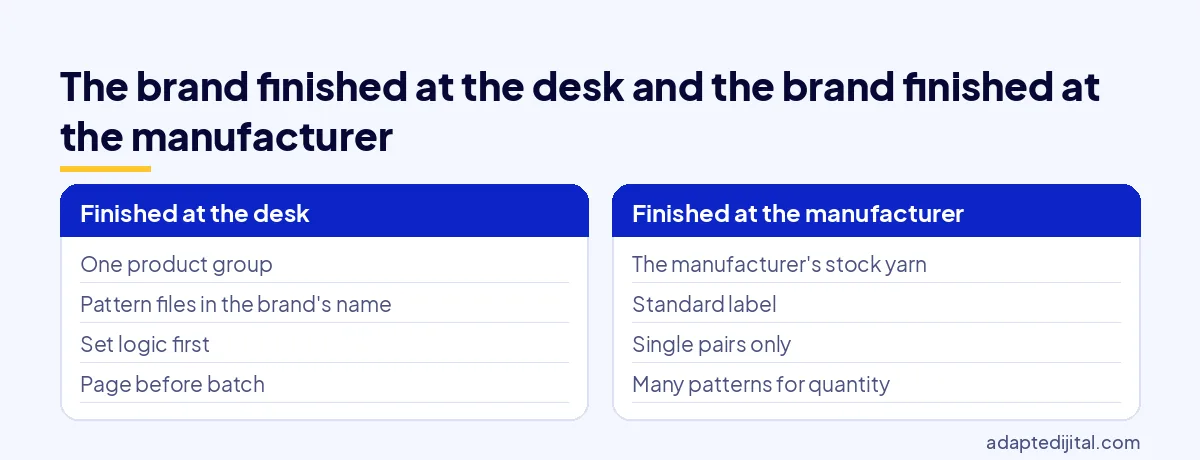
Five steps at the desk, two at the manufacturer, two in the channel: product group, pattern and yarn, set logic, product page and label at the desk; sample and batch at the manufacturer; channel and shelf card outside. Because production is easy, the brand’s work finishes at the desk; a brand finished at the manufacturer is one of a hundred.
Do this today
Print the nine rows and tick each output you hold. The first empty row is today’s job.
Next step
To fit the steps to your calendar, write to us via the consult your expert form; the final check is in the 12-point checklist before a sock launch.
Frequently Asked Questions
Quick Summary
- Nine steps: product group, pattern and yarn, three candidates, sample, label, set, page, channel, batch.
- The order does not change: set logic before page, page before batch.
- Pattern files in the brand’s name; ownership is established in the contract.
- Two sample rounds with wash and fit tests; unwashed is not approved.
- The first batch to channel capacity; few patterns, deep stock.
Short Glossary
- Fit test: wearing and washing a sample to test size fit, measurements after washing and the toe seam
- Set logic: presenting single products as three-pair or boxed groups bought as one decision
- Minimum quantity: the lowest quantity a manufacturer or packaging supplier will accept for an order
- Sell-through rate: the measure of how quickly a product sells in a given channel
Next Step
To fit the nine steps to your calendar, write to us via the consult your expert form; scope is on the brand consultancy page. Next: how Adapte Dijital positions a sock brand.
Updated: October 2026
Sık Sorulan Sorular
The first round shows the yarn and the pattern; the second shows the correction has held. A brand that passes on one round lives the second in its first batch, where it costs a batch, not a sample.
The brand owner; the manufacturer’s list is not yours. To build sequence and calendar, brand consultancy; to find your stage, which consulting for a sock brand.
Nine: product group, pattern and yarn, three candidates, sample and fit test, label and packaging, set logic, product page, first channel, first batch. The order does not change.
As big as the channel you open; few patterns, deep stock. The second batch follows the first channel’s sell-through.
The first round shows the yarn and the pattern, the second shows the correction has held; wash and fit tests are completed in the second round.