
How to Choose a Sock Manufacturer for Your Sock Brand: Three Candidates, One Sample
Choosing a sock manufacturer starts with three candidates, is measured with twelve questions, is tested with one sample and is tied down with a five-clause contract. Finding a manufacturer in Istanbul or Thrace is easy; the hard part is getting three answers to one brief and picking the right one. The thresholds: no decision with fewer than three candidates, no signature unless the brand owns the pattern file, no approval for a sample that fails the wash test.
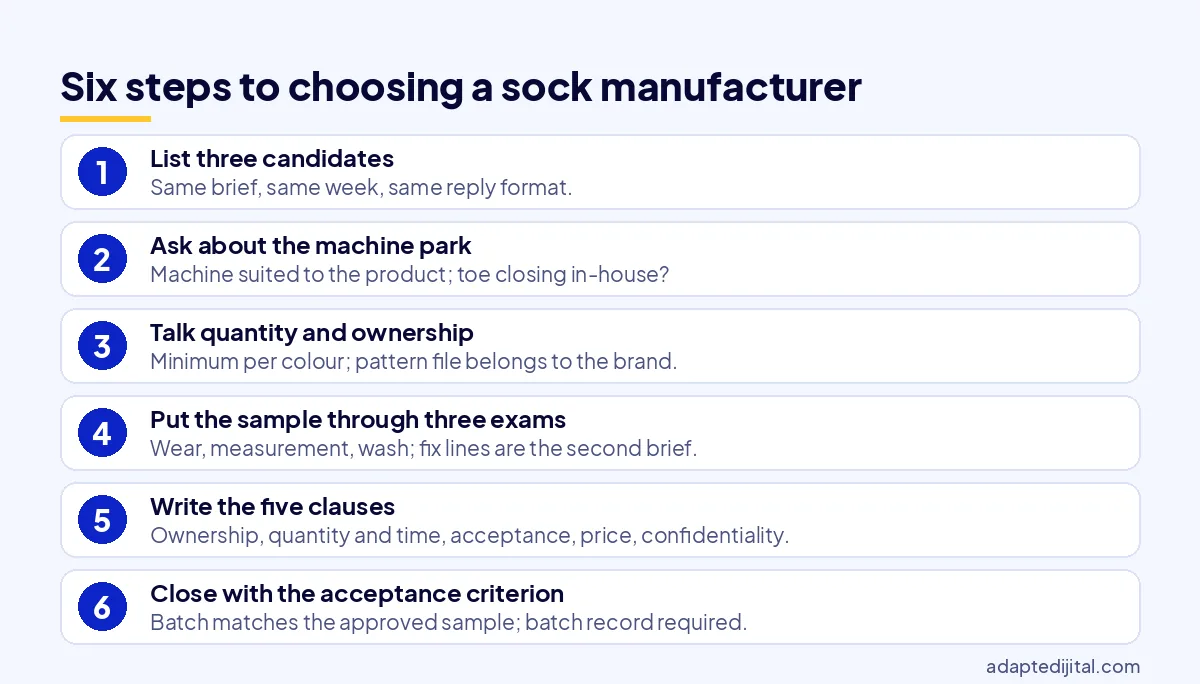
The process in order: candidates, machine park, quantity and pattern ownership, sample and testing, contract, acceptance criterion. In the middle sits a twelve-question list; read it to all three candidates and the choice makes itself.
Why three candidates, and where do you find them?
A brand that talks to one candidate has no yardstick for price, minimum quantity or quality; three candidates give three answers to one brief and the yardstick builds itself. Send the same one-page brief to three manufacturers in the same week and ask for replies in the same format. No sample until all three are in.
The most common mistake
Starting samples with the first manufacturer found or the fastest to reply. A fast reply means spare capacity, good or bad; no judgement until all three are in.
The machine park question: single cylinder or double cylinder?
Sock machines fall into two families: single-cylinder machines knit most patterned, everyday and sports socks; double-cylinder machines serve other knit structures and the classic men’s dress sock. Name your product type and ask which machine and how many needles. A manufacturer who cannot answer does not know your product.
Three follow-up questions
Is toe closing in-house or sent out; is there a boarding step; are dyeing and yarn supply in-house or external. Every outside step adds a link to delivery and quality control.
Threshold
A manufacturer without a machine suited to your product leaves the list; if they use a subcontractor, the subcontractor joins the interview. Indirect production is fine; invisible production is not.
Minimum quantity, and who owns the pattern file?
BU BÖLÜMÜN ÖZETİ
- Why pattern ownership is critical
- The quantity calculation
- The most common mistake
Minimum quantity is discussed per colour and size, not as a total; the manufacturer’s total sounds small, but split by colour it locks up stock. The minimum does not exceed your three-month forecast; if it does, cut the range or change manufacturer. The pattern file is not negotiable: it stays with the brand.
Why pattern ownership is critical
If the file stays with the manufacturer, your pattern stays behind when you move, and can be knitted for another brand. It goes in the contract with a copy handed over; the same principle is in the underwear brand guide.
The quantity calculation
Write down the sales points, put a weekly estimate against each, multiply by a quarter and split across colours and sizes. If the minimum is above that, question the manufacturer; see the cost of starting a sock brand.
The most common mistake
Accepting the minimum to cut the unit price and then widening the range. Variety goes up, depth goes down, the best seller runs out and the rest sits in the warehouse.
How are the sample, the fit and the wash test done?
One sample round is enough, but that sample passes three exams: wear, measurement and washing. Three people in the target size wear it, cuff and toe are checked a day later, then it is washed by the label symbols and compared with the original. Outside the acceptance range, no approval.
The evaluation form
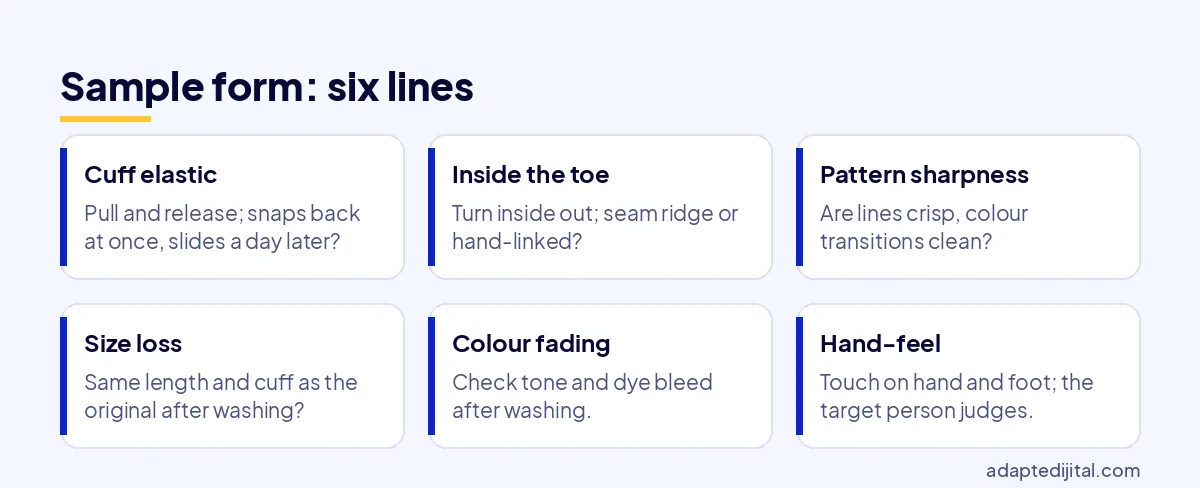
Six lines: cuff snap-back, flatness inside the toe, pattern sharpness, size loss, colour fading, hand-feel; each gets pass, fail or fix. The fix lines are the second brief.
The certificate question
Harmful-substance tests and organic claims come from the yarn and the manufacturer’s documents; ask now, build the claim later. OEKO-TEX is the official source.
Which five clauses go in the contract?
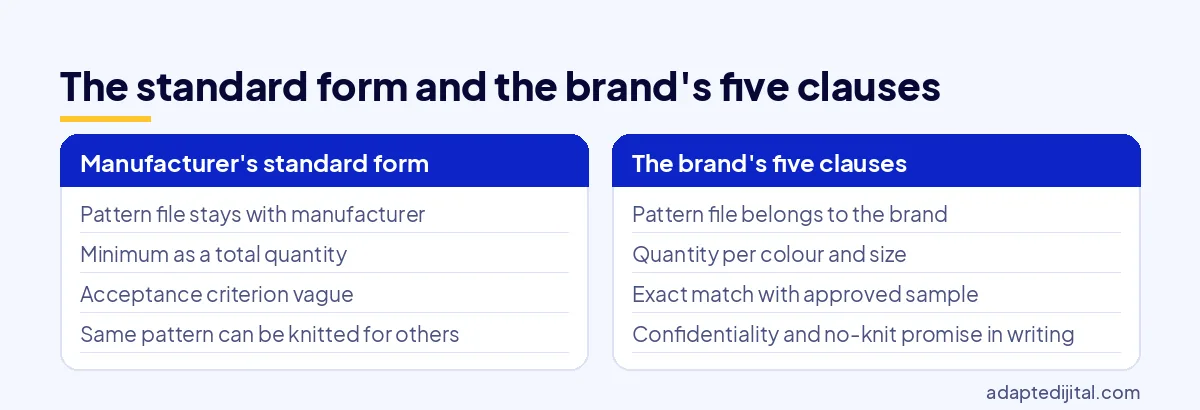
Pattern and file ownership, minimum quantity and delivery time, acceptance criterion and return terms, price validity period, and confidentiality plus a promise not to knit the same pattern for a competitor. Five clauses protect the brand; the standard form protects the manufacturer. If one is missing, no signature.
The five clauses
- The pattern file and the right to use it belong to the brand; a copy is handed over
- Minimum quantity per colour and size; delivery time in days
- Acceptance means exact conformity with the approved sample; a failing batch is returned or remade
- The price holds for the agreed period; a yarn rise passes on only by written notice and approval
- The pattern and its family are not knitted for another brand; brief and files stay confidential
Twelve questions to ask in the manufacturer interview
Read the same list to all three candidates in the same order and write the answers into one table. It covers machine, quantity, ownership, toe, testing and delivery; a candidate who cannot answer two questions drops off. The interview takes an hour; the wrong manufacturer takes a season.
The twelve questions
- Which machine and how many needles for my product?
- Is toe closing in-house; do you hand-link?
- Yarn supply yours or mine; which yarn supplier?
- Minimum quantity per colour and per size?
- Sample lead time and fee; is it credited against the order?
- Who programs the pattern file, and who owns it?
- Will you commit not to knit my pattern for another brand?
- Do you run wash and measurement tests; will you share the report?
- Harmful-substance certificate for the yarn or the factory?
- Do you attach labels and packaging, or do I?
- Delivery time, and what happens if it slips?
- How long does the price hold, and how is a rise notified?
How to read the answers
A clear figure or a document scores one point; it depends scores zero. What decides is the number of zeros, not the total; the order of steps is in how to start a sock brand in 9 steps.
How are the acceptance criterion and the decision written down?
The acceptance criterion is one sentence: the delivered batch conforms exactly to the approved sample in cuff, toe, measurement, pattern and colour; a failing batch is held and inspected in full. Random pairs are pulled from every batch, the six-line form is filled in and the batch number is recorded.
The decision table
| Criterion | Candidate A | Candidate B | Candidate C | Weight |
|---|---|---|---|---|
| Machine suited to the product | Decisive | |||
| Accepts ownership and confidentiality | Decisive | |||
| Minimum within three-month forecast | High | |||
| Sample passed three exams | High | |||
| Accepted the five clauses | High | |||
| Price and validity | Medium |
Frequently Asked Questions
Quick Summary
- Three candidates, one brief, one week; no judgement until all three reply.
- The machine park is asked by product type; invisible production is out.
- Minimum quantity is per colour and size, within the three-month forecast.
- Pattern file and confidentiality go in the contract; both are decisive.
- The sample passes wear, measurement and wash exams; every batch is recorded.
- Twelve questions, three candidates; the fewest zeros wins.
Short Glossary
- Single-cylinder machine: the sock machine family that knits most patterned, everyday and sports socks
- Pattern file: the digital file the sock machine reads; secured for the brand by contract
- Minimum quantity: the lowest run a manufacturer accepts, per colour and size
- Acceptance criterion: the written measure of a batch’s conformity with the approved sample; it also sets return terms
Next Step
To place your three candidates in the decision table, write to us via the consult your expert form; scope is on the brand consultancy page. Next: own site, marketplace or store for a sock brand.
Updated: October 2026
Sık Sorulan Sorular
Product group, product type, the blend, the toe type, an estimated three-month quantity, the colour and size split, the documents you need. You cannot write it without the vocabulary; yarn count, knit density and fibre content explained comes first.
Industrial estates, trade fairs, a yarn supplier’s tip, and the manufacturer line on the label of brands you admire; districts are in starting a sock brand in Istanbul. The label shows who knits for whom.
The brand owner and two people from the target audience; for a gift sock, one must fit the recipient’s profile. The founder’s foot is not the measure; the customer’s is.
A hundred brands come off the same machine; if the pattern sets you apart, only the contract protects it. A manufacturer will find this natural; if not, that is your answer. See I want to start a sock brand.
Choosing a manufacturer is technical work, but the brief and the contract are brand work; brand consultancy places the candidates in this table and carries the five clauses into the contract. Your stage: which consulting for a sock brand; before the interview, consult your expert.
At least three. The same brief goes to all three in the same week, replies come back in the same format; one candidate gives no yardstick.
The brand. A copy is handed over; the right to use it and a no-knit promise go into the contract.
Three exams: wear in the target size, a measurement and cuff check a day later, and size and colour compared after washing.