
Sock Brand Sales Channels: Own Site, Marketplace or Concept Store Compared
The three-channel comparison for a sock brand comes down to one sentence: design and gift socks sell on the own site and in concept stores, basic socks find volume on marketplaces, and corporate gifting is a separate door. The own site has the highest margin but the brand brings its own traffic; the marketplace hands you visibility but buries the design in a price list; the concept store wins an approving seller but works on consignment.
This article compares the three channels on six criteria, gives the table and adds a decision rule by product group. No figures, only relative margin structure; no advertising, only criteria.
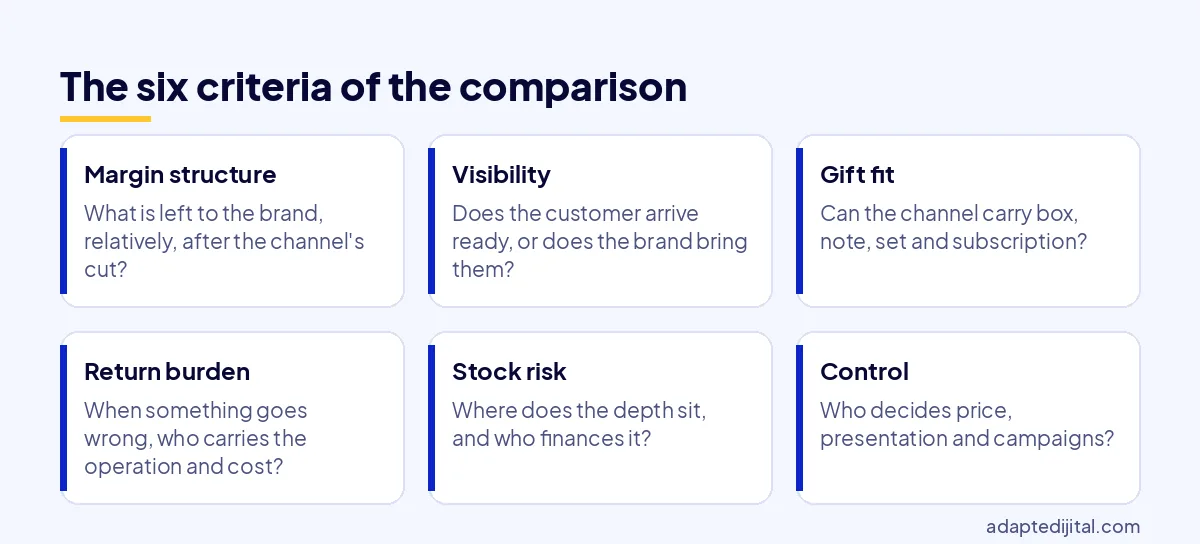
Which six criteria does the comparison use?
Margin structure, visibility, gift fit, return burden, stock risk and control. These six decide a sock brand’s first two years; price is left out on purpose, because price is the brand’s decision, not the channel’s, and must be the same in all three. Each criterion gets low, medium or high; there is no total score.
Own site: the main channel for gifts and sets
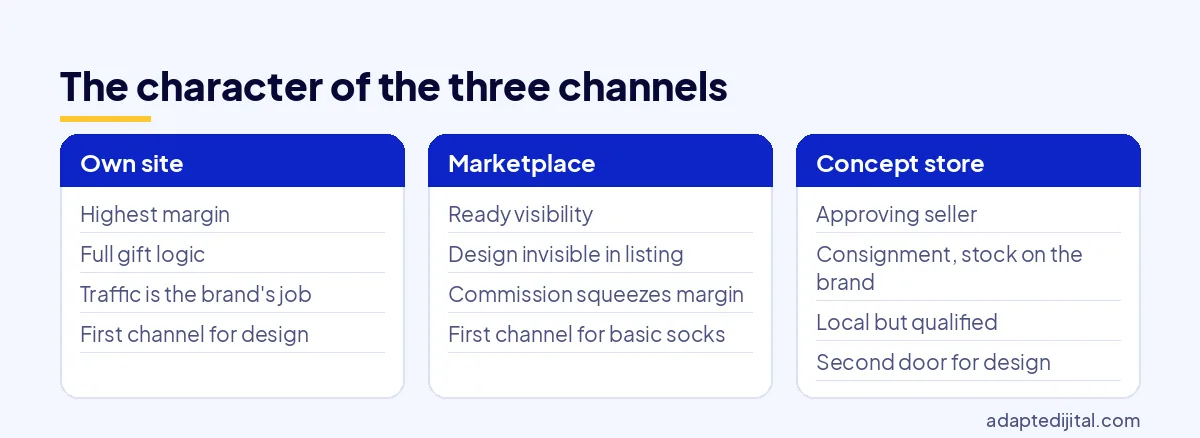
The own site has the highest margin and the fullest control; the gift box, personal note, three-pair set and subscription only work properly here. The price is traffic: the brand brings every visitor itself, through advertising, content and social media. Visibility starts low, and returns, shipping and stock are the brand’s operation.
The upside
Highest margin, full gift logic, the data is yours. The corporate gifting proposal page and the set page run from here; repeat purchase and gift reminders can only be built here.
The downside
Early traffic is expensive and slow, trust starts from zero, the operation is yours. Site setup and conversion are a separate job; e-commerce consulting covers that side.
Marketplace: volume for basic socks, thin margin for design
A marketplace hands you visibility; the searching customer is already there, and for products bought by comparison, such as basic and sports socks, volume builds here. The price is twofold: commission and campaign pressure squeeze the margin, and the listing shrinks the pattern and puts a design sock next to a basic sock’s price. Control is low.
The upside
Ready traffic, a fast first sale, multipack sales for basic socks. For seller rules and commission, the Trendyol seller page is the first source; terms change, read the current version.
The downside
The design is invisible in the listing, the price is compared with the cheapest, the gift box cannot be carried, and a product is sold rather than a brand. That dead end is in why a design sock brand stalls in year one.
Concept store and boutique: an approving seller, a consignment shelf
The concept store is the natural shelf for a design sock: the seller holds the product, explains it to the gift buyer and plays the approver. The price is consignment: you are paid as the product sells, what does not sell comes back, and the stock risk stays with the brand. Margin is medium, visibility local, gift fit high.
The upside
An approving seller, the right customer, a sale at the gift moment. The shelf card and packaging are part of the product here; the shelf introduces the brand, and the web address on the box carries the customer home.
The downside
Consignment payments arrive late, returns come back to the brand, and every store is a separate negotiation. The seller has to be told the difference between gift buyer and wearer; see why people pay for design sock brands.
Three channels on six criteria: the comparison table
The table gives the six criteria for the three channels in relative terms; no figures, only high, medium and low. The last row answers who each channel suits. There is deliberately no total score, because gift fit and control weigh heaviest for design socks, visibility and stock turnover for basic socks.
The table
| Criterion | Own site | Marketplace | Concept store |
|---|---|---|---|
| Margin structure | Highest; traffic cost on the brand | Commission and campaign cut; tightest | Medium; consignment, payment delayed |
| Visibility | Starts low, the brand’s job | Ready and high, price-driven | Local but qualified |
| Gift fit | Full: box, note, set, subscription | Weak: listing view, no box | High: seller explains, box on shelf |
| Return burden | On the brand, shipping included | High; easy-return rules | Consignment returns to the brand |
| Stock risk | Own warehouse, controlled | Campaigns demand depth | Little per shelf, scattered |
| Control | Full | Low; platform rules | Medium; seller’s window |
| Who it suits | Design and gift, set logic | Basic and sports, multipack | Design, local gift buyer |
The decision rule: first and second channel by product group
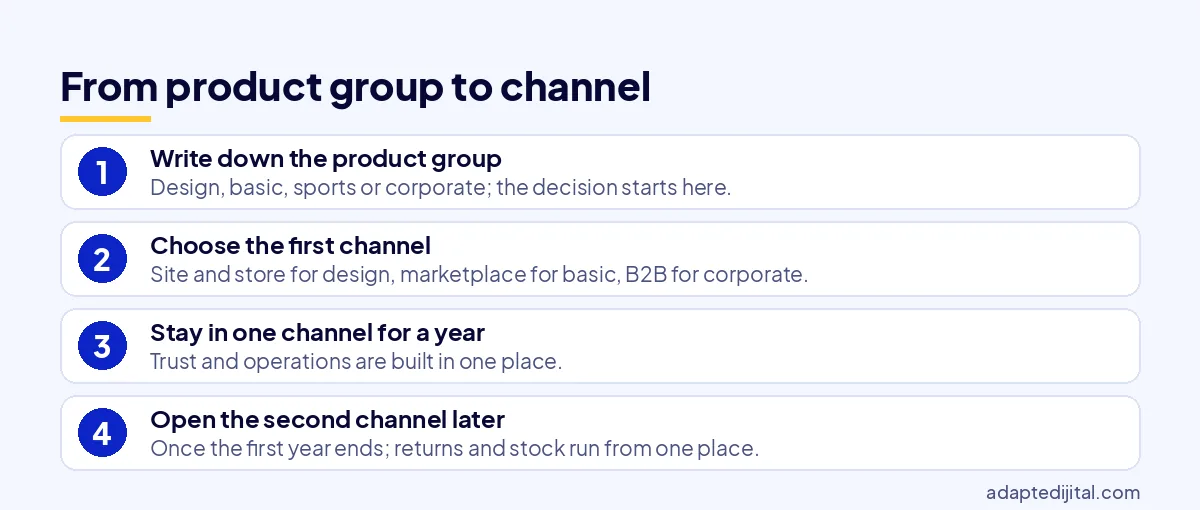
The decision comes from the product group, not preference: design and gift socks go to the own site and concept stores, basic and sports socks to the marketplace, corporate socks to direct B2B sales. The second channel opens after the first year. A brand that enters all three at once ends up half-built in all three.
The decision table
| Product group | First channel | Second channel | Reason |
|---|---|---|---|
| Design and gift socks | Own site + concept store | Corporate gifting | Gift logic and approving seller live here |
| Basic socks | Marketplace | Own site, multipack | Comparison buying; volume is there |
| Sports socks | Marketplace | Sports retailer and own site | Function searched, price compared |
| Corporate and logo socks | Direct B2B proposal | Own-site proposal page | Procurement wants a file, not a channel |
The exception
The only exception is a founder with a ready community: a designer with a following or a retailer with a shop. The community stands in for the approver and the site can come first, as far as the community reaches.
Frequently Asked Questions
Quick Summary
- Six criteria: margin, visibility, gift fit, returns, stock, control; price is not one.
- Own site: highest margin and full gift logic; traffic is the brand’s job.
- Marketplace: ready visibility and volume for basic socks; design invisible, margin thin.
- Concept store: approving seller, sale at the gift moment; consignment, stock on the brand.
- The product group decides: site and store for design, marketplace for basic, B2B for corporate.
- One main channel in year one; the second opens after it.
Short Glossary
- Consignment: a shelf agreement under which the brand is paid as the product sells and unsold stock is returned
- Margin structure: the relative share left to the brand after product cost and the channel’s cut
- Approver: the seller, procurement officer or algorithm that approves the product at the moment of purchase
- Multipack: the marketplace format in which several pairs of the same basic sock are sold at one price
Next Step
To set the channel order for your product group, write to us via the consult your expert form; scope is on the brand consultancy page. Next: the cost of starting a sock brand: line items, three thresholds and the first batch.
Updated: October 2026
Sık Sorulan Sorular
Because socks are a gift product and the packaging and set logic are part of it. Whether the channel can carry a box, a note and a set matters even before margin; for the buyer chain, see the buyer card in the gift-led method article.
A brand that changes price by channel becomes three brands; if a gift recipient sees the same sock cheaper on a marketplace, trust ends. Price is set once; the channel’s cut comes out of the margin.
At launch, after the product and set logic are finished. A brand that picks the channel first bends the product to it; find your stage in which consulting for a sock brand.
A brand starting with design and gift socks, with a set logic and the ability to produce content. A brand that starts here with basic socks cannot earn the traffic spend back.
A brand starting with basic and sports socks, capacity ready and a multipack logic in place. For design socks it is a visibility channel, not a margin channel; for setup, see real profit on Trendyol after commission.
Corporate gifting is a fourth door: direct sales to a procurement officer with a proposal file, a box quantity and a logo sock. It is fed by the own site’s proposal page; its calendar is in when should a sock brand launch.
The channel match comes out of the buyer card; brand consultancy links product group to channel with this table. The overall order is in I want to start a sock brand, the channel cut’s effect on cost in the cost of starting a sock brand; for the decision, consult your expert.
It depends on the product group: own site and concept store for design and gift socks, marketplace for basic and sports socks, direct B2B proposals for corporate socks.
They can, but they go unseen: the listing shrinks the pattern, the price is compared with basic socks and the box cannot be carried. It is a visibility channel, not a margin channel.
The product is left with the store, the brand is paid as it sells, and what does not sell comes back. Stock risk and payment delay stay with the brand.