
Cost of Starting a Sock Brand: Nine Line Items, Three Thresholds and the First Batch
The cost of starting a sock brand is made of nine line items: sample, pattern and programming, first batch, labels, packaging and box, product photography, website, certificate share and marketplace commission share. We give no single total; the items change with the manufacturer, the quantity, the needle count and the packaging decision. Three things do not change: the payment order, the shares inside the unit cost, and three thresholds.
This article opens the nine items in order, says who quotes for each, then gives the unit cost logic for a single pair. In the middle is the when-it-is-paid table; at the end, three thresholds: sample, minimum quantity and packaging.
What are the nine line items, and which one gets forgotten?
The first batch is the item everyone calculates, pattern programming and packaging are the ones everyone underestimates, and the certificate share and commission share are the ones everyone forgets. Sample and photography are small but mandatory; the website is a fixed first-year cost, the label a variable cost in every pair.
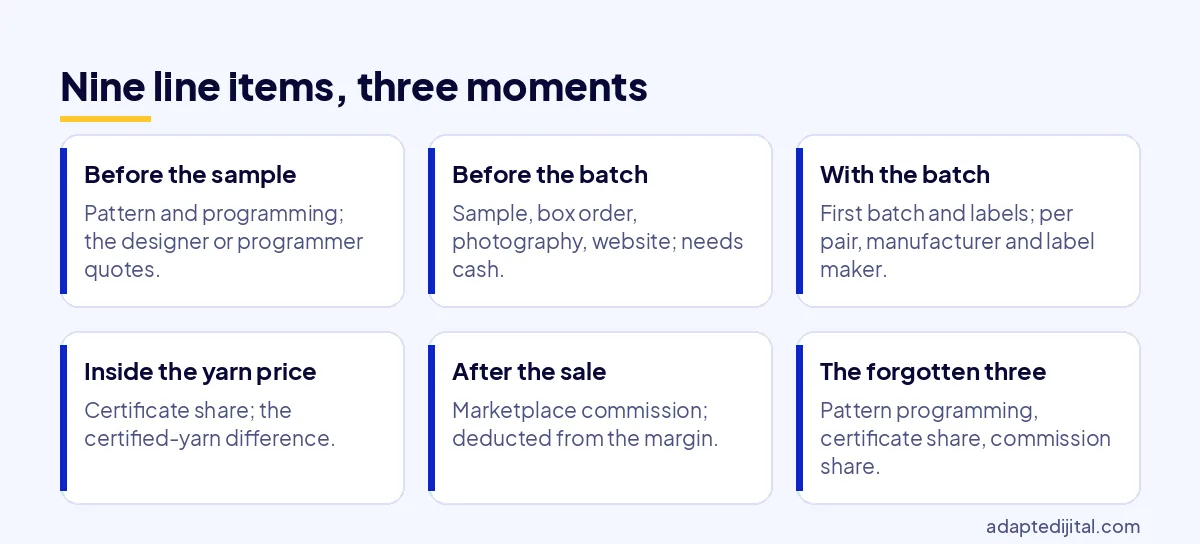
The three forgotten items
Pattern programming, the certificate share and the commission share; none appears in a production quote. You cannot read a quote without the vocabulary; yarn count, knit density and fibre content explained comes first.
Who quotes?
Nine items take quotes from at least six named contacts: the manufacturer prices batch and sample, the designer the pattern, the label maker and printer the labels and box, the photographer the images, the web agency the site, the yarn supplier the certificate share, the marketplace the commission. Get every item in writing; without two quotes it is a flagged estimate.
The single-contact trap
A manufacturer may offer to handle all of it, labels, box and photography included. The convenience is real, but so is the invisibility: the box price gets buried in the unit price and cannot be checked.
When is each item paid?
The items are paid at three moments: before the sample, before the first batch and after the sale. The order is the cash flow itself; a brand that paid for the batch and forgot the box ends up with product waiting unboxed. The table lines up the nine items by timing, contact and type.
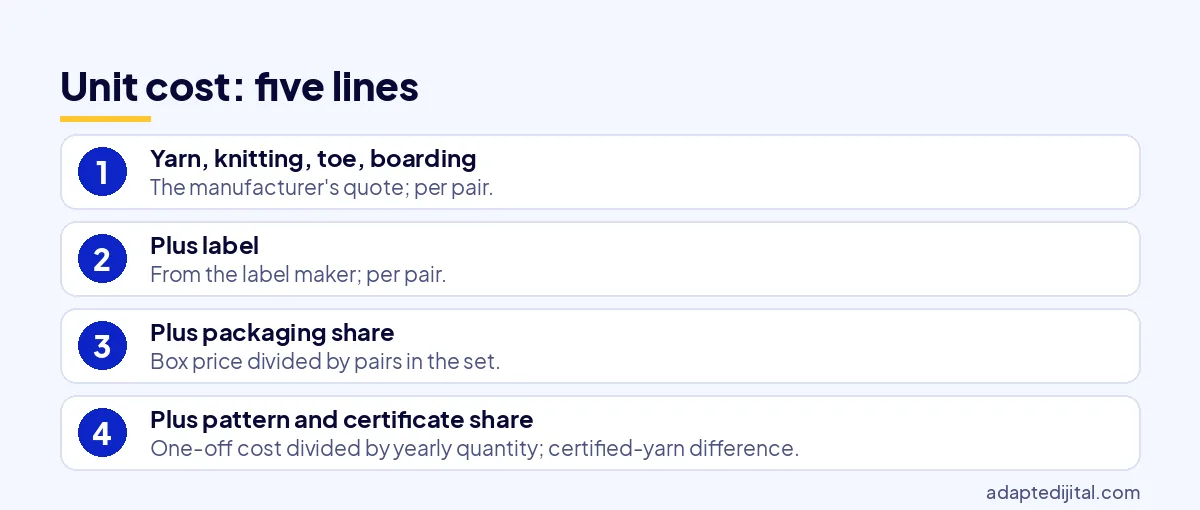
The table
| Line item | When | Contact | Type |
|---|---|---|---|
| Sample | Before the batch | Manufacturer | One-off, usually credited |
| Pattern and programming | Before the sample | Designer, programmer | One-off, per pattern |
| First batch | In production, upfront or in part | Manufacturer | Ongoing, per pair |
| Labels | With the batch | Label maker | Ongoing, per pair |
| Packaging and box | Ordered before the batch | Printer, box maker | Ongoing, per set |
| Product photography | After sample approval | Photographer | One-off, per pattern |
| Website | Before launch | Agency or platform | Fixed, monthly or yearly |
| Certificate share | Inside the yarn price | Yarn supplier | Ongoing, per pair |
| Commission share | Deducted after the sale | Marketplace | Ongoing, per sale |
How to read it
Items paid before the batch need cash; items deducted after the sale come out of the margin. The channel decision opens or closes the commission line; see own site, marketplace or store for a sock brand.
Unit cost logic: what is inside one pair?
BU BÖLÜMÜN ÖZETİ
- The packaging share
- The pattern share
- The formula
The unit cost of one pair has five parts: yarn and knitting, toe and boarding, label, packaging share, and pattern and certificate share. The first two are the manufacturer’s quote; the other three are not on it but sit inside every pair. Divide box price by pairs in the set, pattern cost by yearly quantity, and add both.
The packaging share
In a three-pair gift set the box price is divided by three; in a single-pair sale the whole of it lands on one pair. The set makes the box share bearable; single-pair sales make the same box expensive.
The pattern share
Pattern, programming and photography are one-off costs spread across pairs; a pattern that sells little pushes the unit cost up. Many patterns, little depth is a budgeting mistake, not a design one.
The formula
| Line | What | Where it comes from |
|---|---|---|
| A | Yarn, knitting, toe, boarding | Manufacturer’s quote, per pair |
| B | Label | Label maker, per pair |
| C | Packaging share | Box price divided by pairs in set |
| D | Pattern and photography share | One-off cost divided by yearly quantity |
| E | Certificate share | Certified yarn difference, per pair |
| Unit cost | A + B + C + D + E | Price is built on this |
Three thresholds: sample, minimum quantity, packaging
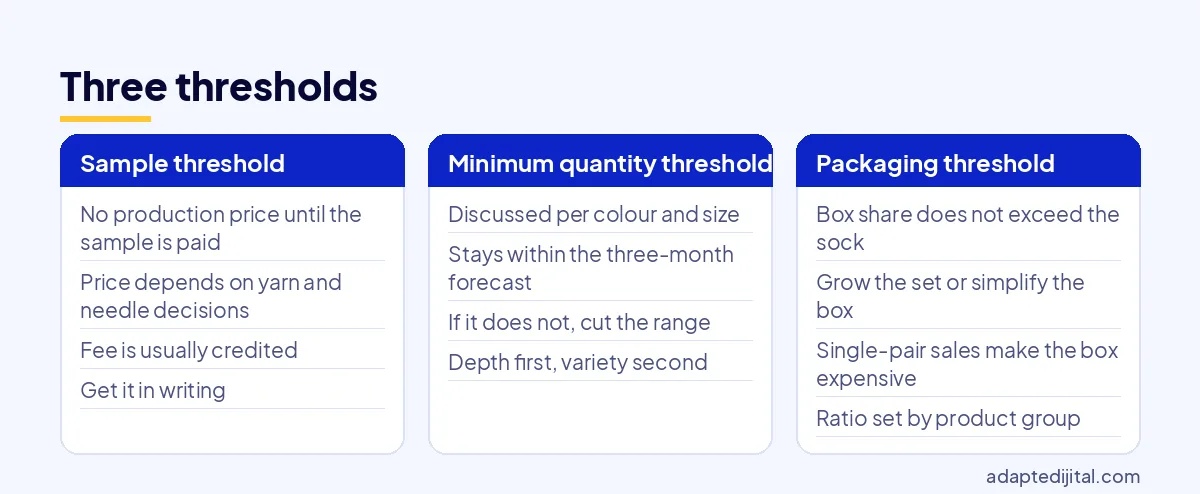
Sample threshold: no production price until the sample fee is paid, because the price depends on the yarn and needle decisions made on the sample. Minimum quantity threshold: the minimum per colour and size does not exceed the three-month forecast. Packaging threshold: if the box share crosses a set limit, the set grows or the box is simplified.
How is the first batch sized?
BU BÖLÜMÜN ÖZETİ
- The most common mistake
- Public support
- The sector picture
The first batch is no larger than the three-month sales forecast and is split depth first, variety second. Write down the sales points and channels, put a weekly estimate against each, multiply by a quarter, and spread the result across a few pattern families and two or three sizes. If the minimum exceeds that, question the manufacturer.
The most common mistake
A big batch and many patterns to cut the unit price. The stock locks up, the best-selling colour runs out, and no money is left for the second pattern family; see the 12-point checklist before a sock launch.
Public support
KOSGEB (Turkey’s small business development agency) runs programmes for new entrepreneurs; conditions change by period, so verify on the official KOSGEB page. Support does not build the budget; it closes a missing item.
The sector picture
The items change with the product group, the order does not; the wider picture is in the industry guide to starting a sock brand, the founder’s perspective in I want to start a sock brand.
Three thresholds on one page
No production price until the sample is paid; the minimum does not exceed the three-month forecast; the box share does not exceed the sock. The three thresholds let a sock brand run its first year from its own calculation, not the manufacturer’s quote. A brand that stays inside them finds money for a second pattern family.
To do today
Open the nine-line table, write in the contacts, and note the three thresholds at the top. The amounts fill in as quotes arrive; the order and the thresholds are known today.
The next step
To find your stage, read which consulting for a sock brand; to fill the table with your quotes, consult your expert.
Frequently Asked Questions
Quick Summary
- Nine line items, from sample and pattern to website, certificate share and commission share.
- The forgotten three: pattern programming, certificate share, commission share; none is on a quote.
- Items are paid at three moments: before the sample, before the batch, after sale.
- Unit cost: yarn and knitting + label + packaging + pattern + certificate shares.
- Three thresholds: no price before the sample; minimum within the three-month forecast; box share below the sock.
- The first batch: depth first, variety second.
Short Glossary
- Packaging share: the box price divided by the pairs in the set and added to each pair’s unit cost
- Pattern share: one-off costs such as programming and photography divided by expected sales and loaded onto each pair
- Certificate share: the difference certified yarn or a certified manufacturer adds to the unit cost
- Crediting: deducting the sample fee from the first order
Next Step
To fill the table with your own quotes, write to us via the consult your expert form; scope is on the brand consultancy page. Next: 12-point checklist before a sock launch.
Updated: October 2026
Sık Sorulan Sorular
Because a sock is thought of as cheap and a box looks like a luxury. In a design sock the box is part of the product, like a perfume bottle; the gift logic is in how Adapte Dijital positions a sock brand.
A harmful-substance test or an organic yarn certificate comes through the yarn and the manufacturer, not in the brand’s name; certified yarn costs more, and the difference lands in the unit cost. Ask for it in the interview; see how to choose a sock manufacturer.
A brand that skips the sample fee takes the production price on an estimate; in the first batch the yarn changes, the price changes, the budget breaks. Most manufacturers credit the fee against the order; get it in writing.
If the box costs more than the sock, the gift recipient remembers they paid for socks, not a box. The ratio is set by product group; brand consultancy sets it together with the set architecture.
There is no single amount; nine line items change with the manufacturer, quantity, needle count and packaging. What does not change is the payment order, the unit cost shares and three thresholds.
Yarn and knitting, toe and boarding, label, packaging share, and pattern and certificate share. Box price is divided by pairs in the set, pattern cost by yearly quantity.
As many as the three-month forecast: points and channels, a weekly estimate per point, one quarter. Depth first, variety second.