
Yarn Count, Knit Density and Fibre Content for a Sock Brand: What They Mean
In a sock, yarn count says how fine the yarn is, knit density says how many stitches sit in a centimetre, and fibre content says what those stitches are made of. Together they decide how the sock sits, how many washes it survives and what goes on the label. In short: fine yarn and a dense knit give a thin, smooth sock; thick yarn and a loose knit give a winter or sports sock; cotton gives feel, polyamide durability, elastane grip.
A pure cotton sock does not exist in practice, because a sock with no elastic slides down. This article opens five concepts in everyday language, tests the bamboo claim against its label and ends with a thirty-second label-reading box.
What does yarn count mean?
BU BÖLÜMÜN ÖZETİ
- In everyday words
- What it means for a brand
- A common mix-up
Yarn count measures how fine a yarn is; in the system commonly used for cotton, a higher number means a finer yarn. Fine yarn means a thin, smooth sock that goes under a suit; thick yarn means a winter, terry-soled or sports sock. The same pattern looks sharp in fine yarn and soft in thick yarn.
In everyday words
Think of pasta: angel hair and spaghetti come from the same dough but sit on the plate completely differently. Yarn count is the same; the dough is cotton, the difference is thickness.
What it means for a brand
Your product group picks the yarn count: a design sock wants fine to medium yarn so the pattern reads, a sports sock wants thick yarn for a padded sole. Name the product type and let the manufacturer propose the yarn; the questions are in how to choose a sock manufacturer.
A common mix-up
Fine yarn is not poor yarn; fine yarn from long-staple cotton costs more and lasts longer. Nor is a thick sock a strong sock; strength comes from blend and knit.
What do needle count and knit density tell you?
BU BÖLÜMÜN ÖZETİ
- In everyday words
- What it means for a brand
- A common mix-up
A sock machine carries a set number of needles in its cylinder; more needles mean tighter stitches, thinner fabric and a sharper pattern. Fewer needles mean bigger stitches, a thicker sock and a softer pattern. The manufacturer states density as a needle count; you feel the result on your foot.
In everyday words
Think of photo resolution: the same picture looks pixelated at low resolution and smooth at high. In a patterned sock the needle count is the resolution; a delicate floral turns into a smudge on a low-needle machine.
What it means for a brand
Before you draw a pattern, ask which needle count it will be knitted on; the file is prepared for that density. A dense knit gives an elegant sock but pushes yarn use and price up; see the cost of starting a sock brand.
A common mix-up
People assume a dense knit is warmer; warmth comes from yarn thickness and fibre, not density. A dense knit mostly means smoothness and sharper detail.
Why do cotton, polyamide and elastane always come together?
BU BÖLÜMÜN ÖZETİ
- In everyday words
- How it appears on the label
- What it means for a brand
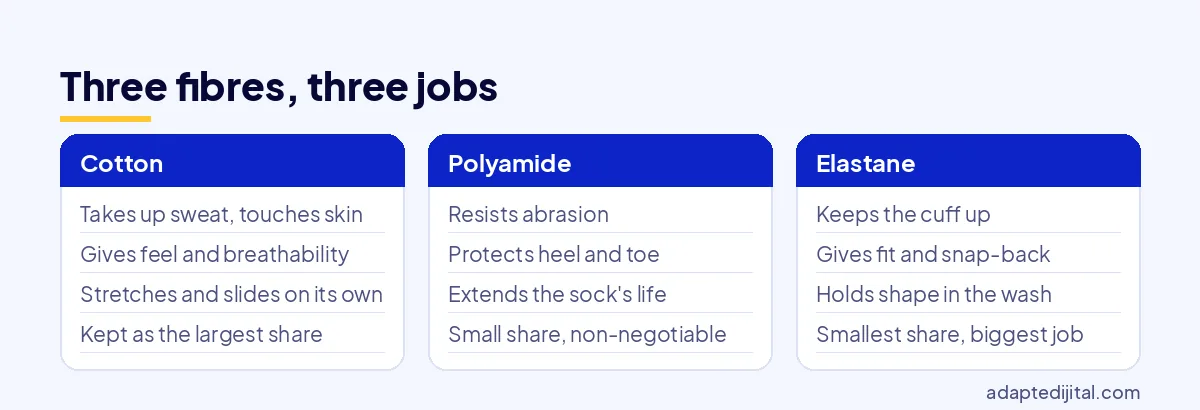
Because each has a different job: cotton takes up sweat and touches the skin, polyamide resists abrasion and extends the sock’s life, elastane keeps it up on the ankle. A cotton-only sock slides to the heel and stretches in the first wash. The blend on the label is the ratio between those jobs.
In everyday words
Picture a team: cotton does the talking, polyamide the heavy lifting, elastane holds everyone together. A customer asking for pure cotton wants the cotton feel; a high cotton share gives that, cotton alone does not.
How it appears on the label
Fibre content is written as a percentage next to a generic fibre name; a trade name is not enough. Turkey’s regulation follows EU rules and lists the fibre names; the text is in the EU textile fibre names regulation.
What it means for a brand
Build the blend with the manufacturer and write the ratio they give you; never write a guess. In an inspection you are asked for the basis of your declaration; see textile labelling rules and unsafe-product inspections.
What is a seamless toe and how do you spot one?
A sock comes off the machine as a tube with the toe open; closing it is called toe seaming. The classic method leaves a ridge of stitching inside; hand-linking joins the loops one by one and leaves the inside flat. If you cannot feel a line across your toes, the brand did something right.
How to check
Turn the sock inside out and look at the toe. A thick raised ridge means a classic seam; loops running flat mean hand-linking, and it takes half a second.
What it means for a brand
The seamless toe is a point of difference because the customer feels it; where the difference sits is mapped in I want to start a sock brand. Not every manufacturer does it; ask, and check the sample.
Is a bamboo sock really bamboo?
BU BÖLÜMÜN ÖZETİ
- In everyday words
- What goes on the label
- Organic claims and certificates
No, most of the time it is not. What is sold as a bamboo sock is usually viscose made from bamboo; the cellulose is dissolved chemically and spun back into a fibre. It is soft with a slight sheen, but the fibre name on the label is viscose, and a brand that misses this gets both label and story wrong.
In everyday words
Think of grapes and wine: wine comes from grapes but is not grapes, and bamboo viscose comes from bamboo but is not bamboo. You do not write grapes on the glass, or bamboo on the label.
What goes on the label
Viscose as the fibre name, with the source in brackets if you like: viscose (bamboo). Bamboo-derived is allowed in marketing copy, not on the fibre line; the full list of misconceptions is in 6 things people get wrong about sock brands.
Organic claims and certificates
Organic cotton or harmful-substance claims are documented through the yarn and the manufacturer, not in the brand’s name. OEKO-TEX is the official source.
How do you read a label in thirty seconds?
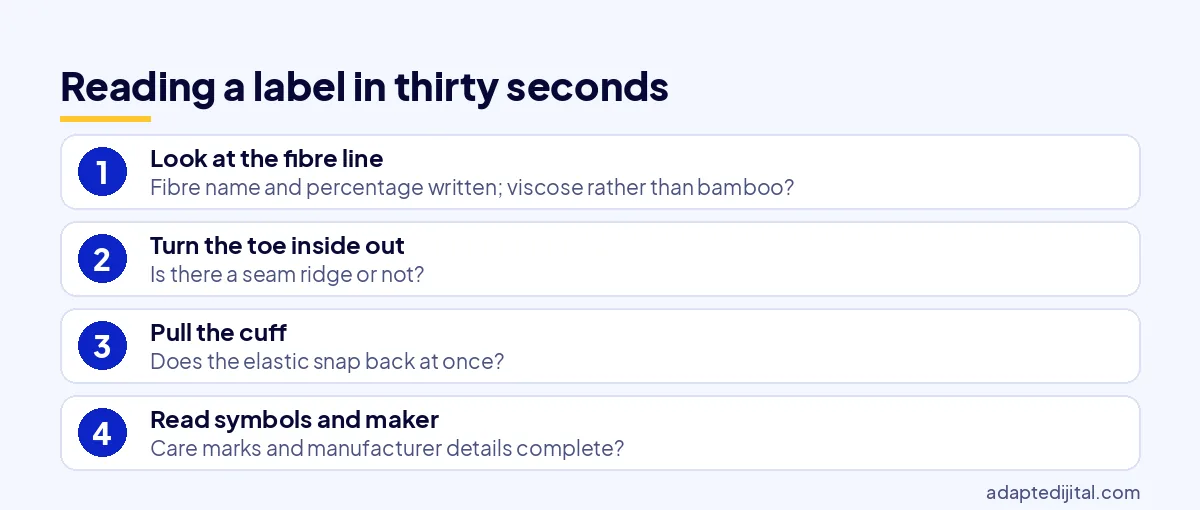
In five glances: the fibre line, the toe, the cuff elastic, the care symbols and the manufacturer details. Each glance answers one question, and together they tell you most of what the sock’s quality is. The box works for buying like a customer and writing like a brand.
The box: five glances
- Fibre line: cotton or wool first, polyamide and elastane present, percentage written
- Toe: turn it inside out, is there a seam ridge
- Cuff elastic: pull and release, does it snap back
- Care symbols: are temperature and drying marks readable
- Manufacturer or importer details: who made it, how to reach them
The empty line
If a glance gets no answer, the label is incomplete. The line missing from your own label is your first job; the one missing from a competitor’s is your opportunity.
You now know this
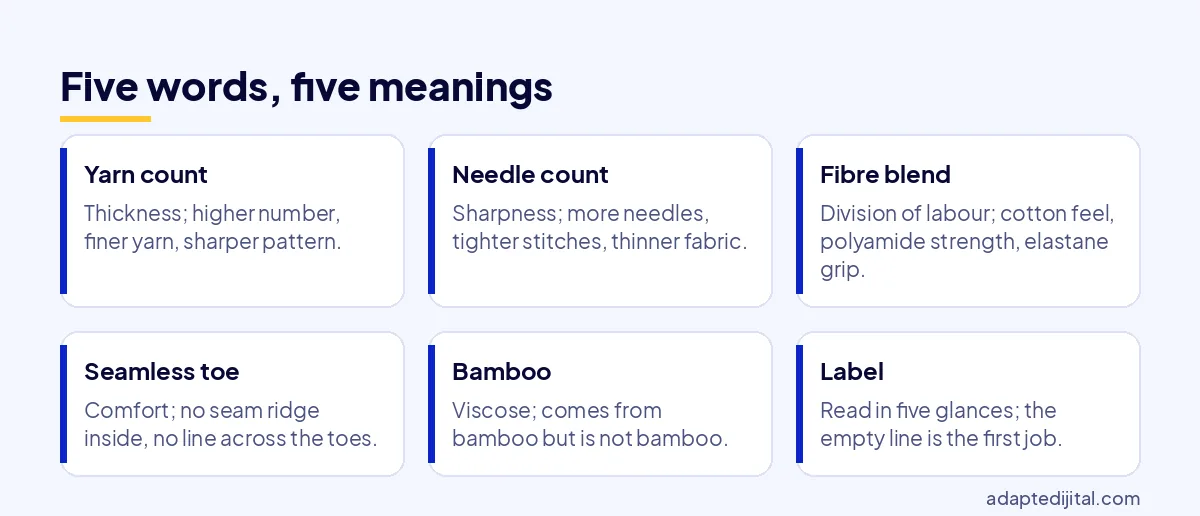
Yarn count means thickness, needle count means sharpness, the blend means a division of labour, the toe means comfort, and bamboo means viscose. A founder who knows these five words speaks the manufacturer’s language and writes the label correctly; one who does not puts marketing where the label should be.
To do today
Take three pairs of socks from your drawer and run the five-glance box on each. The label of your best pair is where your first product brief begins.
A small consolation
Learning these words takes an afternoon; building a brand without them takes a year. To find your stage, read which consulting for a sock brand; to read a label together, consult your expert.
Frequently Asked Questions
Quick Summary
- Yarn count sets thickness; needle count sets stitch density and pattern sharpness.
- Cotton, polyamide and elastane carry three jobs; a pure cotton sock does not stay up.
- A seamless toe is spotted by turning the sock inside out; no ridge means hand-linking.
- A bamboo sock is bamboo viscose; the fibre name on the label is viscose.
- A label is read in five glances: fibre, toe, elastic, care symbols, manufacturer.
Short Glossary
- Yarn count: a measure of how fine a yarn is; in cotton, a higher number means a finer yarn
- Needle count: the number of needles in a sock machine’s cylinder; more needles, tighter stitches, sharper pattern
- Hand-linked toe: closing the toe by joining the loops one by one, leaving no seam ridge inside
- Bamboo viscose: a man-made fibre made from bamboo cellulose; written as viscose on the label
Next Step
To match your label to the manufacturer’s language, write to us via the consult your expert form; scope is on the brand consultancy page. Next: how to choose a sock manufacturer.
Updated: October 2026
Sık Sorulan Sorular
The manufacturer supplies the words, the brand sets their order; brand consultancy matches every line to a document and a story. The wider picture is in the industry guide to starting a sock brand.
It measures how fine a yarn is; in the common cotton system, a higher number means finer yarn. Fine yarn gives a smooth sock, thick yarn a winter sock.
Not in practice; a sock with no elastic slides down. Cotton gives feel, polyamide durability, elastane grip.
Viscose as the fibre name; it may note that the source is bamboo. Bamboo is the raw material for viscose, not a fibre in itself.