
6 Things People Get Wrong About Sock Brands: Bamboo Socks Are Not Bamboo, Read the Label
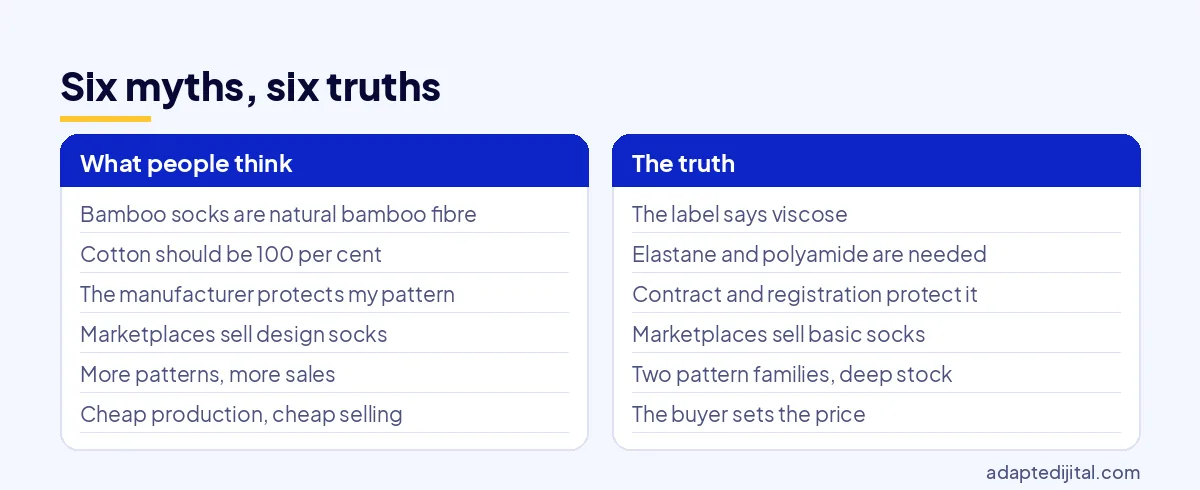
The six things people most often get wrong when starting a sock brand: bamboo socks are natural bamboo fibre, cotton should be 100 per cent, the manufacturer protects my pattern, marketplaces sell design socks, more patterns bring more sales, cheap production means cheap selling. All six sound right, and all six lose money in the first season. The correction sits under each.
You may not have known this: the label on a bamboo sock says viscose, not bamboo, because the fibre-names rule recognises no fibre called bamboo; the fibre made from bamboo chemically is viscose. This article corrects the six one by one and says what each correction does to a brand decision. By the end, you will smile when you hear any of them.
Myth 1: bamboo socks are natural bamboo fibre
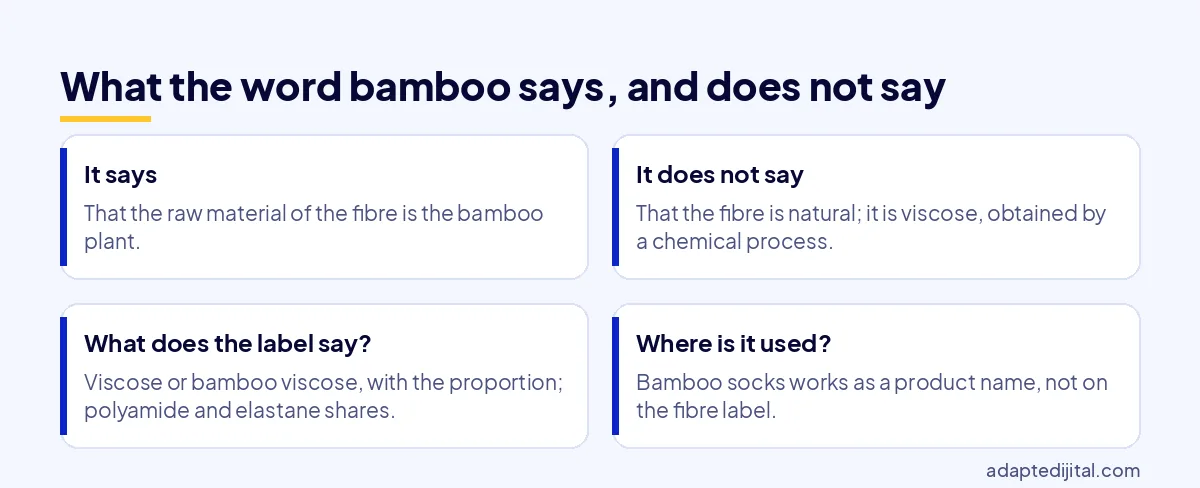
The truth: the fibre in a so-called bamboo sock is viscose, made from the bamboo plant by a chemical process, and the label says viscose or bamboo viscose, never bamboo. The fibre-names rule puts natural plant fibres in one group and regenerated cellulose fibres in another; bamboo falls into the second. That is why it is soft and glossy.
In everyday terms
Making a sock from bamboo is like making paper from a tree: there is tree in it, but what you hold is no longer a tree. The label follows Turkey’s fibre-names regulation and the EU textile labelling regulation it is aligned with; the rule looks at how the fibre is obtained, not how soft it is.
The brand decision
Bamboo can go in the product name, not on the fibre label. Two lines on the page: product name, bamboo socks; fibre content, viscose, polyamide, elastane with proportions. A brand that keeps those lines apart is comfortable in an inspection and with a curious buyer; framework in textile labelling rules and unsafe-product inspections.
Myth 2: cotton should be 100 per cent
The truth: a 100 per cent cotton sock does not stay up. The cuff needs elastane, durability and shape need polyamide; cotton gives softness and breathability, not hold. Three fibres on the label is a good sign. The wish for pure cotton is understandable, but in a sock it is the wrong wish.
The brand decision
Next to the proportions, write one line of function: cotton for softness, polyamide for durability, elastane for grip. The buyer stops looking for pure cotton and starts looking for the right blend.
A comparison to smile at
Asking for a 100 per cent cotton sock is like asking for 100 per cent flour bread: no yeast, no water, no bread.
Myth 3: the manufacturer protects my pattern
The truth: unless the contract says the pattern file is yours, it enters the manufacturer’s archive the moment it is loaded and can be knitted again for another brand. No bad faith is needed; a hundred brands come off the same machine and the pattern stays on it. Protection is a contract clause, not goodwill.
The brand decision
The pattern file belongs to the brand, the manufacturer uses it for this order only and deletes its copy afterwards; three sentences in the contract. Then registration: a design registration for an original pattern is the brand’s job, not the manufacturer’s.
A comparison to smile at
Leaving a pattern file with a manufacturer without a contract is like leaving your key with a neighbour and forgetting to change the lock: the neighbour is fine, the key is in circulation.
Myth 4: marketplaces sell design socks
The truth: a marketplace sells basic socks, ranks design socks by price and squeezes the pattern into a thumbnail. A buyer searching for socks there meets a six-pack and the lowest price; a design sock looks expensive and pointless in that list. Gift logic, box and story are invisible there.
The brand decision
Own site and concept store for design socks, marketplace for basic socks. The rule by product group is in own site, marketplace or store for a sock brand. If you are going onto a marketplace anyway, see real profit on Trendyol after commission.
Myth 5: more patterns mean more sales
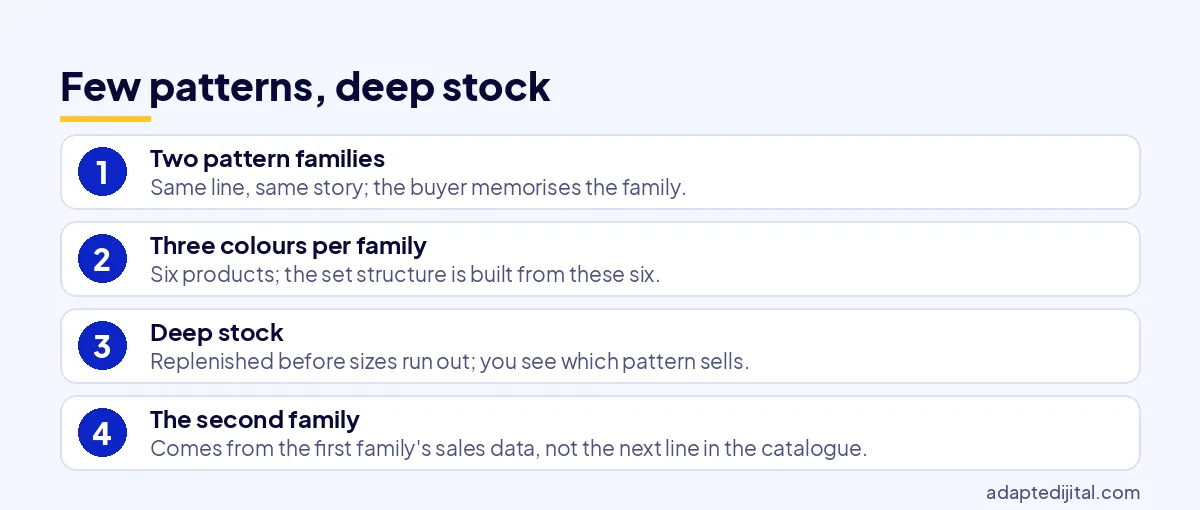
The truth: more patterns mean more samples, stock and photography and a scattered story; sales start from two pattern families. A brand that opens with twenty patterns makes a little of each, reorders none and never learns which one sells. Few patterns, deep stock, a clear story; the second family comes from the first family’s data.
The brand decision
Two pattern families, three colours each, the set structure built from those six products. The buyer memorises the family, the store owner describes it in one sentence, stock is replenished before it runs out.
A comparison to smile at
Opening with twenty patterns is like a first date with twenty conversation topics: you cover them all, none is remembered.
Myth 6: cheap production means cheap selling
BU BÖLÜMÜN ÖZETİ
- Little-known fact
- The brand decision
- Now you know this
The truth: production cost does not set the price; what the buyer is paying for does. A sock off the same machine sells at a basic-sock price in a polybag and at a gift price in a box with a card; the difference is in box, story and channel, not the machine. Selling cheap because you produced cheap leaves your differentiation to the manufacturer.
Little-known fact
What raises the price is the buyer, not the product. The gift buyer pays for ease and story, the wearer for toe and yarn; neither looks at production cost. The case is in why people pay for design sock brands.
The brand decision
Build the price down from the buyer card, not up from unit cost: which channel, which box, who pays. The buyer card is in how Adapte Dijital positions a sock brand; remember the unit cost includes a packaging share.
Now you know this
Bamboo is viscose; cotton does not stand alone; the contract protects the pattern; marketplaces sell basic socks; two pattern families are enough; the buyer sets the price. The order is in I want to start a sock brand, your stage in which consulting for a sock brand, scope on the brand consultancy page, the industry picture in the industry guide to starting a sock brand; to correct the six in your brand, consult your expert.
Frequently Asked Questions
Quick Summary
- A bamboo sock is viscose; the label says viscose, though bamboo can stay in the product name.
- Pure cotton does not stay up; elastane and polyamide are part of the design.
- The contract protects the pattern, not the manufacturer; registration is the brand’s job.
- Marketplaces sell basic socks; design socks belong on your own site and in concept stores.
- Two pattern families and deep stock beat twenty patterns and half-stocks.
- The buyer sets the price, not production cost; the difference is box, story, channel.
Short Glossary
- Viscose: a regenerated fibre made chemically from plant cellulose; the real fibre name of a bamboo sock
- Fibre content label: the mandatory label showing the official names and proportions of a product’s fibres
- Pattern ownership: the clause stating the pattern file belongs to the brand and is used for the order only
- Pattern family: a group of patterns sharing one line and story, produced in several colours
Next Step
To correct the six sentences in your own brand, write to us via the consult your expert form; scope is on the brand consultancy page. Next: when should a sock brand launch.
Updated: October 2026
Sık Sorulan Sorular
Viscose or bamboo viscose, with the proportion. Organic or natural needs a separate document; the certificate is issued to the yarn, not the brand. Terms in yarn count, knit density and fibre content explained.
Because cotton is natural and familiar, and polyamide sounds like plastic. Yet polyamide keeps the heel alive another season; without elastane the ankle drops. The blend is design, not a flaw.
Because manufacturers say, rightly, that they never hand anything over, and most keep their word. But technicians change, workshops change hands, the file stays in the folder. The five clauses and pattern ownership rule are in how to choose a sock manufacturer.
Because the marketplace has traffic, and traffic gets mistaken for sales. But it is the traffic of buyers after cheap socks; the design sock’s buyer is after a gift, elsewhere. The case is in why a design sock brand stalls in year one: the pattern does not show.
When the manufacturer’s minimum for one pattern comes in high, the brand divides the quantity across patterns: ten patterns, a little of each; ten half-stocks and sold-out sizes. The minimum quantity threshold is the second threshold in the cost of starting a sock brand.
The fibre is viscose, obtained from the bamboo plant by a chemical process; the label says viscose or bamboo viscose. Bamboo can be in the product name, not on the fibre label.
It can, but it will not stay up; the cuff needs elastane and durability needs polyamide. Three fibres on the label is a good sign.
Not unless pattern ownership is in the contract; the pattern stays on the machine and can be knitted for another order. Protection is a clause and a design registration.