
Why Does a Turnkey Website Bring No Customers? 6 Reasons Empty Sites Fail
A turnkey website brings no customers when it is delivered empty. The design is finished, but there is little content, no chosen search terms, no measurement and no introduction to Google. Customers search with questions, and an empty site has no answers to show them. Search engines and AI tools then have nothing to match, so the site stays out of sight.
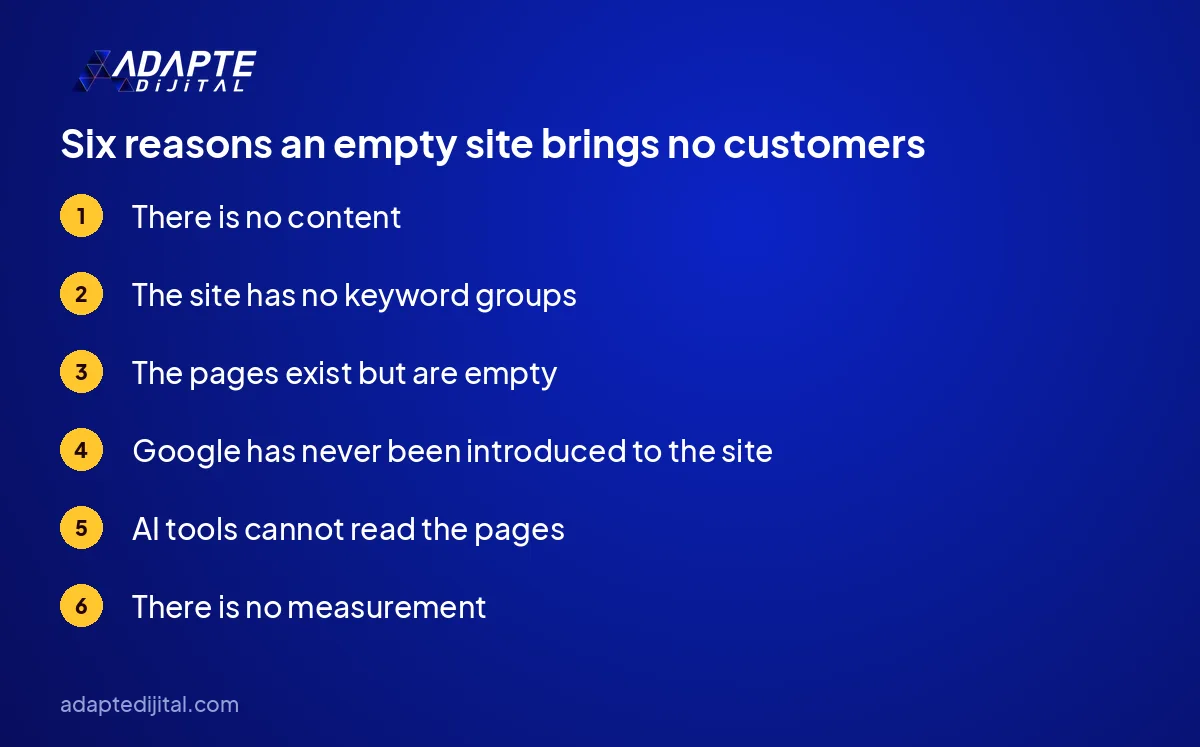
Six causes explain most cases: no content, no keyword groups, empty pages, no measurement, pages AI tools cannot read and a site Google has never been told about. Each one has a simple sign you can check yourself. Each one also has a fix, and every fix starts with what the site says, not how it looks.
Why does a turnkey website bring no customers?
Because a finished design is not the same as a findable site. Customers reach a business through searches, and searches land on pages that answer them. When a site holds only a few short pages, there is little for a search to land on. The owner sees a site that looks complete, while search engines see one with almost nothing to offer.
A familiar scene
A tile installer checks his new site in the evening. The logo looks right and the phone number sits on every page, yet nobody calls. The agency says it takes time.
The common thread
Time alone does not fix an empty site. What the installer has is a shell: a template, his own text, a handful of pages.
Why do missing content and keyword groups keep a site out of sight?
BU BÖLÜMÜN ÖZETİ
- Cause 1: there is no content
- Cause 2: the site has no keyword groups
- Cause 3: the pages exist but are empty
Search works by matching a question to a page. If no pages are written around real questions, there is nothing to match. Content, keyword choice and page depth form one chain: without content, keywords have no home, and without keywords, content drifts from what people type.
Cause 1: there is no content
A few service lines and a contact form give search engines little to understand. How you can tell: count the pages that answer a question a customer would ask. If the count is close to zero, this is the first cause.
Cause 2: the site has no keyword groups
A keyword group is a set of related searches that one part of the site is built to answer. How you can tell: ask the builder which searches the site targets. If there is no clear list, the site has none.
Cause 3: the pages exist but are empty
Many shells deliver five to seven pages, most of them thin. How you can tell: open each page and ask whether a stranger would learn something useful from it.
Why does a site that Google and AI tools never meet stay invisible?
A search engine has to discover, read and understand a page before it can show it. Google states plainly that it does not guarantee any page will be crawled, indexed or ranked. What a site owner can do is submit a sitemap through Search Console and watch the status. A site that skips this step depends on chance.
Cause 4: Google has never been introduced to the site
How you can tell: ask whether Search Console is set up and whether a sitemap has been submitted. If nobody knows, the answer is probably no. A sitemap is a file that lists the pages a site wants found.
Cause 5: AI tools cannot read the pages
AI answers in search pull from pages with clear structure. Structured data, question-and-answer blocks and quotable paragraphs help them. How you can tell: if a page has no headings phrased as questions and no short direct answers, AI tools have little to quote.
Why do customers look for a business online before they call?
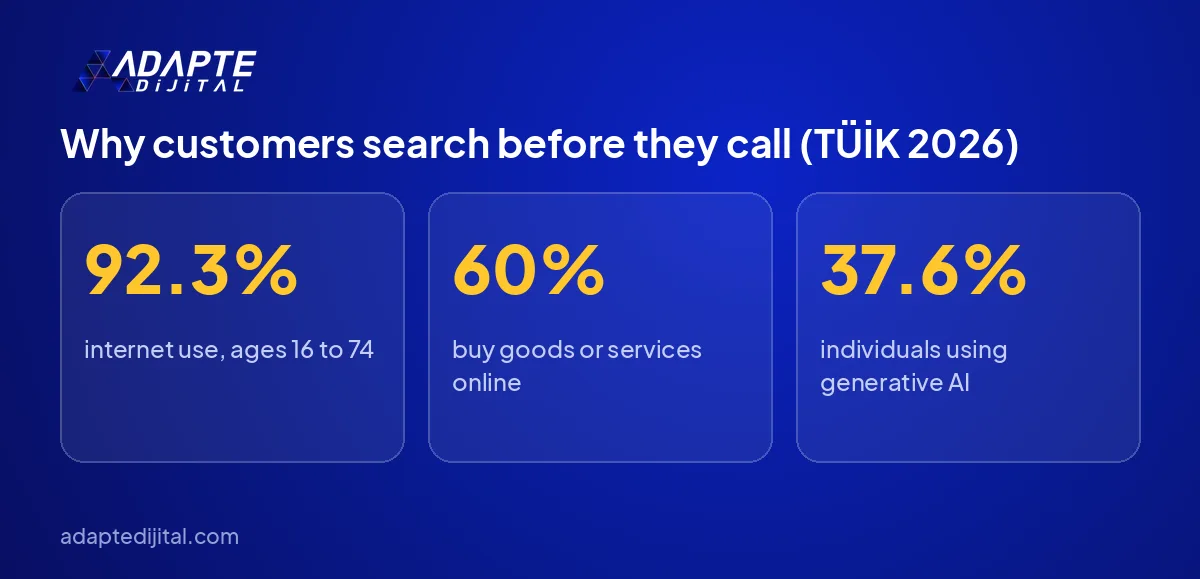
Because nearly everyone is online, and more people now ask AI tools as well. TÜİK’s household survey puts internet use among people aged 16 to 74 at 92.3% in 2026. Buying goods or services online has reached 60%. Generative AI use among individuals stands at 37.6% in 2026, up from 19.2% in 2025.
What these numbers mean for a small business
A customer who finds nothing useful rarely calls to ask. The search moves on to a business whose pages answer the question.
Why AI search raises the bar
Google’s AI Mode and AI Overviews are now available in Turkey. These answers favor clear, structured pages, so an empty site falls further behind.
Why does a site without measurement keep failing quietly?
Without measurement, nobody sees the problem, so nobody fixes it. Google Analytics 4 shows who visits and what they do. Search Console shows which searches bring the site up and which pages Google has indexed. When neither tool is installed, the owner judges the site by the phone alone, and the phone gives no reasons.
Cause 6: there is no measurement
How you can tell: ask who can log in to GA4 and Search Console for your site. If the answer is nobody, the site is running blind.
What measurement turns into
Measurement turns a vague worry into a specific question. Pages with visits but no calls need a clearer offer; pages with no visits need content.
Which fix matches each reason a site brings no customers?
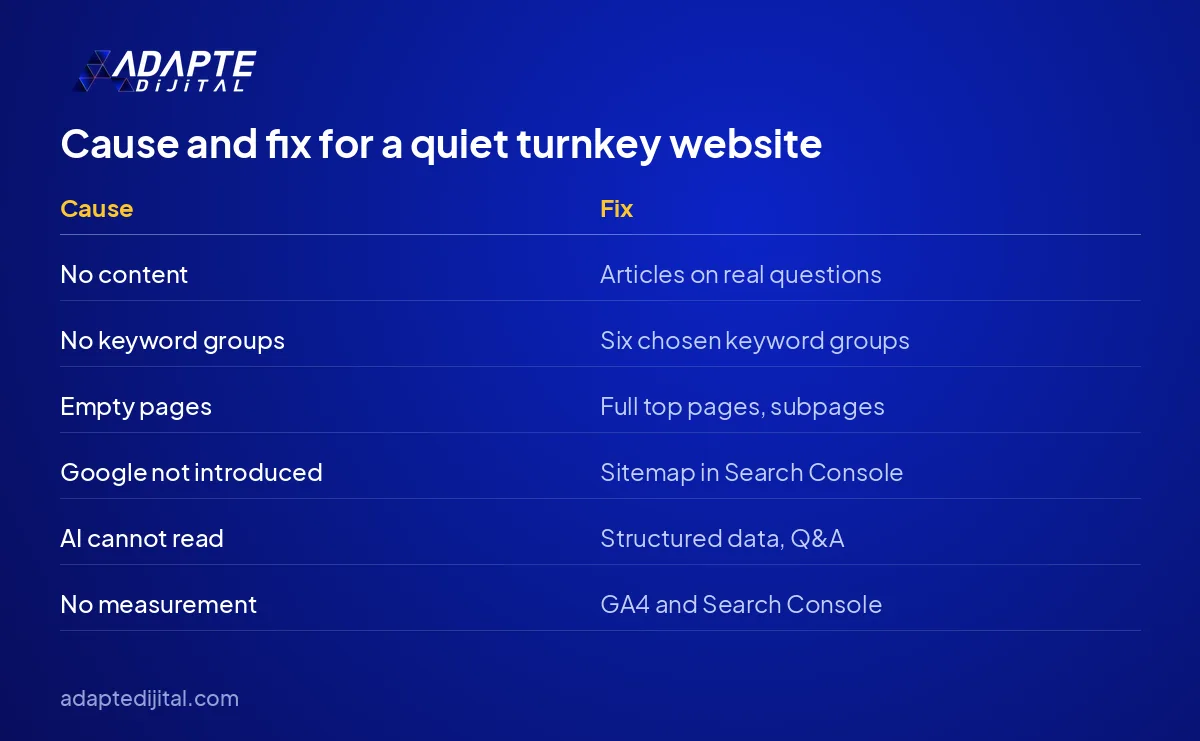
Each cause has a direct fix, and most fixes are about content and setup rather than design. The table puts the six side by side. For a closer look at how a dressed-up template differs from real delivery, see the six signs of a shell delivery.
| Cause | How you can tell | Fix |
|---|---|---|
| No content | Few pages answer real questions | Articles built on customer questions |
| No keyword groups | No list of target searches | Six chosen keyword groups |
| Empty pages | Pages teach a stranger nothing | Full top pages and subpages |
| Google not introduced | No sitemap in Search Console | Search Console set up, sitemap sent |
| AI cannot read | No question headings or short answers | Structured data and Q&A blocks |
| No measurement | Nobody can log in to GA4 | GA4 and Search Console delivered |
A site that arrives with content, chosen search terms and measurement in place starts from a different point. See what the real turnkey website package delivers for a fixed 36,000 TRY + VAT.
Why does a content-led turnkey website change the outcome?
Because it removes the six causes before launch instead of after. In the Adapte package, the site arrives with 6 top pages, 12 subpages, 6 categories and 108 articles across 6 keyword groups. Part of the articles go live at launch, and the rest follow a publishing calendar. GA4 and Search Console are installed at delivery.
Why keyword groups come before articles
Six keyword groups decide what the 108 articles answer. Each article then has a reason to exist and a search it is written for.
Why launch day still needs patience
Google discovers and indexes new pages on its own schedule, with no guarantee. For what to expect after launch, see when a new turnkey website shows up on Google.
Quick Summary
- An empty site has nothing for searches to land on.
- Six causes: no content, no keyword groups, empty pages, no Google introduction, unreadable pages for AI and no measurement.
- Each cause has a sign you can check without technical skills.
- Measurement comes first, because it shows which cause matters most.
- Google guarantees no crawling, indexing or ranking; Search Console lets you watch the status.
- A content-led delivery removes the causes before launch.
Short Glossary
- Sitemap
- Sitemap is the term used for a file that lists the pages a site wants search engines to find.
- Indexing
- Indexing is the term used for a search engine storing a page so it can appear in results.
- Structured data
- Structured data is the term used for code that tells search engines and AI tools what a page is about.
Frequently Asked Questions
Next Step
If your site looks finished but stays quiet, the causes above are the place to start. Apply for a turnkey website built on content, or read what a turnkey website really is and the roadmap for owners who want a site without the hassle. For an outside review, see our digital audit service and why professional web design matters.
Sources: TÜİK, ICT Usage Survey in Households 2026 and Artificial Intelligence Statistics 2026 · Google Search Central, How Search Works · Google Search Help, AI Overviews
Updated: November 2026
Sık Sorulan Sorular
Measurement comes first, because it shows which of the other causes weighs most on your site.
A new look over the same empty pages leaves the causes in place. The fix sits in what the pages say.
Usually because it has little content, no chosen keyword groups and no measurement. Searches have nothing to land on, and nobody sees which part is missing.
Design helps visitors trust what they find, but it does not create visits. Content written around real customer questions is what searches land on.
Ask for access to Search Console and look for a submitted sitemap and indexed pages. Google does not guarantee indexing, but Search Console shows the status.