
Turnkey Website or Shell Delivery? 6 Signs of a Dressed-Up Template
A real turnkey website is handed over ready to use, the way a turnkey building is handed over with lights on and doors working. A shell delivery is a ready-made theme with your name on it, a few mostly empty pages and an “SEO-friendly” label. Both get called turnkey, but only one is.
Six signs give a shell away: the same theme for every sector, a request for your text and logo, five to seven pages that are mostly empty, an SEO label with no SEO behind it, no preparation for AI search, and a quiet site a few months later. The more of them an offer shows, the more likely you are looking at a shell.
Where does the word “turnkey” come from?
Here is something most people never think about. Turnkey is a construction term, and it means the builder hands over a property ready for use. You turn the key and move in: wiring, plumbing, fixtures, all done. Nobody delivers a turnkey apartment and asks the buyer to bring the kitchen.
In construction, turnkey means you can use it today
The promise is not a nice facade. It is that nothing is left for the owner to finish. That is a high bar, and it is a clear one.
On the web, the word lost its furniture
In website sales, “turnkey” often describes a template that is installed and switched on. The walls are up, but the rooms are empty. That gap between the word and the delivery is what this article is about.
What is a shell delivery in a website project?
A shell delivery is a site handed over as a structure without the parts that make it work. The theme is installed, the menu exists, your logo sits in the corner. But the pages have little to say, nobody planned what people will search for, and nothing is measured. It looks finished on the first visit and stays that way forever.
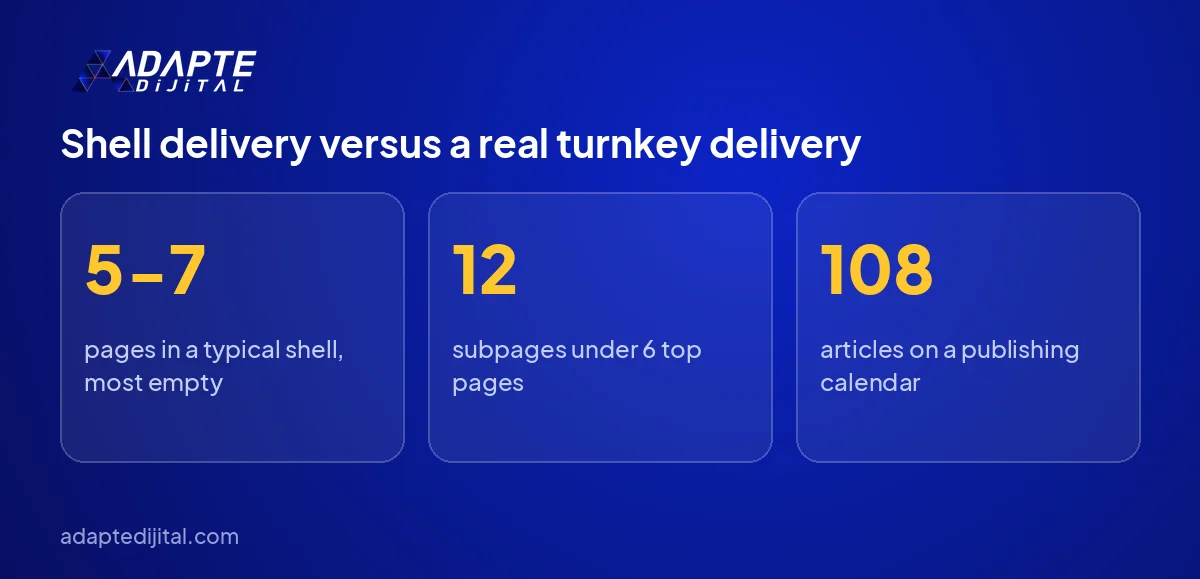
A shell is like a show apartment with cardboard furniture
It photographs well. Then you try to sit on the sofa. A shell site is similar: fine in a screenshot, empty the moment a customer actually reads it.
Shells are easy to sell because they are easy to show
A homepage demo takes the spotlight in a sales meeting. Content plans, keyword groups and measurement are invisible in a demo, so they are the first things left out.
Which six signs reveal a dressed-up template?
BU BÖLÜMÜN ÖZETİ
- Signs one and two are about who does the work
- Signs three and four are about what is inside
- Signs five and six show up after launch
The general market pattern is consistent enough to turn into a checklist. Each sign alone may be harmless. Together they describe a delivery that looks like a turnkey website but works like an empty frame. The table below sets each sign against what a real delivery does instead.
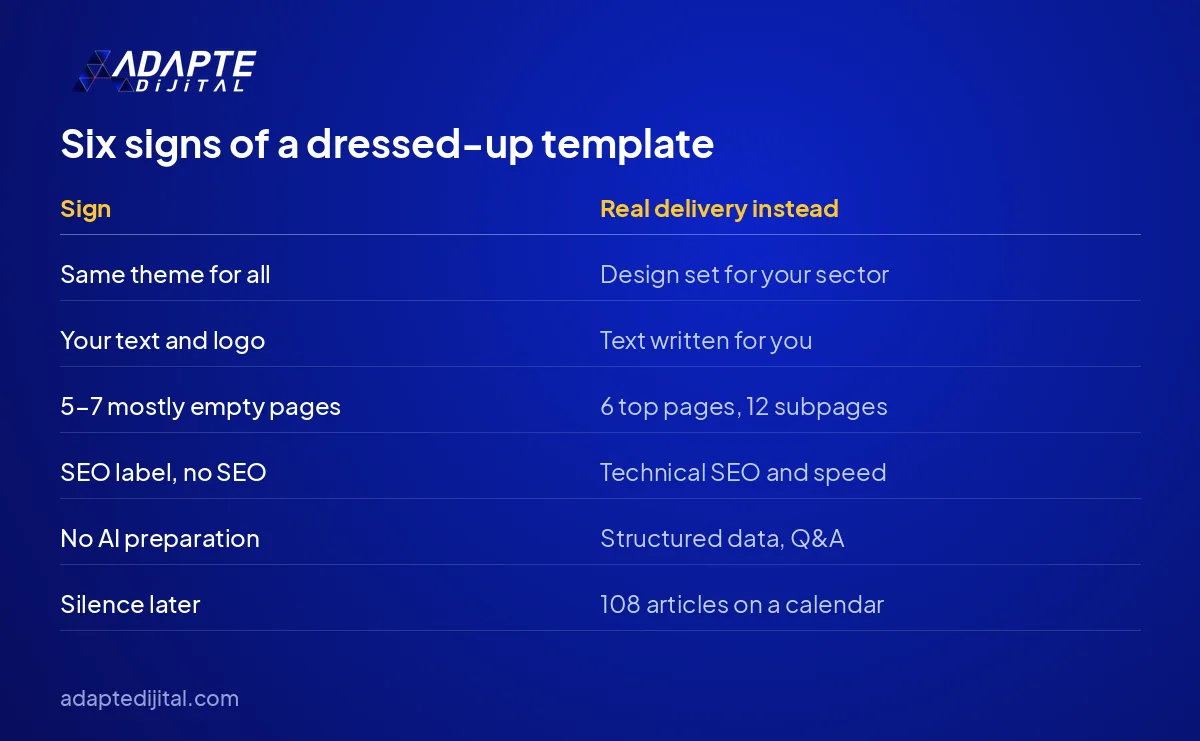
| Sign | What it looks like | What a real delivery does |
|---|---|---|
| 1. Same theme for all | A dentist and a mover look alike | Design set up for your sector |
| 2. Your text and logo | A form asks you for content | Text written for you |
| 3. Five to seven pages | Most of them are empty | 6 top pages, 12 subpages |
| 4. “SEO-friendly” label | No plan behind the label | Technical SEO and speed |
| 5. No AI preparation | AI tools cannot read it well | Structured data, Q&A blocks |
| 6. Silence later | “I have a site, nobody comes” | 108 articles on a calendar |
Signs one and two are about who does the work
If the theme could belong to any business and the content form lands in your inbox, the work has been moved to you. A turnkey promise that starts with homework is already broken.
Signs three and four are about what is inside
Five to seven pages sound like a site. Read them, and most say almost nothing. The “SEO-friendly” label usually means the theme has a title field, not that anyone chose what you should be found for. Google’s own SEO Starter Guide shows how much more the job involves.
Signs five and six show up after launch
A site with no structured data or question-and-answer blocks is hard for AI tools to read. A few months later the owner says the sentence every agency dreads: “I have a site, and nobody comes.” We list the causes in why empty sites bring no customers.
Is a ready-made template the real problem?
No, and this part surprises people. A template is a tool, like a standard door frame that plenty of good buildings use. The problem is a template delivered unprocessed: no sector setup, no content, no keyword plan, no measurement. The frame was never the issue; the empty room is.
A processed template can serve you well
When the design language is adapted to your sector and the pages are filled with real answers, the starting point stops mattering. Customers judge what they read, not which theme sits underneath. Our comparison of ready-made corporate websites covers when this works.
An unprocessed template is a shell in disguise
Same template, no work on top. That is the delivery the six signs are built to catch.
How can you spot shell signs while reading a proposal?
Read the proposal for verbs and numbers. Who writes the text, how many pages are filled, which keyword groups are chosen, and what is measured at handover. If the answers are vague, the delivery will be too. These five questions turn a glossy proposal into something you can actually compare.
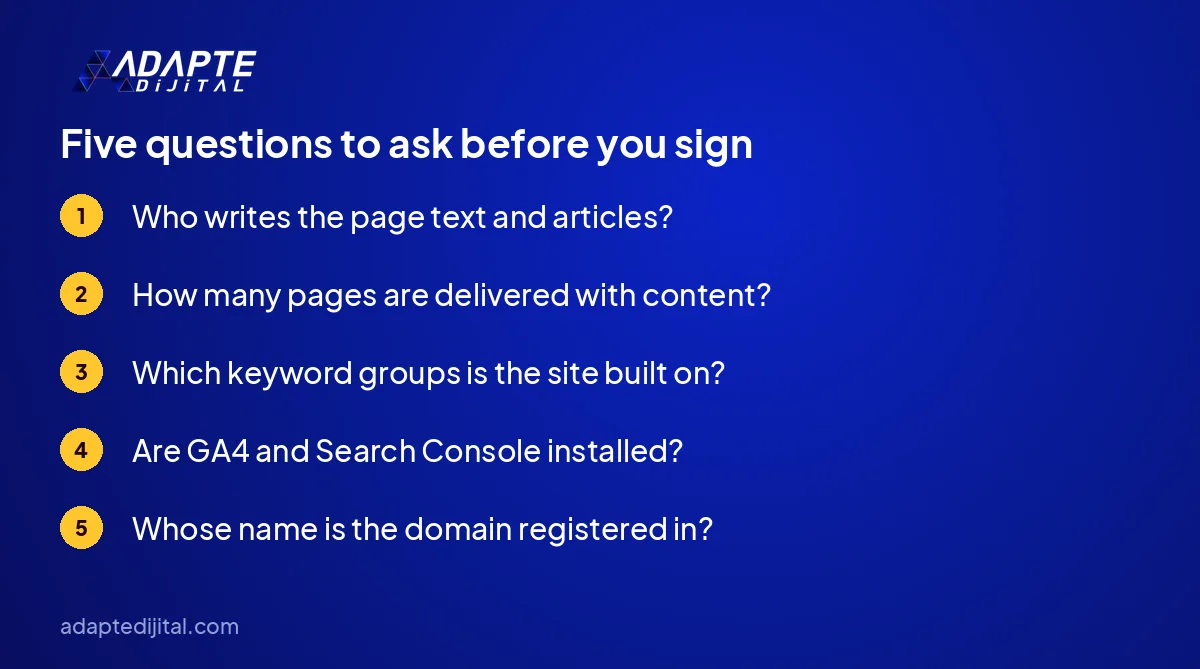
Ask these five questions
- Who writes the page text and the articles?
- How many pages are delivered with content, not just a title?
- Which keyword groups is the site built around?
- Are Google Analytics 4 and Search Console installed at handover?
- Whose name is the domain registered in?
Read “SEO-friendly” and “unlimited” twice
Both words sound generous and promise nothing you can check. Ask what exactly is done for SEO, and ask what exactly is unlimited. A clear answer is a good sign; a long pause is a useful one too.
What does a real turnkey website look like at handover?
At handover you receive access, a measurement panel and the page map, and the matter is closed. The domain is in your name, the first year of hosting is included, and articles are either live or already scheduled. Nothing is waiting on you. That is the construction meaning of turnkey, carried over to the web.
Adapte Dijital delivers 6 top pages, 12 subpages and 108 articles for one fixed price of 36,000 TRY + VAT. See what a real turnkey delivery includes.
Your part stays small
With a turnkey website, you describe your business and approve options that arrive with reasons. Text, photos, logo and technical setup are not asked of you. For the full journey, see the roadmap for owners who want a site without the hassle.
Now you know the difference
A turnkey website is ready to use, not just ready to show. A shell has walls and a nameplate; a real delivery has rooms people can walk into. With six signs and five questions, you can tell which one you are being offered. The full definition of a turnkey site and our note on what corporate web design covers go deeper.
Quick Summary
- In construction, turnkey means handed over ready for use.
- A shell delivery is an installed theme with mostly empty pages.
- Six signs expose a shell, from a generic theme to a silent site.
- Templates are not the problem; unprocessed templates are.
- Five proposal questions reveal what you will actually receive.
Short Glossary
- Turnkey
- Turnkey is the term used in construction for a property handed over ready for use.
- Shell delivery
- Shell delivery is the term used for a site handed over as a structure without content, planning or measurement.
- Structured data
- Structured data is the term used for code that tells search engines and AI tools what a page is about.
Frequently Asked Questions
Next Step
If you want a site that passes all six checks, start by telling us about your business. You receive a sector setup with a page map, keyword groups and a domain name suggestion before any build begins, and you approve it first. Apply for a real turnkey delivery.
Sources: Google Search Central, SEO Starter Guide · Google Search Central, How Google Search Works
Updated: November 2026
Sık Sorulan Sorular
No. Many offers are shell deliveries: a ready-made theme, content requested from you and a few mostly empty pages. Check the six signs before you sign.
No. A template becomes a shell only when it is delivered unprocessed, without sector setup, written content, keyword groups and measurement.
Ask who writes the content, how many pages are delivered filled, which keyword groups are used, whether GA4 and Search Console are installed, and whose name the domain is registered in.