
New therapy practice with no clients? The 6 parts of a client’s trust threshold
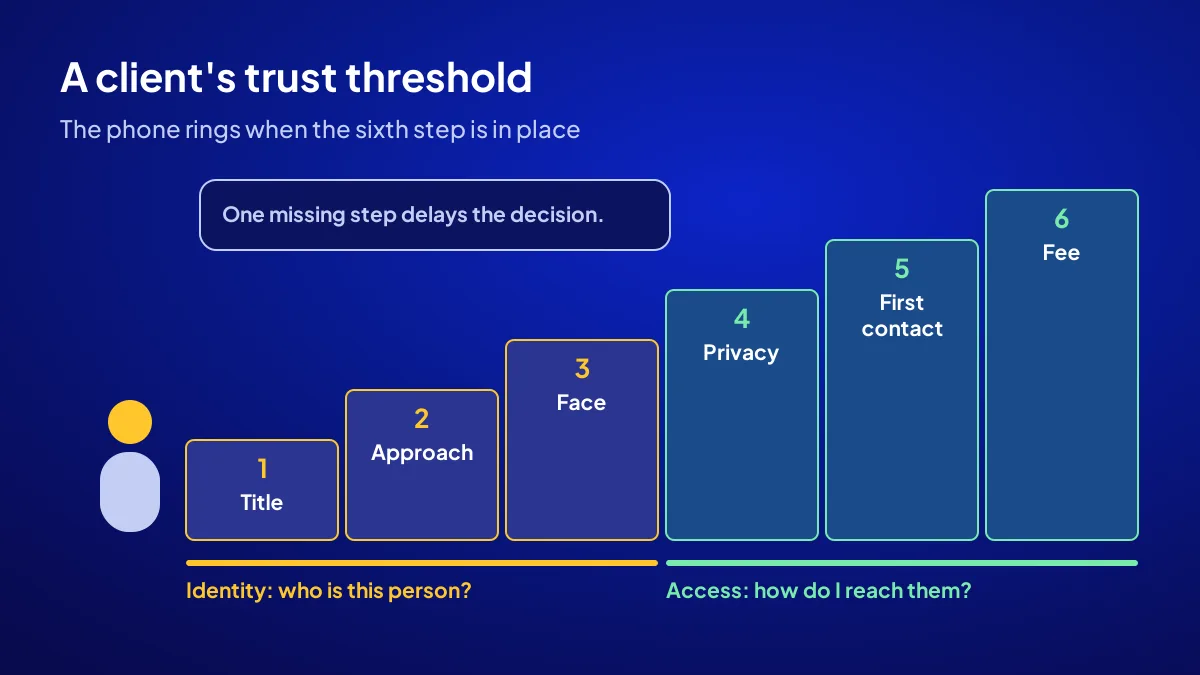
When a new therapy practice has no clients, the problem is rarely your expertise; it is the trust threshold a client must cross first. That threshold has six parts: a clear title, a clear approach, a visible face, privacy, an easy first contact and a fee that can be discussed. If one part is missing, the client researches, saves your page and does not call.
The six parts fall into two groups: an identity group that answers “who is this person” and an access group that answers “how do I reach them”. In 2026, for a practice newly opened in Beşiktaş, Kadıköy or Çankaya, both groups are completed online, before the door. Advertising does not lower this threshold, and promotion limits in mental health services are narrow anyway.
Say you open an office in Moda: why is the phone silent?
Say you are a clinical psychologist renting a flat with a separate entrance on a quiet street in Kadıköy’s Moda. The armchairs are in place and there are three posts on Instagram, but the phone is silent. The reason is neither the district nor the price; it is the gap between the moment a client finds you and the moment they call.
The unexpected finding: clients first want to stay unseen
Most practice owners assume clients look for expertise above all. Yet at the first step, many look for invisibility: researching unseen, asking unheard, entering a building without meeting anyone. A practice that ignores this drops out in the first round, however good it is.
The decision is quiet and slow
Starting therapy is often an inner conversation that lasts weeks. Meanwhile the client searches your name, checks your profile, reads your site. The phone rings when the last part clicks.
What is a trust threshold, and why is it higher in therapy?
A trust threshold is the set of questions a person wants answered before trying a service. At the hairdresser it is low; a bad cut grows out in three weeks. In therapy, the client chooses who will hear their most private story, so a wrong choice costs emotionally and every part gets checked.
Six parts, two groups
The identity group holds title, approach and face. The access group holds privacy, first contact and the fee conversation. Identity asks “can I trust this person?”; access asks “will reaching them wear me out?”
Why the bar rises with selective clients
In higher-income districts, clients are often short of time, compare carefully and notice detail: a consistent title, a well-made website, a short route to booking. Premium expectations lift every part a little higher.
Identity group: why do title, approach and face come first?
BU BÖLÜMÜN ÖZETİ
- 1. A clear title
- 2. A clear approach
- 3. A visible face
A client first wants to understand who they will be talking to. An unclear title, an unwritten approach and no visible face leave a question mark, however experienced the expert. Until identity is complete, good access changes little. One well-written page often completes all three parts.
1. A clear title
Clinical psychologist, psychologist and psychological counsellor reflect different training. A clinical psychology master’s programme registered in the Turkish Qualifications Framework defines the field as the prevention, assessment and psychotherapy of psychological disorders. Under Turkey’s job descriptions for health professionals, clinical psychologists provide psychotherapy, and in cases of illness they do so on referral from a specialist physician. Write your title the same way everywhere.
2. A clear approach
“A holistic approach” tells the client nothing. Write in plain words which ages, topics and session formats you focus on. If you use the name of a school of therapy, translate it into everyday language in one sentence.
3. A visible face
A simple portrait and a few lines of introduction soften the question “what kind of person will I meet?” Stock photos and logos do not answer it.
Access group: where do privacy, first contact and fees get stuck?
BU BÖLÜMÜN ÖZETİ
- 4. Privacy
- 5. An easy first contact
- 6. A fee that can be discussed
A client who trusts your identity now weighs the route: how to enter the building, who to message, how to ask about the fee. If any of these stays unanswered, the decision moves to next week. Access blockages are invisible; clients do not complain, they simply do not call.
4. Privacy
Building entrance, waiting arrangements, clients not running into each other and where messages are stored all belong here. Under Turkey’s Personal Data Protection Law, health data is special category personal data. Explaining your privacy principles in plain words on your website is one of the strongest trust signals you have.
5. An easy first contact
Many people hesitate to phone. A short booking form or a written message route lightens the first step. Reply the same day; being kept waiting at first contact feels like being turned away at the door.
6. A fee that can be discussed
The regulation bans fees in promotion, so the price cannot go in an ad. You can, however, tell anyone who asks clearly and comfortably, one to one. A line on your website such as “fees and session arrangements are shared at first contact” unties the knot of “would it be rude to ask?”
Which shortcuts raise the threshold even higher?
The shortcuts that come to mind when the phone is silent usually raise the threshold. In mental health, clients sense sales language at once and step back. Most of these shortcuts also run into the health promotion regulation of 12 November 2025. Do not reach for them because the till is not ringing.
- Fee and campaign announcements such as “first session discounted”.
- Using client thank-you notes or reviews in promotion.
- Promises of results and duration, such as “anxiety-free in three months”.
- Fear language: alarming posts like “depression signs you have not noticed”.
- Bulk messages to former clients or contacts without consent.
- Using a specialty name that is not part of your title.
Check the rule first
Whenever you are unsure, consult the provincial health directorate and your professional association. We gathered how the rule applies to therapy practices in the new therapy practice promotion guide.
How do you test the six parts in your own practice?
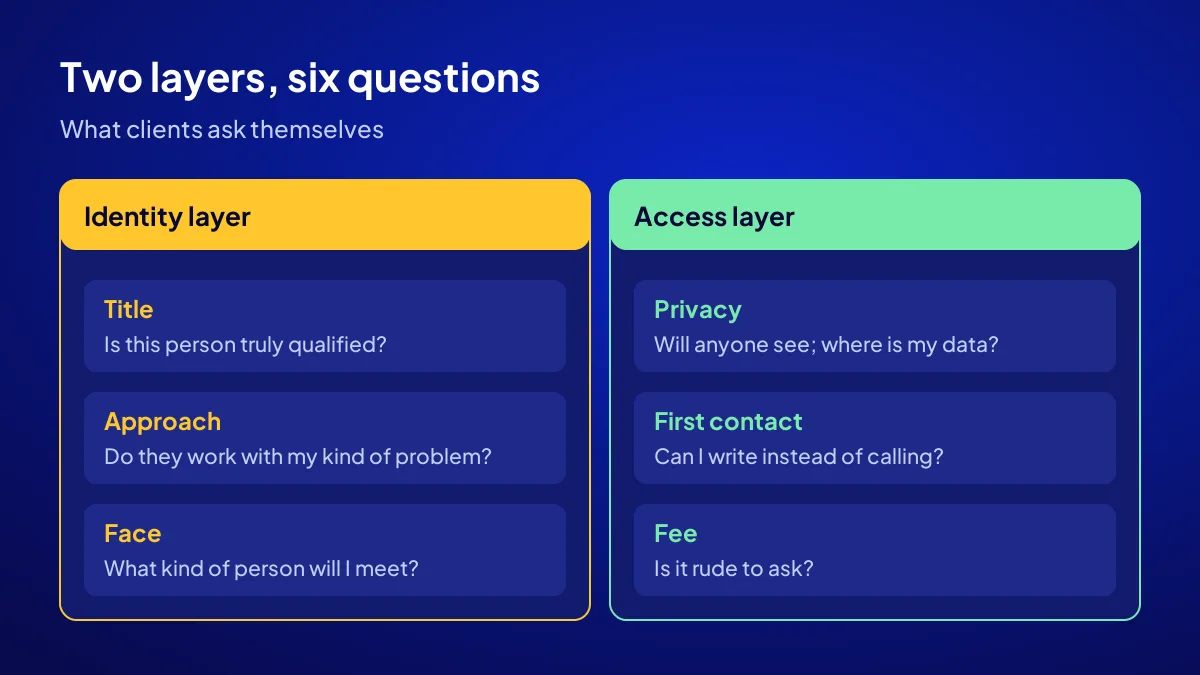
The easiest test is to put yourself in the client’s place. On your phone, in a private tab, search your name and “district + psychologist”, then answer the six questions below. Each “no” shows which part is missing, and the repair order follows from there.
| Part | The client’s inner question | Test |
|---|---|---|
| Title | Is this person truly qualified? | Is the title consistent and the training visible? |
| Approach | Do they work with my kind of problem? | Are focus areas written in plain words? |
| Face | What kind of person will I meet? | Is there a real portrait and short introduction? |
| Privacy | Will anyone see; where is my data kept? | Are entrance and data principles explained? |
| First contact | Can I write instead of calling? | Is there a form or message route? |
| Fee | Is it rude to ask? | Is there a “shared at first contact” note? |
Profile and Instagram
How to fill title, category and hours on your profile is in a therapy practice’s Google Business Profile. Why Instagram cannot carry this threshold alone is in is Instagram enough for a therapy practice.
Repair order
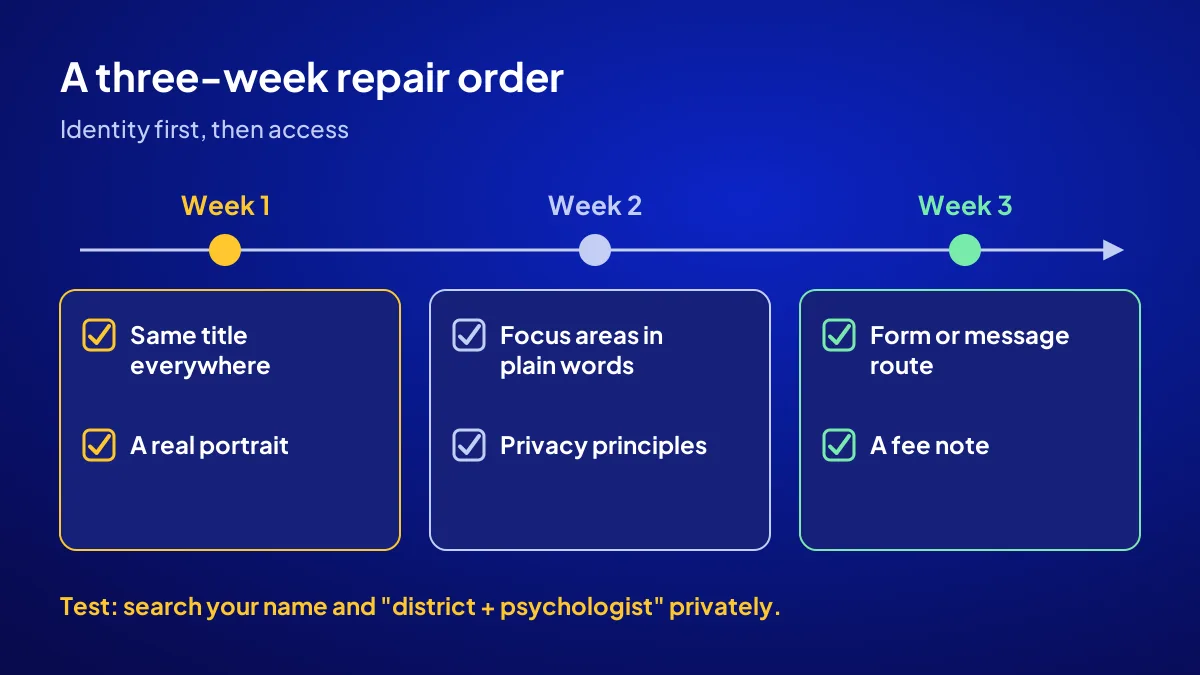
Identity first, then access: title and face in week one, approach and privacy in week two, first contact and the fee note in week three. To plan the first 90 days in this order, see the first 90 days of a new therapy practice.
Once the threshold drops, where do clients find you?
When the six parts are in place, clients find you not only by name but by their question. Questions such as “how do I talk to my teenager” or “when should we consider couples therapy” are asked on Google and to AI assistants. Calm, sourced answers to these questions complete the six parts before the client even contacts your office.
A bridge between question and office
Adapte’s AI SEO Campaign builds this bridge: entity setup, structured data, question-and-answer blocks and 108 articles across 6 question groups. The price is TRY 36,000 + VAT, fixed; delivery in 30 days, 12 businesses per period. Being recommended is not guaranteed; readability infrastructure is built and measured. Details are on the campaign page.
One principle
Clients want to know you before they knock. The practice that offers that introduction quietly, without selling and without gaps, is the one whose phone rings.
Quick Summary
- If clients are not coming, check the trust threshold before advertising.
- The threshold has six parts: title, approach, face, privacy, first contact, fee.
- Clients often want to stay unseen first; privacy is part of the service.
- Fees stay out of ads but are shared comfortably with anyone who asks.
- Discounts, review campaigns and fear language raise the threshold and break the rules.
- Repair order: the identity group first, then the access group.
Short Glossary
Trust threshold: A trust threshold is a concept used to describe the set of questions a person wants answered before trying a service.
Special category personal data: Special category personal data is a legal term used to set apart data, such as health information, that needs stricter protection.
Entity setup: Entity setup is a structure used so that search engines and AI recognise a person’s or business’s name, title and details as one identity.
Next Step
For infrastructure that answers the questions clients ask and gathers your name and title into one identity, apply to the AI SEO Campaign. Share your website and target questions, and your diagnosis card will be prepared.
Frequently Asked Questions
Source: Turkish Qualifications Framework — Clinical Psychology Master’s Degree with Thesis
Sık Sorulan Sorular
In a shop the fix is often the window and sign (see new shop, no customers). A practice’s window is the results on the client’s phone.
Usually one of the six parts of the client’s trust threshold is missing: a clear title, approach, face, privacy, first contact or a fee that can be discussed. The client researches but does not call until the last part is in place.
The health promotion regulation bans using client thank-you notes and reviews in promotion, and incentivised reviews also break platform rules. With your confidentiality duty in mind, avoid asking for reviews and consult your professional association.
No. The campaign does not guarantee recommendations; it builds infrastructure so your name and content are readable and recognisable, and measures it with start and end diagnosis cards. The price is TRY 36,000 + VAT (TRY 43,200 at 20% VAT; check the current rate on your invoice).
Updated: October 2026