
What is an entity in SEO? How AI recognises your business in 3 steps
What is an entity in SEO? An entity is something that exists in the real world and can be told apart from everything else: a person, a neighbourhood, a dental clinic. Entity SEO is the work of getting search engines and AI to recognise your business not as a pile of keywords but as one entity, with its name, address, line of work and connections. It is built in three steps: you define yourself, you link the sources that describe you, and you keep your details identical everywhere.
Most people do not know this: Google moved to this logic in 2012 with the phrase “things, not strings”. The figure Google shared in 2020 was 500 billion facts about 5 billion entities in its Knowledge Graph. In that huge directory, your business is either a clear record or a blurry name. When AI writes an answer, that difference counts.
What is the difference between an entity and a keyword?
BU BÖLÜMÜN ÖZETİ
- A word is a label
- An entity is a record
- An analogy
A keyword is the string of letters someone searches. An entity is the real thing behind that string. “Star” could be a celestial body, a football club or your bakery. Search engines and AI work out which one is meant from context and records; entity SEO makes that job easier, in your favour.
A word is a label
A word is a phrase that appears on your page. A hundred sites can use the same word. A system that ranks by words alone cannot fully answer the question “who?”.
An entity is a record
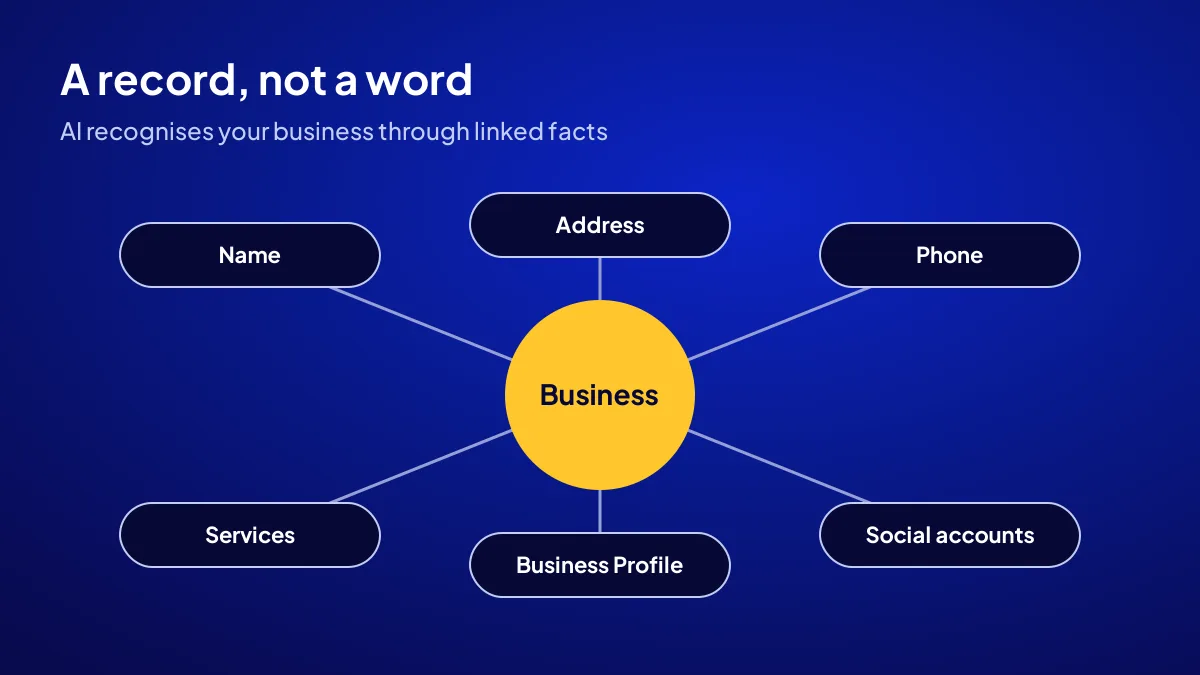
An entity is a record with a name, a type, an address, a founder, services and links to other entities. “A dental clinic in Beylikdüzü, founded by this dentist, at this address” is a record, not a word.
An analogy
In the neighbourhood everyone calls him “Ahmet the Butcher”, the civil registry says Ahmet Yılmaz, and the tax plate reads “Yılmaz Meat Products”. The neighbours know all three are the same man. AI only knows it if it sees the links; otherwise three different Ahmets wander about.
How does AI recognise a business?
BU BÖLÜMÜN ÖZETİ
- Your footprint in the real world
- Your footprint online
- Distinguishing numbers
AI recognises a business not from a single source but from signals that confirm each other. If your website, Google Business Profile, social accounts and sector directory listings all say the same thing, the record becomes clear. If one says something different, AI cannot be sure. And instead of mentioning a business it is unsure about, it may pick someone else.
Your footprint in the real world
Google’s organization structured data guide recommends adding details that show real-world presence, such as an address or phone number, alongside your business name. This is what shows you exist on the street, not just on paper.
Your footprint online
The same guide lists fields such as website address and logo for online presence. You can also link your social media and review profiles with a field called “sameAs”. sameAs is the machine-readable way of saying “this account is mine too”.
Distinguishing numbers
The guide also includes identifier fields such as a tax number. Their purpose is to tell your business apart from others with the same name. Think of how many “Yıldız Construction” companies exist in Türkiye and you will see why the field is there.
Step 1: How do you define yourself?
The first step is describing your business on your own site in a way machines can read. The tool for this is structured data (schema): tags added to the page code that say “this is an organization, its name is this, its address is that”. Visitors do not see it; search engines and AI do. The table below sums up the fields that do the most work for a small business.
| Field | What goes in | Why it matters |
|---|---|---|
| name | The name on your sign, identical everywhere | The main key of the record |
| address | Street, district, city, postcode | Shows you exist in the real world |
| telephone | The number customers call | Confirms identity together with the address |
| url and logo | Site address and logo file | Shows your online presence |
| sameAs | Business profile and social account links | Ties scattered traces to one record |
| vatID | Tax number | Separates you from businesses with the same name |
Step 2: How do you link the sources that describe you?
The second step is gathering the places that mention you online into one record. If your Google Business Profile, LinkedIn company page, Instagram account, sector directories and chamber listing all stand apart, AI struggles to merge them. With the sameAs field and consistent profiles, those traces attach to the same entity.
Which profiles come first?
- Google Business Profile, because it is a record with a verified address and phone
- Your sector’s directories and professional chamber listings
- The social accounts you actually use
Step 3: Why keep your details identical everywhere?
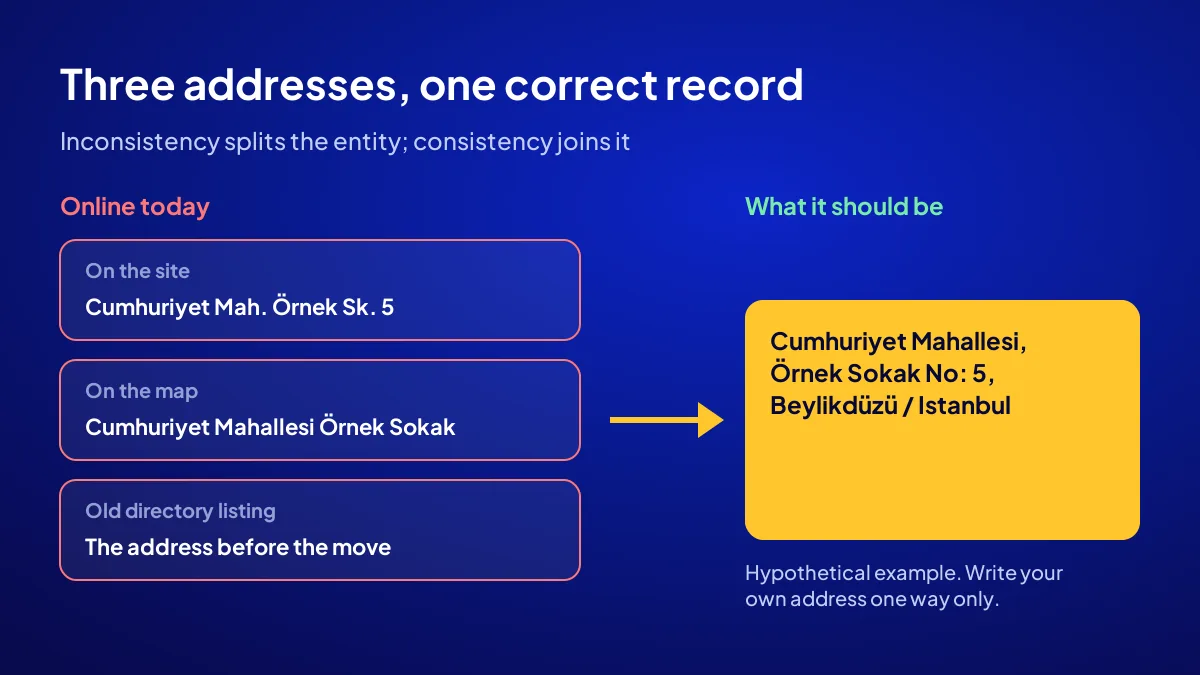
Because inconsistency splits the entity. If your site says “Cumhuriyet Mah.”, the map says “Cumhuriyet Mahallesi” and a directory still shows your old address, AI may not be sure these are the same business. Writing your name, address and phone letter for letter the same everywhere is the cheapest and most neglected step in being recognised.
Where does entity SEO part ways with classic SEO?
Classic SEO looks at a page ranking for a keyword. Entity SEO looks at whether it is clear who the business is. They are not rivals: a business that ranks well but whose identity is vague may struggle to be mentioned in AI answers. That is why entity setup is a separate item in Adapte’s AI SEO campaign.
Now you know
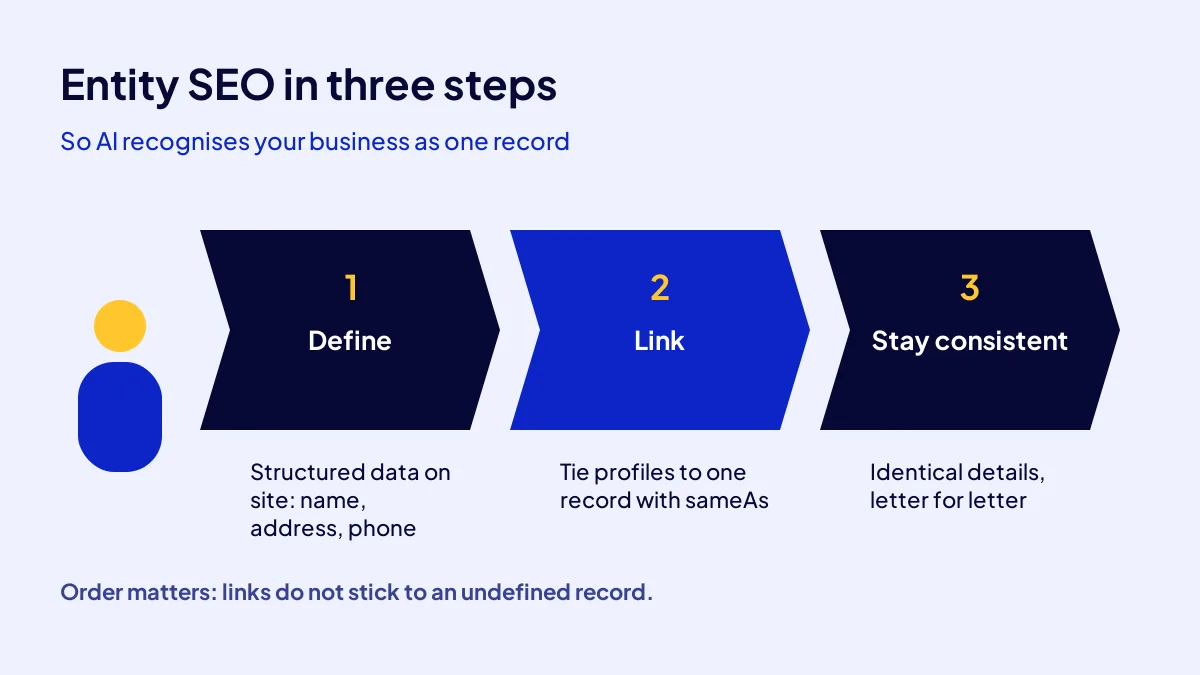
AI recognises your business as a record, not as a word. The record becomes clear in three steps: define yourself, link your traces, keep your details identical everywhere. Everything else is built on top of that record.
Quick Summary
- Entity SEO gets your business recognised as one single entity.
- In 2020 Google reported 500 billion facts about 5 billion entities.
- Step 1: define yourself with structured data.
- Step 2: link your profiles to one record with sameAs.
- Step 3: write name, address and phone the same everywhere.
- Entity setup is a separate item in the AI SEO campaign.
Short Glossary
Entity: An entity is the record search engines and AI use to tell a person, place or business apart from all others.
Structured data (schema): Structured data is a code block used to label information on a page in a form machines can read.
sameAs: sameAs is a structured data field used to show that profiles on different sites belong to the same business.
Next Step
If you want your business to be a clear record in the eyes of AI, apply for the AI SEO campaign and get entity setup built together with structured data and 108 articles.
Frequently Asked Questions
Source: Google Search Central — Organization structured data
Sık Sorulan Sorular
Usually on the home page or the about page, as a single block. What AI mixes up when structured data is missing is shown with examples in why structured data matters.
Google sets no required fields for this data and suggests adding the ones useful to you. Starting with name, address, phone and website is something you can do even when the till is quiet.
An account opened three years ago and abandoned, still showing an old phone number, does not build a link; it confuses. A few up-to-date profiles beat many deserted ones. You can check how your brand looks in AI today with our how does my brand appear in AI guide.
After a move, a phone change or a shortened name. A shop that moves across the street and raises its shutters in the new spot, but never updates old profiles, lives at two addresses online.
Search your business name in quotes and write down the address and phone in the top results. Every line written differently is a job to fix. Why this consistency matters even more in local searches is covered in who AI recommends in Istanbul.
In the fixed-price package at TRY 36,000 + VAT, structured data, brand profiles and directory signals are set up in 30 days, together with 108 articles and AI crawler settings. You can see the whole package in how to do AI SEO and apply on the AI SEO campaign page.
Classic SEO focuses on a page ranking for a keyword. Entity SEO focuses on the business being recognised as one entity, with its name, address and connections. The AI SEO campaign handles both together.
Yes. You do not need to be a big brand to be an entity. Identical name, address and phone everywhere, structured data and up-to-date profiles make a small business a clear record too.
Yes. In the fixed-price AI SEO campaign at TRY 36,000 + VAT, entity setup, structured data, brand profiles and directory signals are set up in 30 days.
Updated: October 2026