
How to write a FAQ block that AI assistants quote: 9 rules for question and answer
How to write a FAQ block, in short: the question is asked in the customer’s own words, the first sentence of the answer fully answers it, the answer stays between 40 and 60 words, and the visible text matches the structured data exactly. When AI assistants prepare an answer, they easily find paragraphs that follow this pattern and make sense on their own.
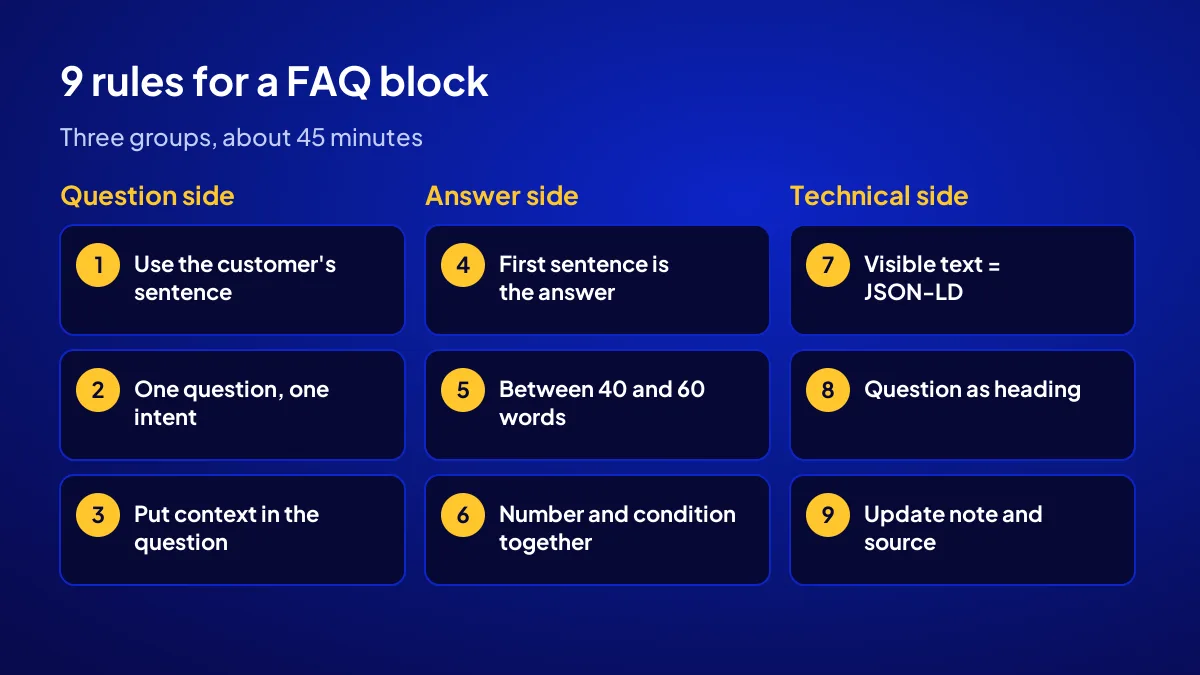
The 9 rules below fall into three groups: the question side, the answer side and the technical side. Each rule notes how long it takes and what it needs. A 6-question block takes about 45 minutes. There is no extra cost; what you need is the list of questions your customers actually ask.
What is a FAQ block and where does it go on the page?
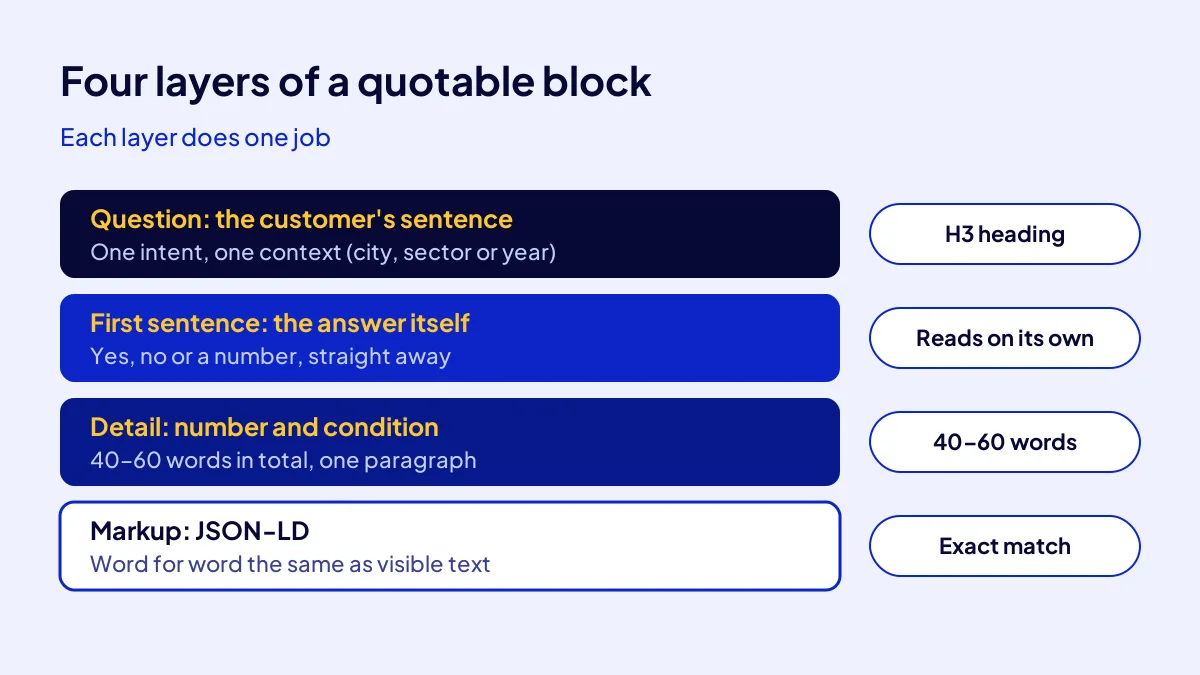
A FAQ block is a series of short paragraphs, each giving one answer to one question, placed at the end of a page or under the relevant section. Its value for AI is that each answer makes sense without reading the rest of the page.
On a service page: right below the decision
The best spot is right below the price or the apply button. When customers are not walking through the door, an unanswered question is often waiting at the threshold.
In an article: before the closing
In informational articles the block comes after the summary and the next step. It gathers the side questions.
Google no longer shows FAQ rich results; does the block still work?
Yes, it does. According to Google Search Central’s documentation updates, FAQ rich results have not appeared in Google Search since 7 May 2026. Only the expandable display is gone, not the text on your page. Google’s general structured data guidelines also say not to mark up content readers cannot see.
Which 3 rules apply to the question side?
BU BÖLÜMÜN ÖZETİ
- Rule 1: Use the customer’s sentence (5 minutes)
- Rule 2: One question, one intent (5 minutes)
- Rule 3: Put the context in the question (5 minutes)
The question side’s job is to capture the sentence a real person actually asks. A made-up question in marketing speak hangs a sign over a door nobody uses. These rules take 15 minutes. You need the questions you hear most on the phone or at the till.
Rule 1: Use the customer’s sentence (5 minutes)
Write “Is installation included in the price?” instead of “What is the scope of our services?”. Copy the 6 most common from the last 30 days.
Rule 2: One question, one intent (5 minutes)
“How much is it and how long does it take?” is two questions. Split them. AI matches one question to one intent; a question with two intents produces two half answers.
Rule 3: Put the context in the question (5 minutes)
Put the city, sector or year in the question: “Are you open at weekends in Beylikdüzü?”
Which 3 rules apply to the answer side?
BU BÖLÜMÜN ÖZETİ
- Rule 4: The first sentence is the answer (2 minutes)
- Rule 5: Between 40 and 60 words (2 minutes)
- Rule 6: Number and condition together (1 minute)
On the answer side there is one test: does the first sentence close the question when read alone? An answer that beats around the bush does not get quoted. These three rules take about 5 minutes per question. What you need is a clear number, time or condition.
Rule 4: The first sentence is the answer (2 minutes)
Start with “Yes”, “No” or a number. The reasoning comes after.
Rule 5: Between 40 and 60 words (2 minutes)
Under 40 words often skips the condition; over 60 drifts into a second question. It is a writing habit, not a search engine rule.
Rule 6: Number and condition together (1 minute)
Write a number instead of “affordable price”, and add the condition it applies to: “TRY 36,000 + VAT, fixed price.”
Common mistake: Ending the answer with “Call us for details” and never giving the real information. There is nothing to quote in such an answer. The call comes after the answer, not instead of it.
Which 3 rules apply to the technical side?
BU BÖLÜMÜN ÖZETİ
- Rule 7: Visible text and markup are identical (5 minutes)
- Rule 8: Question as heading, answer as paragraph (5 minutes)
- Rule 9: Update note and source (5 minutes)
The technical side makes machines read your answer the way people do. The three rules take 15 minutes in total and, on WordPress, are free with the FAQ block of most SEO plugins. What you need is access to the page’s admin panel and a structured data testing tool.
Rule 7: Visible text and markup are identical (5 minutes)
The question and answer in JSON-LD should match the text on the page word for word. Google’s general structured data guidelines say not to mark up content hidden from readers.
Rule 8: Question as heading, answer as paragraph (5 minutes)
Write the question as an H3 and the answer as one paragraph below it. A plain heading and paragraph is the simplest structure.
Rule 9: Update note and source (5 minutes)
At the end of a page whose answers contain numbers, add “Updated: October 2026” and a source link if there is one. Fix changed prices the same day.
Before and after: let’s rewrite one answer together
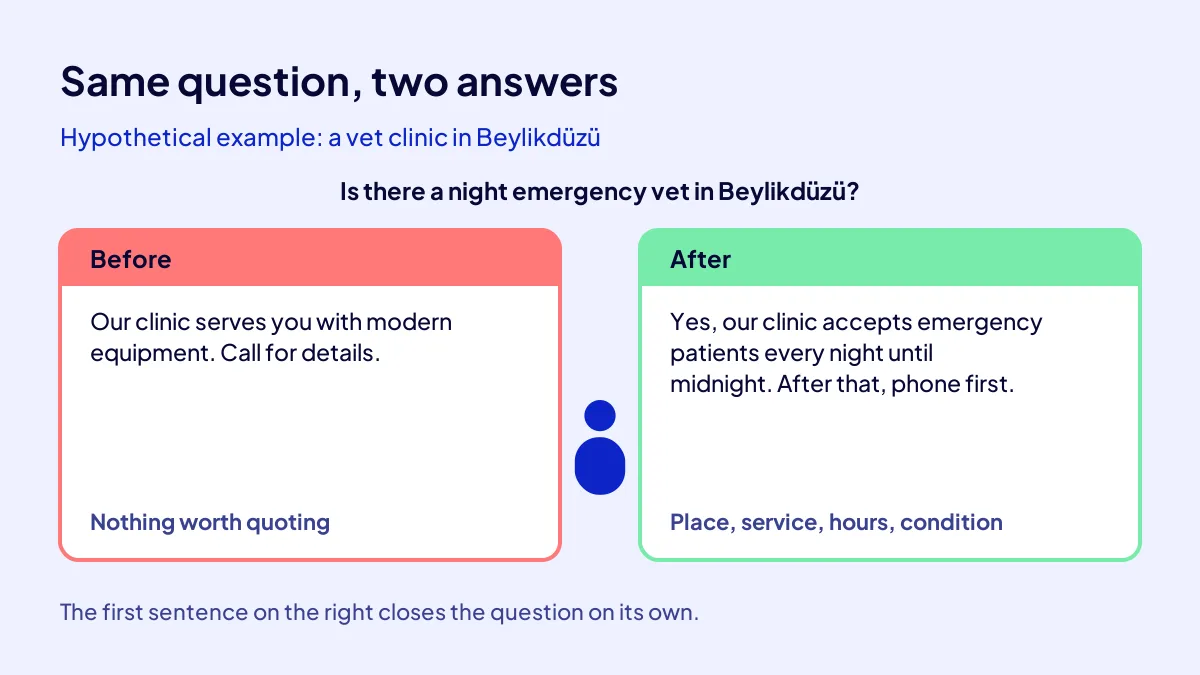
Say you run a veterinary clinic in Beylikdüzü, Istanbul, and the most common question is about night emergencies. The table below shows the same question before and after the rules. The example is hypothetical; use your own hours and conditions.
| Part | Before | After |
|---|---|---|
| Question | About our services | Is there a night emergency vet in Beylikdüzü? |
| First sentence | Our clinic serves you with modern equipment. | Yes, our clinic accepts emergency patients every night until midnight. |
| Condition | Call for details. | After midnight, phone first and the vet on duty will guide you. |
Try it with your own question
If the first sentence in the right column closes the question on its own, the block is ready. How this links to the conditions for being recommended by assistants is covered in how to get recommended by assistants.
How are these rules applied across the 108 articles and existing pages?
In Adapte’s AI SEO campaign, FAQ blocks are added to your existing pages and 108 articles are written across 6 question groups. These 9 rules are applied to every block draft. The campaign is a fixed TRY 36,000 + VAT and is delivered in 30 days. There is no recommendation guarantee; readability infrastructure is built.
Start with existing pages
Adding blocks to pages that already get traffic is the fastest win. Where the question map stays empty on ten-page sites is explained in why small sites stay invisible in AI.
Quota and application
The campaign works with 12 businesses per period and a 10 percent coupon applies. How the question groups are built is shown in AI SEO with 108 articles. To apply, go to the AI SEO campaign page.
Checklist: answer six questions before publishing the block.
- Is every question the customer’s own sentence?
- Does every question carry a single intent?
- Does the first sentence of every answer close the question on its own?
- Are the answers between 40 and 60 words?
- Is the JSON-LD text identical to the visible text?
- Is there an update note at the end of the page?
Quick Summary
- The question is the customer’s sentence; one question carries one intent.
- The first sentence of the answer closes the question on its own.
- Answers stay between 40 and 60 words, with numbers and their conditions.
- JSON-LD text is identical to the visible page text.
- Google no longer shows FAQ rich results; the text keeps its value.
- Three or six questions per page are enough.
Short Glossary
FAQ block: A FAQ block is a series of short paragraphs used to answer a page’s common questions one by one.
JSON-LD: JSON-LD is the structured data format used to describe page information to search engines in machine-readable form.
Intent: Intent is the SEO concept used to classify the real goal behind a search.
Next Step
You can write your first block yourself today; if you want this structure built across 108 articles and all your pages, apply to the AI SEO campaign.
Frequently Asked Questions
Source: Google Search Central — General structured data guidelines
Sık Sorulan Sorular
First for the reader, then for the systems that will quote the answer. The answer that is complete when read on its own is the one that stands out.
There is no need. Markup that matches the visible text causes no errors and keeps describing the page’s structure. Why structured data matters for AI, with examples, is covered in why structured data matters.
The answer on the right is complete without the rest of the page: place, service, hours and condition in one paragraph. It is a price tag in the shop window versus one left in the stockroom.
Each article is written for a specific question and intent. The 108 articles are spread across 6 question groups, and FAQ blocks are added to existing pages. The answer comes in the first sentence, and visible text and structured data are kept identical.
It is not required, but it does no harm. Google has not shown FAQ rich results since 7 May 2026. Markup that matches the visible text keeps describing the page’s structure.
Three or six questions per page are enough. More questions overshadow the page’s main topic. Move the extra questions to a separate article.
Updated: October 2026