
Building a Bag Brand: How Do You Protect a Brand Under Copycat Pressure?
Bags are one of the most appealing and most unforgiving categories for a new brand. Appealing, because the product is visual, price tolerance is high and design differences are genuinely felt. Unforgiving, because here copying moves faster than competition.
A well-received model can appear in near-identical versions within weeks. And not only from rivals — the same workshops can produce the copy. So a brand here can’t be built on a single model.
This guide covers the reality of a bag brand: how to protect yourself under copycat pressure, material and pattern decisions, stock and season maths, price bands and the first 90 days’ output. What gets protected here isn’t a model but a recognisable language.
Copycat Pressure: Four Layers of Protection
You can’t stop copying entirely; you can reduce its value. Four layers work together.
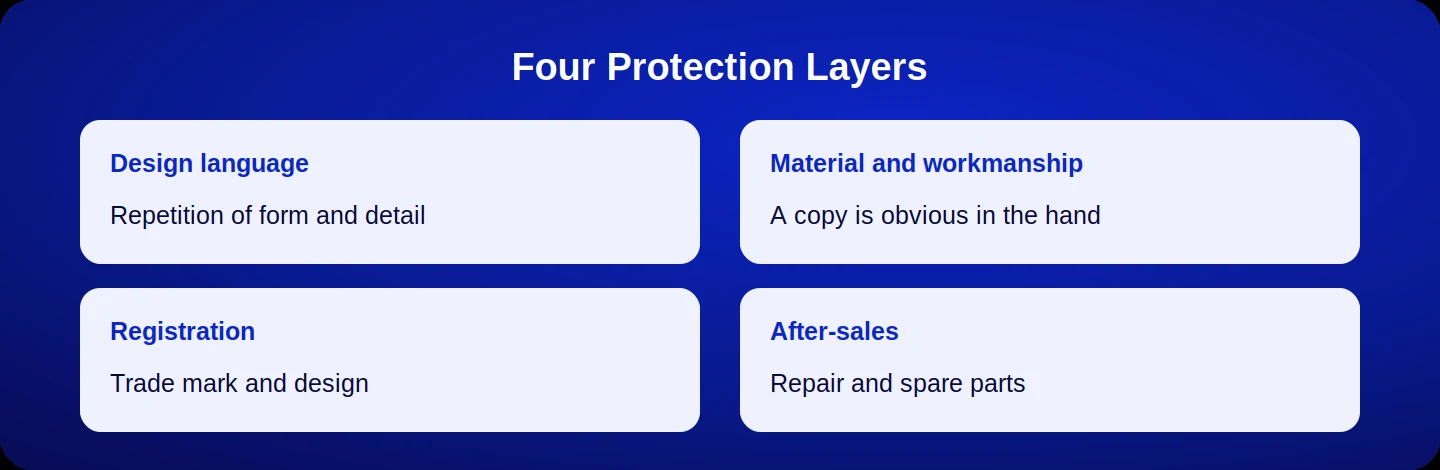
Inside the layers:
Material, Pattern and Production
This category’s technical side ties decisions to the long term. Four headings:
Four headings:
Stock, Season and Variants
In bags money is tied not to models but to variants. Three rules:
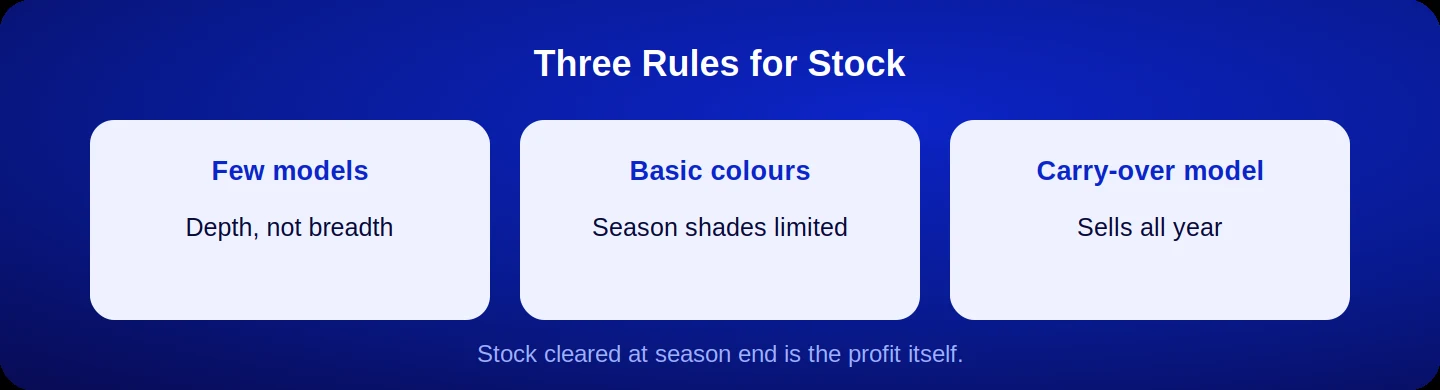
Inside the rules:
Price Band and Channel
The most critical strategic decision here is which band you play in. Four headings:
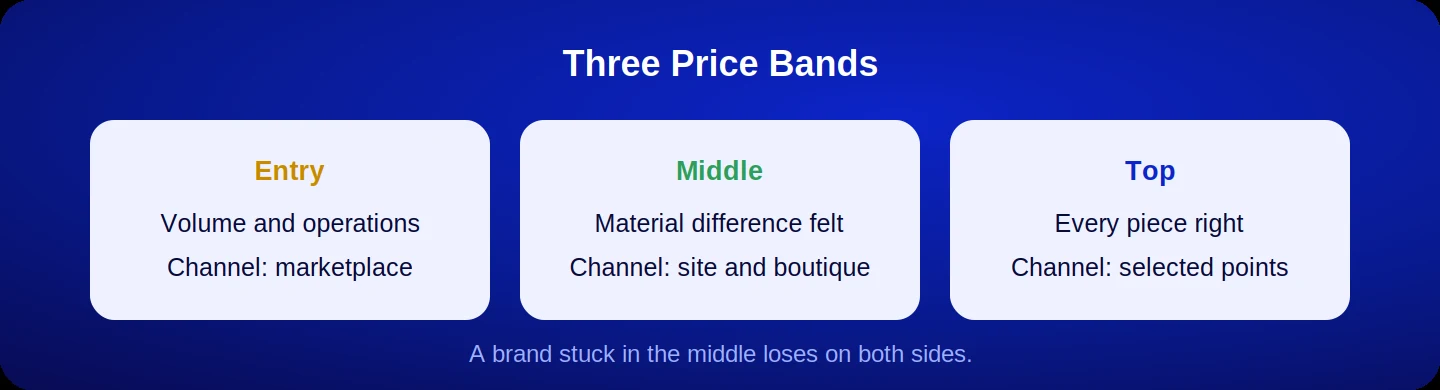
Four headings:
First 90 Days: Counted Output
BU BÖLÜMÜN ÖZETİ
- Month one: band, audience, one model
- Month two: samples, criteria, registration application
- Month three: small batch, one channel
The aim of the three months isn’t a collection but establishing language and quality on one model.
Four headings:
Month one: band, audience, one model
A price-band decision, a use description and one model. The sampling process begins this month. Material isn’t chosen before the band decision; chosen first, the price won’t hold later.
Month two: samples, criteria, registration application
Sample revisions, a quality acceptance criterion, registration processes for the brand name and design. Skip this month and by month three you have no document against a copy.
Month three: small batch, one channel
Small batch, few variants, one channel. Data to collect: which colour sells, return reasons, customer questions. Overall planning is done with digital consulting.
The Meeting Test and Copycat X-Ray
BU BÖLÜMÜN ÖZETİ
- “If your model gets copied, what’s left?”
- “Which price band are you in?”
- “How many models and colours are you starting with?”
- “What do we get if we start small?”
The closing ruler. Four questions:
What good answers sound like:
“If your model gets copied, what’s left?”
A good answer names the design language, the material and the registration. “It won’t be copied” isn’t realistic; here a copy isn’t a possibility but a matter of time.
“Which price band are you in?”
A good answer names the band and its reasoning. Without that decision the brand loses on both sides: too expensive for cheap, too cheap for expensive.
“How many models and colours are you starting with?”
A good answer gives a small number. A broad launch means tying up money before learning which model sells.
“What do we get if we start small?”
A copycat X-ray: a price band and audience definition, design language notes, a quality acceptance criterion and a registration roadmap — fixed fee, the documents are yours. Bring your sample or drawings to a preliminary assessment; the scope is on the brand consultancy page. Neighbouring door: the sock brand guide.
Field Notes
· Brands launching with one model are defenceless when copied; those launching with a language of repeated details survive it, because a copy can’t carry the whole.
· Brands applying for registration before sales begin get faster results from marketplace copy notifications; later applicants lose time in process.
· In first collections opened with many models and colours, sales concentrate in a few products while the rest waits for the end of season.
Mini Glossary
Design language: The whole of form, proportion and detail repeating across models.
Carry-over model: An off-collection product selling all year and regulating cash flow.
Acceptance criterion: The written quality condition for stitching, edging, lining and hardware.
Quick Summary
· Models get copied, identities don’t: design language, material, registration and after-sales are the four protection layers.
· The pattern process is long and variants tie up money: few models, basic colours, a carry-over model.
· The price-band decision defines the category; a brand stuck in the middle loses on both sides.
Your Next Step
Make two decisions this week: which price band you’re in, and which three details will repeat across your models. With both clear you’re ready for sampling. We’ll write the quality criterion together in a preliminary assessment.
Frequently Asked Questions
Is design registration essential?
Not mandatory, but one of the most useful protections in this category: if you have a distinctive design, registration gives you a concrete document against copies and speeds up marketplace notifications. Trade mark registration is a separate and more fundamental step; growing without protecting the name is always risky. In terms of cost and timing, planning both together and applying before sales begin is healthiest. You don’t need to register every model; prioritise the distinctive ones you’ll sell for a long time.
What do I do if I encounter a copy?
Document it first: record where the copy is sold, its images and the dates. On a marketplace, the platform’s intellectual property notification mechanism is the first step and usually produces fast results if you hold a registered right. Contacting the seller directly sometimes works, but a documented process is safer. In the long run the most effective response is strengthening the layers a copy can’t carry: material quality, after-sales, a recognised language. Entering a price war with a copy is where most brands lose.
Should I set up my own workshop?
At the start almost never: equipment, skilled staff and fixed costs are a serious burden that an unvalidated brand can’t carry. The right sequence is starting with a contract workshop in small batches and bringing critical operations in-house once sales are steady. Some brands take a middle route — doing quality control and final assembly on their own premises while keeping production outside. The own-workshop decision makes sense once capacity shortages become a recurring problem and order volume has stabilised.
Sık Sorulan Sorular
Not with one model but with repeated elements: the same flap form, the same stitch detail, the same strap solution, the same sense of proportion. Customers start to recognise it without looking at a logo. A recognised language is a more valuable asset than individual models and a copier can’t carry it whole.
Copies are usually made with cheap materials: lining, edge paint, zips and hardware quality are felt immediately in the hand. Showing that difference on the product page defends the price. Unexplained, the customer compares only two photographs — and in a photograph a copy doesn’t look cheap.
It establishes legal ground for the brand name and a distinctive design; marketplace copy notifications also rest on it. For the general framework on intellectual property and design protection, the Ministry of Justice resources are a starting point. An unregistered brand has no document in hand when the copy appears.
Repair, a replacement strap, a zip change — that is the one thing a copy can’t offer. As product life lengthens, brand value rises. A brand that repairs also changes the purchase decision; the logic matches the after-sales measure in the technology brand guide.
Real leather brings durability and perception at high material and labour cost; alternatives lower cost but span a very wide quality range. The decision follows the target price band; if you make a material claim it must be verifiable, and the rules for sustainability claims sit in the recycling guide.
Sample, revision, second sample, approval: every round takes time and that time goes into the plan. A brand with a season target builds a calendar backwards. The pattern process is this category’s most underestimated line.
Stitch density, edge finishing, lining quality, hardware brand and a carrying test. Without a written criterion the second batch turns into an argument. A criterion protects both the workshop and the brand — the same discipline appears in the underwear guide.
Small workshops are flexible but capacity-limited; large ones demand minimum quantities. The healthy route is starting with small batches and adding a second workshop as work grows. A brand tied to one workshop can’t find capacity in season.
Many models mean thin stock in each; you can’t tell which sells and none has depth. Going deeper on what sells is more profitable than launching new models and it strengthens the design language too.
Basic colours carry volume, season colours bring visibility but carry risk. Season colours are trialled in small quantities. Season colour creates the feeling of a collection; basic colour makes the revenue.
A model outside the collection that sells all year regulates cash flow and anchors the design language. A brand without a carry-over model starts from zero every season.
By planning it from the start: which models go into discount, which don’t, how remaining stock gets cleared. Unplanned discounting lowers brand perception along with the price. Channel and campaign design is planned with e-commerce consulting.
Price decides, volume is required and margins are thin. Marketplaces are this band’s natural channel and price comparison is constant. Building a brand here is a volume and operations job — design difference is hard to protect.
The band where material and workmanship differences are felt and a price can be justified. For most independent brands this is the most realistic space. A price with reasons gets paid.
Material, workmanship, packaging, store experience and after-sales together. High price alone doesn’t create a top band; a missing piece breaks the perception. The top band requires every piece to be right at once.
Entry band to marketplaces, middle band to your own site and boutique shelves, top band to selected points and direct relationships. Site and product presentation run through website consulting, visual language through digital media, and the measure of advertising waste through advertising consultancy.
Clarifies the price band, cuts the model count, gets the quality criterion written, puts registration on the agenda and builds the end-of-season plan up front. A consultant doesn’t draw the design; they stop you losing to copies and stock. Brand architecture sits with brand consultancy; category choice in the sector map; choosing a consultancy in the umbrella guide.