
Building a Pet Care Brand: How Far Can You Go Without Veterinary Approval?
Pet products are one of the fastest-growing categories and the appeal is justified: the audience is attached, willingness to spend is high, repeat purchase is regular. But this category has a peculiarity all its own — the one using the product isn’t the one buying it.
A human decides, an animal experiences. So feedback arrives indirectly: “he wouldn’t eat it”, “she scratched”, “he didn’t like it”. A brand has to close that uncertainty with trust.
This guide covers the reality of a pet care brand: the question of veterinary approval, the documentation burden by product type, the claim line, channel and community, and the first 90 days’ output. Here a brand sells by reducing the owner’s anxiety.
Category Choice and Documentation Burden
“Pet product” isn’t one business; four groups sit under four different regimes. The first decision is made here.
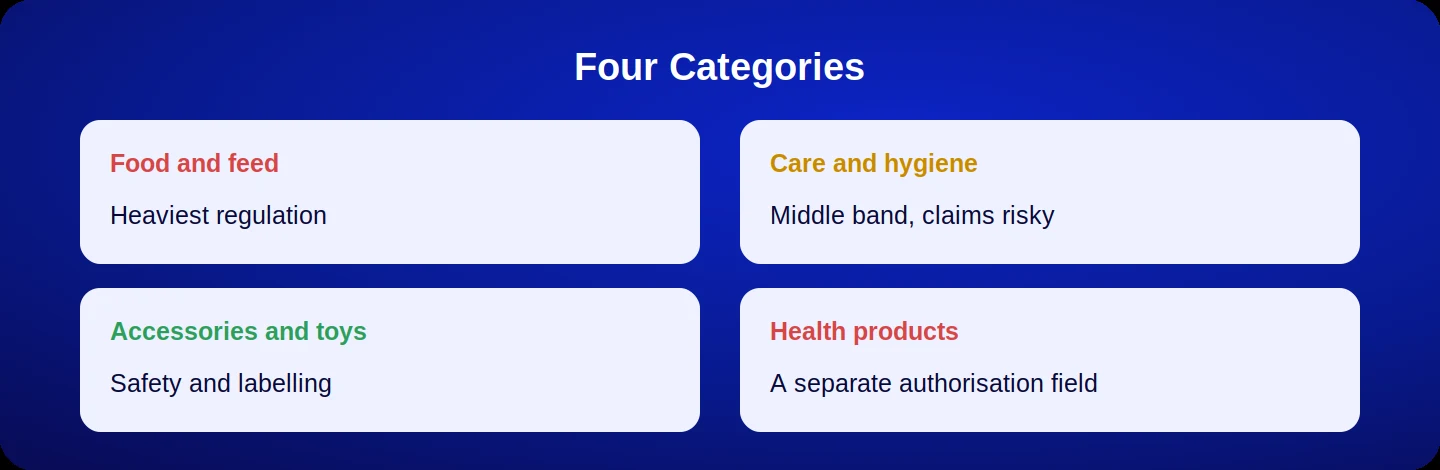
Inside the categories:
Buyer and User Are Different People
This is the category’s storytelling reality. Four headings:
Four headings:
The Claim Line and Label Language
Here what usually ends a brand is a well-meaning sentence. Four rules:
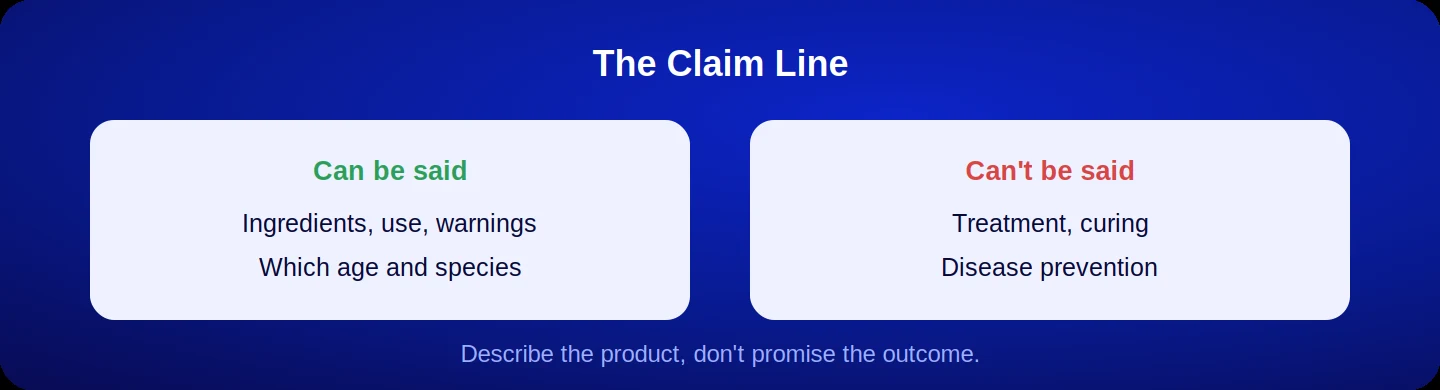
Inside the rules:
Channel, Price and Repeat Purchase
This category’s economic advantage is regular consumption. Four decisions:
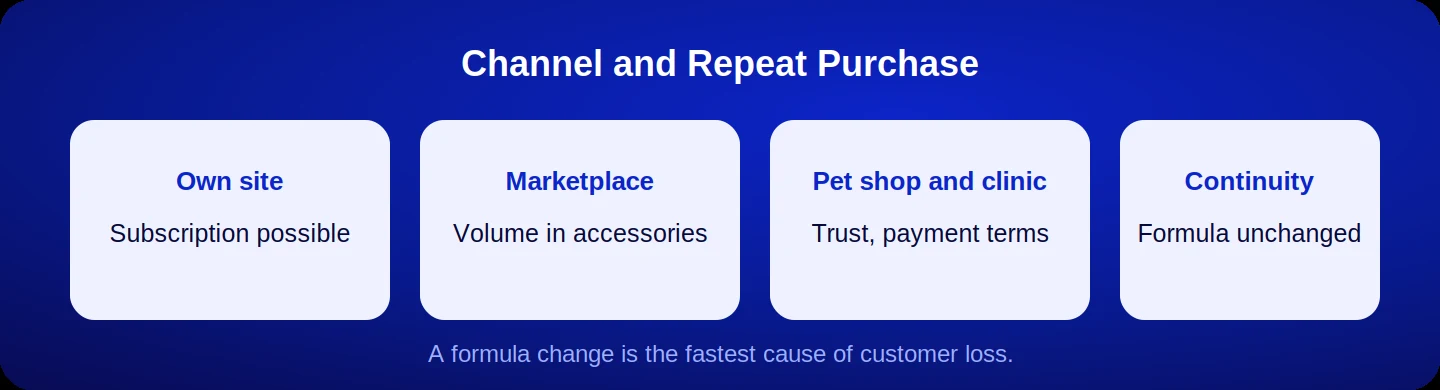
Four decisions:
First 90 Days: Counted Output
BU BÖLÜMÜN ÖZETİ
- Month one: category, manufacturer, classification
- Month two: documents, label, claim list
- Month three: trial size and one channel
The aim of the three months isn’t a wide range but setting documentation and trust language on one product.
Four headings:
Month one: category, manufacturer, classification
Which category, which documentation regime, which manufacturer? Labels aren’t written before classification is clear. A brand starting in the wrong class prints its packaging twice.
Month two: documents, label, claim list
Registration and permit arrangements, ingredient and analysis declarations, warning texts and a list of sentences not to be used. Packaging is finalised this month.
Month three: trial size and one channel
Small batch, trial size, one channel. Data to collect: repeat order rate, return reasons, owners’ questions. The site side is built with website consulting, the advertising measure with advertising consultancy.
The Meeting Test and Trust X-Ray
BU BÖLÜMÜN ÖZETİ
- “Which class is the product in, and which documents are needed?”
- “Which sentences won’t you write?”
- “Do you have a trial size?”
- “What do we get if we start small?”
The closing ruler. Four questions:
What good answers sound like:
“Which class is the product in, and which documents are needed?”
A good answer names the class and lists the documents. A vague answer means packaging and labelling will change later.
“Which sentences won’t you write?”
A good answer produces a banned-phrase list: treatment, curing, disease prevention. Without one, risk appears in the first piece of advertising copy.
“Do you have a trial size?”
A good answer says yes and has priced it. A food brand without a trial size hasn’t taken the owner’s risk onto itself.
“What do we get if we start small?”
A trust X-ray: a category and document list, a permitted-and-banned phrase list, draft label and warning wording, subscription and shipping calculations — fixed fee, the documents are yours. Bring your product idea to a preliminary assessment; the scope is on the brand consultancy page.
Field Notes
· Where a trial size exists, the first sale becomes noticeably easier; owners don’t want to buy a large pack their animal may refuse.
· Brands changing formula or supply get their first reaction as “he won’t eat it any more”; in this category continuity beats novelty.
· Brands listing ingredients in full build a loyal audience among owners of sensitive animals; those who don’t never see that audience at all.
Mini Glossary
Trial size: A small-format entry pack that lowers the owner’s purchase risk.
Claim line: The boundary between describing a product and promising an outcome.
Continuity: Keeping formula, supply and quality unchanged.
Quick Summary
· Category sets the documentation burden: food heaviest, care mid-band, accessories light, health products a separate regime.
· The owner decides, the animal experiences; the telling must reduce anxiety and avoid promising outcomes.
· The economic advantage is regular consumption: trial sizes, subscription and continuity are the three tools.
Your Next Step
Write two lists this week: your product’s full ingredient and warning table, and the sentences you won’t write. With both ready you can move to label and sales language. We’ll review them together in a preliminary assessment.
Frequently Asked Questions
Can I write “vet approved”?
Not unless there is a concrete process behind it: the phrase creates a perception of specific oversight and approval in consumers’ minds, and without substance it is both misleading and a reputational risk. If you’ve worked with a veterinarian on product development or content, describe that as it is — who contributed, and on what. Veterinarians also have professional communication rules that limit product promotion; assess that side before setting up a collaboration.
Is food production or accessories a more sensible start?
In terms of risk and documentation, accessories and toys are a far easier entry: light burden, accessible production, low return rates. In return, repeat purchase is infrequent and the shelf is crowded. The food side is harder on documentation and production but offers regular consumption and subscription potential. A practical route is building an audience and channel with accessories, then moving to food or consumables. The reverse is possible too, but starting with food means having the document file and production partner ready from day one.
Does a donation structure for street animals affect sales?
Sensitivity is high in this audience so it can have an effect, but the structure must be concrete and verifiable: to which organisation, at what proportion, over what period. A vague “a portion is donated” reads like a vague environmental claim in the recycling category and can damage trust. The healthiest route is a regular, reported structure: publishing at the end of each period how much was donated. Rather than putting donation at the centre of the sales argument, winning with the product itself and offering the donation as a tiebreaker produces more durable results.
Sık Sorulan Sorular
Animal nutrition products follow their own legislation: business registration, ingredient and analysis declarations, labelling rules, traceability. Even in contract manufacturing liability sits with the brand. For veterinary and feed regulation, professional body resources such as the Turkish Veterinary Medical Association are a starting point. Don’t enter this category without preparing a document file.
For shampoos, ear cleaners and paw care the documentation burden is mid-band; the real risk is in claims. Phrases like “stops itching” or “cures fungus” move the product into the health category. Describe the product, don’t promise the outcome.
Safety: small parts, choking risk, paint and material safety, durability. The burden is light but the responsibility is real. A toy that breaks and can be swallowed produces the most serious complaint — durability testing happens before production.
Parasite treatments, medicines and medicinal products follow separate authorisation and licensing regimes; entering unprepared is a serious risk. A health claim changes the category — the same boundary logic is set out in the wellness guide.
The owner — and the owner buys under a fear of harming their animal. So the telling is built around trust: what’s inside, how to use it, what to watch for. A brand that reduces anxiety sells, not one that creates excitement.
Animals don’t speak; owners interpret. “He wouldn’t eat it”, “she didn’t like the smell”, “he scratched” may or may not indicate a product fault. That uncertainty makes clarifying the returns policy up front essential.
Especially in food: a small trial size lowers the owner’s risk and eases the first sale. If they like it, the large size follows. The trial size is this category’s most effective entry tool and the doorway to repeat purchase.
Pet owners ask each other; vets, pet shops and social groups are strong recommendation channels. Recommendation works better than advertising. Distribution and content are built with digital media.
Ingredients, the species and age it suits, usage quantity and frequency, storage conditions and warnings. In food, analysis values too. A missing label is a reason for sales to stop in this category.
As educational content and product development advice rather than product advertising. Veterinarians have their own professional communication rules and that boundary must be observed. “Vet approved” isn’t used unless there is a concrete process behind it.
Warnings such as “not for puppies” or “consult your vet during pregnancy” signal responsibility and reassure an anxious owner. A brand reluctant to write warnings doesn’t inspire trust.
By giving the full ingredient list and stating common sensitivity triggers plainly. That information also reduces return reasons. The same transparency discipline runs in the organic food guide.
For food and consumables your own site and subscription are strong; for accessories and toys marketplaces bring volume. Pet shop and veterinary clinic shelves carry trust value but come with payment terms and return conditions. Channel design runs through e-commerce consulting.
Food runs out regularly; shipping intervals can be set by the animal’s weight and consumption rate. Cancellation and postponement must be easy. Subscription is this category’s healthiest revenue model and makes production predictable.
Raw material, production, analysis and documentation, packaging, shipping (food is bulky and heavy), returns allowance and customer acquisition. In food, shipping cost is the margin’s biggest enemy — the volume logic matches the calculation in the kitchenware guide.
Correct shipping intervals, reminders, a loyalty structure and a consistent product. A formula change is the fastest cause of customer loss here — the animal has adapted. Sustaining the same product at the same quality beats launching a new one.
Clarifies classification, has the claim list written, puts shipping and waste into the price, and plans the subscription structure. A consultant doesn’t formulate the product; they stop an unprovable sentence and the wrong classification. Brand architecture sits with brand consultancy, overall planning with digital consulting; category choice in the sector map and choosing a consultancy in the umbrella guide.