
How Adapte Dijital Positions a Baby Brand: A Method Built on a Mother’s Trust
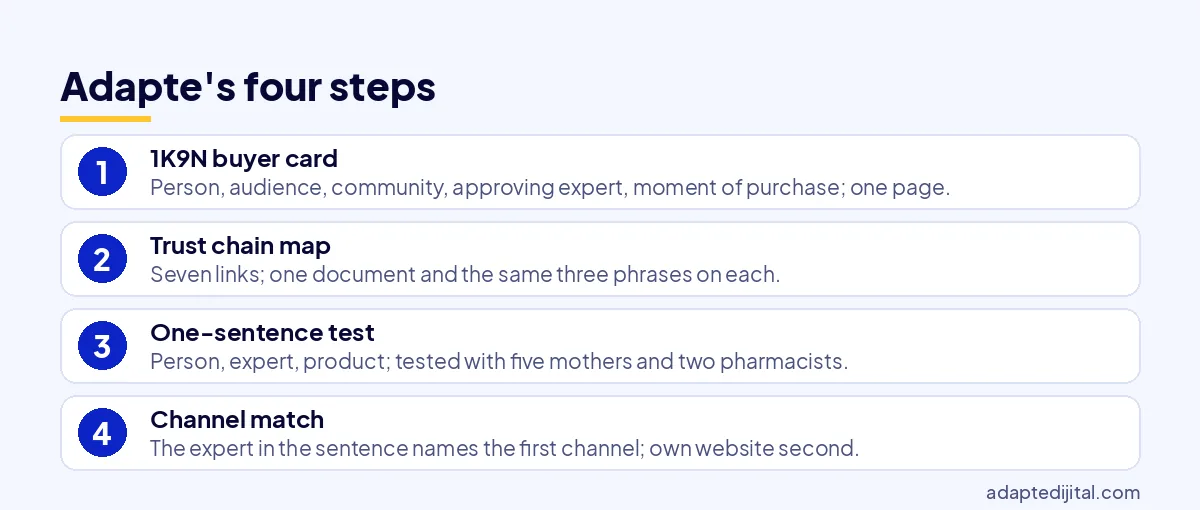
Adapte Dijital positions a baby brand in four steps: it defines the buyer with 1K9N, draws the trust chain map, runs the position through the one-sentence test and matches the sentence to a channel. The method is independent of the manufacturer; we do not decide what gets made, we decide who it is sold to and with which document of trust. In a baby brand the position is not the product’s position but trust’s.
This article walks through the method step by step, names the output of each step and shows what is specific to the baby category. We have applied the same method in our cosmetics, hair care, underwear and organic food sets; what sets baby apart is the weight of the approving expert. No sales pitch; this is how we do it, and this is what comes out.
Why do we start with the buyer rather than the product?
BU BÖLÜMÜN ÖZETİ
- The 1K in 1K9N
- What is different in the baby category
- The output
Because in the baby product category the difference between products is small and the difference in trust is large. The shampoos of five contract manufacturers come out close to one another in the laboratory; in a mother’s eyes one is trustworthy and four are unknown. So the first piece of work is not a product brief but a buyer definition; the product brief is derived from the buyer.
The 1K in 1K9N
The who question is answered in three layers: the person (a mother raising her first baby), the audience (reads labels, buys on recommendation) and the community (parent groups, pharmacies, the midwife network). No N question is asked until those three layers are written.
What is different in the baby category
In other categories the buyer and the user are the same person; here there are three people, and the approving expert carries the most weight. A brand whose buyer definition leaves out the pharmacist or the store assistant is only half defined.
The output
A one-page buyer card: person, audience, community, approving expert, moment of purchase. This card feeds the next three steps and fills the first gap in the decision order set out in the pillar article.
What is the trust chain map?
BU BÖLÜMÜN ÖZETİ
- The seven links
- Putting a document on a link
- Putting a sentence on a link
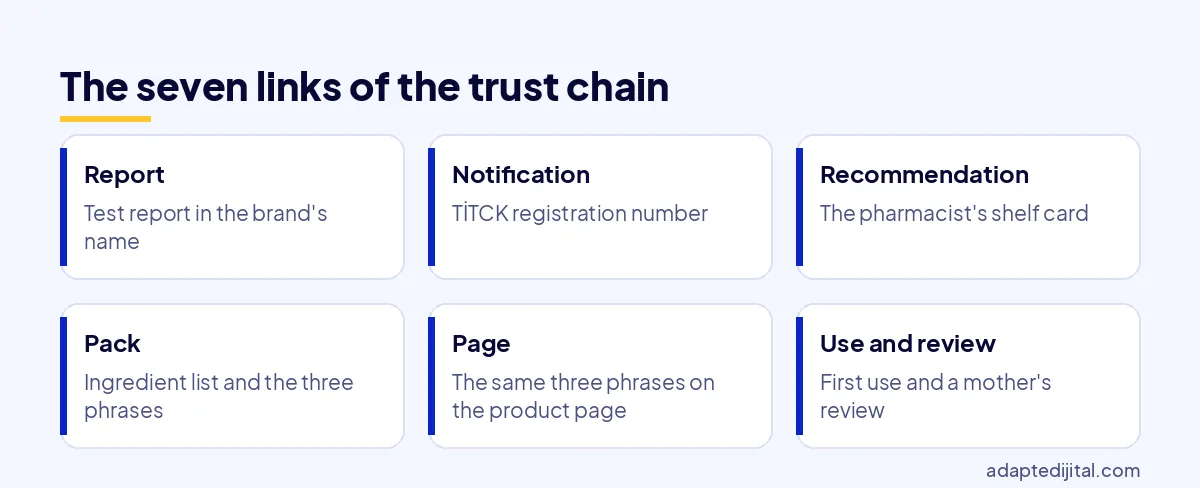
The trust chain maps the points where trust changes hands on the way to a mother’s purchase decision: laboratory report, notification, pharmacist’s recommendation, pack information, product page, first use, a mother’s review. Seven links; if one breaks, trust drops there. We place one document and one sentence on every link.
The seven links
Report, notification, recommendation, pack, page, use, review. The first three belong to the pharmacist’s world, the next four to the mother’s. The brand has to speak to both in a single voice.
Putting a document on a link
A test report on the report link, a registration number on the notification link, a shelf card on the recommendation link, an ingredient list on the pack link. A link without a document is broken; the case is in the pharmacy shelf article.
Putting a sentence on a link
The same three phrases repeat on every link: fragrance-free, dermatologically tested, suitable for newborns. When the pharmacist, the pack and the page all say the same sentence, trust carries from one link to the next.
How does the one-sentence test work?
If the position does not fit into one sentence, there is no position. The sentence pattern is fixed: this brand makes the that a [expert] can recommend with an easy conscience to a [person]. The sentence is read to five mothers and two pharmacists; if five of the seven do not read it the same way, it is rewritten. The test takes a day and settles a year.
A failing sentence
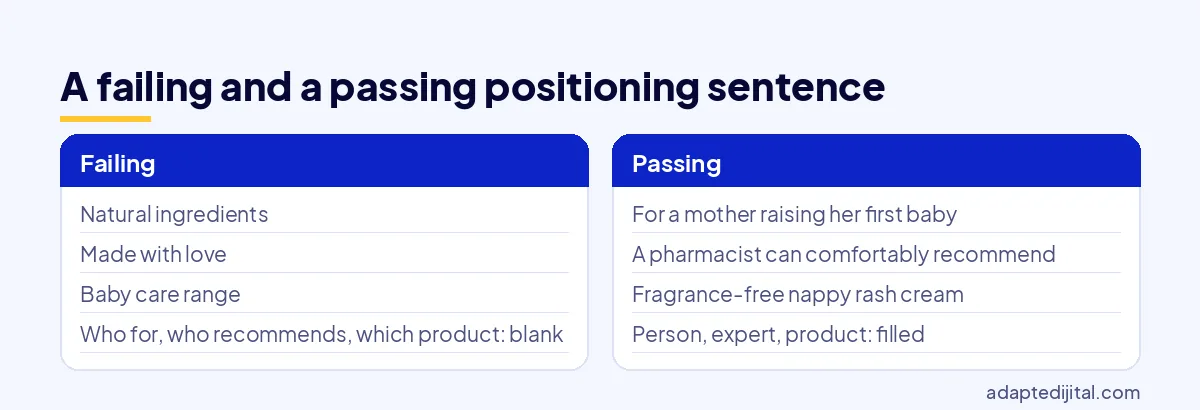
A baby care range with natural ingredients, made with love. Who it is for, who recommends it, which product; all three blank. This sentence sits on no link at all.
A passing sentence
A fragrance-free nappy rash cream that a pharmacist can comfortably recommend to a mother raising her first baby and reading every label. Person, expert, product; all filled, and the three phrases sit on their links.
How is the sentence matched to a channel?
The expert in the sentence names the channel: pharmacist means the pharmacy comes first, store assistant the baby store, midwife or doctor clinics and the referral network. Your own website is the second channel in every case, because the mother who arrives on a recommendation repeats her purchase there. The channel decision comes out of this match, not out of preference.
The matching table
| Expert in the sentence | First channel | Second channel | Measure |
|---|---|---|---|
| Pharmacist | Pharmacy | Own website | Shelf turnover and repeat purchase |
| Store assistant | Baby store | Own website and marketplace | Seasonal turnover and size spread |
| Midwife / doctor | Clinics and referral network | Own website | Share of first orders from referrals |
The channel side
Cost and speed of the three channels are compared in the article on pharmacy, baby store or your own site; the e-commerce set-up falls under e-commerce consulting.
Where does the data behind this method come from?
BU BÖLÜMÜN ÖZETİ
- The method’s name
- What the sector sets taught us
- An honest limit
From our own contract-manufacturing request form and our sector sets. Almost every baby product enquiry reaching the form asks about the manufacturer and the price, none about the buyer; that gap gave birth to the method’s first step. In the sector sets we applied the same four steps to cosmetics, hair care and underwear; for baby products only the weight of the expert link changes.
The method’s name
The brand side of the FORM-97 content methodology begins with the 1K9N buyer definition; the detail is on the brand consultancy page and the cosmetics application in the cosmetics brand guide.
What the sector sets taught us
In cosmetics the buyer and the user were the same person and the sentence had two parts; in baby products the expert came in as the third part. In underwear the trust link was the size chart, here it is the test report. Same method, links change by category.
An honest limit
The method builds trust; it does not issue documents. Testing is the laboratory’s job, notification TİTCK’s (the Turkish Medicines and Medical Devices Agency), inspection the Ministry of Trade’s; the official framework is on the TİTCK pages. We build the order and the language.
Four steps on a single page
BU BÖLÜMÜN ÖZETİ
- What comes next
- The four-week calendar
- To get started
Buyer card, trust chain map, the one sentence, channel match: four outputs, four weeks. These four pages are the input for the pre-launch checklist and the budget plan. To apply the method to your own brand, the first step is the buyer card; we fill it in together.
What comes next
Once the four pages are ready, the twelve-point pre-launch checklist and the article on budget items come into play; the stage order is in the hub article.
The four-week calendar
Week one the buyer card, week two the trust chain, week three the sentence test, week four the channel match. Each week ends with a single page the brand owner signs; an unsigned page is not the input for the next week.
To get started
To fill in the buyer card together, write to us via the consult your expert form; the sector comparison is in the baby brand sector guide.
Frequently Asked Questions
Quick Summary
- Four steps: 1K9N buyer card, trust chain map, one-sentence test, channel match.
- In the baby category the buyer is three people; the approving expert carries the most weight.
- The trust chain has seven links; each carries one document and the same three phrases.
- The expert in the sentence names the first channel; your own website is the second channel in every case.
- The method builds trust, it does not issue documents; testing, notification and inspection belong to specialists and institutions.
Short Glossary
- 1K9N: Adapte Dijital’s buyer and content definition method, starting with the who question and spreading across nine N questions (what, how, why, how much, where, from where, when, what happened, what next)
- Trust chain: the points on the way to a purchase decision where trust passes from one source to the next
- One-sentence test: the method of checking with seven people whether a brand position fits into a single sentence containing a person, an expert and a product
- Buyer card: the one-page working document that gathers the person, audience, community, approving expert and moment of purchase
Next Step
To fill in the buyer card together, write to us via the consult your expert form; the scope is on the brand consultancy page. Next article: what dermatologically tested and hypoallergenic mean for baby products.
Updated: October 2026
Sık Sorulan Sorular
Five mothers represent the paying side, two pharmacists the approving side. A sentence neither side understands reaches neither the shelf nor the basket. Not a big survey; the right seven.
It defines the buyer with 1K9N, draws the trust chain map, runs the position through the one-sentence test and matches the sentence to a channel; it does not choose the manufacturer or issue documents, it builds the order and the language.
The map of the seven points where trust changes hands on the way to a mother’s purchase decision: report, notification, recommendation, pack, page, use, review.
Five mothers represent the paying side and two pharmacists the approving side; a sentence neither side understands reaches neither the shelf nor the basket.