
Hypoallergenic, Dermatologically Tested and Paraben-Free: What a Baby Brand Label Means
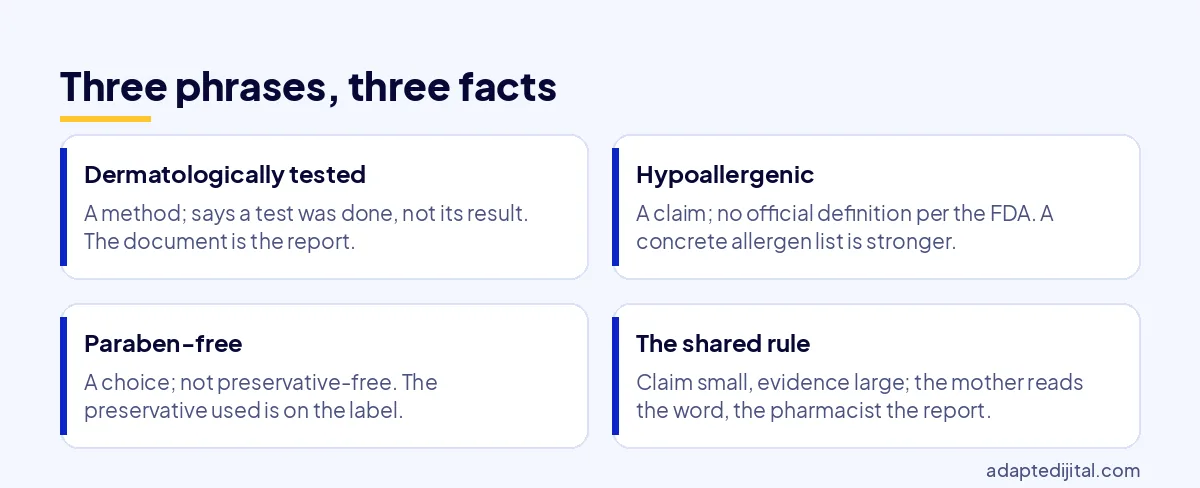
The three phrases on a baby product label mean this: dermatologically tested says the product went through a skin test under a dermatologist’s supervision, but not which test; hypoallergenic says the maker tried to keep the allergy risk low, but the word has no official definition; paraben-free says certain preservatives were left out, but not that the product has no preservative. All three are claims, not documents. The document is the report itself.
You may not have known this: according to the US Food and Drug Administration, the word hypoallergenic has no official definition or standard, and any manufacturer can use it by its own measure. This article opens the three phrases one by one, says what should sit behind each, and shows a baby brand founder what to write on the label and what to leave off. By the end you will read a label like a pharmacist.
What does dermatologically tested actually mean?
It means the product went through a skin compatibility test on volunteers under a dermatologist’s supervision, usually a patch test: the product is applied to the back and any redness is observed. The phrase says a test was done; it does not say what the result was or how many people took part. The document is the test report, which gives volunteer count, duration and outcome.
In everyday terms
Say a friend cooks a meal and lets you taste it. I let you taste it does not mean you liked it. A dermatological test is the same: the product was tried, the result is in the report. No report, and the meal was never tasted.
What does hypoallergenic really mean?
The dictionary meaning is low likelihood of causing an allergy; the legal meaning, in most countries, does not exist. The US FDA says it plainly: no federal standard or definition governs the term hypoallergenic, and manufacturers need not submit evidence for the claim. In Turkey and Europe the claim falls under general cosmetic claim rules, so whoever uses the word must keep the evidence ready.
A little-known fact
The FDA’s own page states that there is no guarantee hypoallergenic products will not cause allergies, and that the word means whatever a manufacturer wants it to mean. Source: FDA, Hypoallergenic Cosmetics. We know this sentence shakes the word mothers trust most.
What does paraben-free say, and what does it leave out?
Parabens are a widely used group of preservatives in cosmetics; paraben-free says this group was not used. It does not say the product has no preservative. Every product that contains water needs a preservative, so another one takes the paraben’s place, and it too appears on the label. The European Union has banned certain parabens in products applied to the nappy area of children under three.
The European rule
Regulation 1004/2014 under the EU Cosmetics Regulation bans propylparaben and butylparaben in leave-on products for the nappy area of children under three, and sets an upper limit for general use. Turkish cosmetics legislation follows the EU closely; for the current list, TİTCK (Turkish Medicines and Medical Devices Agency) is the official source.
How do the three phrases sit together on a label?
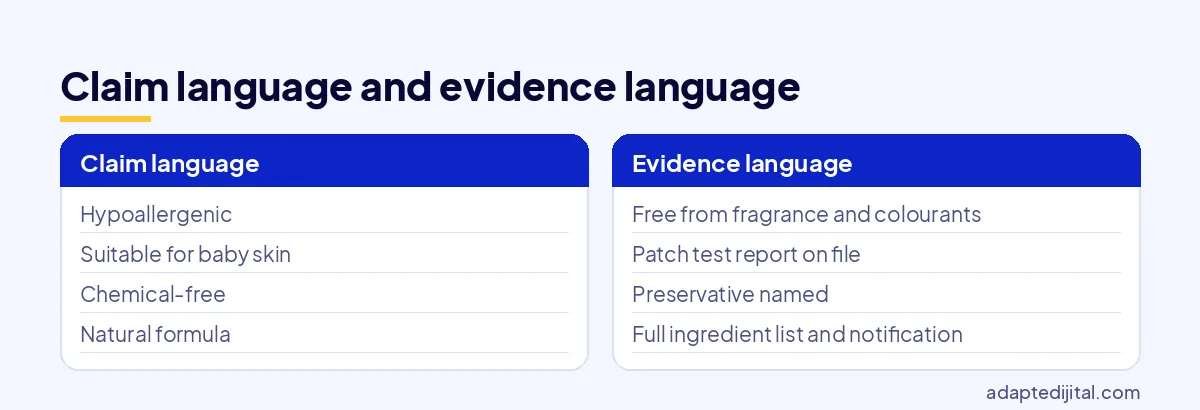
The strongest label prints none of the three phrases in large type; it names the test report, gives the concrete allergen-free list and prints the full ingredient list. Claim small, evidence large. That layout gives the same confidence in an inspection, at the pharmacy counter and on a mother’s phone.
An example layout
| What the label says | The document behind it | What not to write |
|---|---|---|
| Dermatological patch test completed | Laboratory report, number of volunteers | Suitable for baby skin (without a report) |
| Free from fragrance and colourants | Ingredient list | Hypoallergenic (on its own) |
| Preservative: phenoxyethanol | Ingredient list, TİTCK notification | Chemical-free |
How do these concepts change brand decisions?
BU BÖLÜMÜN ÖZETİ
- The product brief
- The budget
- The brand language
In three ways: the product brief specifies tests rather than claims, the budget carries a report line from day one, and the label shifts from claim language to evidence language. A brand that does not know this prints big words on the label and gets sent back at the first inspection or pharmacy meeting. A brand that knows it looks less boastful and more trustworthy.
The product brief
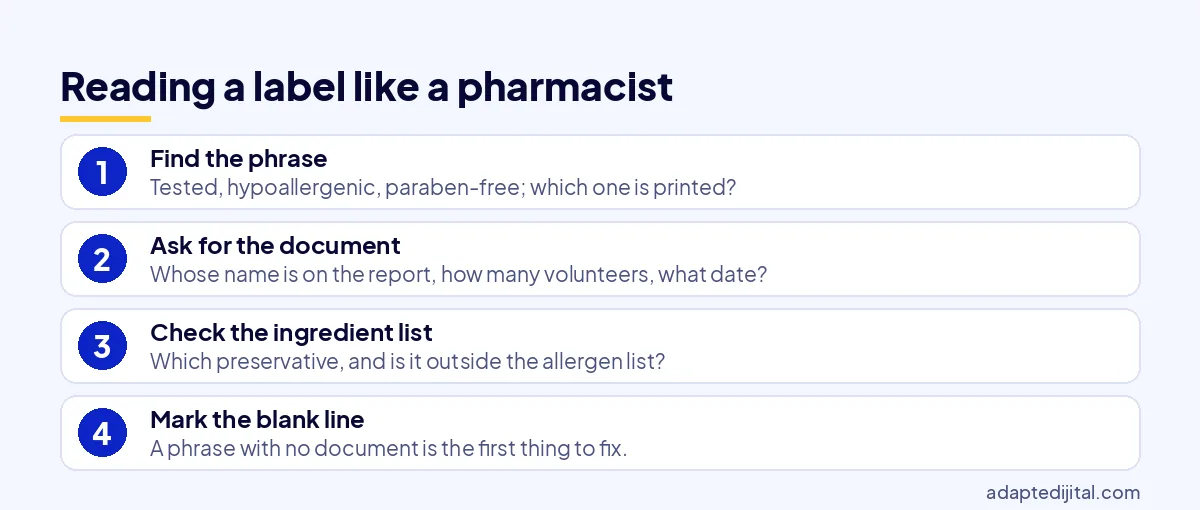
Instead of telling the contract manufacturer make it hypoallergenic, say: fragrance-free, colourant-free, outside the recognised allergen list, patch test report included. Four concrete items beat one abstract word. Manufacturer selection is in the article on how to choose a contract manufacturer.
The budget
Test reports are part of the product cost, not a separate expense. The line items are listed in the article on the cost of starting a baby care brand.
The brand language
Moving to evidence language is the consultant’s job; brand consultancy matches every sentence on the label to a document. The general framework is in the pillar article, and the cosmetics side in the cosmetics brand guide.
What you now know
BU BÖLÜMÜN ÖZETİ
- To do today
- A small consolation
- Next step
A dermatological test is a method; its result is in the report. Hypoallergenic is a claim, with no official definition in most places. Paraben-free is a choice, not preservative-free. All three should sit small on the label with the evidence large; the mother reads the word, the pharmacist reads the report.
To do today
Take the label of the product you have or are planning, find the three phrases, and under each write which document sits behind it. The blank line is your first job.
A small consolation
Most people start a baby brand without knowing these three phrases; those who know them are a minority, and pharmacy-shelf brands come from that minority. Reading a label like a pharmacist can be learned, and you have just learned it.
Next step
For your stage, read the hub article on which consulting comes first; to read the label together, consult your expert.
Frequently Asked Questions
Quick Summary
- A dermatological test is a method; the document is the report itself, not the phrase.
- Hypoallergenic has no official definition according to the FDA; a concrete allergen list is stronger.
- Paraben-free does not mean preservative-free; the EU bans certain parabens in nappy-area products.
- The strongest label prints the claim small and the evidence large.
- The concepts change the product brief, the budget and the label language.
Short Glossary
- Patch test: a dermatological compatibility test in which the product is applied to the skin and the reaction observed over a set period
- Hypoallergenic: a claim that the risk of allergy has been kept low; it has no official definition in most countries
- Paraben: a group of preservatives used in cosmetics; some types are banned in the EU for nappy-area products for children under three
- Preservative: a substance that prevents microbiological spoilage in a product that contains water
Next Step
To match every sentence on your label to a document, write to us through the consult your expert form; the scope is on the brand consultancy page. Next article: how to choose a contract manufacturer for baby products.
Updated: October 2026
Sık Sorulan Sorular
Laboratory name, test date, number of volunteers, application period, result. For a baby product the ideal is a test on volunteers with sensitive skin; that is the first thing a pharmacist looks for. We saw the case in the article on the pharmacy shelf.
Only the name of the test actually done, not a claim built on it. To write suitable for baby skin you need a report that supports that claim; no report, no sentence.
Leave the word out, or say what sits behind it: no fragrance, no colourants, none of the substances on the recognised allergen list. A concrete list is stronger than an abstract word, and it can be defended in an inspection.
The mother reads hypoallergenic as will not cause an allergy. The reading is wrong but widespread; the brand’s job is not to feed it but to write the correct information plainly. The full list of such misconceptions is in the article on six things people get wrong about baby brands.
A jar of cream with no preservative is milk left with the lid off; within a week something starts living in it. In a baby product, microbial safety runs through the preservative. Paraben-free means contains a different preservative, and that is written honestly.
The full ingredient list, the preservative’s name visible, the claim kept short. If paraben-free goes on the label, the preservative used goes on too; the pharmacist reads the two together.
Because all three phrases are claims, and a claim asks for evidence. Once the evidence is on the label, the claim is not needed. The pre-launch label check is set out in the twelve-point checklist.
It says the product went through a skin compatibility test on volunteers under a dermatologist’s supervision; it does not give the result or the number of people, which are in the report.
According to the US FDA there is no federal definition or standard; in Europe and Turkey it falls under general cosmetic claim rules and the evidence must be kept ready.
No. Every product that contains water needs a preservative; another preservative takes the paraben’s place and appears on the label.