
Why Does a Design Sock Brand Stall in Year One? Four Reasons from One Case

A design sock brand stalls in its first year not because people dislike the patterns, but because nothing turns liking into buying. The sock shared on social media gets applause; the sock that reaches the basket needs gift logic, the right price comparison, a visible pattern on the marketplace and deep stock. Miss one, and likes rise while sales stall.
This article follows a real brand through its first year; no name, only observations. Four points where it stalls, what the founder sees and what gets corrected. The observation at the end: the gap is closed by structure, not product.
Say your patterns are liked but nobody buys
Say you are a founder with a graphic design background, you launch with twelve patterns and every post draws hundreds of likes. The manufacturer is good, the toe seamless, the yarn cotton-rich. The problem is not the product; the one who likes and the one who pays are different people, and the brand only talks to the first.
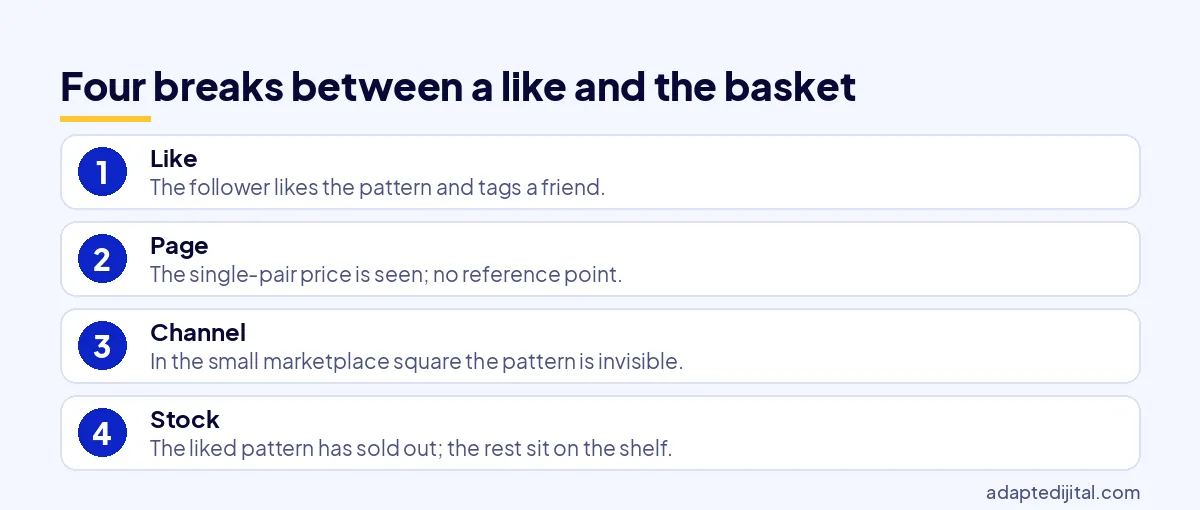
What the founder sees
The founder makes more patterns; each brings new likes, and sales stay put. This loop eats half the first year. Stock spreads thinner, page work multiplies, the till stays the same.
The unexpected finding
Most buyers are buying a gift, not socks for their own feet, and the founder spots this in the order notes. The page, meanwhile, speaks of your own feet. The buyer wants a gift, the brand sells socks.
Why people pay for design socks at all is a separate case: why people pay for design sock brands.
Reason one: no gift logic, only single-pair sales
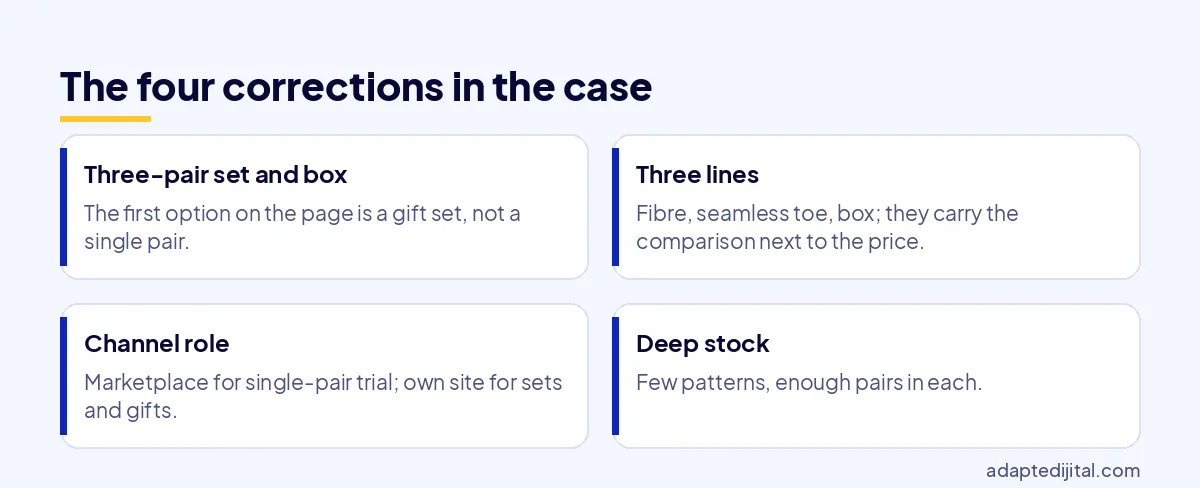
Design socks are a gift product; the buyer is usually not the wearer. Here the brand sells single pairs only: no box, no set, no gift card. A gift giver cannot put a lone pair on the table; a product with no gift structure is not chosen, and sales stall at the first reason.
The founder’s sentence
The product is beautiful, why would it need a box. That is the founder looking through their own eyes; the gift buyer sees what they will hold when they hand it over. The box is the product in its gift form.
The correction
The brand builds a three-pair set and a gift box; the single pair stays, but the set becomes the first option on the page, priced as one gift decision. The set architecture is in how Adapte Dijital positions a sock brand.
Reason two: the price is compared with basic socks
When the buyer sees the price, the reference point in their head is the basic sock on the supermarket shelf. A design sock sits far above it, and if nothing on the page moves the comparison, the buyer closes it as too expensive. Here the page shows a photo and never says where the difference lies.
The correction
Three lines are added to the page: fibre content, seamless toe, gift box. Next to the price, the comparison is now with another gift, not a basic sock. The same lines repeat on the packaging and shelf card.
The other side of comparison
Cutting the price does not win the comparison; a low price sends a design sock down to the basic-sock shelf. The founder tries it, sales do not rise, the margin melts. Moving the reference point is cheaper than moving the price.
Reason three: the pattern is invisible on the marketplace
BU BÖLÜMÜN ÖZETİ
- What the founder sees
- The correction
- Source
The brand opens a marketplace store and a month later the result is close to zero. In a marketplace listing a sock appears inside a small square; the pattern cannot be made out, only the price can. There a design sock stands next to a basic sock, and the basic sock wins.
What the founder sees
The most clicked product is the cheapest pattern; the best pattern never appears in the listing. Ads go on, clicks rise, sales do not. The algorithm reads price and sales velocity, not patterns.
The correction
The marketplace keeps basic socks and single pairs; sets and gift boxes move to the own site. Its job becomes visibility and trial. The channels are compared in own site, marketplace or store for a sock brand; for the marketplace setup, real profit on Trendyol after commission is a separate guide.
Source
The marketplace’s seller rules, commission and categories sit on the Trendyol seller page; the structure follows the product group, not the platform.
Reason four: wide variety, shallow stock
Twelve patterns, three sizes per pattern and a handful of pairs per size: that is how the first batch is spread. The liked pattern sells out in a week, the rerun takes weeks because of minimums, the unliked pattern stays on the shelf. Variety brings likes; depth brings sales, and here there is no depth.
The correction
The pattern count is cut and depth added to what remains; with set logic, three patterns sell as one gift. Reruns are planned per set. The belief that more patterns mean more sales is taken apart in 6 things people get wrong about sock brands.
Where is the case today?
Today the brand sells two pattern families, a three-pair set and a gift box; its own site is the main channel, the marketplace the trial channel. Likes are the same, but sales now move with them. The patterns did not change; the box, the three lines, the channel roles and stock depth did.
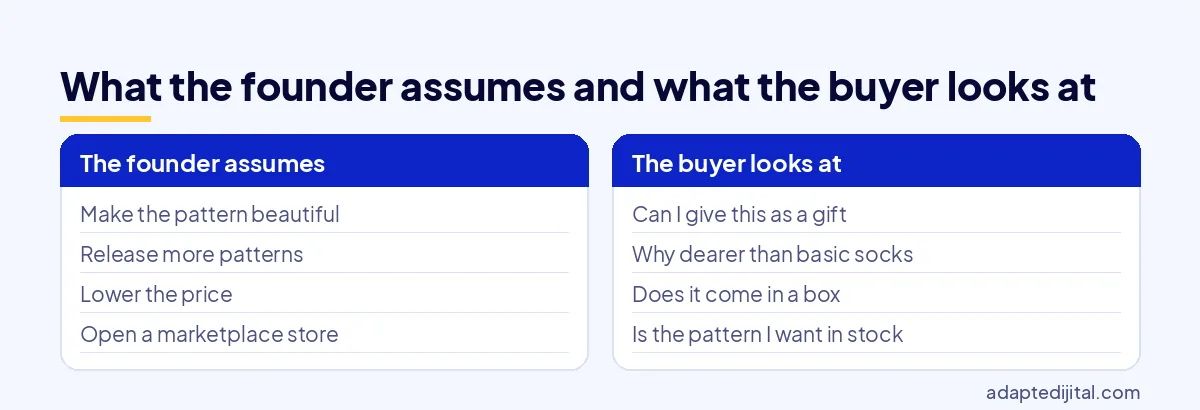
The likes-to-sales gap
The lesson: the gap between likes and sales opens through missing structure, not product quality. Four things close it: gift logic, reference point, channel role, stock depth. All four are decisions, not production.
The cost in time
The four corrections take most of the first year; done from the start, they fit one season. That is why the sequence in I want to start a sock brand is an order of decisions, not of products.
One observation
A design sock brand sells through structure, not through likes. The structure is four things: gift set, reference point, channel role and stock depth, all built at the desk. Before drawing a new pattern, check these four; if all are in place the pattern sells, if one is missing it is only liked.
Do this today
Open your product page as someone buying a gift. Is there a set, three lines carrying the comparison, a box? If one answer is no, you need structure, not a new pattern.
Next step
To find your stage, read which consulting for a sock brand; to build the structure together, use the consult your expert form.
Frequently Asked Questions
Quick Summary
- The gap between likes and sales opens through missing structure, not through the product.
- The case: twelve patterns, many likes, few sales; the buyer wants a gift, the brand sells socks.
- Four corrections: three-pair set and box, three lines on the page, single-pair role for the marketplace, few patterns with deep stock.
- Cutting the price does not win the comparison; moving the reference point is cheaper.
- One observation: a design sock brand sells through structure, not through likes.
Short Glossary
- Likes-to-sales gap: the difference between social media likes and actual sales, caused by missing structure, not product quality
- Set logic: presenting single products as three-pair, boxed or themed groups bought as one decision
- Reference point: the product a buyer compares against when judging a price; the brand must move it
- Stock depth: the number of pairs held in a single pattern and size; the opposite of variety
Next Step
To read your product page through a gift buyer’s eyes, write to us via the consult your expert form; scope is on the brand consultancy page. Next: what textile labelling rules and unsafe-product inspections mean for a sock brand.
Updated: October 2026
Sık Sorulan Sorular
A follower likes the pattern, comments, tags a friend. Then they open the product page, see the single-pair price and close the tab. A like takes a second; a purchase needs a comparison, and the page offers none.
In the buyer’s mind socks are a cheap category; unless the brand moves the reference point, the buyer compares against what they know. The pattern alone cannot carry it, cheap patterned socks exist; the yarn, the toe seam and the gift form can.
The founder loves every pattern, so all get made; the manufacturer demands a minimum, so each gets few pairs. The best seller is out of stock, the worst is everywhere. Stock maps taste, not sales.
A designer draws the pattern; a consultant builds the sequence. Here brand consultancy built the set architecture, the three lines and the channel roles, independent of the manufacturer.
Usually the structure is missing, not the product: no gift set, price compared with basic socks, pattern invisible on the marketplace, stock wide but shallow. All four are decisions.
Yes for single pairs and basic products, hard for sets and gift boxes; in a listing the price is read, not the pattern. Sets sell on the brand’s own site.
Few patterns, deep stock: so the liked pattern does not sell out and the unliked one does not sit on the shelf. Set logic makes many gift options from few patterns.