
Food Contact Material Rules: What Should a Kitchenware Brand Do Now?
Food contact material rules tell a kitchenware brand one thing: a pot, plate, storage box or chopping board must not transfer harmful substances to food, and proving it is the brand’s job. In Türkiye the Turkish Food Codex Regulation on Food Contact Materials sets this principle; in the EU, framework Regulation 1935/2004. The proof is the declaration of compliance and its migration test; the Ministry of Trade also announces unsafe products periodically.
Below: the development, the rule, then five steps, from official sources. At the centre is one box: the three documents inspectors ask for.
What happened: the Ministry announced its unsafe product checks
BU BÖLÜMÜN ÖZETİ
- Official source
- Reasons that concern kitchenware
- Timing
The Ministry of Trade published market surveillance results for the first half of the year, announcing sales bans, recalls and public notices for unsafe products. The reasons for each decision are public. Kitchenware is not exempt, and for food contact products the Ministry of Agriculture and Forestry’s rules also apply.
Official source
The full text is in the Ministry of Trade unsafe products statement; figures are there, and this piece explains the rule, not the numbers.
Reasons that concern kitchenware
Three stand out: migration into food, missing label information and unsupported health claims. Pot coatings, ceramic glaze and plastic additives are one problem.
Timing
Seasonal products are checked heavily before their season. A brand preparing trousseau or holiday sets gathers documents before printing and production; see when a kitchen brand should launch.
Which legislation is the food contact rule based on?
Two texts are read together: in Türkiye, the Turkish Food Codex Regulation on Food Contact Materials from the Ministry of Agriculture and Forestry; in the EU, framework Regulation 1935/2004. Both say a material must not transfer substances to food in amounts that harm health, change its composition or spoil its taste and smell.
The Turkish side
Current texts are on the Ministry of Agriculture and Forestry website. The regulation is aligned with the EU framework, so a brand that knows both needs no second system for export.
The EU side
The framework is in EU Regulation 1935/2004. It also requires traceability: each product’s batch and supplier must be recorded.
What are a declaration of compliance and a migration test?
A declaration of compliance is a written statement that a product meets food contact rules; the migration test is its basis. The product is kept with a food simulant under set conditions and the substances passing into it are measured. No declaration without a test, and no use for a test report left off the declaration.
Declaration of compliance
It states product, material, suitable foods and temperatures, tests and issuer, passing from coating supplier to manufacturer to brand.
Migration test
Overall migration measures total transfer; specific migration measures one named substance. An accredited lab runs it under real use: an ovenproof pan is tested at oven temperature.
Ceramics, plastics and coatings: extra rules by material
BU BÖLÜMÜN ÖZETİ
- Ceramics and porcelain
- Plastic storage boxes
- Non-stick coatings and the PFOA claim
- Electrical appliances are separate
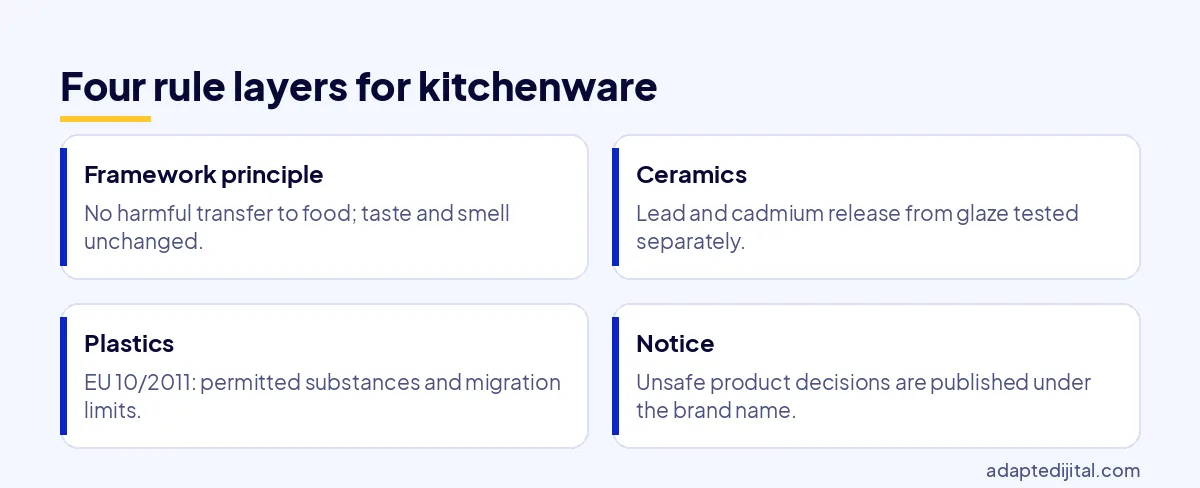
The framework rule covers all materials, but some have extras. For ceramics and porcelain, lead and cadmium release from glaze is limited separately; for plastics, EU Regulation 10/2011 lists permitted substances and migration limits. With non-stick coatings the issue is the claim: PFOA-free needs a document.
Ceramics and porcelain
A brand sourcing from the Kütahya and Bilecik belt asks for a lead and cadmium release report. For decorated items, whether decoration reaches the rim is a separate question.
Plastic storage boxes
Plastics fall under EU plastics Regulation 10/2011, and Turkish rules align with it. A glass box with a plastic lid falls under two rule sets.
Non-stick coatings and the PFOA claim
PFOA-free does not mean PTFE-free; most granite-effect coatings are PTFE-based. See what granite, ceramic, steel and cast iron mean in cookware and six things people get wrong about kitchen brands.
Electrical appliances are separate
Kettles and blenders also fall under electrical safety and CE rules, which need their own compliance file.
The three documents asked for in an inspection
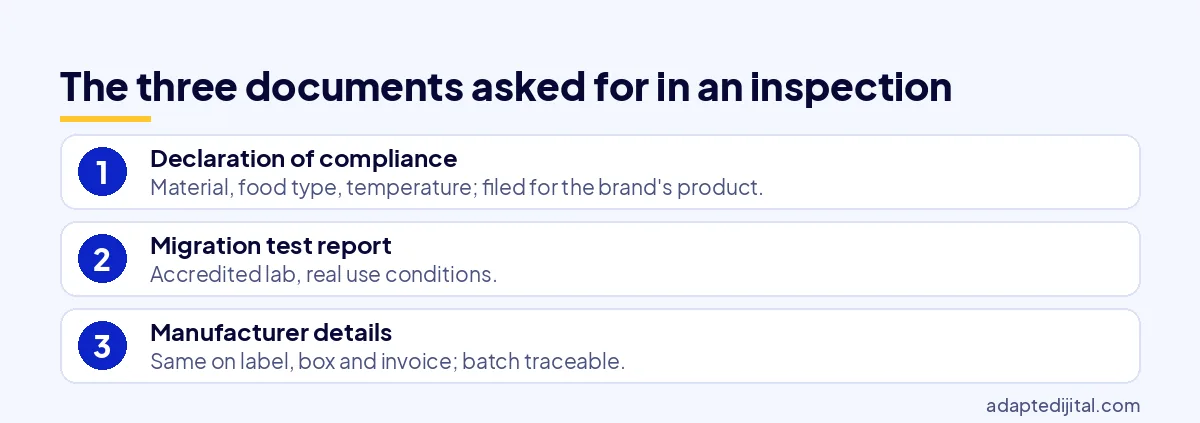
An inspector does not put the pot on the hob; they ask for three things: the declaration of compliance, the migration test report and manufacturer and placing-on-market details. The brand must hold all three; the manufacturer’s file is not enough. This box is the original part of this piece; print it for supplier meetings.
The three-document box
The three documents that land on the table:
- Declaration of compliance: product, material, food type, temperature, supporting tests; filed for the brand’s product
- Migration test report: accredited lab, real use; lead and cadmium for ceramics, specific migration for plastics
- Manufacturer and placing-on-market details: same name and contact on label, box and invoice; traceable by batch
A document left with the manufacturer does not exist for the brand.
The line in the supplier contract
The contract says the three documents are filed in the brand’s name and updated each batch; otherwise nobody finds them on inspection day.
Five steps for a kitchenware brand
BU BÖLÜMÜN ÖZETİ
- The five steps in order
- Pre-launch check
- The industry picture
All five come before production: get material and coating details in writing, run migration tests under real use, file the declaration for the brand’s product, limit health claims to the documents, and put a use and care guide in the box. All five are decisions; none can wait for the sales stage.
The five steps in order
- Get coating and material details in writing from manufacturer and coating supplier
- Run migration tests under real use: oven, hob, microwave or dishwasher
- File the declaration for the brand’s product; update it every batch
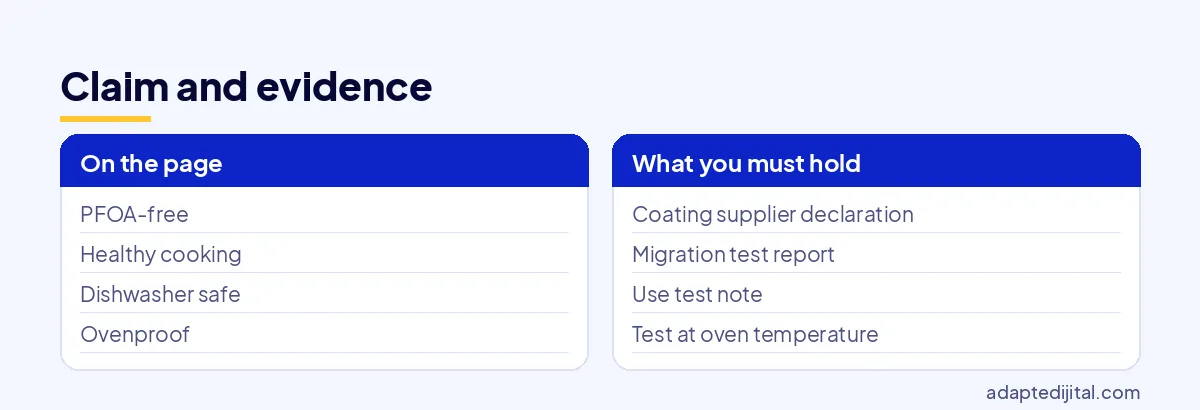
- Limit health claims to the documents; if you write PFOA-free, hold the evidence
- Add a use and care guide: heat level, utensils, dishwasher suitability
Pre-launch check
These steps form the documents and packaging group of the twelve-point pre-launch checklist for kitchen products.
The industry picture
The general route is in the starting a kitchenware brand industry guide; the decision order in the I want to start a kitchenware brand pillar.
What does an inspection mean for a kitchen brand?
The loss is the channel, not the fine: an unsafe product notice carries the brand name, housewares and trousseau shop owners check the list, and search results show the name beside the notice. A small brand in a health-related category has no reputation to cushion that. With documents in order, an inspection takes a day; without, a year.
Housewares, HoReCa and export
Shop owners ask for documents before ordering, hotel and restaurant buyers at quotation, overseas buyers in the first call. For exporters, foreign trade consultancy is a separate topic.
The consultant’s role
A consultant does not issue documents; they set the order, the contract clause and the page wording. Scope is on the brand consultancy page; to find your stage, see the hub on which consultancy a kitchenware brand needs.
Summary and what to do today
A food contact product must not transfer harmful substances to food, and proving it is the brand’s job. Today, check whether you hold the declaration of compliance, migration test report and manufacturer details for every product on sale or on order. If even one is missing, the batch stops, not the sales.
One check
Write the supporting document next to every health claim on your product page. Any claim without one comes off.
Next read
For the full setup, read how to set up a kitchenware brand in nine steps; to review documents with us, use the consult your expert form.
Frequently Asked Questions
Quick Summary
- Food contact products must not transfer harmful substances; the proof is the declaration and migration test.
- Türkiye’s Turkish Food Codex regulation and EU Regulation 1935/2004 are aligned.
- Extra checks: lead and cadmium in ceramics, EU 10/2011 for plastics, evidence for coating claims.
- Inspectors ask for three documents: declaration, migration test report, manufacturer details.
- Five steps come before production; the real loss is the channel, not the fine.
Short Glossary
- Declaration of compliance: a written statement that a product meets food contact rules
- Migration test: a lab test measuring substance transfer into a food simulant
- Food simulant: a test liquid standing in for acidic, fatty or watery food
- Placing on the market: offering a product under your own brand, with legal responsibility
Next Step
To review your documents against the three-document box, use the consult your expert form; scope is on the brand consultancy page. Next read: how to set up a kitchenware brand in nine steps.
Updated: October 2026
Sık Sorulan Sorular
Whoever places the product on the market under their own brand. With private-label cookware the manufacturer makes it, but the brand places it; responsibility sits with the logo’s owner.
The manufacturer declares for its production; the brand, placing it on the market, files it for its own product. Asking for it before ordering is on the list in how to choose a manufacturer for kitchen products.
A declaration of compliance, its migration test report, and manufacturer and placing-on-market details on label and box. The brand must hold them, not the manufacturer.
The product is kept with a food simulant under set conditions and the substances passing into it are measured. It must reflect real use and run in an accredited lab.
You must prove it and hold the evidence. PFOA-free also does not mean PTFE-free, so phrase it so it does not mislead.