
Kitchenware Brand Manufacturer: How to Choose Local, Import or Private Label
Choosing a kitchenware manufacturer starts with one of three routes: a local contract manufacturer, import, or private label on a ready-made product. Then you meet three candidates, measure them with twelve questions, test one sample round and bind the winner with a five-clause contract. Thresholds: fewer than three candidates, no decision; no written declaration holder, no signature; failed use test, no approval.
Below is the process in order. Read the same list to all three candidates, write the answers side by side, and the choice makes itself.
Local manufacturer, import or private label: which suits whom?
Private label is fastest: your logo on a ready product within weeks, but the same product sits under other brands. A local manufacturer is slower, but mould, coating and base decisions stay with the brand. Import needs volume and leaves documents and customs to the brand. Threshold: if you want differentiation in the product itself, private label can only be early proof, not the brand route.
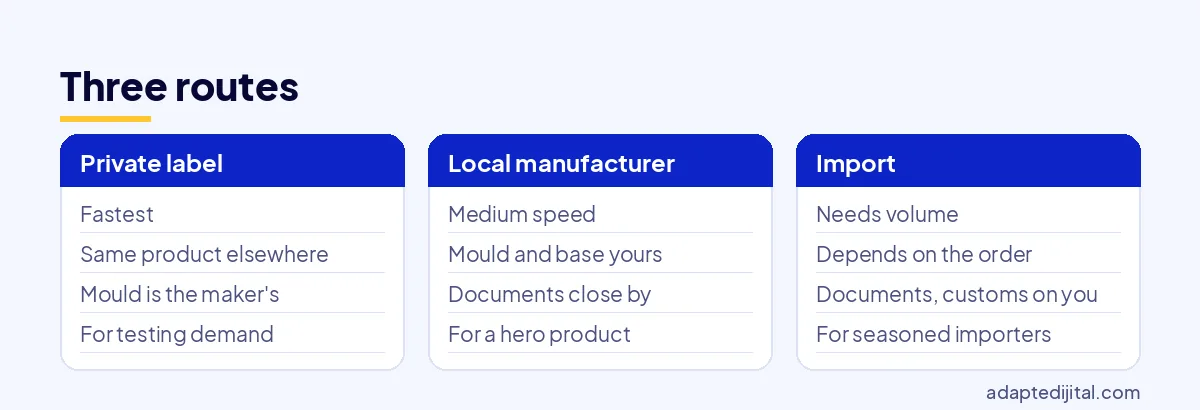
Decision table
| Route | Speed | Differentiation | Document load | Best for |
|---|---|---|---|---|
| Private label | Fastest | Lowest; same product elsewhere | Maker’s declaration, brand checks | Creators testing demand |
| Local manufacturer | Medium | High; mould and base are yours | Chain close by, easy to audit | Brands building a hero product |
| Import | Variable | Medium; depends on the order | Declaration, tests, customs on brand | Those with volume and trade experience |
The extra load of import
For imports, food contact documents are the brand’s responsibility; for paperwork see foreign trade consultancy. This article focuses on local makers.
Why three candidates, and where do you find them?
One quote is no measure, two are a haggle, three are a comparison. Send the same one-page brief to three manufacturers in the same week and ask for answers in the same format. For pots and pans, Istanbul’s metalware belt and Kayseri stand out; for porcelain, Kütahya and Bilecik; for glass, the large producers. Threshold: no sample order until all three candidates are in.
The most common mistake
Starting samples with the fastest replier. A fast reply only shows spare capacity; wait for three answers.
Who owns the mould, and who supplies the coating?
If the design is yours, the mould is a separate line item and the right to use it stays with the brand; in private label the mould belongs to the manufacturer, and you need to know that from the start. The coating is often made not by the manufacturer but by a separate coating supplier. Do this: ask in writing for the coating supplier’s name and technical sheet. Threshold: no sample approval if the supplier is not named.
Why mould ownership is critical
If the mould stays with the maker, your model stays too, and it can be run for another brand. Tie the right of use to the brand in the contract; see the starting a kitchenware brand pillar article.
Who issues the declaration of compliance?
The manufacturer issues the declaration of compliance for a food contact material, but once the product goes on sale under your name, the brand is also responsible for it being correct and current. The declaration rests on a migration test report and states which foods and temperatures the product suits. Threshold: if copies of the declaration and test report are not on your file, the first batch is not accepted.
The framework
Türkiye applies the Turkish Food Codex, Europe the EU framework regulation 1935/2004; inspection documents are listed in the food contact material rules article.
Ceramic versus plastic
Porcelain is tested for lead and cadmium; plastic storage falls under a separate EU rule. Ask for the test specific to your group.
How do you run the sample and use test?
One sample round passes three exams: heat, base and cleaning. Do this: have two people from your target customer group use the sample for two weeks; test high heat on an empty pan, flatness on induction, the dishwasher and handle heat one by one. Threshold: if the base warps, the coating blisters or the handle heats up, the sample is not approved and a fix is requested.
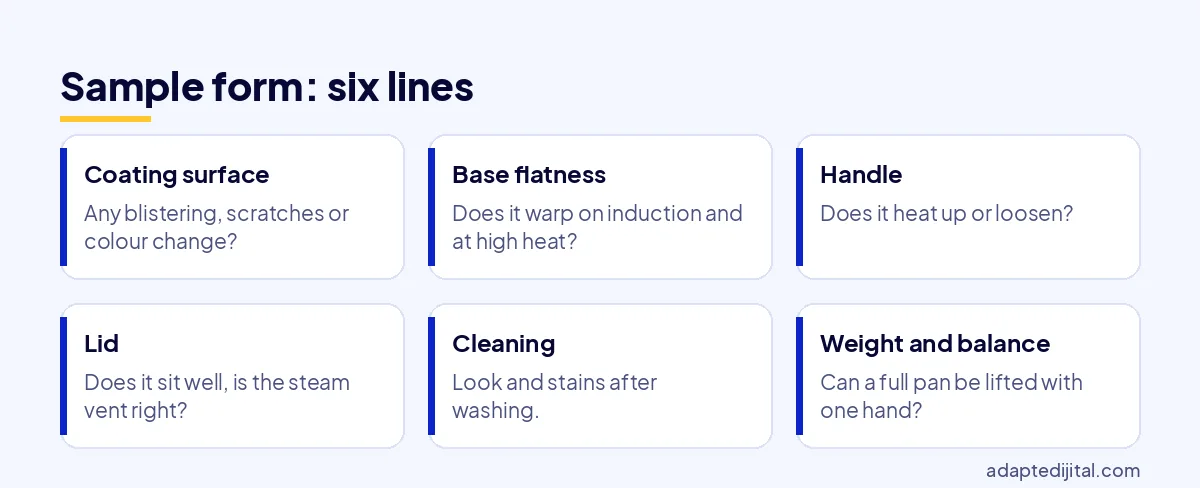
Evaluation form
Six lines, each marked pass, fail or fix. The fix lines become the second brief.
Twelve questions for the manufacturer interview
Read the same list to all three in the same order and log answers in one table. It covers mould, coating, base, documents, samples, quantities, contract and delivery. Two unclear answers and a candidate drops out.
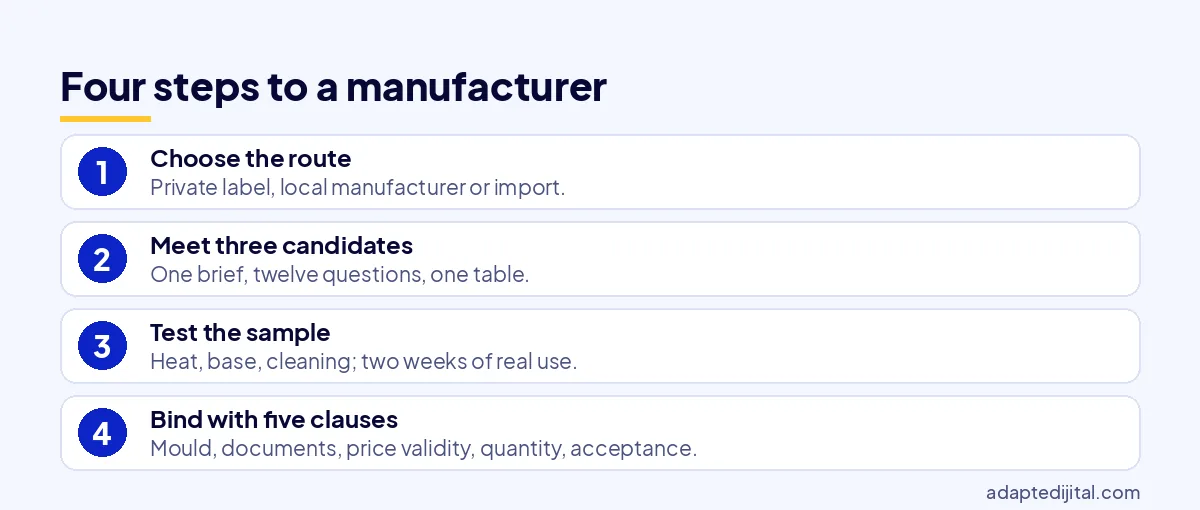
Twelve questions
- Who owns the mould, and can the same mould be run for another brand?
- Which supplier provides the coating, and is there a technical sheet?
- What is the base type, and do you test for warping on induction?
- Do you issue the declaration of compliance, and which lab runs the migration test?
- For porcelain or ceramics, is there a lead and cadmium test?
- How long does a sample take, what does it cost, is it offset against the order?
- What is the minimum quantity per product and colour?
- How long is the price valid, and how are raw material increases notified?
- Can you produce spare lids and handles, and for how many years?
- Do you print the box, user manual and label?
- What is the lead time, and what happens if it is late?
- Will you accept an acceptance criterion based on the approved sample?
How to read the answers
A clear answer with a document scores one, it depends scores zero; the fewest zeros wins.
Which five clauses go into the contract?
Mould rights, documents, price validity, minimum quantity with lead time, and acceptance. Five clauses protect the brand; a verbal deal protects the maker. If one is missing, add it before signing.
Five clauses
- The right to use the mould and model belongs to the brand; the same model is not made for another brand
- Declaration of compliance, migration test report and coating document are delivered current with every batch
- The price is valid for a set period; any increase needs written notice and mutual approval
- Minimum quantity is set per product and colour, lead time in days
- Acceptance means an exact match with the approved sample; a non-matching batch is returned or remade
How do you write the acceptance criterion and the decision?
Acceptance is one sentence: the batch matches the approved sample in body, coating, base, handle and lid. Check random units from each batch on the six-line form and record the batch number; a maker never accepts its own batch.
Decision table
| Criterion | Candidate A | Candidate B | Candidate C | Weight |
|---|---|---|---|---|
| Mould rights and confidentiality | Decisive | |||
| Declaration and migration test file | Decisive | |||
| Coating supplier disclosed | High | |||
| Sample passed three exams | High | |||
| Spare parts promise | Medium | |||
| Price and validity period | Medium |
Frequently Asked Questions
Quick Summary
- Three routes: private label is fast but generic, a local manufacturer differentiates, import brings documents and customs.
- Three candidates, one brief, one week.
- Mould rights stay with the brand; request the coating supplier and its technical sheet in writing.
- The manufacturer issues the declaration; the brand is also responsible for its accuracy.
- The sample passes heat, base and cleaning tests; every batch is accepted on record.
- Twelve questions, same order, three candidates; the fewest zeros wins.
Short Glossary
- Private label: selling a ready-made product under another brand’s logo and packaging
- Declaration of compliance: a document stating that a food contact product meets the rules and under which conditions it can be used
- Migration test: a lab test measuring substance transfer from the material into food; the basis of the declaration
- Acceptance criterion: a written measure of a batch’s match with the approved sample that sets the return condition
Next Step
To place your three candidates in the decision table together, write to us via consult your expert; the scope is on the brand consultancy page. Next up: own site, marketplace or housewares shop for a kitchenware brand.
Updated: October 2026
Sık Sorulan Sorular
Product group, body, coating, base, handle and lid, three-month quantity and required documents. The concepts come first, which is why the granite, ceramic, steel and cast iron article comes first.
Trade fairs, wholesaler tips and the maker line on a box you like; districts are in the starting a kitchenware brand in Istanbul article. The box line is the most honest source.
Claims like PTFE-free or dishwasher safe come from the coating supplier’s document, not the manufacturer’s word.
The owner plus two daily cooks; the measure is someone’s nightly dinner, not the owner’s hand.
After the declaration, before packaging; see the nine-step guide.
If the coating supplier changes, so does the document; only per-batch requests catch it. Cost impact: the cost of starting a kitchenware brand article.
Brief, order and contract are brand work; brand consultancy places the three candidates in this table. For your stage see the four gates by stage hub article, and before the interview, consult your expert.
At least three, with the same brief in the same week.
Private label tests demand fast; a local manufacturer lets the brand own mould, coating and base.
The manufacturer, but the brand is also responsible for it being current; keep copies on file.