
How does a new dentist practice get known? A 90-day plan from practice to clinic
A new dentist practice gets known in its first 90 days through three things: an accurate profile that shows on the map when searched, a plain website that opens fast on a phone, and the dentist’s name written the same everywhere. Because of the advertising ban in Turkey, paying to be pushed forward is not an option. So the plan is built around patients finding you through their own searches. Solo practice, polyclinic or oral and dental health centre, the skeleton is the same; only the scale changes.
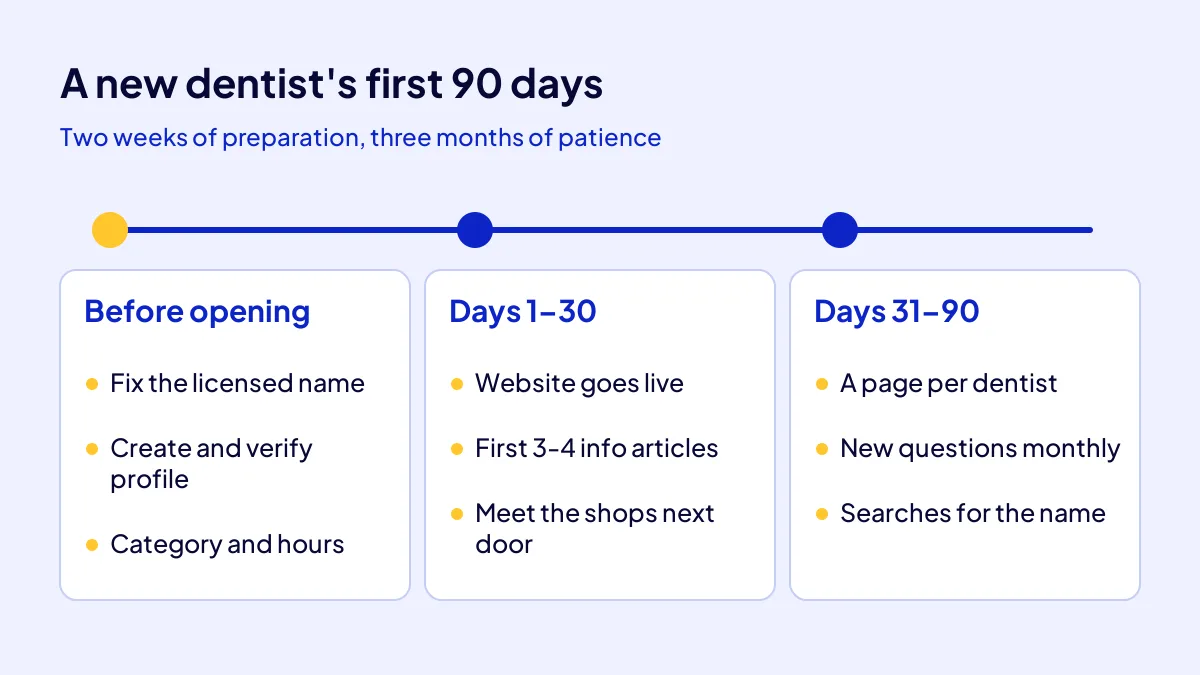
The plan splits into three parts. The two weeks before opening are for the name and the map. The first 30 days are for the website and the first information articles. Days 31 to 90 are when the dentist’s name starts to travel.
Solo practice, polyclinic or centre: does the plan change?
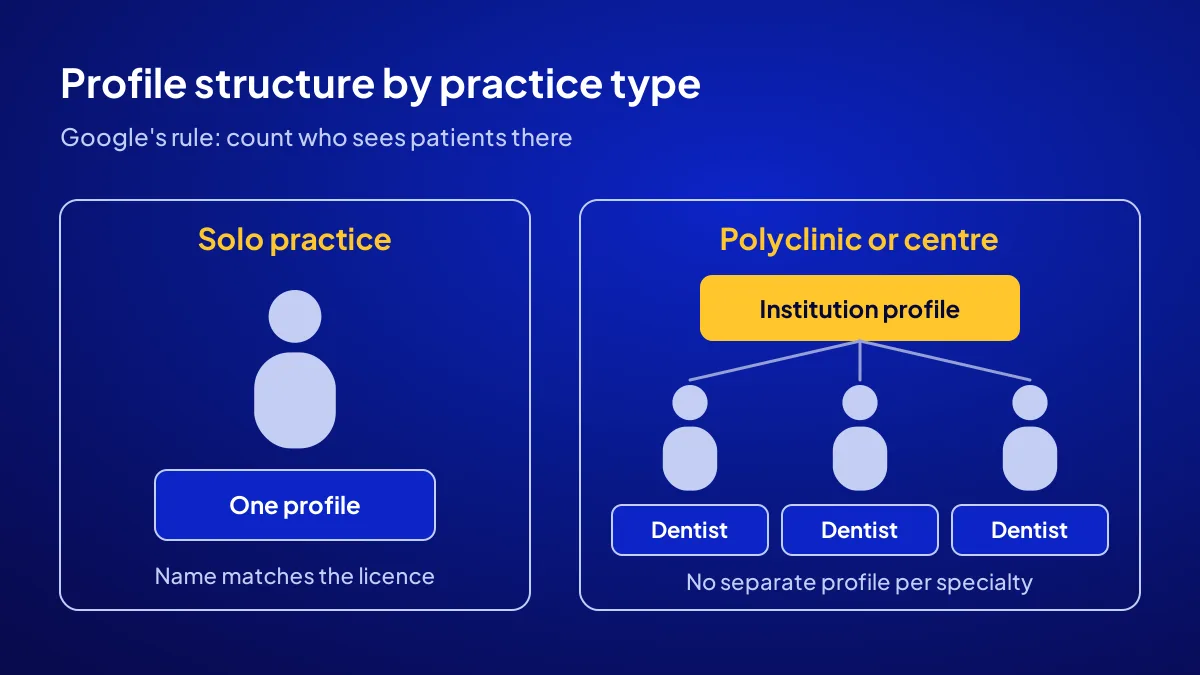
The skeleton stays, the profile structure changes. A solo practice is opened by one dentist in their own name; people get to know both the place and the person. Polyclinics and oral and dental health centres work with several dentists; there, the institution’s name and each dentist’s name are known separately. Google draws the same line in its guidelines.
A solo practice
Under Google’s guidelines, if you are the only professional seeing patients face to face at a location, one profile is enough. The profile name matches the licensed name. Whether the patient searches your name or the neighbourhood, they reach the same profile.
A polyclinic or centre with several dentists
Where several dentists work, the institution gets its own profile, and dentists may keep their own. A dentist cannot open a separate profile for each specialty.
What goes into the two weeks before opening?
These two weeks are for invisible work, and they carry everything that follows. The licensed name, full address, landline and opening hours are fixed on a single page. The profile is created and sent for verification. Before the shutters go up, the online door is ready.
- Write the licensed name letter for letter; no abbreviations or extras.
- Create the profile and start address verification.
- Choose the primary category and enter opening hours.
- Take plain photos of the waiting room and the treatment room.
- Tie everything to one phone number; do not change it after opening.
- Buy the domain and get the first pages prepared.
The first 30 days: what brings the first patient through the door?
BU BÖLÜMÜN ÖZETİ
- Meeting the shopkeepers next door
- The limits of an opening announcement
- The general logic of a first digital setup
Proximity usually brings the first patient. A passer-by, a neighbour, someone the baker sends over. When that person checks their phone, they must find you complete. The site goes live and the first three or four information articles are added with the dentist’s approval.
Meeting the shopkeepers next door
Look, in a neighbourhood shopkeepers know each other. A hello visit, a business card and “we are here if you need us” are enough. Do not bring gifts, discount coupons or free check-up offers; the regulation counts these as incentives.
The limits of an opening announcement
The announcement carries the address, hours, the dentist’s name and title; no prices, campaigns or “opening special”. Six compliant sample sentences are in how to announce a dental clinic opening.
The general logic of a first digital setup
The order of digital pieces any new business sets up in its first month is covered in a new business’s first 30 days. At a dental clinic, the difference is that the ads step does not exist.
Why do patients decide on their phones?
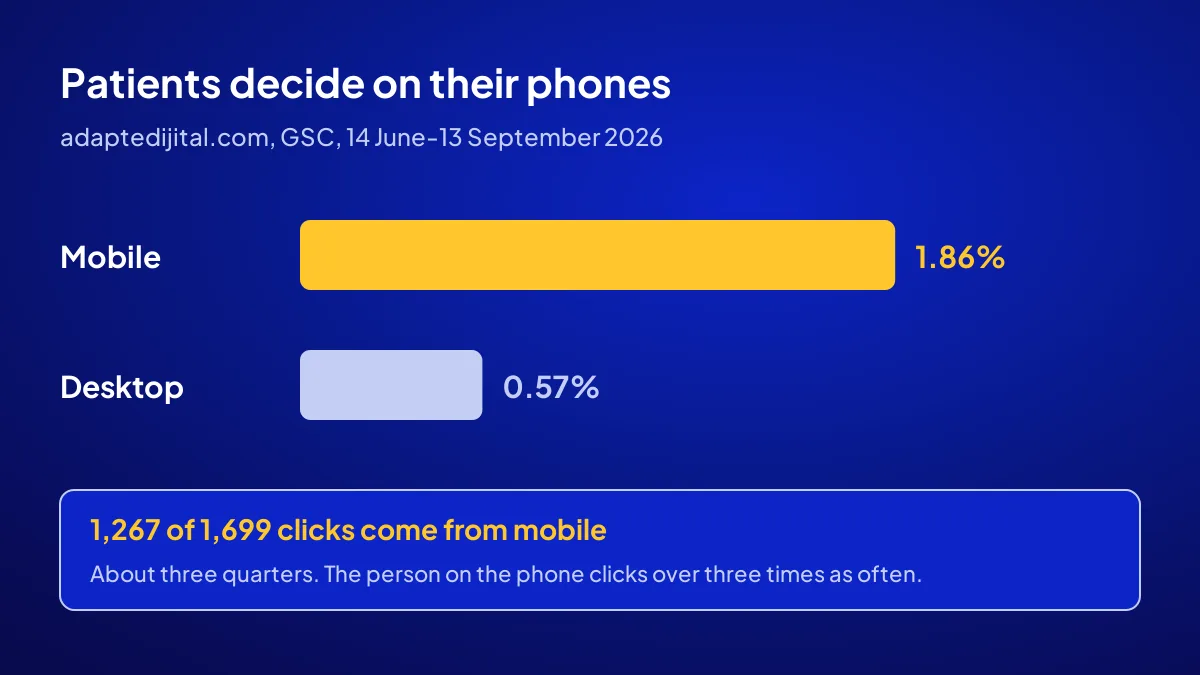
Because search now happens in the pocket, and pocket searches get clicked more. Our own site adaptedijital.com shows it: in Search Console for 14 June to 13 September 2026, 1,267 of 1,699 clicks come from mobile, roughly three quarters. The click-through rate is 1.86% on mobile and 0.57% on desktop. The person on the phone clicks more than three times as often.
| Device | Clicks | Click-through rate |
|---|---|---|
| Mobile | 1,267 | 1.86% |
| Other devices | 432 | 0.57% on desktop |
| Total | 1,699 | About 1.2% on average |
Days 31 to 90: how does the dentist’s name travel?
In the second month, word-of-mouth patients start to arrive, and the person recommending you usually says the dentist’s name, not the clinic’s. People say “go to Dr Ayşe”, not “go to such-and-such polyclinic”. That is why days 31 to 90 are when the dentist’s name has to find an echo online.
A page for each dentist
The site has a page for each dentist: name, professional and academic title, specialty and patient days. This information sits right inside the promotion area the regulation allows. Why patients search the dentist’s name is covered in why patients search the dentist’s name.
Question-and-answer articles
A few questions go up every month: “When can I eat after a filling?”, “When is bleeding gum serious?” The dentist approves each article, and their name and title sit beneath it.
Which 6 mistakes eat the first 90 days?
What these mistakes share is a shopkeeper’s reflex. A price banner because the till is not ringing, a campaign because no one walks in. In dentistry, they bring fines. A new dentist who stays away from the six mistakes below in the first three months is already halfway there.
- Using different names on the sign, profile and site.
- Announcing an opening discount or instalments.
- Sharing patient thanks as advertising.
- Running paid search ads or sponsored posts.
- Changing the phone number after opening.
- Publishing health information without the dentist’s approval.
Which question do you answer at the end of 3 months?
Let me ask you just one thing: when someone who does not know your clinic searches for a dentist in your neighbourhood, do they find you? After three months you see the answer in profile views, calls from the profile and direction requests. Small numbers are fine if they point up.
Building these three months in one go
The Website Recipe in Adapte’s Get Visible Online campaign builds the identity, map and website parts of this plan. It includes a mobile-friendly sales page, contact buttons, a Google Business Profile, basic SEO and visitor tracking. The price is TRY 36,000 + VAT, upfront and fixed, for a 3-month period; this recipe has no ad budget line. For details and to apply, go to the Get Visible Online campaign page.
My decision: a new dentist is first found, then remembered; the first 90 days are spent on being found.
Quick Summary
- A new dentist gets known in 90 days through the profile, the site and the dentist’s name.
- A solo practice needs one profile; a multi-dentist practice opens an institution profile.
- Sign, profile and site carry the licensed name letter for letter.
- About three quarters of clicks come from mobile; build the first screen for the phone.
- From month two, the dentist’s name and question-and-answer articles grow.
- Discounts, patient thanks and paid promotion eat the first 90 days.
Short Glossary
Solo practice: A solo practice is the term used for a health facility a dentist opens in their own name to practise independently.
Primary category: The primary category is the Google Business Profile field used to define a business’s main activity, which decides how it matches searches.
Click-through rate: Click-through rate is the percentage used to measure how much of your visibility in search results turns into clicks.
Next Step
If you want the identity, map and website parts of the first 90 days built with a ready recipe, apply to the Get Visible Online campaign and we will set the scope together from your needs form.
Frequently Asked Questions
Source: Google Business Profile Help — Guidelines for representing your business on Google
Sık Sorulan Sorular
The name comes from the licence. The rules for private oral and dental health facilities allow no name other than the licensed one. When the sign, profile and site carry the same name, Google recognises you as one entity.
The category is the first signal that tells Google which searches to match you to. A wrong category sends the right patient to another clinic. The right choice and six fields to fill are in the right Google category for a dental clinic.
The entrance, the waiting room, a clean dental unit and the team go in. Patient faces, treatment moments and before-and-after images stay out. The profile photo introduces the clinic, not the patient.
Here is what I noticed in years of reading my own sites’ data: the table always turns the same way. Toothache is not searched at a desk; it is searched on the bus, in the kitchen, in bed at midnight. If your site does not open on a phone in two seconds, the patient moves on.
A one-tap call button, directions, opening hours and the dentist’s name. Patients research a dentist only as long as the pain allows, which is not long.
Read the Regulation on Promotion and Information Activities in Health Services first, then your chamber of dentists’ announcements. The full map of what is allowed and what is not sits in new dental clinic promotion.
There is no fixed day. Once the profile is verified and complete, it usually starts getting views in the first weeks.
It is not mandatory, but it is recommended. The profile catches the patient on the map; the site carries the dentist, title, hours and health information in order. A plain site that opens fast on a phone is enough.
No. Incentives, gifts and campaign information in health services are banned by the regulation. An opening notice needs only your address, hours and dentist details.
No. The ad budget is paid separately only in the Google Ads and Meta Ads recipes. The Website Recipe sets up no ads; its price is TRY 36,000 + VAT, upfront and fixed.
First the needs form is filled in, then Adapte suggests a recipe; delivery starts with payment. Results are reviewed together at the end of the first month.
State the code on the application form or in the first call.
Updated: October 2026