
Mağazanolsun unveils a 45-language AI tool, what does an e-export consortium offer SMEs?
Mağazanolsun presented a renewed version of its AI tool, MAI, at a launch in Antalya; according to the company, the tool answers customer questions in 45 European languages (HardwareLab, 12 October 2026). Tekkart A.Ş., the company that owns the brand, appears on the Turkish Ministry of Trade’s list of companies with e-export consortium status, with a status date of 2 January 2026 (Ministry of Trade list, updated 11 September 2026). The company plans to start e-exporting to Europe via the Netherlands in January 2027, and then to the US.
For a manufacturer or SME, here is what it means: consortia are a way into e-export without carrying warehousing and integration on your own. The AI tool is the shop window of that route; the real decision is which service the consortium gives you, and at what price. In autumn 2026, for a small Turkish producer getting ready to export online, the math starts with the contract, not the tool.
What did Mağazanolsun present with MAI, and what is its consortium status based on?
Mağazanolsun presented a renewed version of its AI tool, MAI; its consortium status rests on the Ministry list. The list does not name Mağazanolsun but the brand’s owner, Tekkart Bilişim Hizmetleri Ticaret A.Ş. The company is based at YTÜ Teknopark, the technology park of Yıldız Technical University in Istanbul, and is in its tenth year in the sector according to the company.
How does selling abroad through an e-export consortium like Tekkart’s work?
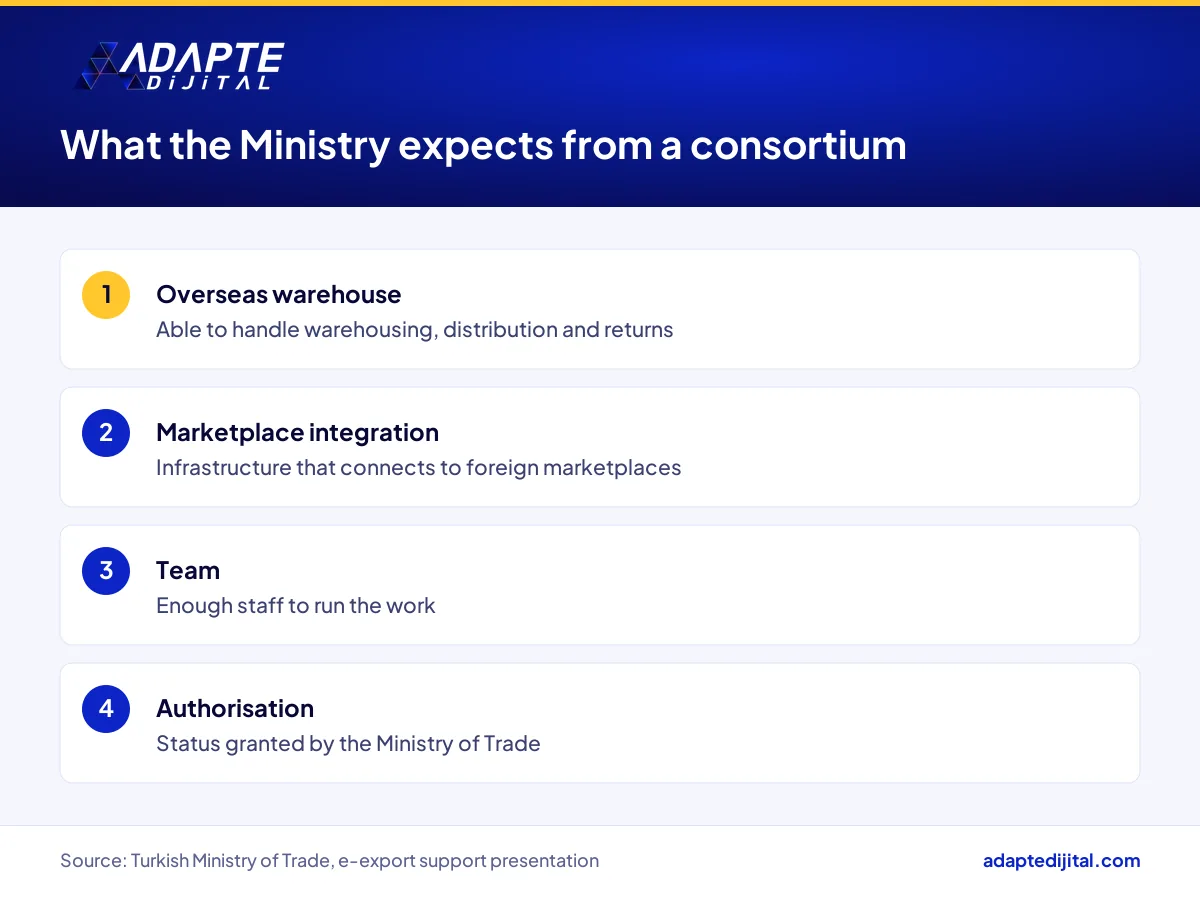
A consortium is an intermediary with Ministry status that takes a producer’s goods to overseas marketplaces and warehouses. According to the Ministry of Trade’s presentation on e-export support, these companies are expected to handle overseas warehousing, distribution and returns, integrate with foreign marketplaces and have enough staff. The producer focuses on the product while the consortium carries the operations.
Who does the e-export consortium model affect, and how?
It affects small producers most: those whose products are ready but who have no operations team. The likely winners are SMEs making products that ship well, such as textiles, home goods, non-food gifts and cosmetics. The ones who struggle are businesses that sign without knowing their costs and book a loss instead of a profit on the first order.
What does a 45-language AI tool like MAI change on the digital side of e-export?
It lowers the language barrier, but it does not fix your product data. Multilingual customer replies, marketplace content and visuals save time. Still, a tool will describe a wrongly entered size wrongly in 45 languages; the quality of the output depends on the quality of the input.
What should an SME calculate before sitting down with a consortium such as Tekkart?
It should calculate the contribution margin per product. From the selling price, subtract product cost, the consortium’s service fee, the marketplace commission, and a shipping and returns allowance; what is left is your share. Signing without running this math on your own numbers is like reading the recipe once the pot is already boiling.
What should a business owner considering e-export do this week?
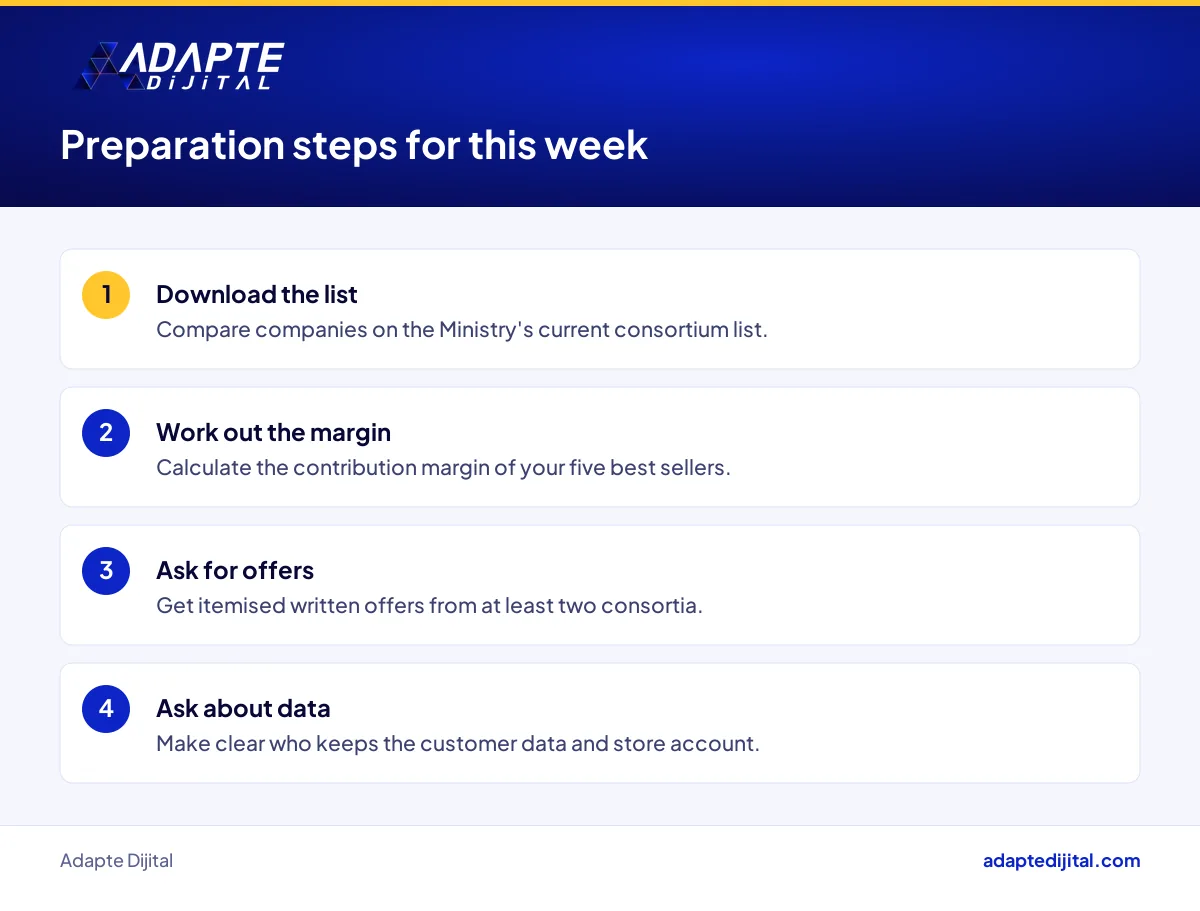
Three jobs fit into this week: download the Ministry list and compare the consortia, work out the margin on your five best sellers, and ask at least two consortia for written offers. None of these costs money, and they let you sit down at the table with numbers. We set up foreign trade channels to fit a business’s scale through our foreign trade consultancy work.
Quick Summary
- Mağazanolsun presented a renewed version of its AI tool, MAI (HardwareLab, 12 October 2026).
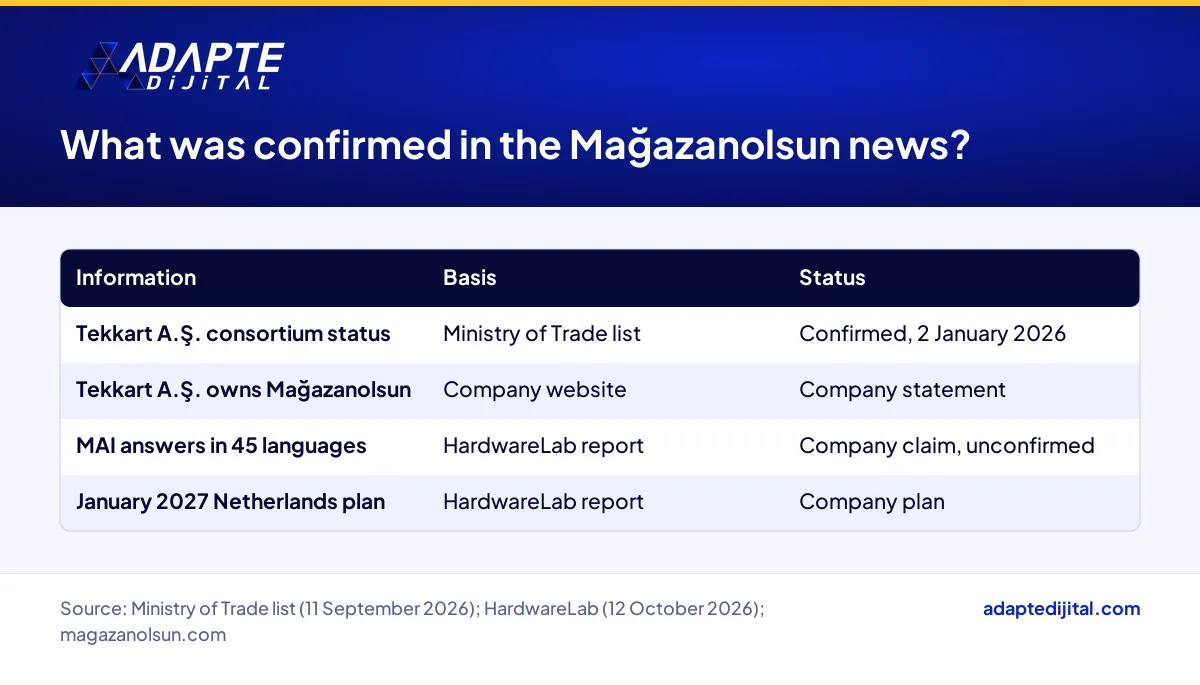
- Tekkart A.Ş., the brand’s owner, is on the Ministry of Trade’s consortium list with a status date of 2 January 2026.
- The Ministry’s list dated 11 September 2026 includes 11 e-export consortia.
- The claim that the tool works in 45 languages comes from the company and has no independent confirmation.
- For an SME, the first step is to work out the margin per product and get written offers from more than one consortium.
Short Glossary
- E-export consortium
- E-export consortium is the term used in Türkiye to describe a company with Ministry of Trade status that sells producers’ goods online abroad.
- Order fulfilment
- Order fulfilment is the concept used to describe picking an order from the warehouse, packing it and sending it to the customer.
- Marketplace integration
- Marketplace integration is the expression used to describe the automatic transfer of product, stock and order data between a seller’s system and a marketplace.
Frequently Asked Questions
Next Step
If you want to review your e-export channel and consortium offers together, fill in the consult your expert form.
Sources: Turkish Ministry of Trade, list of companies with e-export consortium status, 11 September 2026 · Mağazanolsun (Tekkart A.Ş.) corporate website · HardwareLab, 12 October 2026
Updated: October 2026
Sık Sorulan Sorular
According to the company, MAI answers customer questions in 45 European languages, produces marketplace content and social media campaigns, and creates 3D product models. These abilities have not been independently tested. Which technology the tool runs on and how many businesses use it have not been disclosed either.
The Ministry’s list dated 11 September 2026 includes 11 companies with e-export consortium status. The status is still being granted during 2026. You can read the list directly in the Ministry of Trade’s e-export consortium document.
Mağazanolsun offers a service that sets businesses up with a ready-made online store backed by a supplier network. The company website shows a starting price of TL 50,000 as a one-off fee. That figure is for the starter package; ask separately about the price of the e-export service.
Product quality, continuity of stock and cost calculation stay with the producer. A consortium opens the sales channel, but it cannot sell a product that just sits on the shelf. A producer that misses delivery times loses even the best channel.
The Ministry presentation lists items such as digital marketplace promotion, order fulfilment, overseas warehouse rent, marketplace commissions and integration. Amounts and rates depend on the regulations in force. Verify with the official source; this is not legal or financial advice.
If you join directly, warehousing, returns, language and tax all stay with you. In the consortium model that load is shared, but so are some decisions and part of the margin. The question of joining new European marketplaces such as easyShop directly means putting these two routes side by side.
Renting an overseas warehouse and setting up multilingual customer service is more than a single workshop can handle. A consortium that serves several producers can spread these fixed costs. The load per product can then fall.
For a business that has built its own channel, a consortium can also mean handing over control. Who keeps pricing, promotions and customer data should be written clearly in the contract. A brand that loses its customer data loses the second order too.
Couriers, customs brokers, product photographers and translation services may see new work. Stores feel it too: a retailer selling winter outerwear needs the same care in its store and online shop window checks when it moves into an overseas channel.
A person should check the size chart, material statement and return terms in every language. A bad translation can push up your return rate. The tool adds speed; the responsibility stays with the seller.
Where shoppers cannot touch a product, they want visual reassurance. A 3D model may show size and texture better, which can make the add-to-cart decision easier. The company has not published results for this feature, so you need to test its effect on your own products.
Because the 45-language ability is a company claim without independent confirmation. Ask for a trial with a handful of your own products and real customer questions. Compare the answers with what a native speaker would write before you put the tool in front of buyers.
Ask in writing for the set-up fee, monthly fee, share per sale and warehouse charge as separate items. A single all-in price can lead to extra items later. It should also be clear which country each item applies to.
Support can lower the consortium’s costs, but it may not mean a direct payment to the producer. Ask who receives the support and how it shows up in your price. Verify this with the official source and your accountant.
Products with small shipping volume, low return risk and high margins suit a first test. A product with many variants makes stock tracking in an overseas warehouse harder. Pick the simplest SKUs in your range.
Ask in whose name the customer data and the store account are opened. What happens to that data when the contract ends should be in writing. Company CEO Yasemin Çil told HardwareLab that e-exporting “will become as easy as a click”; the click may be easy, but reading the contract is still your job.
Look at the Ministry of Trade’s published list of companies with e-export consortium status. The list shows company names, not brand names, so check separately which company owns the brand.
Support items are defined through the consortium, and amounts depend on the regulations in force. Ask the consortium in writing how the support shows up in your price, and verify it with the official source.
If you cannot set up warehousing, languages and returns on your own, a consortium can be a sensible start. Before deciding, work out your margin per product after the service fee.