
What Is a Cold-Gas Thruster? How SpaceX Rocket Technology Got Into the Tesla Roadster
A cold-gas thruster is the simplest type of rocket engine. It produces thrust by releasing compressed gas through a nozzle, using pressure alone. There is no combustion chamber, no flame and no fuel. Gas waits in a tank, passes through a valve and leaves through the nozzle; the vehicle is pushed the opposite way. Satellites and spacecraft use these small thrusters to adjust their orientation and correct their position.
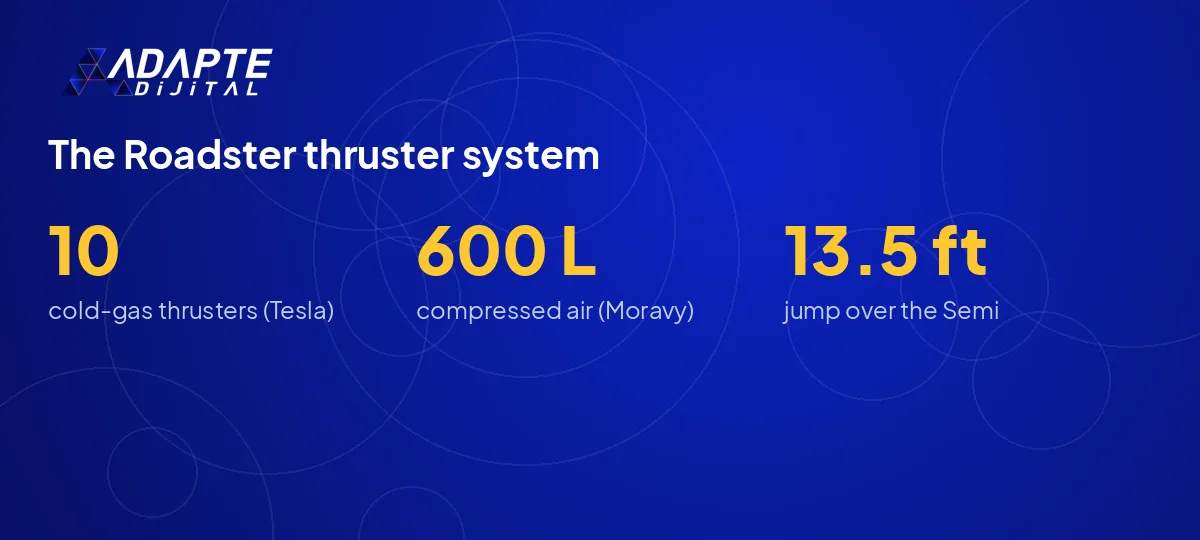
The Tesla Roadster unveiled on October 15, 2026 at the SpaceX test site near Waco, Texas brings the same principle to a car. According to Tesla, the vehicle carries 10 cold-gas thrusters fed by 600 liters of compressed air. A system built to nudge satellites in orbit now lets a car flip in mid-air and jump over other vehicles on the ground. There is no independent verification yet; every figure comes from Tesla and from Lars Moravy, its vice president of engineering.
How does a cold-gas thruster work?
The system has three parts: a high-pressure tank, a valve that opens and closes, and a nozzle that accelerates the gas. When the valve opens, the gas rushes out because of the pressure difference. Gas goes one way, so the vehicle is pushed the other way. The effect is small, but it starts and stops instantly. That makes it ideal for precise control of direction.
What do cold-gas thrusters do on spacecraft?
On spacecraft, cold-gas thrusters handle attitude control. When a satellite needs to point its antenna at Earth, turn a solar panel toward the Sun or make a small orbital correction, it fires these thrusters for a short burst. The main engine takes care of large maneuvers; fine adjustment is the job of cold gas.
The idea translates easily into everyday terms. If you sit on an office chair and squeeze a fire extinguisher, the chair slides the other way. In space there is no friction, so the same small push is enough to turn a spacecraft. The Tesla Roadster does the same thing, but with gravity and air resistance working against it. That means it burns through far more gas.
How did SpaceX technology get into the Tesla Roadster?
The idea goes back to 2018. That year Musk wrote about a “SpaceX option package” with “around 10 small rocket thrusters” that might “even allow it to fly”. Eight years later the launch took place at SpaceX’s Rocket Development and Test Facility in Waco/McGregor, Texas. The venue was no accident. The thrusters trace back to the attitude-control systems of the rocket company.
At the event Musk said he had asked himself “Am I crazy?” when he proposed the idea to his team. After the demo he said: “This is going to be the real car on the roads.” Tesla’s official X account named the SR-71 reconnaissance aircraft and the F-35 as design inspirations. The whole concept was framed in the language of aerospace from the start. The full launch story is in the flying car era article.
How are the 10 thrusters arranged in the Tesla Roadster?
According to Tesla, the car has 10 cold-gas thrusters, and only the rear thrusters are active in the first versions; the other axes come later. Moravy put the tank volume at 600 liters of compressed air. A Tesla post on X stated that “every usable space in the vehicle is filled with carbon-fiber overwrapped pressure vessels (COPV)”. These tanks are the light, high-pressure vessels also used in rockets.
What is the difference between a cold-gas thruster and a rocket engine?
Both produce thrust by expelling gas; the difference is where the gas comes from. A rocket engine burns fuel and creates a very powerful, hot stream of gas. A cold-gas thruster releases gas that is already pressurized. One is designed for launch, the other for fine adjustment.
| Feature | Cold-gas thruster | Fueled rocket engine |
|---|---|---|
| Energy source | Pressurized gas | Fuel and oxidizer |
| Temperature | Low | Very high |
| Thrust | Small | Large |
| Typical task | Attitude and position control | Launch and main propulsion |
| Place in the Roadster | 10 units, at the rear | None |
This is why the Roadster system is called a “thruster”, not a “rocket”. It does not launch the car; it completes the work of the fan and the wing. The 0.81-second 0-60 mph figure is also a Tesla claim, and the contribution of the thrusters to that time was not stated separately. All the numbers are collected in Tesla Roadster by the numbers.
How does the thruster system fire in 3 steps?
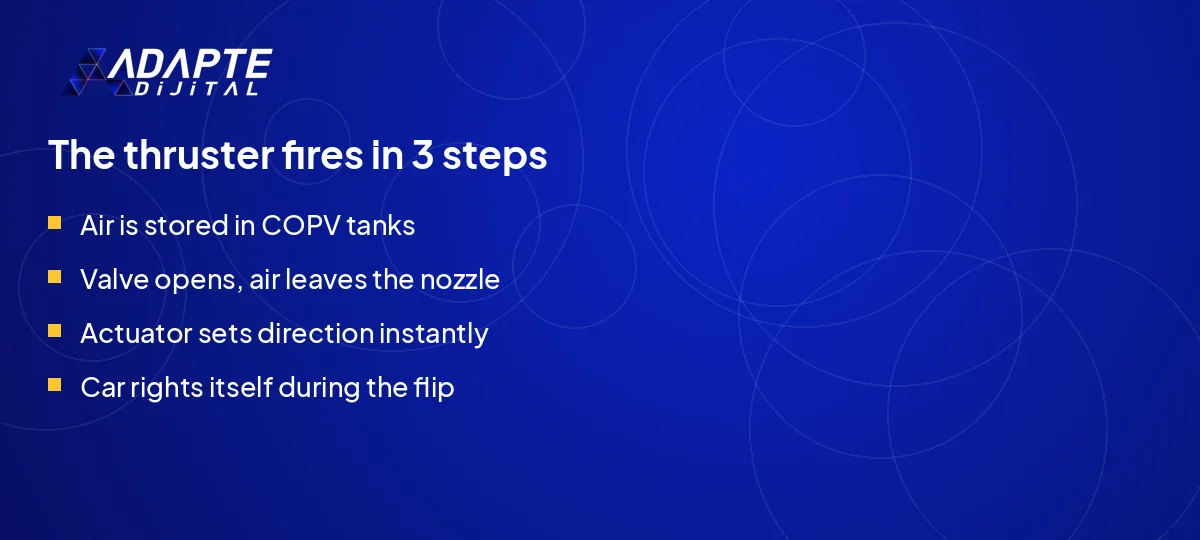
Based on Tesla’s demo, the process runs in three steps: store the gas, fire instantly, correct the attitude. Each step has its own threshold. The sequence below rests on statements by Tesla and Moravy; there is no independent measurement.
- Storage: COPV tanks hold 600 liters of compressed air (Moravy’s figure) at high pressure. The tank refills while driving.
- Firing: The valve opens and air leaves through the nozzle. An electric actuator sets the direction within a fraction of a second.
- Correction: During the mid-air flip the thrusters right the car. In the demo the Roadster cleared the Semi, which stands 13.5 feet (about 4.1 meters) tall, this way.
Common mistake: treating a cold-gas thruster as a “mini rocket engine”. There is no combustion in a thruster; it only releases pressurized air. Expecting flames, exhaust heat or a fuel tank is wrong. The system has more in common with a fire extinguisher than with a rocket engine.
A checklist for understanding cold-gas thrusters
When a news story mentions a “thruster”, weigh the system against these six questions. Each item is paired with its Roadster answer, and every answer is a Tesla claim. Reservations are not open in Turkey yet, but these technical terms will keep showing up in the news.
- Does the gas burn? No; cold gas is only expelled.
- How many thrusters? 10 according to Tesla; only the rear ones are active in the first version.
- How much gas? 600 liters of compressed air according to Moravy.
- What kind of tank? Carbon-fiber overwrapped pressure vessels (COPV).
- Does it refill? According to Tesla, yes, while driving.
- Is there independent verification? Not as of October 2026.
Which version carries how many thrusters is covered in the guide what is the Tesla Roadster; why other flying car concepts chose eVTOL instead is in why there are still no flying cars; the whole series sits in the flying cars archive. The official technical description is on Tesla’s Roadster page, and the COPV statement is in Tesla’s post on X. For demo details, the main sources are TechCrunch’s launch report and InsideEVs’ demo story.
Frequently Asked Questions
Quick Summary
- A cold-gas thruster produces thrust by expelling pressurized gas without burning it.
- Spacecraft use these thrusters for attitude and position control.
- According to Tesla, the Roadster has 10 thrusters and 600 liters of compressed air.
- The tanks are carbon-fiber overwrapped COPVs that refill while driving.
- As of October 2026, none of the figures has been independently verified.
Short Glossary
A cold-gas thruster is the simplest rocket system, producing thrust by expelling compressed gas through a nozzle without combustion.
A COPV is a tank with an inner liner and a carbon-fiber overwrap that carries high-pressure gas in a light body.
An actuator is a component that converts an electrical signal into mechanical motion to change the direction of a thruster.
Next Step
The flying car era: why the Tesla Roadster flies and when it goes on sale
Sources
- Tesla – Roadster official page
- Tesla X – COPV tank statement
- TechCrunch – Tesla reveals SpaceX-powered Roadster that flies and falls with style
- InsideEVs – Tesla Roadster backflip, suction, 2G
Updated: October 2026
Sık Sorulan Sorular
A conventional rocket engine burns fuel, produces hot gas and expels it. A cold-gas thruster skips that step. The gas is already under pressure; it is simply released. The temperature does not rise, which is why the gas is called “cold”.
Thrust depends on tank pressure and nozzle design. It is far weaker than a fueled engine. In return the system is light, cheap and safe. It carries no explosive material, only pressurized gas.
A COPV is a pressure vessel with a metal or plastic liner wrapped in carbon fiber. It is much lighter than a steel tank and holds the same pressure with less mass. In a car, weight translates directly into speed and range, which explains the choice.
According to Tesla, the tank can be refilled while driving. That allows repeated use instead of a single burst. Refill time and consumption per burst have not been disclosed.
The thrusters change direction within a fraction of a second using fully electric actuators. An actuator is a component that turns an electrical signal into mechanical motion. That speed is needed to right the car during a mid-air flip. How the thrusters work together with the fan system is explained step by step in the guide how does a flying car fly.
Because there is no combustion and no fuel, it carries less risk than a rocket engine. High-pressure tanks still demand serious engineering. Whether the Tesla Roadster system is legal on public roads remains unclear.
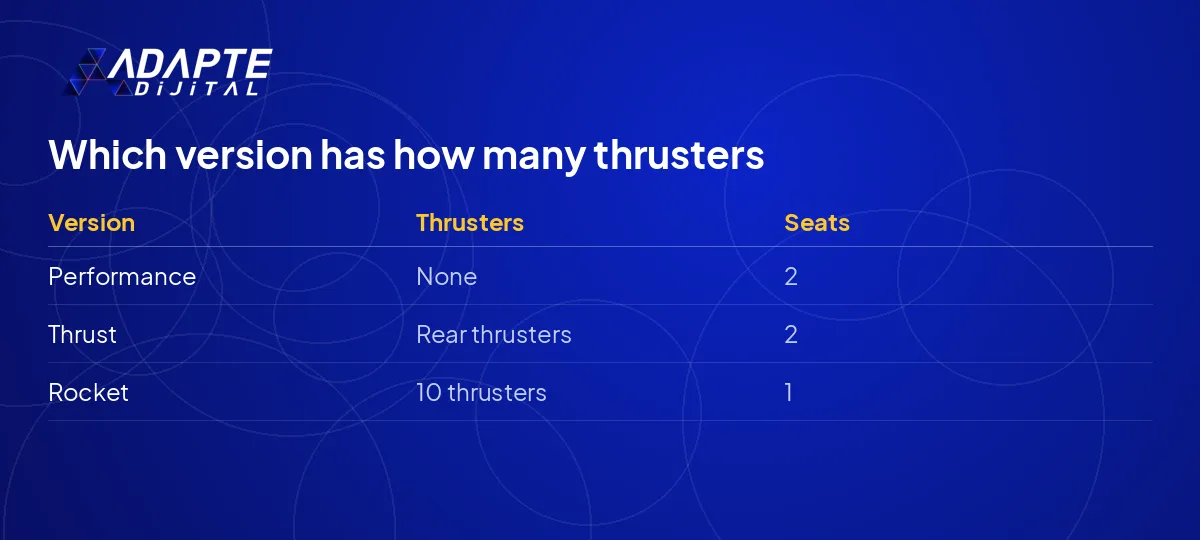
According to Tesla, 10 cold-gas thrusters. Only the rear thrusters work in the first versions; the other axes will be added later. The Performance version has no thrusters; Thrust has rear thrusters and Rocket has the full system.
In the demo the car flipped in mid-air and jumped over vehicles; it did not sustain flight. Tesla presents this as “limited flight”. There is no independent demonstration of longer time in the air.