
In-Answer Ads at Nine Months: Which Decisions Come as the Channel Grows?
Nine months into in-answer ads, the channel has found its place and decisions about growth come onto the agenda. Nine months build up enough data to see seasonal effects and to compare the channel’s share with others. The decision to grow is now made on accumulated results rather than guesswork. 📈
This page is the fourth step of the in-answer advertising horizon series. It covers what is realistic in nine months, how to decide on growth, how ads and content work together and which risks grow. Forecasts are labelled as forecasts and revisited in the update log.
What is realistic in nine months?
BU BÖLÜMÜN ÖZETİ
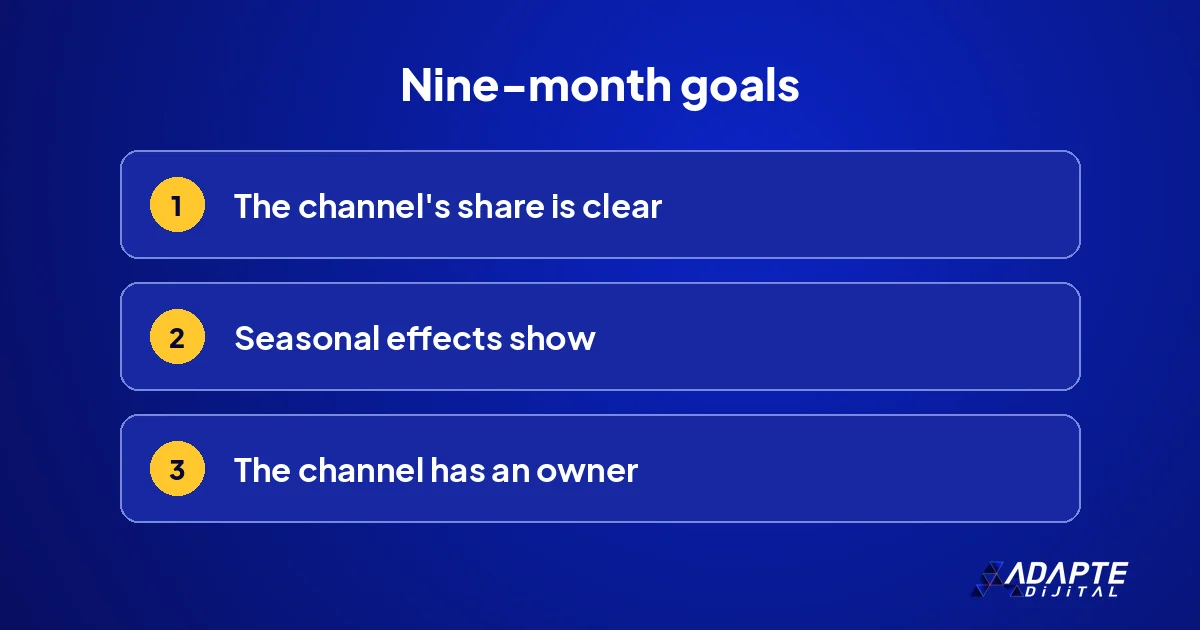
- The channel’s share becomes clear
- Seasonal effects show
- An owner for the channel
Nine months is enough to see how the channel behaves in different periods. It gives a solid basis for deciding whether to grow it or hold it steady.
The channel’s share becomes clear
By the end of nine months, the share of in-answer advertising in total conversions and its cost per conversion are clear. Those two numbers decide the channel’s place in the mix. A channel with a small share but good efficiency is a good candidate for growth. A channel with a large share but high cost needs putting in order first. 📊
Seasonal effects show
Nine months cover most of a business’s busy and quiet periods, so you can see how the channel behaves across seasons. Comparisons are made between like periods; comparing a busy month with a quiet one misleads. A seasonal note feeds straight into next year’s budget calendar, so the same pattern is not rediscovered at full cost.
An owner for the channel
At nine months, the channel stops being a test and becomes an area of responsibility. Who reads it, who makes changes and who decides should be written down. A channel without a clear owner is either neglected or becomes a messy area that everyone touches. One owner with written authority is the most robust arrangement. 🔑
How do you decide on growth?
Growth is not just raising the budget. Done along the right axis and at the right pace, it protects the result.
What extra budget returns
In any channel, the first units of budget bring the most efficient results; as the budget rises, extra units usually return less. So growth happens in steps, and cost per conversion is read after each step. If the cost rises above an acceptable limit, growth stops there. How to plan budget is covered in in-answer ads budget. Small steps also make it easy to go back. 🪜
Holding steady is a decision too
Not every successful channel has to grow. Sometimes the right decision is to keep it at its current efficient level and move spare budget to another channel. A decision to hold steady is written down as carefully as a decision to grow, together with its reasons. Growth is not the only measure of success. ⚖️
How do ads and content work together?
BU BÖLÜMÜN ÖZETİ
- The same questions
- Citations come another way
- Pages are a shared asset
In the ninth month, what was learned from ads can be carried over to content. The two feed each other, but neither replaces the other.
The same questions
The context hints that work best in ads show the questions customers really ask. Those questions can also be topics for the site’s content. A list of questions learned from ads is one of the most valuable inputs to a content plan, because it rests on real customer language rather than guesses. 💬
Citations come another way
Being cited as a source in an assistant’s answer cannot be bought; an ad is a labelled card, and a citation is the assistant’s own assessment. Raising the ad budget does not earn citations. Citations need content that is readable, reliable and current. The difference is explained in ad or citation in AI answers. The two paths are planned separately, but they can share a question list.
Pages are a shared asset
The landing page an ad leads to and the content page an assistant reads are often on the same site. The clearer and more consistent a page is, the easier it passes ad review and the easier it is to read as content. A good page serves both channels at once, which makes page work one of the best investments at this stage. 📄
Which risks grow?
BU BÖLÜMÜN ÖZETİ
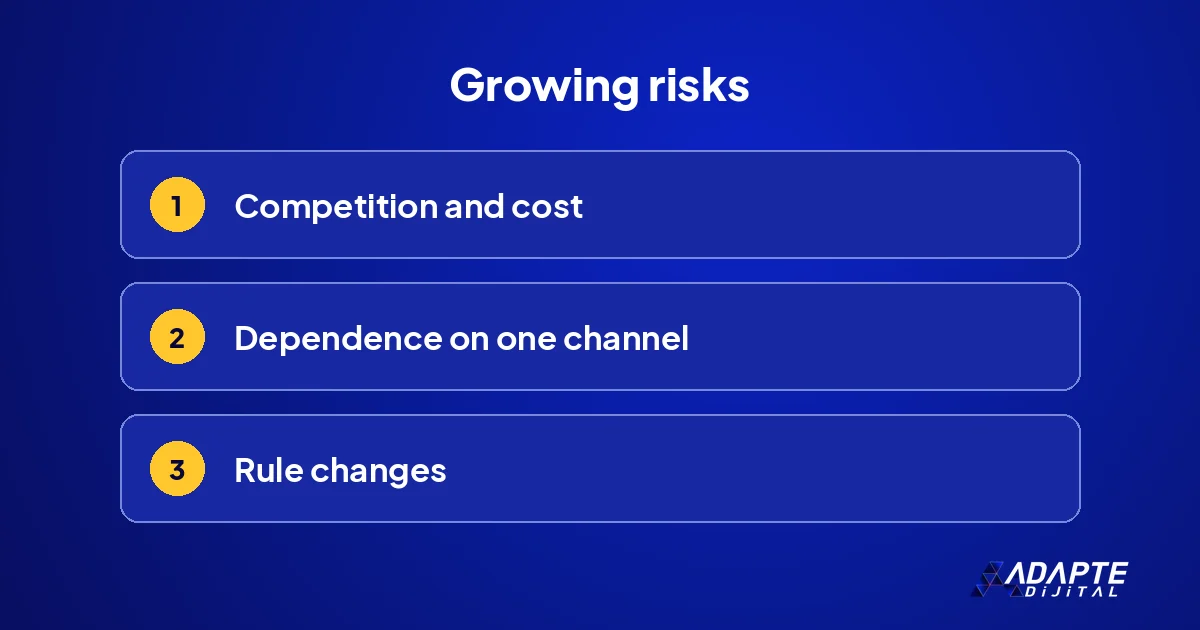
- Competition and cost
- Dependence on one channel
- Rule changes
As the channel grows, so do its risks. Three of them need particular attention at nine months.
Competition and cost
As more advertisers enter the surface, auction competition increases and cost per conversion may rise. Treating early-period costs as permanent misleads the budget plan. The cost trend is watched every month and the plan updated accordingly. A rise in cost is not an error; it is the natural result of a maturing surface. 💸
Dependence on one channel
However well a channel works, getting most customers from a single surface is risky. A rule change or a price increase can affect the business through one decision made elsewhere. Keeping the channel mix balanced reduces that risk. No single surface should carry all conversions, however attractive its numbers look.
Rule changes
Because the ads manager is still developing, rules, formats and targeting options can change. In a growing channel, the effect of each change grows too. Reading changes every quarter and reflecting them in campaigns reduces surprises. Rule tracking is insurance for growth, and it costs very little compared with what it protects. 🔍
What is rising on this horizon?
BU BÖLÜMÜN ÖZETİ
- Today: product cards are getting richer
- Forecast: ads and shopping move closer
- Forecast and log
The nine-month horizon looks at summer 2027. The first item is today’s status; the next two are forecasts.
Today: product cards are getting richer
Industry sources report that in July 2026 OpenAI announced an update to the product ad card format to show prices and star ratings. On Google’s side, shopping ads that explain why a product fits were announced as well. As product information gets richer, accurate and current product data matters more than ever. 🛒
Forecast: ads and shopping move closer
Forecast: in the coming period, in-answer ads will move further into product comparison and the purchase decision itself. That will favour businesses that keep their product data in order. A business whose prices, stock and attributes are consistent will benefit most from this shift.
Forecast and log
Forecast: businesses that make growth decisions in steps at nine months will be less affected when cost increases arrive. Update log. 12 November 2026: first publication. The forecasts on this page are re-read when they fall due; a forecast that turns out wrong is not deleted but corrected here. The previous step is in-answer ads: six months; the next is in-answer ads: one year.
How does the ninth month work with Adapte Digital?
BU BÖLÜMÜN ÖZETİ
- A single delivery package
- What is delivered
- Where to start
Ninth-month work is a growth plan: along which axis and at what pace to grow is written down, and the structure is delivered.
A single delivery package
Adapte Digital does not charge a monthly management fee. Work starts with a single delivery package whose scope is written down in advance: 36,000 TRY + VAT. If the work grows, the new need is defined as a separate add-on package, priced by what will be delivered rather than by the hours spent. 📦
What is delivered
The output of this work is a growth plan, a campaign structure separated by axis and the list of questions learned from ads. We review the overall state of the account alongside it.
Where to start
Which packages are open, and at what price, is shown on our campaign pages, item by item. 🧭
Planning to do this work for other businesses? Our article on managing ads and AI visibility together shows what that door looks like.
Quick Summary
- At nine months the channel’s share and cost become clear.
- Growth happens in steps and along one axis at a time.
- Holding steady is as valid a decision as growing.
- Questions learned from ads feed the content plan; citations cannot be bought.
- Forecasts are revisited in the update log.
Short Glossary
- Growth axis
- The direction in which a channel is extended: offer, region, customer situation or surface.
- Channel mix
- The overall spread of ad and content channels through which a business wins customers.
- Gradual increase
- Raising a budget in small steps and reading the result after each one.
Frequently Asked Questions
Next Step
Put the last nine months of monthly results in one table and mark the most efficient offer; it is the first candidate for growth. Our campaign pages list the packages that cover growth planning.
Sources: OpenAI — Testing ads in ChatGPT · OpenAI Help Center — Create campaigns for ChatGPT Ads
Updated: November 2026
Sık Sorulan Sorular
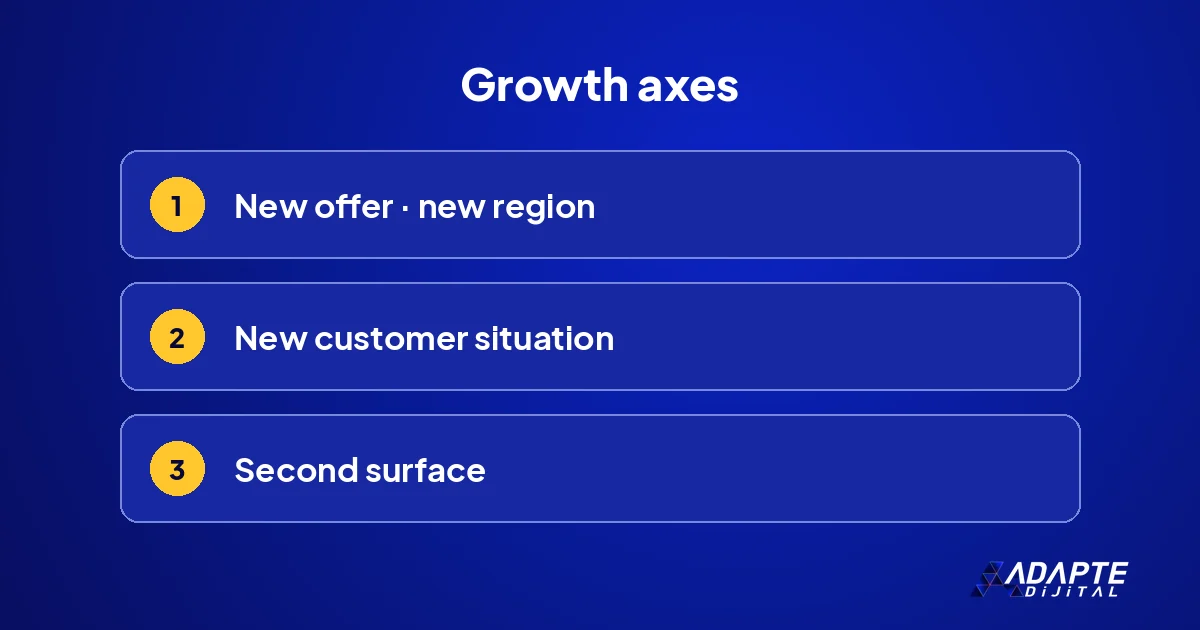
Growth has several axes: a new offer, a new region, a new customer situation or a second surface. Growing along one axis at a time keeps it clear where results come from. Growing first along the axis with the most data reduces risk. Keeping each axis in its own campaign or ad group makes the reading easier still.
We do not give a figure. Increase in small steps and read cost per conversion after each one; stop when the cost passes an acceptable limit.
No. A citation is the assistant’s own assessment and cannot be bought. Questions learned from ads can, however, feed the content plan.
Usually the offer or region with the most data. Growing along one axis at a time keeps results readable.