
EU AI Act Article 50 Summary: How Do the Transparency Rules Affect a Turkish Business?
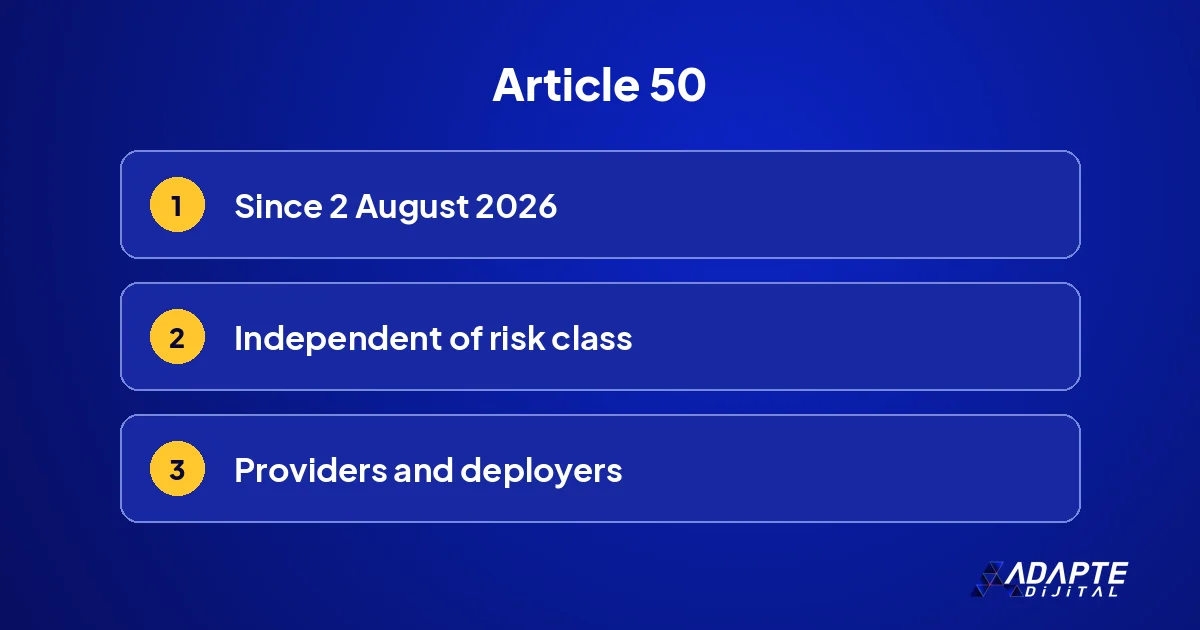
EU AI Act Article 50 is the article that sets transparency rules for AI systems: people should know when they are talking to AI and when the content they see was generated or manipulated with AI. It has applied since 2 August 2026 and concerns not only high-risk systems but all systems of certain kinds. ⚖️
This summary explains what the article is, the duties of providers and of businesses that use AI, what it means for a Turkish business, and the tools and penalties that shape its application. The information was compiled from the official text and legal sources on 12 November 2026. This article is for information only and is not legal advice; consult a lawyer about your own situation.
What is Article 50?
Article 50 is the AI Act’s transparency article, and it works independently of the risk classes. Three points are enough to understand who must do what, and since when.
A transparency article
Most of the Act focuses on high-risk systems; Article 50 instead requires transparency for certain uses regardless of risk class: systems that talk to people, systems that generate synthetic content, emotion recognition and biometric categorisation, and deepfakes. That makes it the article that touches ordinary business use the most. A business that never builds AI can still be in its scope simply by using it. 🧭
What must providers do?
BU BÖLÜMÜN ÖZETİ
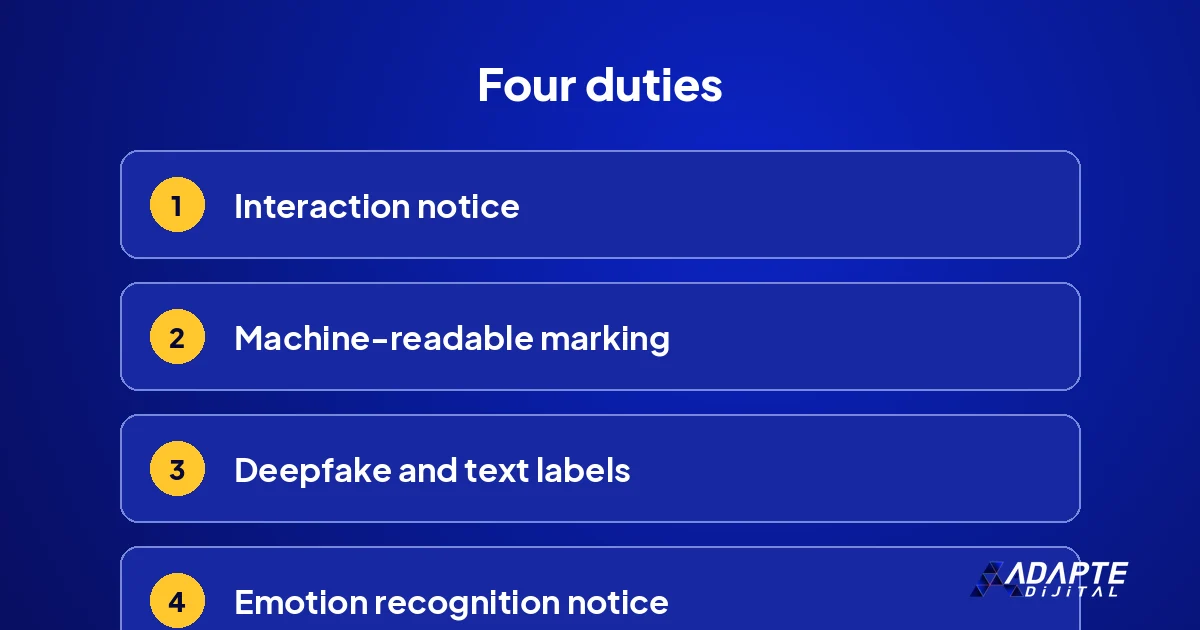
- Interaction notice
- Machine-readable marking
- The 2 December transition
Providers have two main jobs, both concerning how the system is designed.
Interaction notice
The provider of a system that interacts directly with people must design it so that people learn they are interacting with AI, unless this is obvious from the context. Chatbots and voice assistants are the most typical examples. The notice is given at the latest at the first interaction. How to word it is covered in AI disclosure in chatbots. 💬
Machine-readable marking
Providers of systems that generate audio, images, video or text must mark outputs in a machine-readable way and make it possible to detect that they were artificially generated. The Act asks that these solutions be effective, interoperable, robust and reliable. This job belongs to the tool provider, but the business choosing the tool should know whether its provider does it, because the output ends up on the business’s own channels.
The 2 December transition
The transition covers only the marking duty, and only generative systems already on the market before 2 August. The labelling duties of businesses that use AI were not postponed. Asking the provider of your tools about its marking plan in writing is the most practical step of this period. Keep the answer with your inventory. ⏰
What must a business that uses AI do?
BU BÖLÜMÜN ÖZETİ
- Deepfake labels
- Public-interest text
- Emotion recognition and biometric categorisation
The duties of a business that uses AI in its own work depend on the kind of content it produces.
Deepfake labels
A business that generates or manipulates image, audio or video content resembling real people, objects, places or events, and that could be taken as real, must disclose that the content was artificially generated or manipulated. For artistic, creative, satirical or fictional work, the disclosure can be made in a way that does not spoil the presentation. Realistic AI imagery in advertising sits close to this provision. 🎭
Public-interest text
Text generated or manipulated with AI and published to inform the public on matters of public interest must disclose that it is AI-generated. If the text has undergone human review and someone holds editorial responsibility, the duty does not apply. For businesses that publish news or current-affairs content, this distinction matters, and the editorial review should be documented.
Emotion recognition and biometric categorisation
A business using an emotion recognition or biometric categorisation system must inform the people exposed to it; personal data rules apply on top. In a shop or a call centre, such a system is assessed under both the European rule and personal data law. In practice, few small businesses should be using such systems at all without specialist advice. 🔐
How does it affect a Turkish business?
BU BÖLÜMÜN ÖZETİ
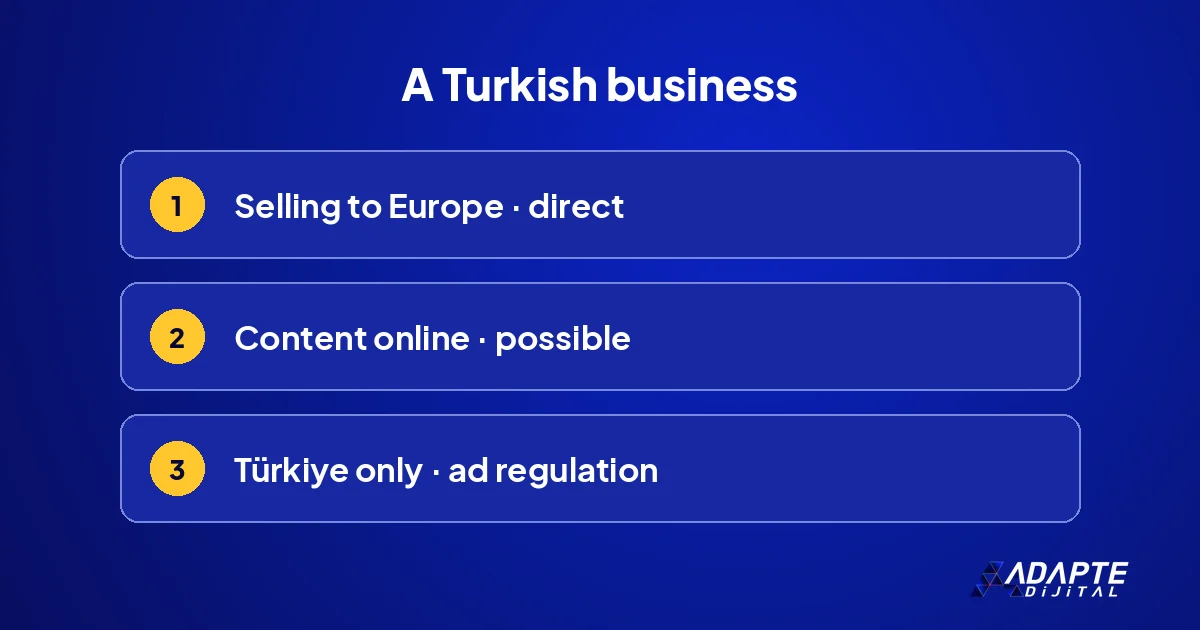
- A business selling to Europe
- Content open to the internet
- A business selling only in Türkiye
Article 50 is a European rule, but its effect reaches businesses in Türkiye. Three situations should be considered separately.
A business selling to Europe
For a business that offers goods or services to customers in Europe and interacts with them through AI, Article 50 is directly on the agenda. Chatbots, automated emails and visual content are reviewed with this in mind. If Europe is the target market, staying outside the rule is rarely possible. Preparation for exporters is covered in AI compliance preparation for EU exporters. 🇪🇺
Content open to the internet
Legal sources report that the Commission takes a broad view on deepfake labelling: publishing content on the globally accessible internet, without any requirement that it specifically target the European market, may trigger the obligation. That reading may also concern the social media content of Turkish brands. A business with realistic AI imagery on public channels should review it with this in mind.
A business selling only in Türkiye
The European rule may seem distant, but in Türkiye the advertising regulation has required, since 1 August 2026, that AI use in ads be disclosed clearly in certain cases, and it prohibits showing an AI copy of a real person as if they had tried a product. The two rules differ, but they point the same way. Both belong on the same compliance calendar. 🇹🇷
Application tools and penalties
BU BÖLÜMÜN ÖZETİ
- The code of practice
- The Commission guidelines
- Penalties
Three documents and a penalty provision shape how Article 50 is applied.
The code of practice
The Commission published the voluntary code of practice on marking and labelling on 10 June 2026; in July, the Commission and the AI Board assessed it as adequate. The code does not replace the obligations, but it is a practical way to demonstrate compliance. Its details are explained in the AI content code of practice. 📚
The Commission guidelines
The Commission published the final version of its Article 50 guidelines on 20 July 2026. They explain who is in scope and how each obligation works in practice, but they do not present themselves as a definitive interpretation. The final word rests with the practice of supervisory authorities and courts. Tracking their decisions belongs on the calendar described in how to build a compliance calendar.
Penalties
Under the Act’s penalty provisions, breaches of Article 50 obligations can lead to administrative fines of up to 15 million euros or, for a company, 3 percent of worldwide annual turnover. How strictly authorities will enforce in the first period will become clearer over time. For most businesses, the nearer risk is not a fine but lost trust. ⚠️
How does Adapte Digital approach Article 50 preparation?
BU BÖLÜMÜN ÖZETİ
- A single delivery package
- What is delivered
- Where to start
We do not give legal opinions; we map your AI use, set up the labelling and notice arrangement and work alongside your lawyer.
A single delivery package
Adapte Digital does not charge a monthly management fee. Work starts with a single delivery package whose scope is written down in advance: 36,000 TRY + VAT. If the work grows, the new need is defined as a separate add-on package, priced by what will be delivered rather than by the hours spent. 📦
What is delivered
The output is an AI usage inventory from an Article 50 perspective, labelling and notice decisions and a list of questions to put to your providers. The work is organised so your lawyer can review it quickly.
Where to start
Our current packages and capacity are listed on our campaign pages; scope and price are written there before any work starts. 🧭
We cover the earning-gate side of this topic in our article on content provenance records.
Quick Summary
- Article 50 is the transparency article that has applied since 2 August 2026.
- Providers give an interaction notice and mark outputs in a machine-readable way.
- Businesses that use AI label deepfakes and public-interest text.
- The transition covers marking only and runs until 2 December 2026.
- Fines can reach 15 million euros or 3 percent of turnover; this article is not legal advice.
Short Glossary
- Provider
- A person or organisation that develops an AI system and places it on the market under its own name.
- Deployer
- A person or organisation that uses an AI system under its own authority in a professional activity.
- Machine-readable marker
- A marker showing, in a form software can read, that content was artificially generated.
Frequently Asked Questions
Next Step
Mark in your inventory the AI uses that reach people in Europe, and note for each whether you act as a provider or a deployer. Our campaign pages list the delivery packages that cover this work.
Sources: EUR-Lex — Regulation (EU) 2024/1689 (Artificial Intelligence Act) · Faegre Drinker — Commission confirms transparency Code of Practice as adequate · Alomaliye — Reklam Yönetmeliğinde Kapsamlı Değişiklik
Updated: November 2026
Sık Sorulan Sorular
The article began to apply on 2 August 2026. The amending regulation that postponed the timetable for high-risk systems did not touch the substance of Article 50. The only exception is a transition until 2 December 2026 for the machine-readable marking duty of generative systems already on the market before 2 August; systems placed on the market after that date get no transition at all.
The article speaks of two actors: the provider, who develops a system and places it on the market, and the deployer, the business that uses the system in its own work. A Turkish business is usually in the second group, producing content or talking to customers with a ready-made tool. A business that develops and offers its own chatbot, however, may also face provider duties. 👥
No. The article works independently of risk class and company size; it can concern any deployer that talks to people, generates content or publishes deepfakes.
No. The transition covers only providers’ marking duty for systems already on the market; the other duties have applied since 2 August 2026.
Given the broad reading on deepfakes published online and Türkiye’s advertising regulation, it is wise to follow the topic. Consult a lawyer about your own situation.