
The Product Data Agents Read: Which Fields Get Your Store Into the Comparison?
The product data agents read is the structured information an AI agent uses to find, compare and recommend a product: identity, price, stock, delivery, returns and product attributes. A person can look at a photo and decide; an agent trusts only data that is written down and consistent. 🔎
This article explains how an agent reads a product, which fields are mandatory and which are decisive, and the routes by which data reaches the agent. Field names were compiled from the Google Merchant Center product data specification, the schema.org vocabulary and the feed rules of the agent commerce standards.
How does an agent read a product?
BU BÖLÜMÜN ÖZETİ
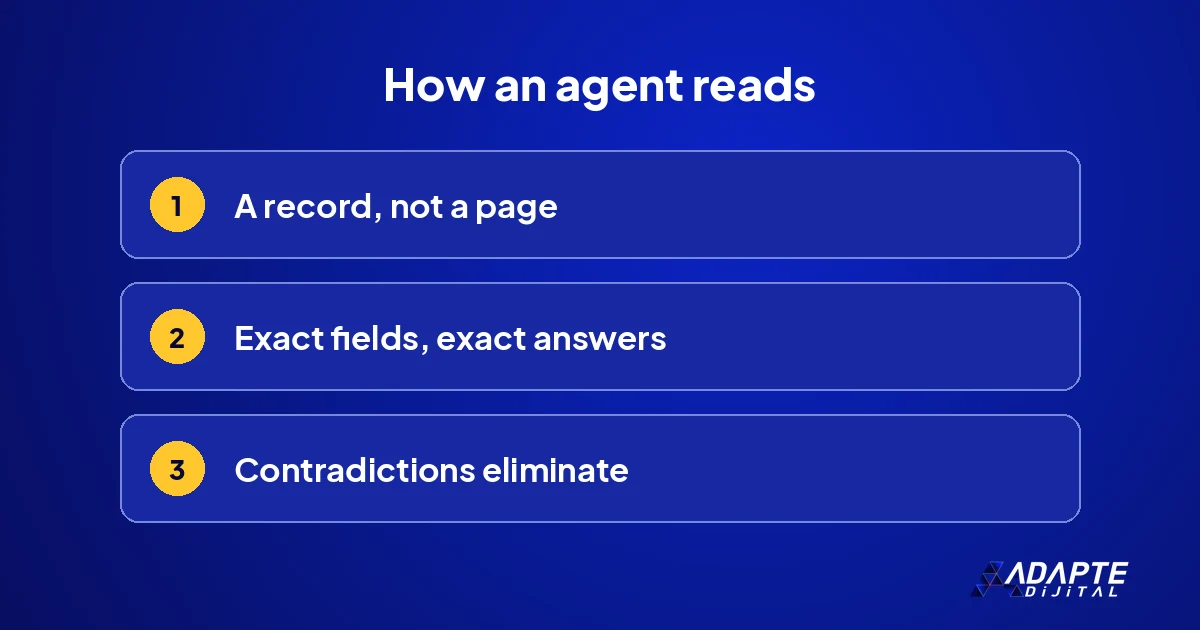
- A record, not a page
- Exact fields, exact answers
- Contradictions eliminate
A human buyer browses a page; an agent reads a record. That difference explains why product data needs a fresh look.
A record, not a page
When an agent opens a product page, it looks less at images and design than at the structured data on the page and the record in the feed. Price, stock and delivery time sit there as individual fields. Information buried in running text is hard for an agent to read, or untrustworthy. That is why information needs to move into separate fields, where it can be checked and compared without guesswork. 📑
Exact fields, exact answers
When a customer asks an agent for “size 42, delivered tomorrow, free returns”, the agent looks for those three conditions in the data. If the fields are filled, the product makes the list; if they are empty, the agent usually skips the product rather than guessing. An agent speaks in yes or no. An unclear answer is usually read as no, and the product drops out of the shortlist.
Contradictions eliminate
If the feed shows one price for a product, the page another and a marketplace a third, the agent cannot tell which to trust. Contradictory data is worse than missing data, because it undermines trust. That is why consistency checks sit at the centre of any product data work, ahead of adding new fields or rewriting descriptions. ⚠️
Product identity fields
BU BÖLÜMÜN ÖZETİ
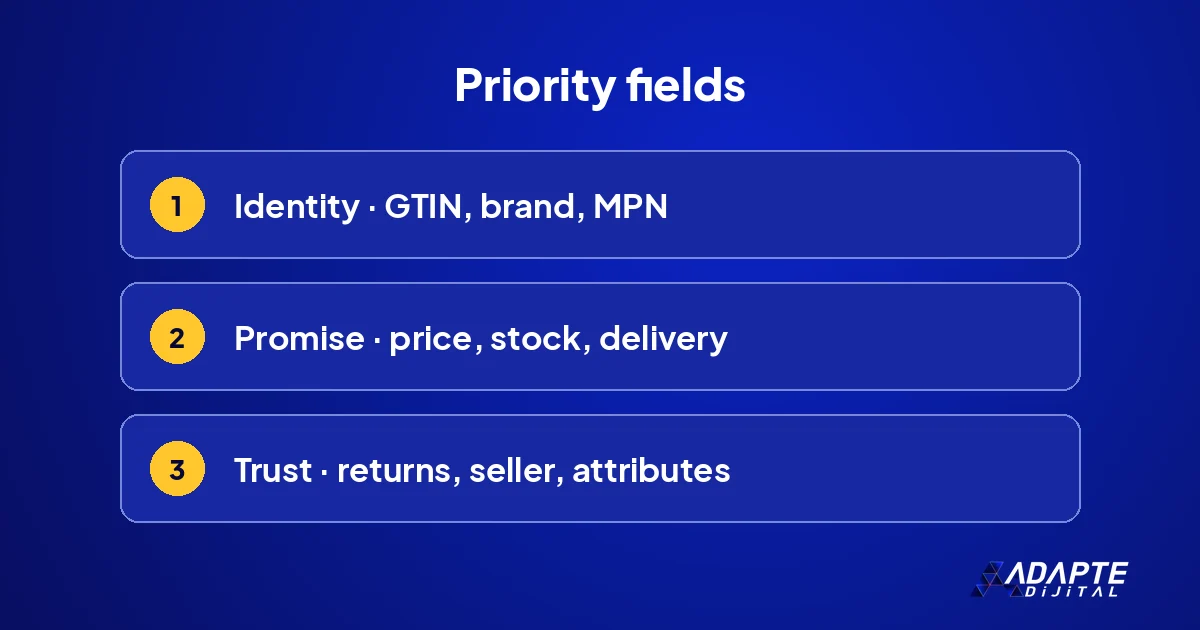
- GTIN, brand, MPN
- Title and category
- Variants
Identity fields let an agent recognise a product and match it with the same item in other stores.
GTIN, brand, MPN
The GTIN is the global identification number on a product’s barcode; the brand and manufacturer part number (MPN) complete it. The Merchant Center specification asks for the GTIN on products that have one assigned by the manufacturer. A correct GTIN puts a product into price comparisons. For custom products without a barcode, that fact is stated separately. The underlying structure is covered in organising product data.
Title and category
A title should state the brand, the product type and the distinguishing attribute in a plain order, such as “brand, model, colour, size”. Campaign phrases and capitalised emphasis belong in separate fields, not in the title. The right category decides in which questions an agent treats the product as a candidate, so a miscategorised product may never be considered at all. 🏷️
Variants
Options such as colour, size or capacity should be defined as separate variant records and linked by a shared group identifier. Each variant has its own price, stock and identifier. Variants squeezed into a single record make it impossible for an agent to answer “is size 42 in stock?”. Clean variants also make stock and price synchronisation more reliable across channels.
Price, stock and delivery
BU BÖLÜMÜN ÖZETİ
- Price consistency
- Stock freshness
- Delivery time and shipping
These three fields are the content of the promise an agent makes to the customer. When they are wrong, the problem lands directly on the order.
Price consistency
The price field must match the price on the product page and at checkout. A sale price goes in a separate field with its validity dates. A price that rises at checkout loses the trust of both the agent and the customer. Whether VAT is included, and the currency, should be explicit in every record, since an agent cannot ask a follow-up question the way a shopper can. 💳
Stock freshness
How often stock is updated can matter even more than price in agent commerce. WooCommerce’s August 2026 guide recommends updating stock in near real time from a single reliable source. Stock updated once a day makes false promises during the day for fast-selling products. The fastest sellers are the place to start, because that is where the gap between data and shelf grows quickest.
Delivery time and shipping
An agent answers delivery questions from data: shipping cost, handling time, transit time and shipping region. In Merchant Center, this information can be defined at account level or per product. Ranges such as “1–3 business days” are worth more than a vague “fast shipping”. The more concrete the delivery data, the more questions an agent can answer for the customer. 🚚
Returns and trust fields
BU BÖLÜMÜN ÖZETİ
- Return window and conditions
- Seller information
- Product attributes
An agent looks not only at whether a product is good but also at whether the purchase is free of risk.
Return window and conditions
The return window, who pays for returns and how a return is made should be written in a machine-readable way. A return policy can be defined in Merchant Center and marked up on the site with structured data. A product with unclear returns is a riskier option in the agent’s eyes. Statutory rights and the store’s extra commitments are written separately, so neither is mistaken for the other. 🔁
Seller information
The store’s name, contact details, address and customer service channels should be published consistently. Structured data for the organisation helps an agent recognise the store correctly. A seller whose identity is unclear falls behind in an agent’s list. This information should be the same on every channel, from the site footer to marketplace profiles.
Product attributes
Size, material, weight, compatibility, warranty period and usage information should be given as separate fields or in a tidy attribute table. This is what answers questions such as “will this case fit my phone?”. A product whose attributes are written down is a product that can speak in a comparison. Attributes are also where most return reasons can be prevented before the order. 📐
Where does data reach the agent from?
BU BÖLÜMÜN ÖZETİ
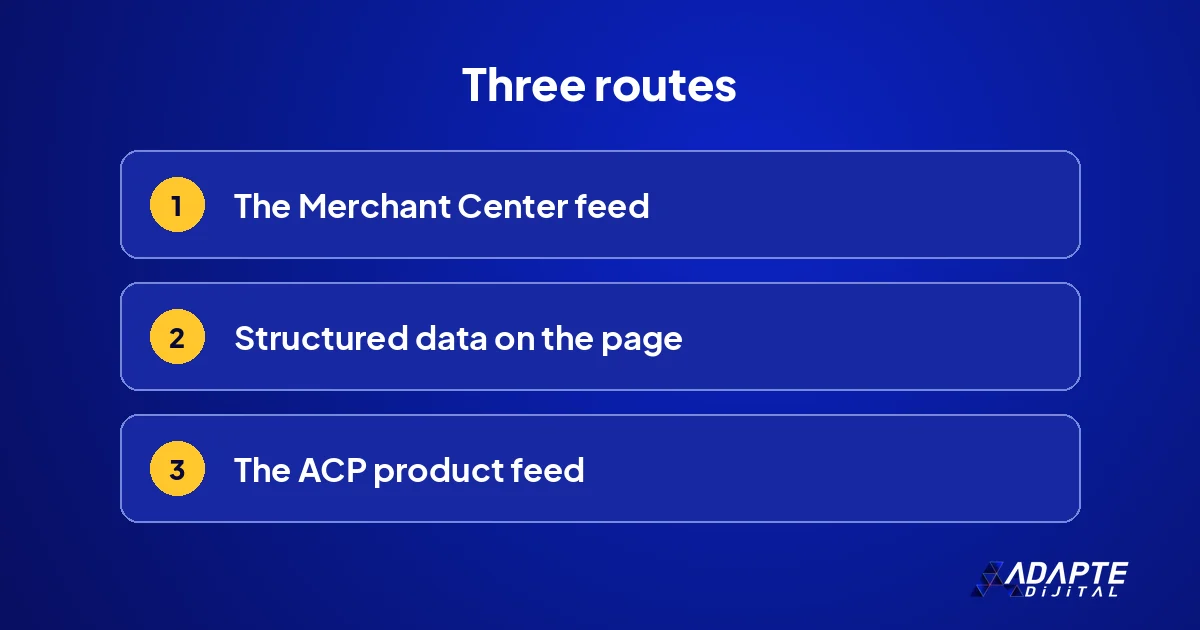
- The Merchant Center feed
- Structured data on the page
- The ACP product feed
The same data can reach an agent through three separate routes. All three need to say the same thing.
The Merchant Center feed
Google’s shopping surfaces read product data from Merchant Center, and onboarding to UCP also runs through Merchant Center. The feed’s error and warning report shows missing fields product by product. A clean feed is the base of visibility on the Google side. Ways to improve a feed are covered in shopping feed optimization.
Structured data on the page
Schema.org markup on the product page makes product, offer, shipping and return information machine-readable within the page itself. When an agent arrives at a page, it verifies the feed’s information here. Agreement between the feed and the structured data is the second link of trust. How this markup supports AI systems is discussed in schema structured data and AI. 🧩
The ACP product feed
On the ChatGPT side, product data is presented according to ACP’s feed specification. The fields largely resemble Merchant Center’s but are not identical. Producing both feeds from a shared master data source is safer than maintaining two by hand. It also reduces the risk of the two feeds drifting apart and contradicting each other over time.
How does Adapte Digital approach product data work?
BU BÖLÜMÜN ÖZETİ
- A single delivery package
- What is delivered
- Where to start
We do not fix product data once and walk away; we bind it to rules: fields are completed, the feed and structured data are aligned, and the rules are handed over to you.
A single delivery package
Adapte Digital does not charge a monthly management fee. Work starts with a single delivery package whose scope is written down in advance: 36,000 TRY + VAT. If the work grows, the new need is defined as a separate add-on package, priced by what will be delivered rather than by the hours spent. 📦
What is delivered
The output is a product table completed field by field, a consistency report for the feed and structured data, and catalogue rules for creating new products. The standards that read this data are compared in what UCP and ACP are.
Where to start
Which packages are open, and at what price, is shown on our campaign pages, item by item. 🧭
Thinking of building a business in this area? Our article on product data preparation services looks at that door separately.
Quick Summary
- An agent reads a product from structured data and the feed record, not from the page.
- Identity fields (GTIN, brand, MPN) put a product into comparisons.
- Price, stock and delivery are the content of the agent’s promise to the customer.
- Return, seller and attribute information makes a purchase look risk-free.
- The feed, structured data and the ACP feed should draw on the same master source.
Short Glossary
- MPN
- The part number a manufacturer assigns to a product; an identity field that complements the GTIN.
- Variant group
- A structure that links a product’s options, such as colour and size, through a shared identifier.
- Master data source
- The single source where product information is considered correct and from which it is distributed to other channels.
Frequently Asked Questions
Next Step
For your five best-selling products, compare the price in the feed, on the page and at checkout; if there is a difference, note where it comes from. Our campaign pages list the delivery packages that cover this work.
Sources: Google Merchant Center Help — Product data specification · Schema.org — Product · WooCommerce — From found to bought: Getting your store ready to sell through AI
Updated: November 2026
Sık Sorulan Sorular
Handmade or custom products may not have a GTIN. In that case, fill in the brand and manufacturer part number, state in the feed that there is no GTIN, and never fill the field with a random number.
Restructure them rather than shorten them. A description that cuts adjectives and puts size, material, compatibility and usage first answers the questions of both the agent and the customer.
The fields overlap a great deal but are not identical. The healthiest approach is to produce both feeds from the same master data source.