
Agent Access Policy: Which AI Bots and Agents Should Enter Your Site, and Why?
An agent access policy is a short document that sets out in writing what a site opens to AI bots and agents, what it closes and why those decisions were made. Behind the few lines in robots.txt, there should be a decision someone thought through. 🔐
This article covers what an access policy is, the types of visitor a site receives, the tools available, how to write the policy and its risks. The information was checked on 12 November 2026 against official documentation and standards texts.
What is an agent access policy, and why is it needed?
The number and variety of automated visitors to websites is growing fast. A policy is how a site responds to that crowd consistently.
Definition
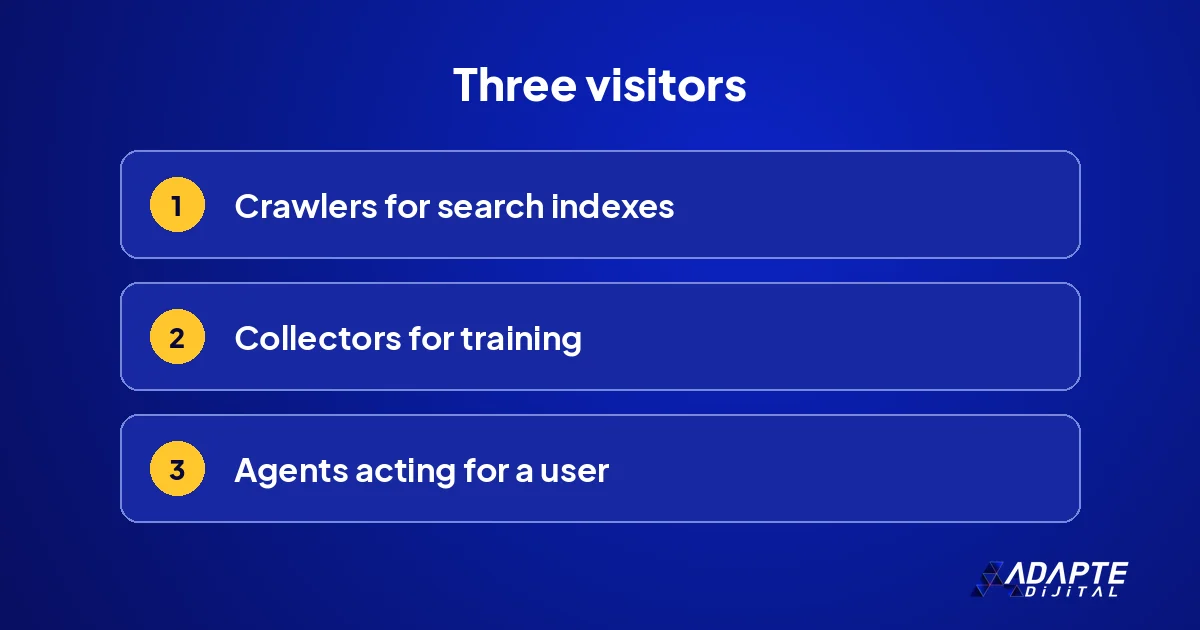
An access policy sets out the site’s stance towards crawlers that build search indexes, bots that collect data for model training and agents that open pages on a user’s behalf. Each stance comes with its reason and the name of the person who decided it. The policy is the source of the technical settings; robots.txt and firewall rules are derived from it and never contradict it. 📄
What types of visitor are there?
BU BÖLÜMÜN ÖZETİ
- Crawlers that build search indexes
- Collectors for training
- Agents acting for a user
Automated visitors related to AI fall into three main groups. Each group has a different purpose and a different means of control.
Crawlers that build search indexes
These bots read pages to add them to the index of an AI search service. According to OpenAI’s documentation, visibility in ChatGPT search is managed through OAI-SearchBot. Blocking these bots risks not appearing in assistants’ answers. For most service businesses, this door stays open, because these answers are exactly where customers look for them today. 🔍
Collectors for training
Some bots collect content to train AI models; at OpenAI, GPTBot does this job, and at Google, the Google-Extended token controls training use. Closing training is not the same decision as search visibility, but each company draws the line differently, so each one’s documentation has to be read. Platforms’ own default settings for training are discussed in platform content and AI training defaults.
Agents acting for a user
Visits that happen when a user tells their assistant to open a page or do a task form a separate group. According to OpenAI, robots.txt rules may not apply to user-initiated ChatGPT-User visits. For this group, identity verification is a more effective tool than robots.txt. It lets a site trust a verified agent while still checking unknown automation that copies familiar names. 🤖
Which tools are used?
BU BÖLÜMÜN ÖZETİ
- Robots.txt
- The Search Console setting
- Firewalls and signature verification
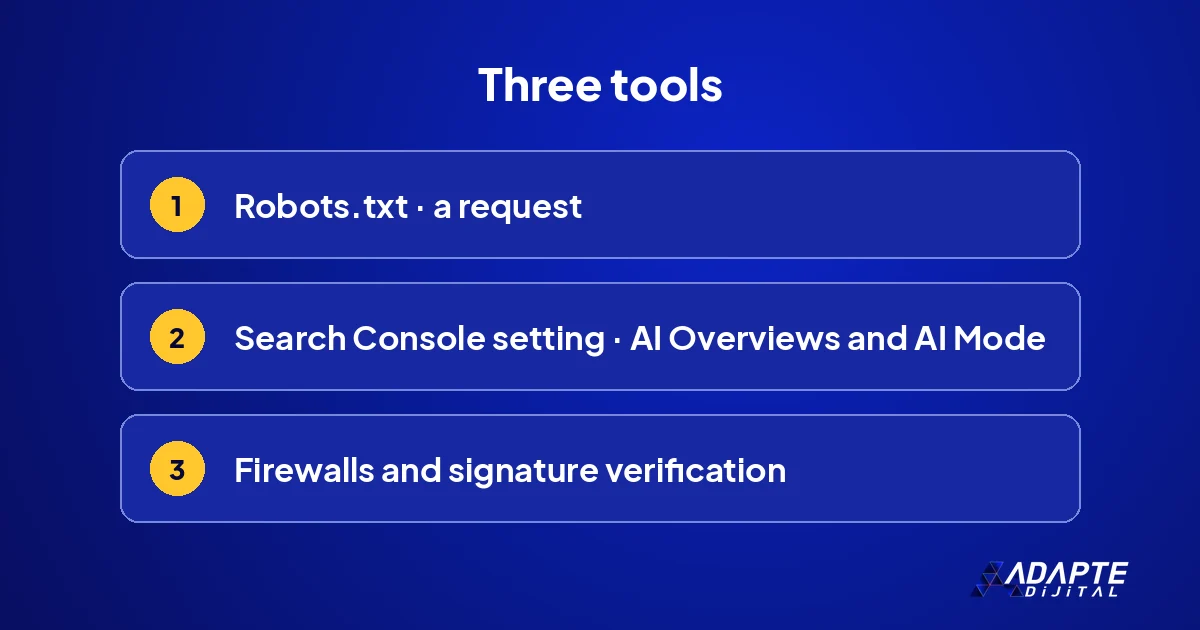
An access decision is not enforced with a single tool. Three tools are used together, and each has a different strength.
Robots.txt
Robots.txt is a file that tells bots which paths not to crawl, and it was standardised as RFC 9309. The standard itself states that these rules are not a form of access authorisation. Robots.txt is a request, not a lock; well-behaved bots comply, ill-intentioned ones may not. The status of another machine file is covered in what llms.txt is. 📜
The Search Console setting
In August 2026, Google opened a Search Console setting to all sites that lets them choose whether to appear in AI Overviews and AI Mode. According to Google, a site that switches it off receives no traffic or impressions from those features, and the setting is not used as a ranking signal in search outside them. Training control runs separately through Google-Extended. The two decisions should be made independently.
Firewalls and signature verification
Firewalls and CDN services can separate bots by identity and behaviour. The Web Bot Auth draft being developed at the IETF proposes that agents send their requests with a cryptographic signature. Signature verification is far more reliable than a user-agent string, because anyone can copy that string. As more agents sign their requests, this becomes the most precise tool a site has. 🛡️
How is the policy written?
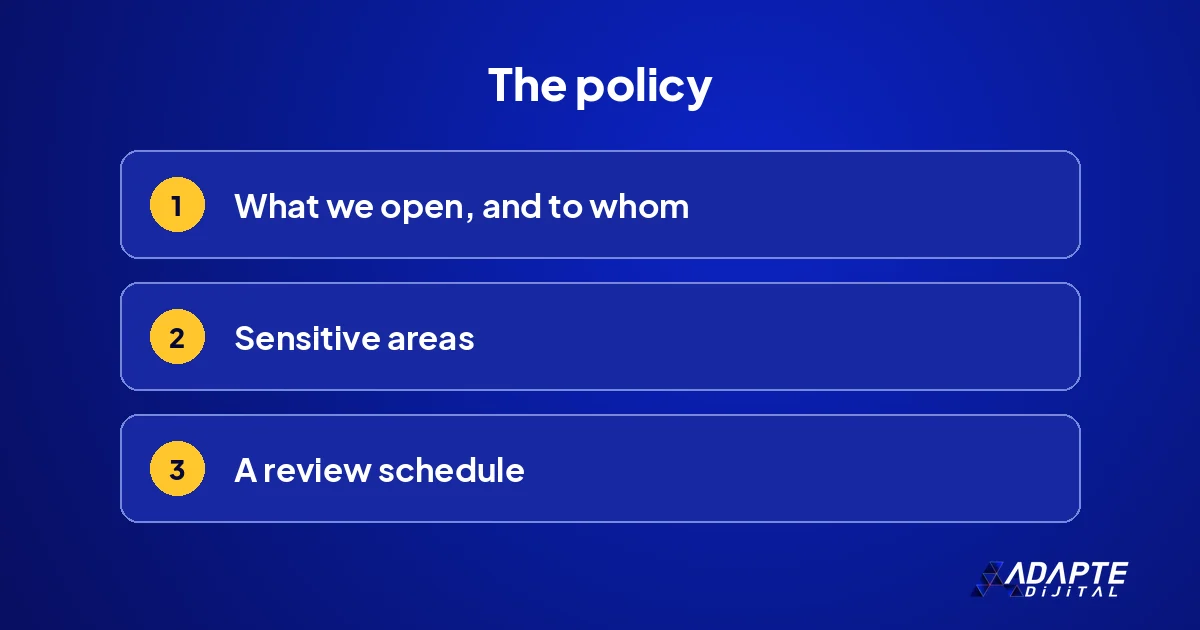
A good access policy fits on one page. It has three sections and is reviewed at least once a year.
Sensitive areas
Customer dashboards, payment steps, internal search results and pages containing personal data are handled in a separate section of the policy. These areas are protected not only by robots.txt but by session and permission controls. If a page that must stay private is listed in robots.txt, its address is effectively announced to everyone. Privacy is therefore secured with other tools.
A review schedule
New bots, new platform settings and new signature methods keep appearing. The policy is reread at least once a year and after every major platform change. Every change is recorded with its date, so it is always possible to see when and why a setting changed. A dated record also makes it easy to undo a change that turns out to be a mistake. 📆
What are the risks and limits?
BU BÖLÜMÜN ÖZETİ
- Rules may not be followed
- Blocking by mistake
- The cost of closing
An access policy is a powerful tool, but it has limits. Knowing three risks up front sets expectations correctly.
Rules may not be followed
Some bots ignore robots.txt, and some visits made on a user’s behalf are not bound by those rules. A policy does not replace technical protection; sensitive content is protected with sessions, permissions and firewalls. The policy tells well-intentioned visitors what is expected and gives direction to the technical settings, which do the actual enforcing. ⚠️
Blocking by mistake
A new version of a security plugin or CDN setting can block wanted assistants without anyone noticing. Only server logs or falling enquiries reveal the error. A short agent test after every settings change greatly reduces this risk. The result of the test is added to the guide with a date, so the next person can see what was checked and when.
The cost of closing
Blocking every AI visitor may look like protecting content, but not appearing in assistants’ answers can mean customers never hear of the business at all. A decision to close is also a marketing decision. That is why the policy is written not only with the technical team but with the business owner, who carries the cost of either choice. ⚖️
What does Adapte Digital do on access policy?
BU BÖLÜMÜN ÖZETİ
- A single delivery package
- What is delivered
- Where to start
We write your access policy with you and translate it into technical settings: robots.txt, the Search Console setting and firewall rules are aligned with the policy and handed over.
A single delivery package
Adapte Digital does not charge a monthly management fee. Work starts with a single delivery package whose scope is written down in advance: 36,000 TRY + VAT. If the work grows, the new need is defined as a separate add-on package, priced by what will be delivered rather than by the hours spent. 📦
What is delivered
The output is a one-page access policy, an updated robots.txt, a firewall check note and a review schedule. How often AI crawlers actually visit is discussed in how often AI crawlers read your site.
Where to start
Which packages are open, and at what price, is shown on our campaign pages, item by item. 🧭
Thinking of building a business in this area? Our article on agent traffic analysis looks at that door separately.
Quick Summary
- An agent access policy sets out, with reasons, what is open to AI bots and agents.
- There are three visitor types: search crawlers, training bots and agents acting for a user.
- The tools are robots.txt, the Search Console setting, firewalls and signature verification.
- The policy fits on one page and is reviewed at least once a year.
- Robots.txt is a request; a decision to close is also a marketing decision.
Short Glossary
- Robots.txt
- A text file at a site’s root that tells bots which paths not to crawl.
- Google-Extended
- A robots.txt token Google provides for controlling use in AI training.
- User-agent string
- The text a bot or browser uses to identify itself, which is easy to copy.
Frequently Asked Questions
Next Step
Sort the AI lines in your robots.txt into three groups, search, training and user-initiated visits, and write a one-sentence decision for each group. Our campaign pages list the delivery packages that cover this work.
Sources: RFC Editor — RFC 9309: Robots Exclusion Protocol · OpenAI — Overview of OpenAI Crawlers · Google — New opportunities, control and insights for website owners · IETF Datatracker — draft-ietf-webbotauth-httpsig-protocol (Web Bot Auth)
Updated: November 2026
Sık Sorulan Sorular
An access decision that is not written down gets debated again with every security update or change of agency. One person blocks a bot; someone else unblocks it without knowing why. A written policy keeps decisions consistent and gives a single answer to anyone who asks why a setting is the way it is. It also keeps the arrangement intact when the team or the agency changes.
Publishers whose content is valuable, service businesses that want to share their information and shops that sell products need different policies. A publisher may close training and keep search open, while a service business may leave most doors open for visibility. The right policy depends on the business model, which is why it cannot be copied from someone else’s robots.txt. 🏢
A one-sentence decision is written for each visitor group, for example: open to search crawlers, closed to training bots, open to user-initiated agents if signed. The decision sentence is the plain-language version of the technical setting. How to organise the data agents will read is covered in structured data for agents. 🗂️
It depends on your business model. Blocking protects content but risks not appearing in assistants’ answers; separate decisions for search and training are more balanced for most businesses.
Not completely. According to OpenAI, its search and training bots are managed through robots.txt, but those rules may not apply to user-initiated visits.
According to Google, the setting is not used as a ranking signal in search outside AI Overviews and AI Mode. You will, however, get no traffic or impressions from those features.