
Agent-Ready Website at 2 Years: Standards Mature, So What Should a Site Keep Ready?
The two-year horizon for an agent-ready website is a time frame in which today’s trials could turn into routine work. Which interface will lead in two years is unclear, but which preparation will pay off either way can already be seen. 🔭
This page is the sixth step in the agent-ready web horizon series. It covers what may change in two years, which way standards may move, how Türkiye may be affected, what a site prepares today and what is rising over this time frame. Every inference on a distant horizon is a forecast and is marked as such.
What may change in two years?
BU BÖLÜMÜN ÖZETİ
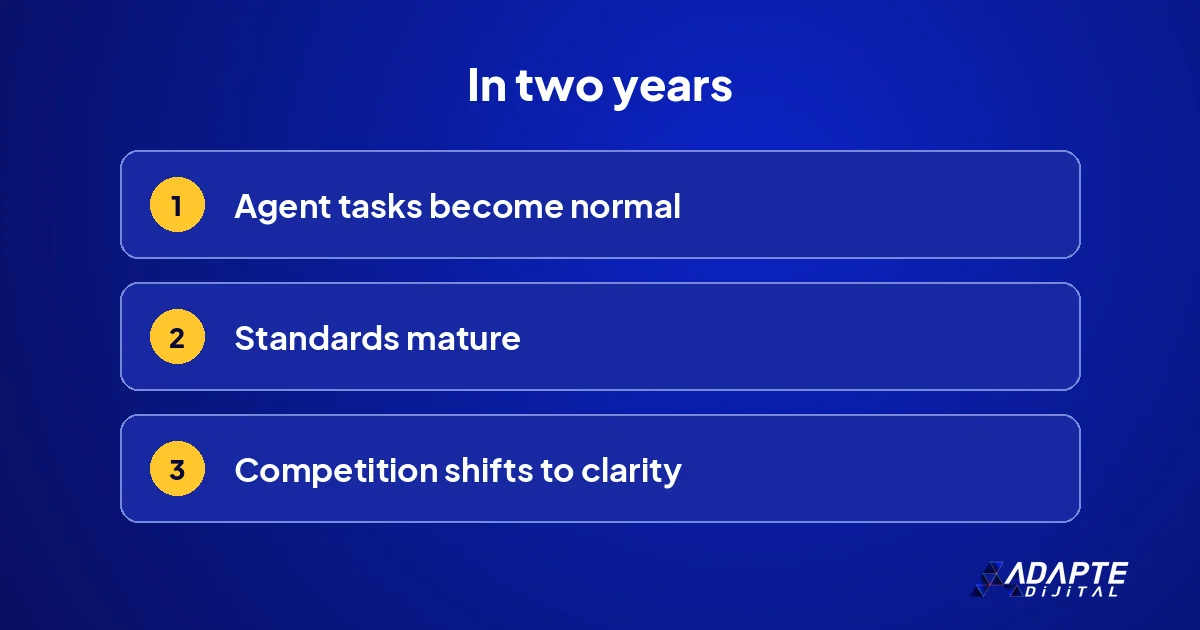
- Getting things done through agents becomes normal
- Standards mature
- Competition shifts to clarity
Two years is often long enough for a technology to move from trial to ordinary use. Three changes look especially likely.
Getting things done through agents becomes normal
Over a two-year horizon, leaving a booking, quote or information request to an assistant may become ordinary behaviour for part of a business’s customers. In that case, enquiries from agents are no longer a separate project; they are a natural part of daily work. The source tracking and confirmation flow built today are how a business enters that period prepared. A business without them loses those enquiries without noticing. 🤝
Standards mature
During 2026, WebMCP changed its name, opened for trial in Chrome and saw its draft updated several times. Within two years, the interface is likely to settle into a more stable form, and other browsers’ positions are likely to become clearer. Maturity means less risk for a site; a trial run in a test environment today moves to the live site with fewer surprises later.
Competition shifts to clarity
Once tool interfaces are open to many sites, what decides an agent’s choice will still be the accuracy of information, the clarity of forms and the business’s trust signals. When everyone has the same door, the difference lies in the order behind it. That is why the basic work offers a longer-lasting advantage than any new interface on its own. 🏁
How may standards change in two years?
BU BÖLÜMÜN ÖZETİ
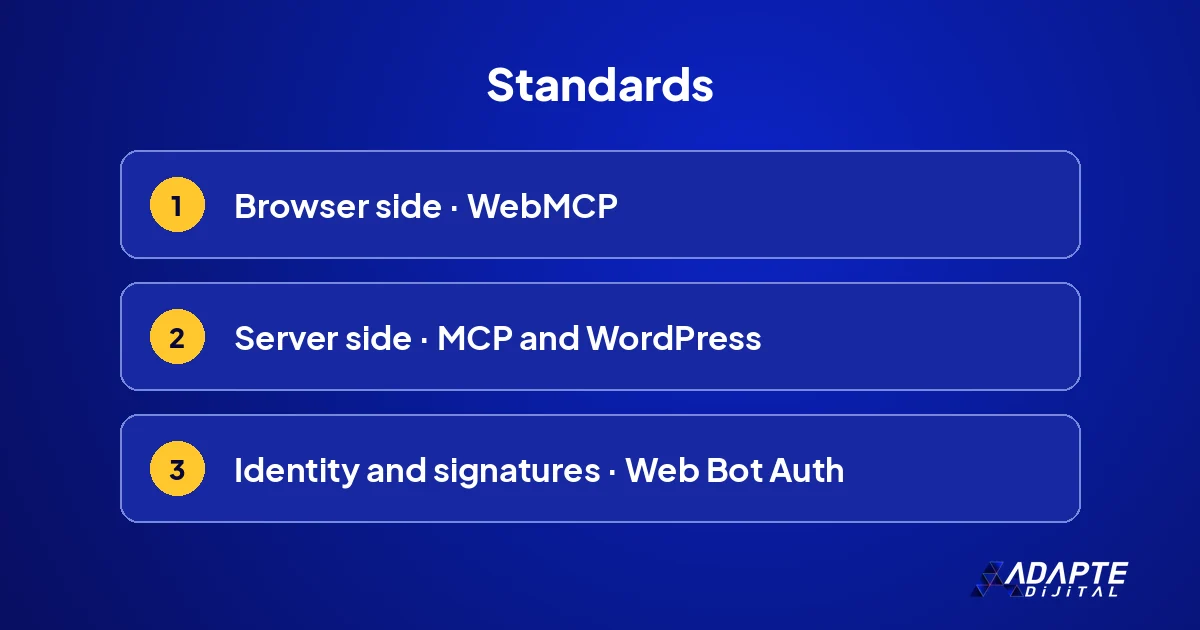
- The browser side
- Server-side tools
- Identity and signatures
Today’s developments offer clues about where the next two years may go. Three areas stand out.
The browser side
WebMCP is currently a W3C community group draft in trial in Chrome, while Edge offers the feature behind a flag. Whether the draft moves closer to a standards process within two years depends on other browsers joining in. A feature that relies on a single browser should not replace core functionality until then. The site must keep working completely without it, whatever the browser. 🌐
Server-side tools
MCP is an open protocol that AI applications use to connect to external systems. WordPress has built a path for opening site abilities to it through the Abilities API and the official MCP Adapter. Within two years, these tools are likely to reach ordinary sites through plugins, but opening each ability will remain a permissions decision. The details are covered in preparing a WordPress site for agents.
Identity and signatures
The Web Bot Auth draft at the IETF proposes a way for agents to identify themselves verifiably. Over a two-year horizon, platforms may increasingly expect agents to sign their requests. More tasks can be opened to verified agents, while automation of unknown identity is checked more strictly. The access policy is updated to reflect that distinction, and the change is recorded with a date. 🔐
How may Türkiye be affected?
BU BÖLÜMÜN ÖZETİ
- An uncertain timetable
- Content in Turkish
- Local infrastructure
No timetable has been announced for Türkiye. But the variables that will affect sites in Türkiye can already be seen.
An uncertain timetable
Google’s booking and quote links in AI Mode are limited to the United States today, and no date has been given for Türkiye. Timetables have also been seen to slip. The right stance for a site in Türkiye is not to wait for the timetable but to be ready whenever it arrives. That is why the basic preparation is done now and kept up steadily. 🗓️
Content in Turkish
Assistants’ answers to questions asked in Turkish rely on clear, well-organised content written in Turkish. Writing service names, price ranges and terms plainly in Turkish helps the agent match them correctly. Content that reads like a translation, or that is buried in images, is a disadvantage in Turkish searches. On multilingual sites, both languages deserve equal care; see multilingual websites.
Local infrastructure
In Türkiye, a large share of booking, reservation and payment work runs through local software. Whether these providers open their doors to assistants may decide how quickly getting things done through agents spreads in Türkiye. Asking your provider about its roadmap on this is a simple but valuable step you can take today, and the answer shapes your own plan. 🧩
What does a site prepare today?
BU BÖLÜMÜN ÖZETİ
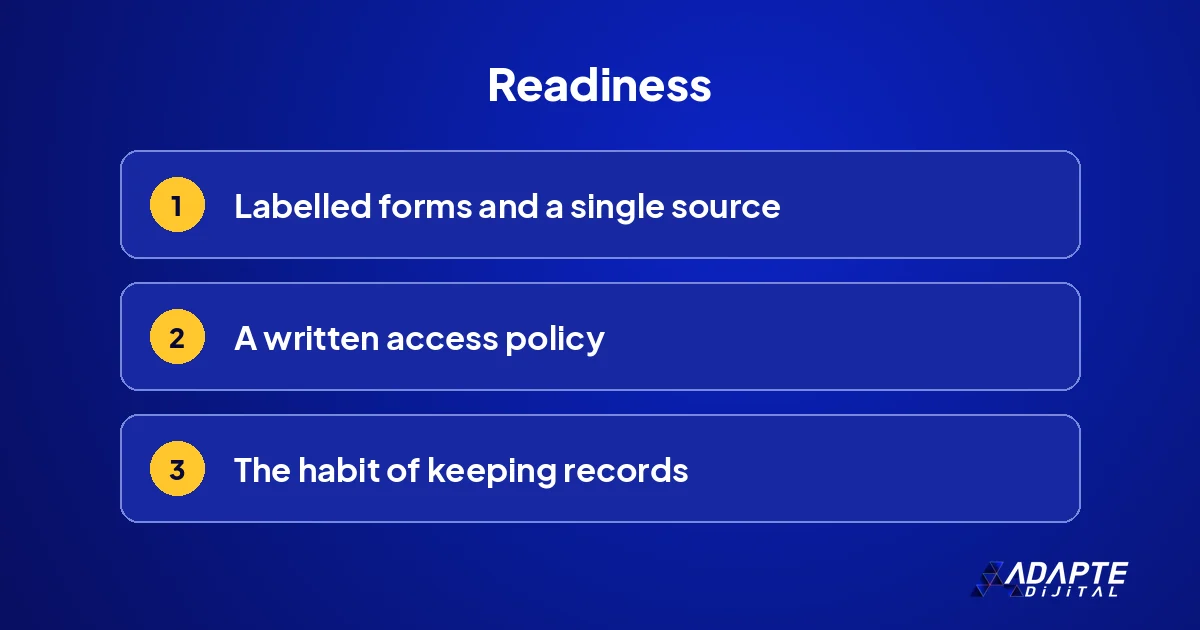
- Labelled forms and a single source
- A written access policy
- The habit of keeping records
Preparing for the two-year horizon is nothing more than keeping today’s work going. Three habits pay off in every scenario.
Labelled forms and a single source
Forms made of labelled fields of the right type, and content fed from a single source, pay off whichever interface comes to the fore. This foundation turns adding a new interface into a matter of hours rather than days. Every form fix made today is also preparation for the tool layer two years from now. With a solid base, a new interface is simply an addition. ✅
A written access policy
A policy that records what is open to which agent makes quick decisions possible when new bots and signature methods arrive. The policy is a fixed reference point against changing technology. How to write one is explained in the agent access policy. A short document reviewed once a year proves useful many times over two years.
The habit of keeping records
If enquiry sources, agent test results and settings changes are recorded from today, it will be possible to see in two years which preparation paid off. Records are the most valuable document on a long horizon. A site that keeps no records lives through change without learning from it. The routine is kept simple so it survives busy periods too. 📒
What is rising over this time frame?
BU BÖLÜMÜN ÖZETİ
- Today: choice for site owners
- Forecast: control tools multiply
- Forecast and log
Over a two-year horizon, the choices given to site owners are widening. The first item is today’s status; the next two are forecasts.
Today: choice for site owners
Google announced a Search Console setting in June 2026 in response to expectations from the UK competition regulator, and made it available worldwide in August 2026; site owners can now choose whether to appear in AI Overviews and AI Mode. Regulators and platforms are taking steps that increase site owners’ control. 📅
Forecast: control tools multiply
Forecast: within two years, other platforms will also offer site owners similar settings for AI features and agent access. Sites with a written access policy will be able to manage these settings within a single framework rather than through scattered decisions.
Forecast and log
Forecast: within two years, sites that offer their forms as tools will form a visible group among businesses that take bookings and quotes in Türkiye as well. Update log. 12 November 2026: first publication. The forecasts on this page are re-read when they fall due; a forecast that turns out wrong is not deleted but corrected here. The next step in this series is agent-ready website at 3 years.
How does Adapte Digital approach the two-year horizon?
BU BÖLÜMÜN ÖZETİ
- A single delivery package
- Today’s step
- Where to start
We prepare for the two-year horizon not by writing a long plan but by building today’s foundation well: forms, the content source and the access policy are put in order and handed over.
A single delivery package
Adapte Digital does not charge a monthly management fee. Work starts with a single delivery package whose scope is written down in advance: 36,000 TRY + VAT. If the work grows, the new need is defined as a separate add-on package, priced by what will be delivered rather than by the hours spent. 📦
Today’s step
Today’s version of the two-year direction is labelled forms, content fed from a single source and a written access policy. We decide together which step comes first, within a single delivery package.
Where to start
Our current packages and capacity are listed on our campaign pages; scope and price are written there before any work starts. 🧭
Quick Summary
- Over two years, getting things done through agents may become routine and standards may mature.
- Standards are developing on the browser, server and identity sides.
- There is no timetable for Türkiye; Turkish content and local infrastructure may be decisive.
- Today’s preparation: labelled forms and a single source, a written access policy, record keeping.
- Inferences on a distant horizon are forecasts and are re-read in the log.
Short Glossary
- Maturity
- A standard’s move from trial to stable, widespread use.
- Tool interface
- An interface that describes what a site can do in a form agents can call.
- Control setting
- A setting where a site owner chooses how their content is used in AI features.
Frequently Asked Questions
Next Step
Rate your site’s three core preparations, labelled forms, a single source and an access policy, in one sentence each, and note which one is missing. Our campaign pages list the delivery packages that cover this work.
Sources: Google — New opportunities, control and insights for website owners · IETF Datatracker — draft-ietf-webbotauth-httpsig-protocol (Web Bot Auth) · W3C Web Machine Learning Community Group — WebMCP (Draft Community Group Report)
Updated: November 2026
Sık Sorulan Sorular
A solid foundation works better than a detailed plan: labelled forms, single-source content and a written access policy keep their value in every scenario.
That is uncertain. It is currently a community group draft in trial in Chrome; nothing definite can be said until other browsers’ positions are clear.
No timetable has been announced. The best stance is to keep forms and content ready, whenever it arrives.