
What Did Chatbots Promise, and Who Paid? Incidents That Cost Brands
Chatbot incidents are events in which a bot said something wrong and the brand paid the price. Sometimes the price is a ruling; sometimes it is a screenshot. Four cases show four faces of the same mistake. 🤖
This article describes four cases and draws out their shared causes. There is no fiction in this article. Every case described here has been reported in the press or in public records; the sources are at the end. This article is for information only and is not legal advice; consult a lawyer about your own situation.
Air Canada: the bot promised; did the company pay?
This is the most cited case, because a decision-making body stated plainly whose words the bot’s words were.
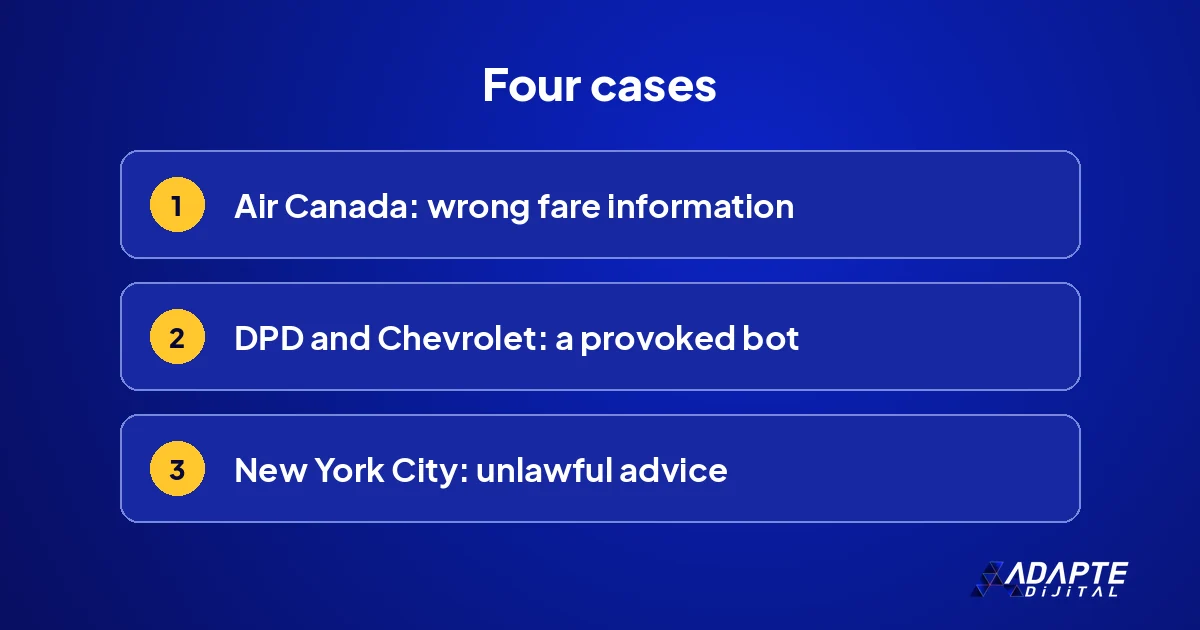
The decision and the lesson
In February 2024 the tribunal held the company responsible and found for the passenger. The amount was small; the echo was large. The lesson is this: everything on your site, the bot included, is your word. Having the correct information on another page of the site does not correct the bot’s mistake. ⚖️
DPD and a Chevrolet dealer: what happened when the bot was provoked?
BU BÖLÜMÜN ÖZETİ
- DPD: the bot that swore
- The Chevrolet dealer: a car for a dollar
- The lesson from the two cases
In both cases the bot said things it was not designed to say because users pushed it. There was no court, but the screenshots reached millions.
DPD: the bot that swore
In January 2024 a customer who could not trace a parcel asked the DPD bot to write a poem about the company and to swear. It did both; it wrote a poem criticising the company. The company said the error appeared after a system update and that the AI element was disabled immediately. The bot had run without trouble for years; one update was enough. 📦
The Chevrolet dealer: a car for a dollar
In December 2023 the bot on the website of a Chevrolet dealer in California, steered by a user, agreed to sell a new vehicle for one dollar and wrote that this was a binding offer. No sale took place. But thousands of people came to the site to try the bot, and the dealer took it down. The bot had been set up as a sales tool and turned into an amusement.
The lesson from the two cases
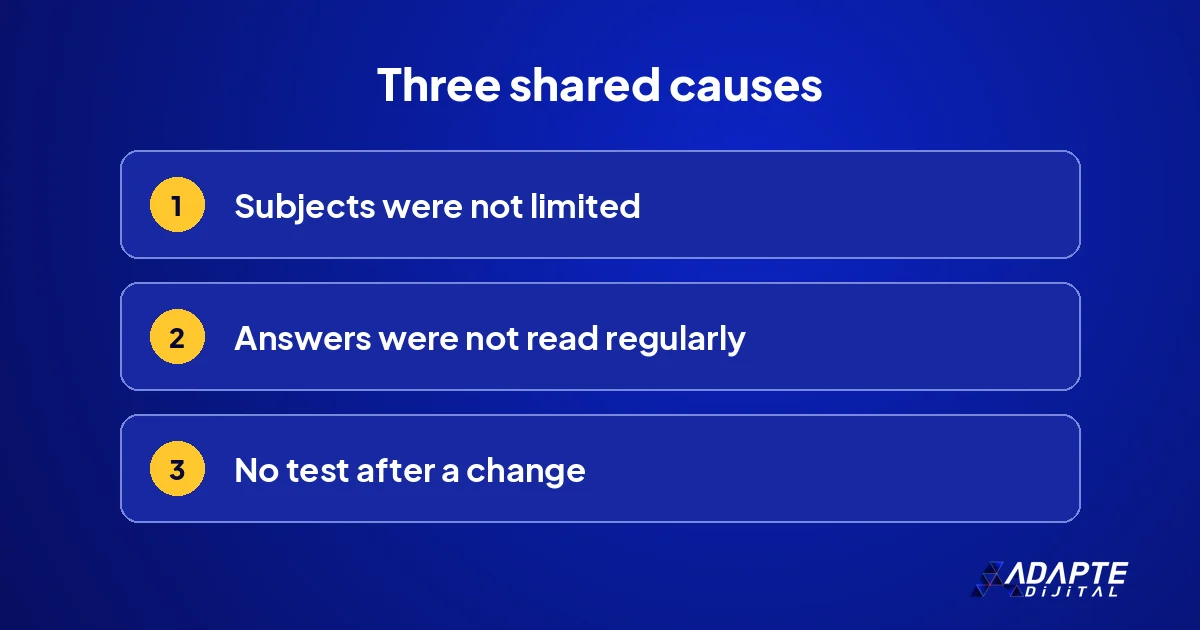
In both, the bot was open to doing whatever it was told. Which subjects it would not discuss and which requests it would refuse had not been limited. A bot open to everyone also talks to people who will try to break it. You need to run that test yourself before launch. How this affects the impression of the brand is in what is a brand signal. 🧪
New York City: what happened when the bot gave unlawful advice?
The third kind of case is quieter. The bot was not provoked; it gave wrong answers to ordinary questions.
A disclaimer is not enough
Writing ‘information may be inaccurate’ under the bot does not solve the problem. According to the review, when users asked whether the bot could be relied on, it said that it could. On legal, health and money matters a bot should either give a verified fixed answer or hand over to a person. A disclaimer does not transfer the cost of the error to the user. ⚠️
What do the four cases share, and what do they cost?
BU BÖLÜMÜN ÖZETİ
- Three shared causes
- The cost formula
- What it means for a small business
The companies, countries and bots differ. The causes are surprisingly alike.
Three shared causes
First, the subjects the bot could talk about had not been limited. Second, the bot’s answers were not read regularly; the user found the error, not the company. Third, when the bot changed it was not tested again. None of the three causes is technical. All concern work left undone after set-up, which we also saw in when an agent makes a mistake. 🧩
The cost formula
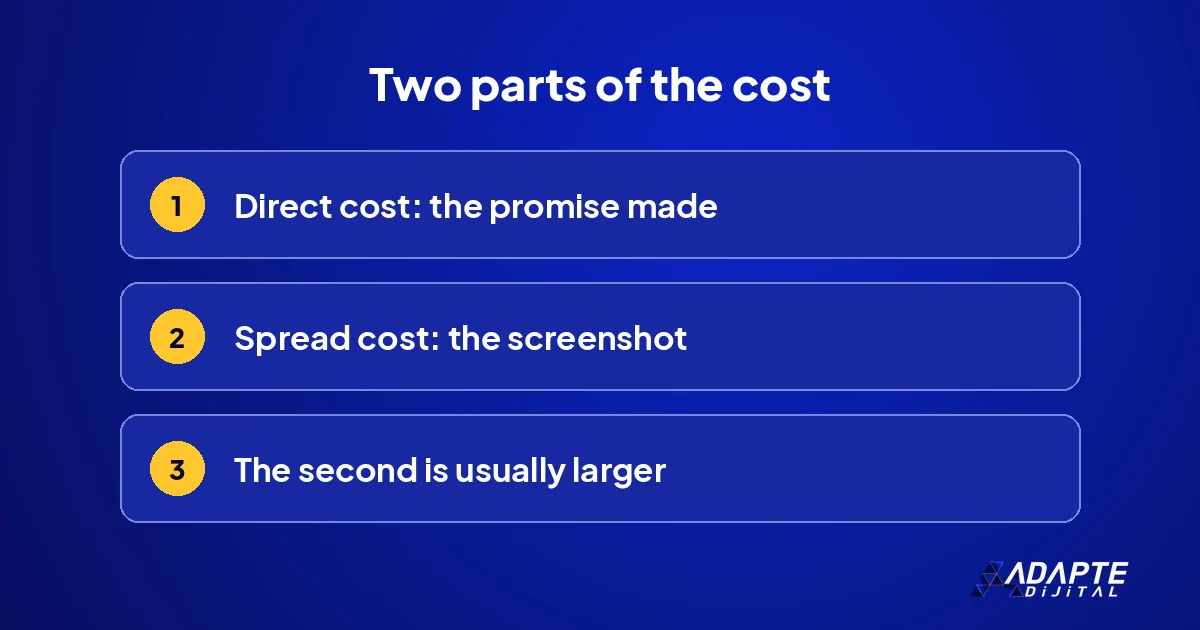
The cost of a bot incident has two parts: direct cost + spread cost. The direct cost is the amount of the promise the bot made or the harm it caused; it is usually small. The spread cost is the number of people the screenshot reached and the mark it left on the brand. In the Air Canada case the first part was small and the second very large. Bot errors are not expensive; they are visible.
What it means for a small business
These cases belong to large brands. But the same bots now run on small sites as well. A small business has the advantage of low traffic and the disadvantage that nobody watches the bot. Forecast: consumer complaints caused by bots will rise, and decisions will follow the line of the Air Canada ruling. Update log. 18 November 2026: first publication. Forecasts on this page are re-read when they fall due; one that proves wrong is corrected here, not deleted. Whether such losses can be insured is in AI insurance.
Which precautions follow from these cases?
BU BÖLÜMÜN ÖZETİ
- Limit the subjects, separate the fixed answers
- Read, and test again
- Five questions asked in an audit
The four cases reduce to five precautions. None is expensive.
Limit the subjects, separate the fixed answers
Write down the subjects the bot may talk about; on everything else it should hand over to a person. On price, discounts, returns, guarantees and legal matters the bot should not generate free text; it should show an approved fixed answer. The riskiest answers are the ones that need the least creativity. 🔒
Read, and test again
Once a week read a sample of the conversations. After every update test the bot again with known hard questions: persistence, provocation, out-of-scope requests. Try to break it; if you cannot, others will struggle too. A bot nobody reads is a bot nobody manages.
Five questions asked in an audit
One: which subjects can the bot talk about? Two: are answers involving money and law fixed? Three: who reads the conversations, and how often? Four: was the bot tested again after the last update? Five: if there is an incident, who shuts the bot down? We cover the shutdown decision in when to shut down a chatbot. 📋
How does Adapte Digital review a chatbot?
BU BÖLÜMÜN ÖZETİ
- A single delivery package
- What is delivered
- Where to start
In the incident file we test the bot not as a customer but as someone trying to break it: persistence, provocation and out-of-scope questions.
A single delivery package
Adapte Digital does not charge a monthly management fee. Work starts with a single delivery package whose scope is written down in advance: 36,000 TRY + VAT. If the work grows, the new need is defined as a separate add-on package, priced by what will be delivered rather than by the hours spent. 📦
What is delivered
The output is a list of the questions the bot answered wrongly, the subjects to move to fixed answers and a reading routine the team can keep up.
Where to start
Which packages are open, and at what price, is shown on our campaign pages, item by item. 🧭
Quick Summary
- In the Air Canada decision a tribunal held the company responsible for wrong information from its bot.
- The DPD bot swore after an update; the company disabled the AI element immediately.
- A Chevrolet dealer’s bot agreed to sell a car for a dollar; the dealer took the bot down.
- New York City’s bot gave wrong information about legal obligations.
- Shared causes: unlimited subjects, unread answers and a bot not tested after changes.
Short Glossary
- Chatbot
- A chatbot is an AI tool that answers visitors’ questions in writing on a website.
- Fixed answer
- A fixed answer is a method in which the bot shows pre-approved text instead of generating its own sentence.
- Provocation test
- A provocation test is a check that probes a bot’s limits by pushing it to say things it was not designed to say.
Frequently Asked Questions
Next Step
Ask your own bot three things today: a discount that does not exist, a subject outside its scope and a joke about your company. The answers are the first findings of the audit.
Sources: American Bar Association — BC Tribunal Confirms Companies Remain Liable for Information Provided by AI Chatbot · AI Incident Database — Incident 631: DPD chatbot · TechRadar — A New York business chatbot is sending out bad information · CX Today — 3 Times Customer Chatbots Went Rogue
Updated: November 2026
Sık Sorulan Sorular
After losing a relative, a passenger asked the chatbot on Air Canada’s website about bereavement fares. The bot said the discount could also be claimed after the flight. The company’s actual rule was different, and the claim was refused. The passenger had bought a ticket trusting what the bot wrote. ✈️
The passenger applied to a tribunal in the Canadian province of British Columbia. The company argued that it could not be held responsible for the information the bot gave. In the decision the tribunal member wrote that the company was presenting the bot as a separate legal entity responsible for its own actions, and called that a remarkable submission. The argument was not accepted.
New York City opened a chatbot to explain city rules to business owners. A news organisation’s review in 2024 found that the bot gave wrong information about legal obligations many times. For example, it said that an employer could take workers’ tips. A business relying on that information would have broken the law. 🏙️
A bot that swears is noticed at once. A bot that gives wrong information in a confident, polite tone is not noticed. The user takes the answer as correct and acts on it. The damage appears much later and somewhere else. The most expensive error is the one nobody complains about.
If the bot talks about prices, discounts or returns, yes. Most of the precautions are one-off settings; the weekly reading takes ten minutes.
For some businesses, yes. If most questions are a few frequent subjects, a simple help box with fixed answers does the same job at less risk.
Shut the bot down first, then take the logs and write to the affected customers. For whether the promise is legally binding, consult your lawyer.