
Evidea names Irem Aydin marketing director, how do retailers build AI-powered marketing?
Turkish home and living retailer Evidea has appointed İrem Aydın as marketing director, and her focus areas include bringing artificial intelligence into marketing, AI-assisted creative production and personalisation technology (Perakende.org, 29 September 2026). Aydın has more than 14 years of experience in FMCG and retail. At Evidea she is responsible for marketing and communication strategy, growth, CRM, digital marketing, social media, customer experience and corporate communications.
What it means for you: a home and living retailer that is expanding its store network is rebuilding marketing around customer data and AI. In autumn 2026, every business in Türkiye selling home textiles, decor or kitchenware faces the same question. What is the small-scale version of this system, and where do you start?
Which areas will Evidea’s new marketing director İrem Aydın lead?
Her remit covers seven areas: marketing and communication strategy, growth, CRM, digital marketing, social media, customer experience and corporate communications. The report highlights AI integration and personalisation as her focus areas. It does not give a start date; we only have the publication date.
Why is a home and living retailer like Evidea rebuilding marketing around AI?
Because as the range grows, producing content for every product by hand gets harder. You cannot hand-craft the images, descriptions and campaign copy for thousands of SKUs one by one. AI can speed up creative production and also read customer data to decide who should see which product. The report does not say which tools or budget Evidea will use to build this.
How does a small home textiles shop build AI-powered marketing like Evidea’s?
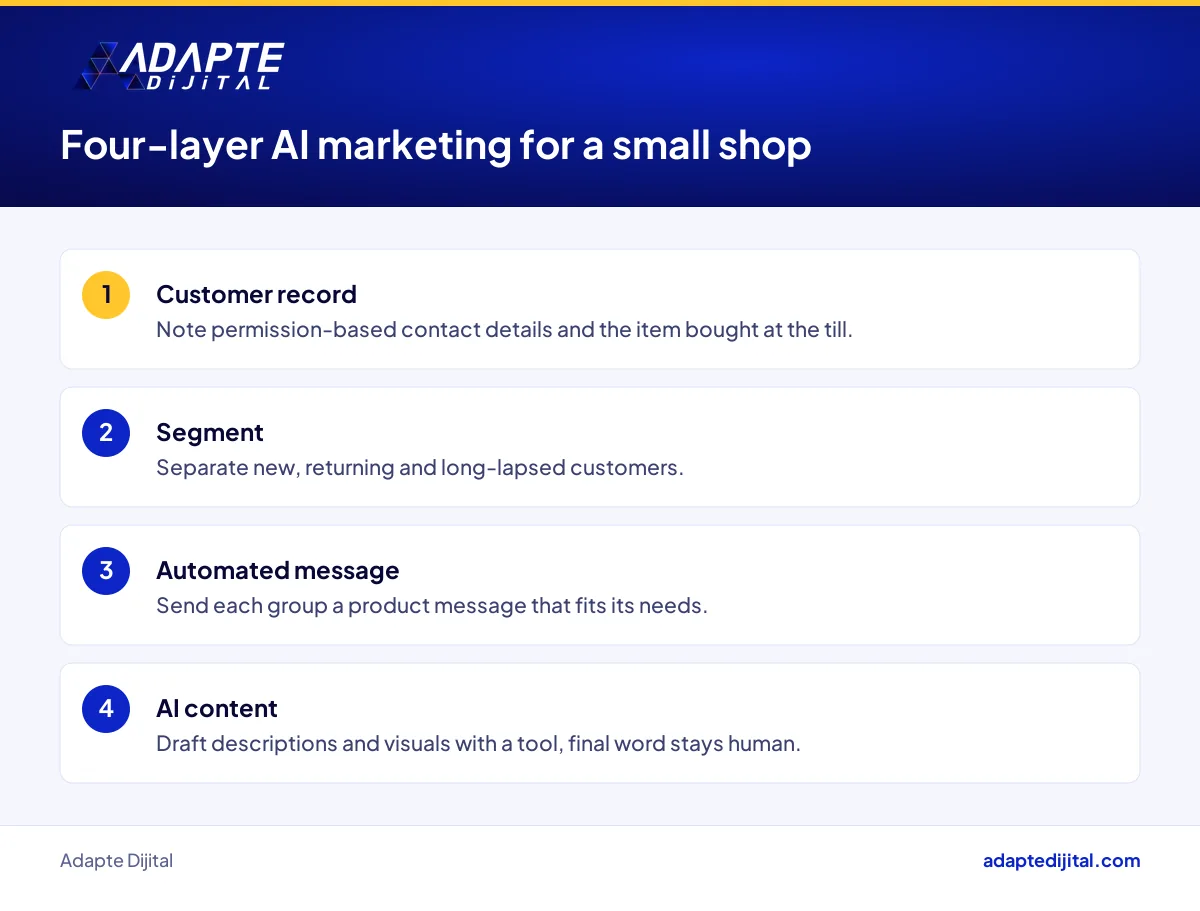
It is built in four layers: customer records, segments, automated messages and AI-assisted content. The small version of a big chain’s system is not expensive software. It is a well-kept customer list and simple tools that read it. Order matters: without data, AI goes to waste.
Picture a representative scene; it describes no real person, only a moment that repeats in many shops. A woman who sells home textiles in a neighbourhood market street sees a customer off at the till. The customer leaves with a bedspread, and the owner notices something: she has no way of finding this person again. That evening, with the customer’s permission, she writes her first record in a notebook: a phone number and the item bought.
That notebook is the turning point. A few weeks later, when new duvet sets arrive, she prepares a short message showing a matching set to everyone who bought a bedspread. She drafts the message and the product photo caption with an AI tool, and she has the final word. Some of the people who walk in now say they came because of the message.
Which businesses does Evidea’s CRM and AI focus affect, and how?
The most direct effect shows up in chains and independent shops that sell home textiles, decor and kitchenware. A customer who gets personalised messages may pay less attention to generic discount messages. Agencies and content creators will have to adapt to AI-assisted creative workflows.
What do personalisation and AI creative turn into on Evidea’s and other retailers’ digital channels?
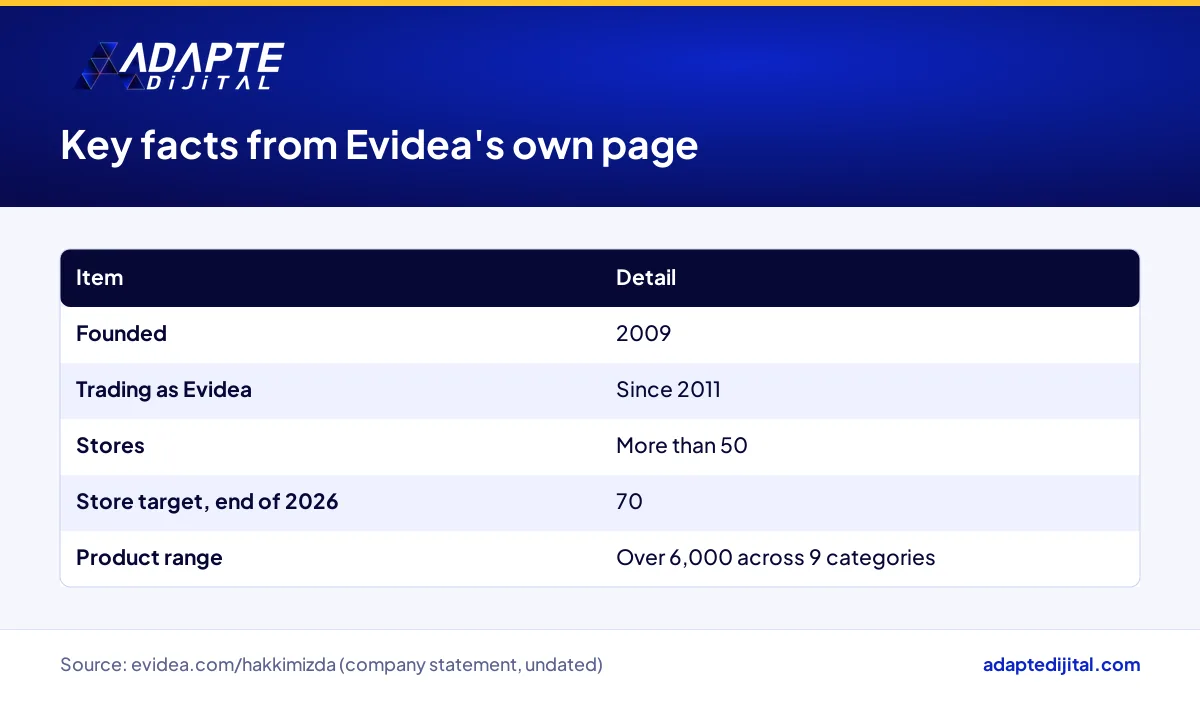
They become personalised product suggestions on the website, segment-based messages by email, quickly tested visuals on social media and richer product pages on marketplaces. Evidea’s own page says the company combines e-commerce with its growing physical store network. That combination requires linking digital data to in-store sales.
Where should a home goods shop owner start on Evidea-style marketing this week?
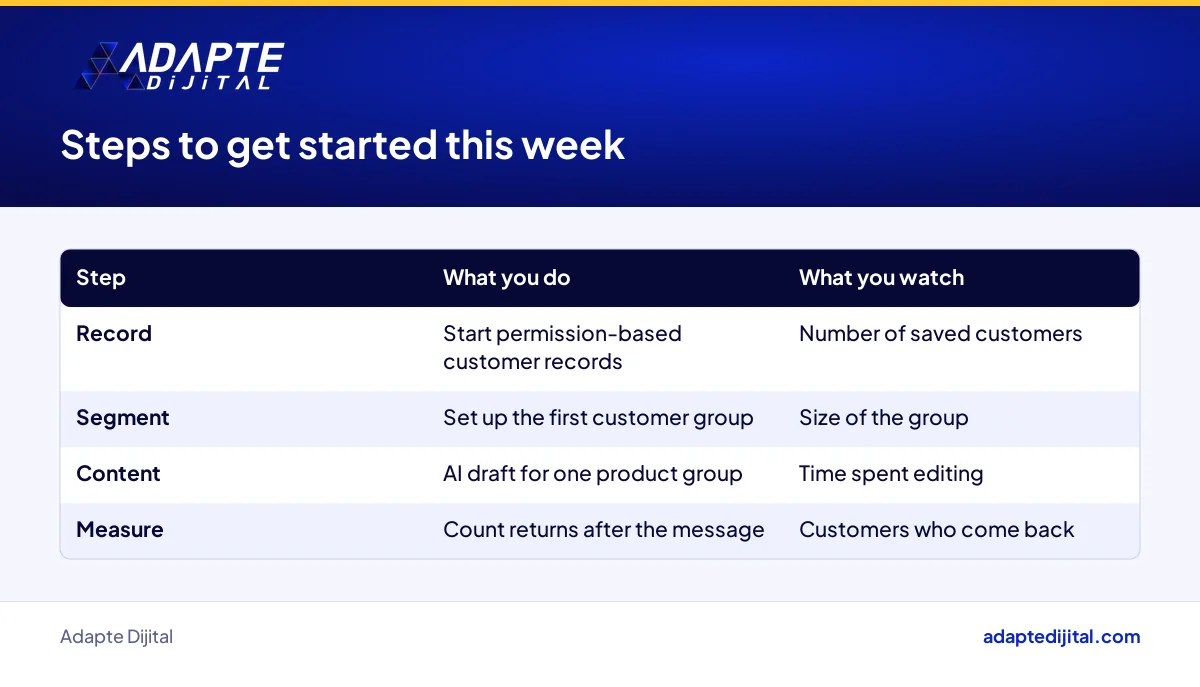
Do one thing this week: start keeping customer records at the till, with permission, and build your first segment. Then use an AI tool to draft a description and a message for one product group, and edit it into your own voice. The whole system is built on top of these two steps.
Quick Summary
- Evidea appointed İrem Aydın as marketing director (Perakende.org, 29 September 2026).
- Aydın has more than 14 years of experience in FMCG and retail (Perakende.org).
- Her focus areas are AI integration, AI-assisted creative production and personalisation.
- Evidea aims to grow from more than 50 stores to 70 by the end of 2026 (evidea.com, company statement).
- For a small shop, AI marketing starts with permission-based customer records and simple segments.
Short Glossary
- CRM
- CRM is the system used to collect customer details and purchase history in one place and manage the relationship.
- Personalisation
- Personalisation is the marketing method used to show each customer different products or messages based on their past behaviour.
- AI-assisted creative
- AI-assisted creative is the production workflow used to draft ad visuals and copy quickly with artificial intelligence tools.
Frequently Asked Questions
Next Step
If you want to set up a marketing routine for your shop, from customer records to AI content, let’s look at where you stand together. Just fill in the consult your expert form.
Sources: Perakende.org, 29 September 2026 · Evidea About Us page · Our retail page, where we interpret retail news for you
Updated: October 2026
Sık Sorulan Sorular
Aydın previously worked at FLO Ayakkabıcılık, Bella Maison and English Home. At these companies she worked across 360-degree brand communication, e-commerce, media, customer loyalty and new customer acquisition. The report does not say which years she spent where, or what her titles were.
According to the company’s own page, Evidea was founded in 2009 and has traded under the Evidea brand since 2011. The page lists more than 50 stores, a target of 70 stores by the end of 2026, and over 6,000 products across 9 categories. Its head office is in Ataşehir, Istanbul. These figures are undated and come from the company itself.
Perakende.org reports that Evidea opens its second store in Samsun, in the Atakum district, on 9 October 2026. As the network grows, marketing has to build the same customer language in every new city. CRM and personalisation become the tools that keep branches consistent.
The bottleneck is the number of products multiplied by the number of campaigns. Every season brings new duvet sets, new plates and new curtains, and each one needs images in different sizes for different channels. AI-assisted production shortens that repetitive work, while the human team focuses on ideas and the brand.
Home purchases pull other purchases along with them. Let’s say a customer buys a new sofa; next they look for cushions, throws and a rug. A system that knows their past purchases shows them the product that completes their room, not a random discount. That way, average basket size grows from need, not from promotions.
Personalisation starts with knowing who you know. Without contact details collected with permission and a purchase history, no tool can show the right product to the right person. Check the rules on processing personal data with the official source; this is not legal advice.
Three groups are enough to start: new customers, returning customers and customers who have not been back for a long time. Each group gets a different message. Lapsed customers get a reminder, returning ones see the new collection, and new ones get a complementary product.
Product descriptions, message drafts, captions for social media images and resizing visuals for different formats. Decisions and tone stay with the shop owner. The tool takes the repetitive work, and the person stays on the side that knows the customer.
Mid-sized home and living brands that keep their customer data in order gain an edge. They can reach the same tools and often decide faster than a large chain. The neighbourhood shop that knows its regulars by name is not behind in this race either.
Shops that sell only through the window display and discount posters will struggle. If customers walk out and nobody knows who they were, there is no way to invite them back. Home textile stores sharing the same corridor in an AVM, the Turkish term for a shopping mall, are among the first to feel the difference.
AI-written product descriptions can answer more search queries, as long as they stay original and specific to each product. One-size-fits-all, copy-paste descriptions make thousands of pages look alike. The aim is to gain speed without losing originality.
Because several image and copy variations for the same product can be produced quickly, ad testing gets easier. You can see which visual brings more sales much sooner. The budget then moves to the winning variation.
If a customer who shops in the store is recognised online with the same record, the two channels tell one customer story. Store location listings and local search visibility are also part of this chain.
Count how many of the customers you messaged come back to the shop or the website. This one number shows whether the system works. You can try the same method for stock that is sitting on the shelf.
Outside help makes sense when combining records, segments and AI content into one routine feels like too much. We support retailers in setting up AI-assisted marketing through our AI and advertising consultancy.
You can read about another marketing move in home and living retail in our piece on Yataş Group’s three internal appointments. For an appointment that builds growth around measurement, see ideasoft’s new Growth Director. For Evidea’s company details, the primary source is the Evidea About Us page.
How many customers leave your till today without leaving their name?
Yes, it saves time on repetitive work such as product descriptions and message drafts. The benefit grows when it is combined with a well-kept customer record.
Personal data processing and commercial messaging rules apply. Verify your current obligations with the official source; this answer is not legal advice.
As long as they stay original and specific to each product, no problems are expected. Descriptions that repeat the same template across every product make pages look alike.