
Digital company 3-year exemption from TOBB and chamber dues, what does Law No. 7582 cover?
Law 7582 exempts companies set up and run in line with the digital company (dijital şirket) definition, and founded by people who have qualified as incubator entrepreneurs, from TOBB, chamber and exchange fees and dues for up to three years from the date of incorporation (Official Gazette, Issue 33270, 4 June 2026). TOBB is the Union of Chambers and Commodity Exchanges of Türkiye. The rule sits in paragraph 16 of Article 3 of Law 5746, limits the exemption to payments under Article 24 of Law 5174, and took effect on publication, 4 June 2026.
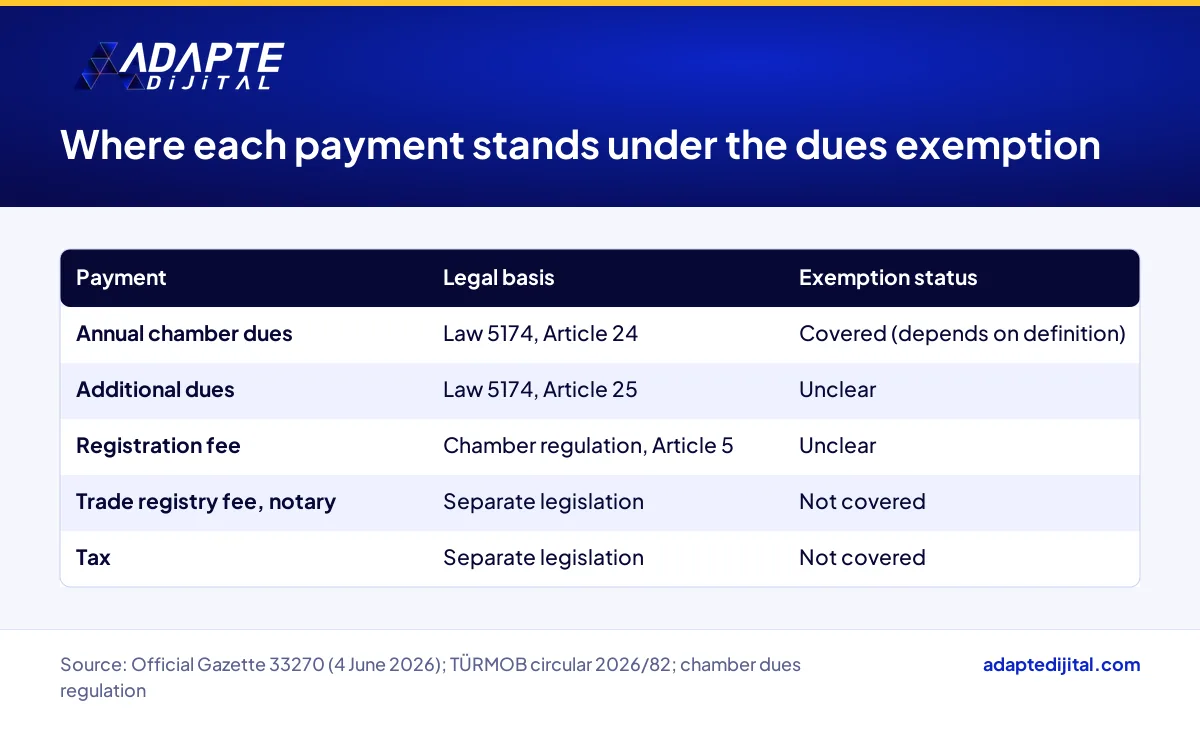
What this means for you: the provision is in force but cannot be used today, because the Ministry of Industry and Technology had not published the digital company definition as of 14 October 2026. The exemption does not cover tax, trade registry fees, notary costs or MERSİS costs; MERSİS is Türkiye’s Central Registry System for companies. Whether the additional dues and the registration fee fall under the exemption is unclear.
Which payments does the TOBB dues exemption cover for a digital company?
The exemption covers the fees and dues under Article 24 of Law 5174, and nothing else. A TÜRMOB circular, from Türkiye’s union of certified public accountants, calls it “TOBB and chamber fee and dues payments”. The law text in Official Gazette issue 33270 draws the line through Article 24.
What are the conditions of the digital company exemption under Law No. 7582?
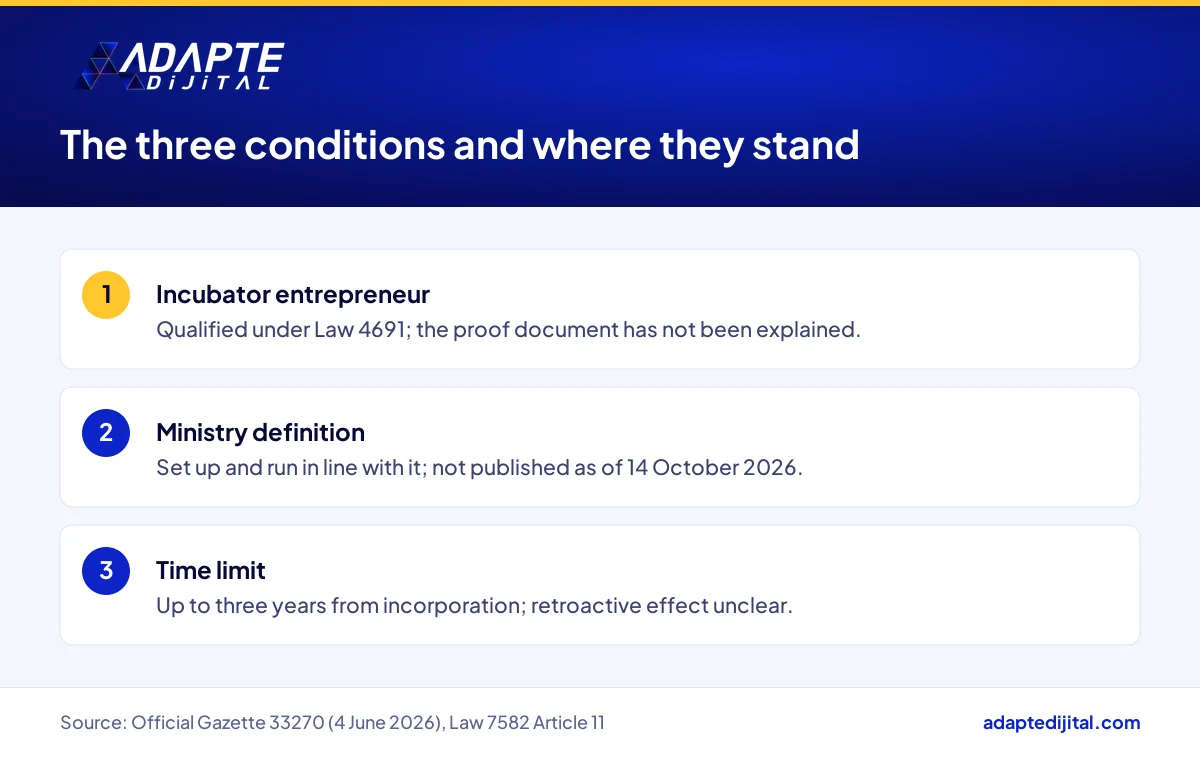
Three conditions apply at once, and if one is missing, the exemption does not work. The founder must have qualified as an incubator entrepreneur under Law 4691, the company must be set up and run in line with the Ministry’s definition, and the period runs for up to three years from the date of incorporation.
Who does the digital company dues exemption affect, and how?
BU BÖLÜMÜN ÖZETİ
- Software teams in technology parks may be the winners
- E-commerce shops and agencies without incubation are outside
- Accountants and chambers will field the practical questions
The direct target group is narrow: founders who come out of an incubation centre linked to a technology development zone and form a company that fits the definition. A business with no incubation background cannot use this paragraph. Accountants and chambers are affected indirectly, as the ones who will apply the rule.
Software teams in technology parks may be the winners
Let’s say a software team goes through incubation in a technology development zone in Istanbul or Ankara in autumn 2026. That team stands closest to the conditions. Lower chamber dues are a small, steady relief, but not before the definition is published.
E-commerce shops and agencies without incubation are outside
A self-funded online shop, digital agency or consulting company cannot use this paragraph, even with “digital” in its name. The incubator entrepreneur condition stands on its own.
Accountants and chambers will field the practical questions
No implementing letter or announcement on this exemption could be found from TOBB or the chambers.
Which steps should a founder take toward the digital company exemption?
BU BÖLÜMÜN ÖZETİ
- Step 1: Document your incubation status
- Step 2: Plan the incorporation date around the definition
- Step 3: Ask the chamber about the exemption in writing
- Common mistake: reading it as a tax exemption
Four steps of preparation are enough, but none of them pays off before the definition appears. The official texts give no time or cost. For items such as incubation centre rent or advisory fees, get your own quotes.
Step 1: Document your incubation status
No official list says which document proves “qualified” status. So keep every record of your relationship with the technology development zone’s management company, including space allocation and project acceptance letters.
Step 2: Plan the incorporation date around the definition
Because the period counts from the date of incorporation, the date is a strategic choice. Urgency and waiting client contracts decide whether to wait.
Step 3: Ask the chamber about the exemption in writing
At registration, ask your chamber in writing which items the exemption will apply to. A verbal answer is hard to rely on later.
Common mistake: reading it as a tax exemption
The most common mistake is reading the chamber dues exemption as a general tax or fee exemption. The paragraph looks only at chamber payments under Article 24. A founder who drops tax returns and registry fees from the budget may hit a cash squeeze.
What does the digital company exemption mean for web, search and data?
The exemption is not a digital investment item, and nobody knows which digital criteria the definition will use. So there is no firm list. Even so, describe your field of activity the same way on your website, in records and in search results.
What should a business owner considering a digital company do this week?
BU BÖLÜMÜN ÖZETİ
- Write your incubation status on one page
- Build the budget on a no-exemption scenario
- Plan the digital infrastructure with the incorporation
Do three concrete things this week: clarify your incubation status, build the incorporation budget without the exemption, and send your chamber a written question. Our digital company page, where we collect every question on the topic, will be updated when the definition is published.
Write your incubation status on one page
Put on one page which zone, which management company and which project you are linked to. The overall frame of the definition is summarised in our guide what is a digital company in Türkiye.
Build the budget on a no-exemption scenario
Calculate chamber dues, registry fees and accounting costs as if you will pay them in full.
Plan the digital infrastructure with the incorporation
A website, domain and company email are needed the moment the company exists. We handle the digital consulting side of setting up a digital company, meaning the infrastructure and visibility plan.
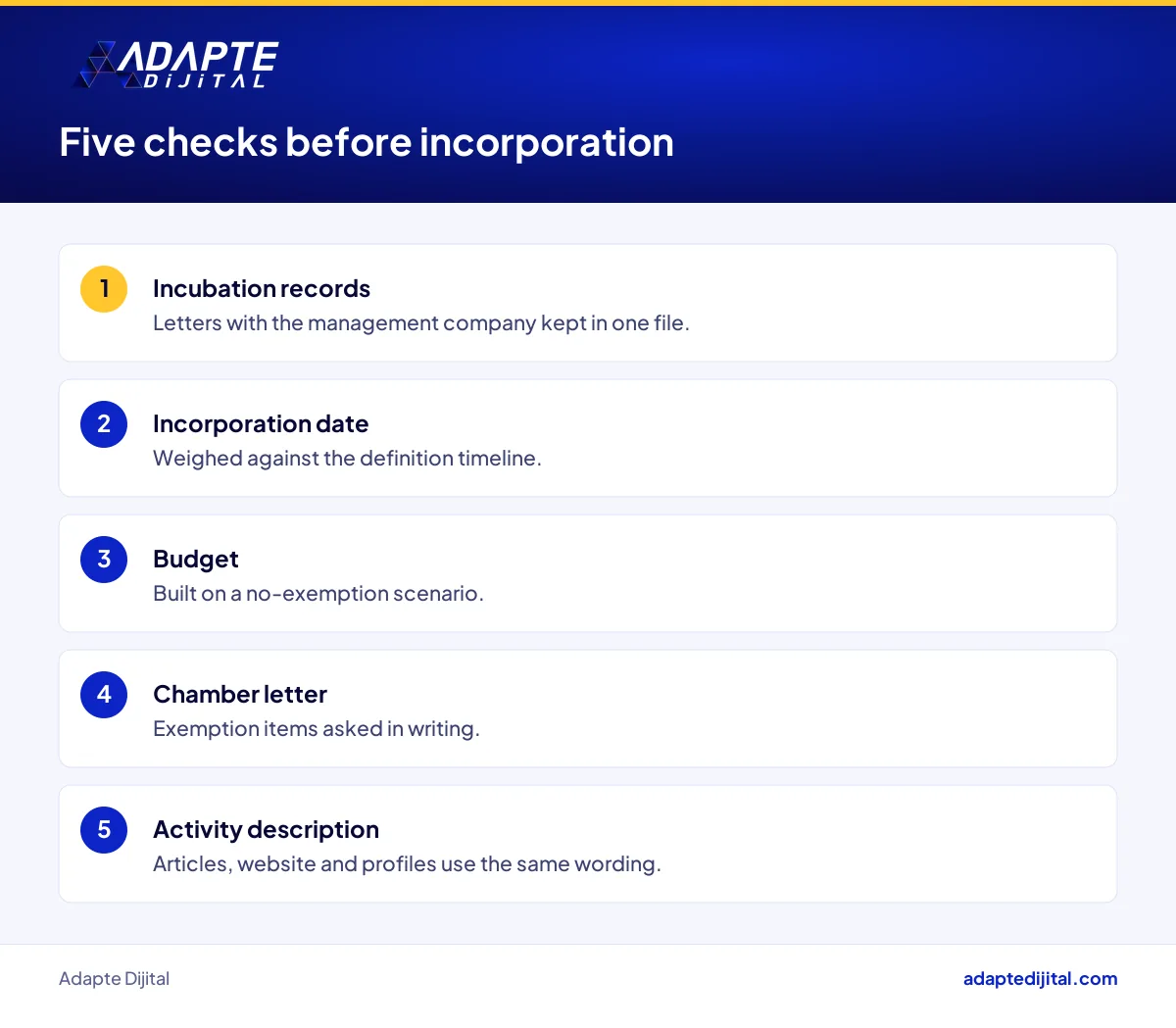
- Are the letters showing your incubation relationship on file?
- Has the incorporation date been weighed against the definition timeline?
- Is the budget built on a no-exemption scenario?
- Has a written exemption question gone to the chamber?
- Does the activity description match the website and records?
Quick Summary
- Article 11 of Law No. 7582 added a dues exemption paragraph to Article 3 of Law No. 5746 (Official Gazette No. 33270, 4 June 2026).
- The exemption covers only fees and dues under Article 24 of Law No. 5174, for up to three years from the date of incorporation.
- Three conditions apply: incubator entrepreneur status, fit with the Ministry’s definition and the time limit.
- As of 14 October 2026, the Ministry has not published the definition, so the exemption cannot be used in practice.
- The status of the additional dues and registration fee is unclear; there is no tax or registry fee exemption.
Short Glossary
- Annual dues
- Annual dues is the term used for the membership payment a chamber member pays each year under the tariff based on Article 24 of Law 5174.
- Additional dues
- Additional dues (munzam aidat) is the term used for the extra chamber payment calculated under Article 25 on commercial or balance-sheet profit.
- Incubator entrepreneur
- Incubator entrepreneur is the status used for an early-stage technology founder in an incubation centre under Law 4691.
Frequently Asked Questions
Next Step
If you want to review your incubation status, incorporation date and digital infrastructure plan together, fill in the consult your expert form.
The definition and conditions of the digital company scheme are not final yet; check the latest information with the Ministry of Industry and Technology, KOSGEB and the Official Gazette before deciding. This is not legal or financial advice.
Support amounts and conditions can change; check the current terms on the institution’s official page before applying. This article is not financial or legal advice.
Sources: TÜRMOB circular 2026/82 (4 June 2026) · Official Gazette No. 33270, Law No. 7582 (4 June 2026) · Regulation on the Registration Fee, Annual Dues and Additional Dues
Updated: October 2026
Sık Sorulan Sorular
According to chamber guidance, Article 24 sets the chamber’s annual dues through a dues tariff based on that article. The annual dues are capped at half of the gross minimum wage for the year they are charged.
That is unclear. The additional dues (munzam aidat) are regulated in Article 25 and calculated at five per thousand of commercial profit or commercial balance-sheet profit. Since the paragraph refers only to Article 24, it can be read as leaving the additional dues out. There is no official interpretation, so do not treat it as settled.
That is unclear as well. The registration fee appears as a one-off payment in the chamber regulation, which rests on Articles 24, 25 and 50 together. Whether the fee sits inside Article 24 could not be confirmed from the law text.
No, not in this paragraph. Trade registry fees, notary costs and tax obligations stay as they are. Plan your numbers accordingly.
The law links this status to Law 4691, the Technology Development Zones Law. It has not been explained which document will prove the “qualified” status at founder, shareholder or company level. How the status is obtained is set out step by step in our guide to incubator entrepreneur status.
Because without a definition, fit cannot be measured. The paragraph speaks of “companies set up and run in line with the digital company definition”. So the way the company is run must fit too, not just its setup.
The period counts from the date of incorporation and lasts up to three years. Whether the exemption will apply retroactively to a company formed before the definition is unclear.
The field of activity in your articles of association, the service description on your website and the category in your business profiles should match.
Yes, as a separate cost item. KOSGEB is Türkiye’s Small and Medium Enterprises Development Organization. Article 6 of its Directive provides non-repayable support up to the platform registration fee for a digital company that fits the definition. That support runs independently of the dues exemption and also depends on the definition.
Not today. The exemption depends on the Ministry’s digital company definition, which had not been published as of 14 October 2026. Whether it will apply retroactively to companies formed before the definition is also unclear.
The law ties the exemption to founders who have qualified as incubator entrepreneurs under Law 4691. A company without that status cannot use this paragraph, even with “digital” in its name.
No. The paragraph covers only chamber and exchange fees and dues under Article 24 of Law 5174. Tax, registry fees and notary costs stay as they are.