
Koton generated 1.8 billion TL free cash flow in H1, how should a retailer manage stock?
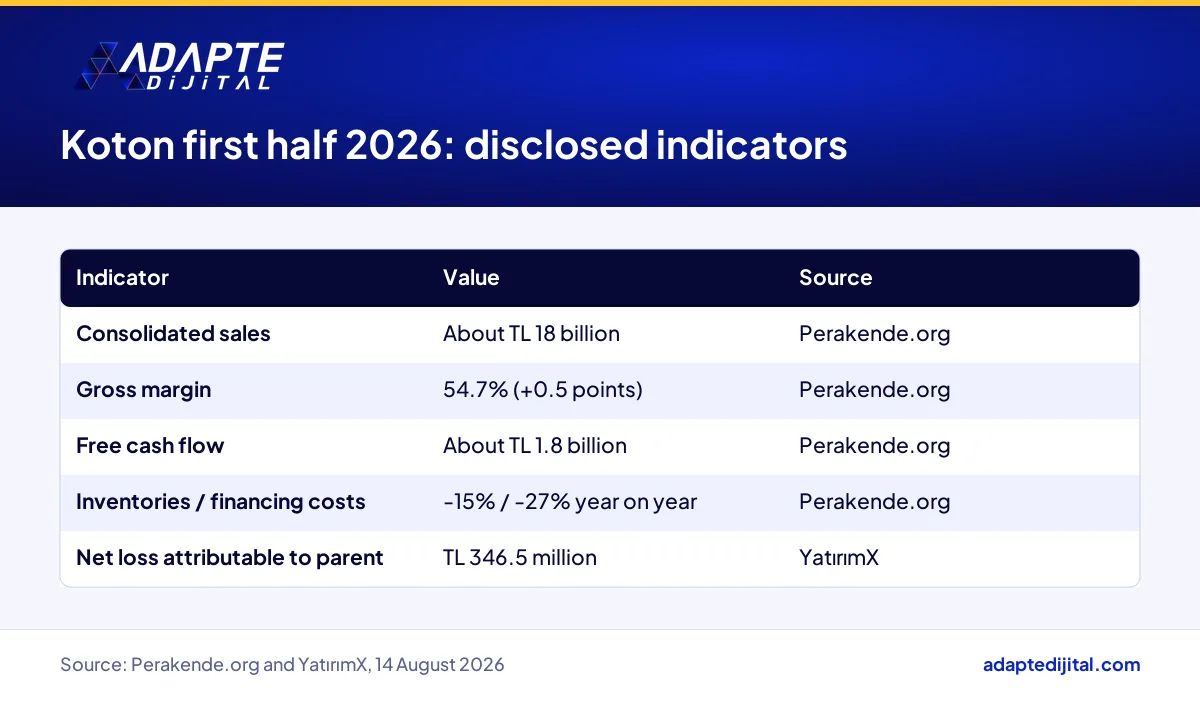
Koton, the Turkish apparel retailer, reported consolidated sales of about TL 18 billion for the first half of 2026, free cash flow of about TL 1.8 billion and inventories down 15% year on year (Perakende.org, 14 August 2026). For the same period, the financial news site YatırımX reports a net loss attributable to the parent of TL 346.5 million and revenue down 2% year on year, so this is not a one-way success story.
Here is what it means for you: when sales lag inflation, what protects your till is not turnover but how fast the stock on your shelves turns back into cash. If you run a clothing store in an Istanbul AVM (the Turkish term for a shopping mall) or on an Anatolian high street in autumn 2026, Koton’s figures are a useful dataset for rereading your own stock and working-capital decisions.
What do Koton’s first-half 2026 figures tell a retailer?
BU BÖLÜMÜN ÖZETİ
- Free cash flow of about TL 1.8 billion
- Inventories down 15%, financing costs down 27%
- The bottom line is mixed
Three things: sales are flat, cash management is tightening, and the growth is coming from abroad. Consolidated sales came in at about TL 18 billion with an EBITDA margin of 21.4% (Perakende.org). Koton’s CEO, Dr A. Bülent Sabuncu, put the full-year outlook this way: “We are revising our year-end sales growth expectation to flat to low single-digit growth.”
Free cash flow of about TL 1.8 billion
The company generated about TL 1.8 billion in free cash flow in the first half (Perakende.org). The disclosed figures point to leaner inventory and lower financing costs, though the report does not break down the sources.
Inventories down 15%, financing costs down 27%
Inventories fell 15% and financing costs 27% year on year (Perakende.org). The two often move together: less stock on the shelf means less borrowing, and less interest, to carry it. In a small store, that means interest on credit cards and short-term loans.
The bottom line is mixed
For the same period, YatırımX reports operating profit from core activities down 78% to TL 252.3 million and a net loss of TL 346.5 million. Generating cash is not the same as making a profit. Koton publishes its results and investor presentations on its corporate investor relations site; the final word belongs to the statements filed on KAP, Türkiye’s public disclosure platform, and this is not investment advice.
What does Koton’s smaller inventory mean for a small clothing store?
Cutting stock does not mean cutting sales; it means not carrying the wrong goods. Koton reduced inventories by 15% while its gross margin rose 0.5 points to 54.7% (Perakende.org). For a small store too, margin comes from the right stock on the shelf, not from more stock.
Which retailers does Koton’s half-year picture affect, and how?
BU BÖLÜMÜN ÖZETİ
- Under pressure: independent clothing stores carrying wide stock
- Relatively comfortable: chains with strong cash and supplier terms
- Indirectly affected: mall management and contract workshops
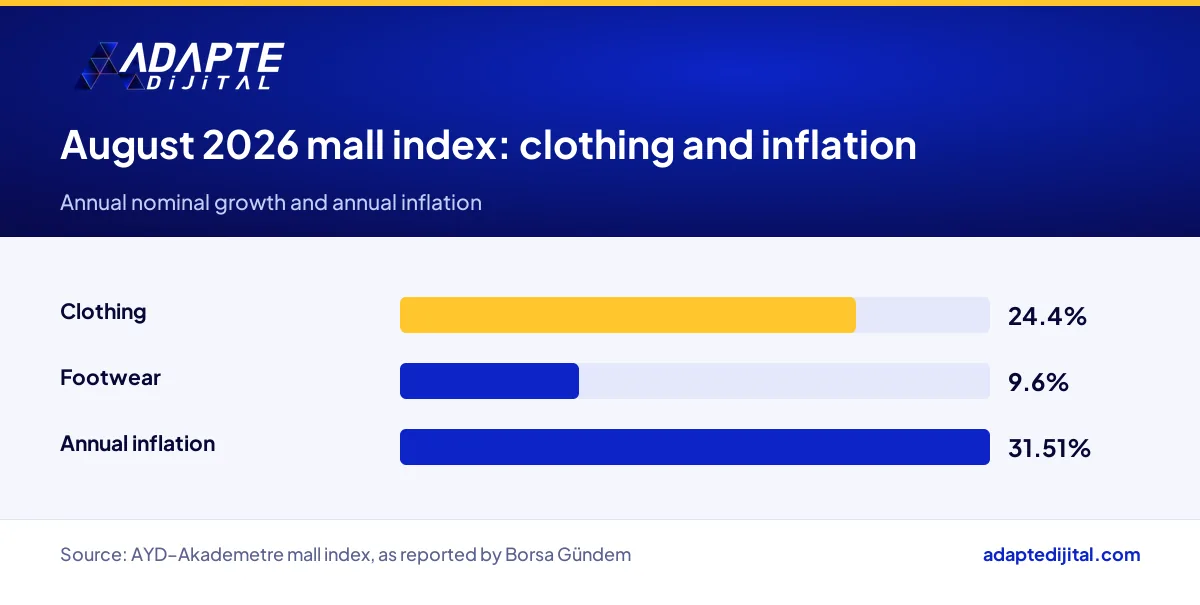
It matters most to independent stores selling mid-market clothing in malls and on high streets. The AYD–Akademetre mall turnover index rose 25.2% in nominal terms in July 2026, against annual consumer price inflation of 31.75%, a real contraction of about 5% (Perakende Türkiye). In August, clothing rose 24.4% and footwear 9.6% in nominal terms, with inflation at 31.51% (Borsa Gündem).
Under pressure: independent clothing stores carrying wide stock
A store that pays upfront for goods and sells them slowly feels the squeeze hardest when sales lag inflation, because the till simply isn’t turning. Loan interest and rent stay fixed while the stock on the shelf loses value in real terms. We break down this real decline for store owners in our article on the July mall turnover index.
Relatively comfortable: chains with strong cash and supplier terms
Chains that turn stock quickly and can negotiate payment terms with suppliers are better placed to generate cash, even in a tight market. Koton’s net loss for the same period is the reminder that cash alone does not deliver profitability.
Indirectly affected: mall management and contract workshops
If large chains cut stock, order volumes at contract manufacturing workshops may shrink. On the mall side, as sales per square meter fall in real terms, tenant mix and rent negotiations come back to the table.
What do Koton Club’s 10 million members say about the digital side?
They show that a loyalty program is data infrastructure, not just a promotions tool. Koton Club membership has passed 10 million (Perakende.org). The report does not give the online sales share, so we do not know how many members shop through e-commerce. Still, a list this size is the groundwork for measuring whom to clear stock to, and through which channel.
What framework do Koton’s 11 openings and 11 closures give for store decisions?
They show that you can refresh a store portfolio without growing the store count. Koton opened 11 stores and closed 11 in the first half, for a total of 466 stores (Perakende.org). Reports differ on whether 466 is the end-June or the August count. The report also gives no location or reason for the closures.
What should a clothing store owner do with stock this week after Koton’s figures?
BU BÖLÜMÜN ÖZETİ
- Split your stock into three age groups
- Choose one exit channel for broken runs
- Tie supplier terms to sell-through speed
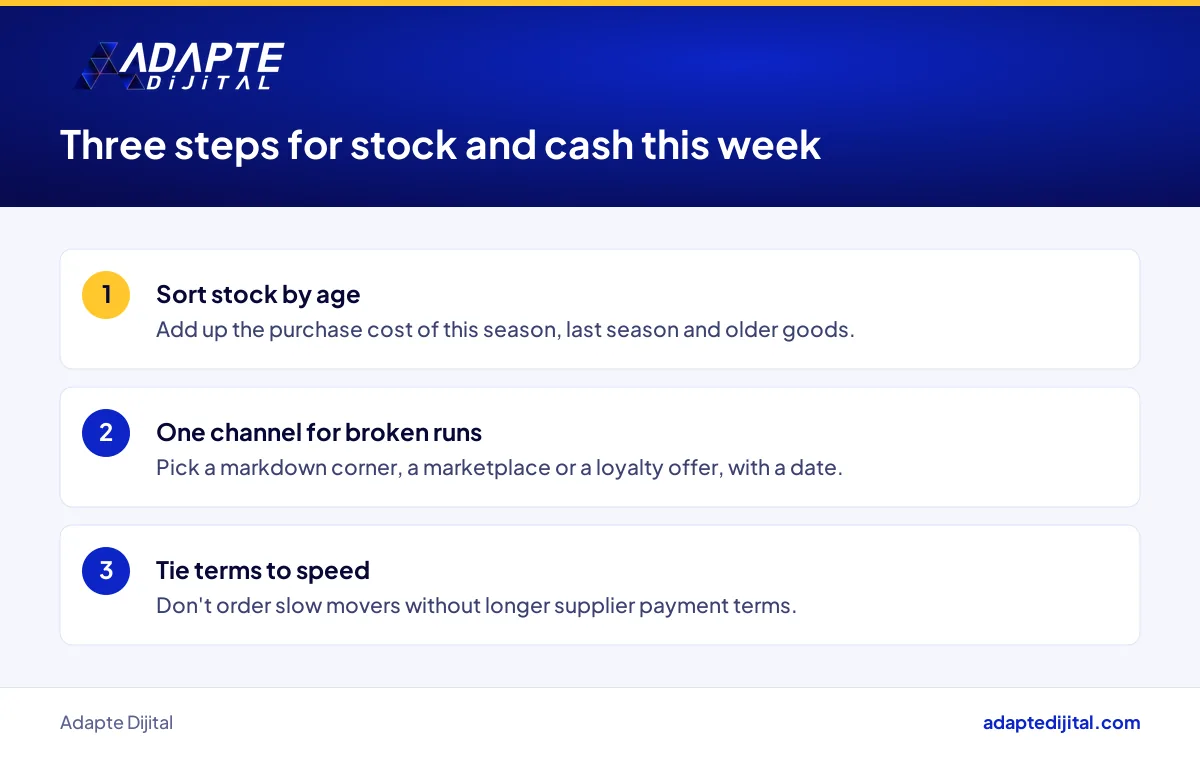
Do three things this week: sort your stock by age, pick one exit channel for broken size runs, and match supplier payment terms to sell-through speed. All three can start in a single team meeting, and each one touches the till directly.
Split your stock into three age groups
Make three lists: this season, last season and older. Add up the purchase cost of each group, and you will see clearly how much money is sitting on your shelves.
Choose one exit channel for broken runs
An in-store markdown corner, a marketplace, or an exclusive offer to your loyalty list: pick one and put a date on it. Three prices in three channels only teach shoppers to wait.
Tie supplier terms to sell-through speed
Short payment terms are fine on fast movers; on slow movers, don’t place an order without longer terms. Reading stock, loyalty data and digital channels in one plan is work we do through our digital consulting service.
Quick Summary
- Koton reported about TL 1.8 billion in free cash flow for the first half of 2026 (Perakende.org).
- Inventories fell 15% and financing costs 27% year on year (Perakende.org).
- For the same period YatırımX reports a TL 346.5 million net loss, so profit and cash should be read separately.
- With 11 openings and 11 closures in the first half, the total store count stands at 466 (Perakende.org).
- For a small retailer, the lesson is to manage stock turnover and supplier terms before chasing revenue.
Short Glossary
- Free cash flow
- Free cash flow is the measure used to show the cash left in a business after operating and investment spending.
- Stock turnover
- Stock turnover is the ratio used to show how many times the goods on the shelf are sold and replaced in a given period.
- Like-for-like (LFL) sales
- Like-for-like sales is the measure used to compare the performance of existing stores only, leaving new openings out.
Frequently Asked Questions
Next Step
If you want to read your store’s stock, cash flow and digital channels together, fill in the consult your expert form and we will get back to you.
Sources: Perakende.org, 14 August 2026 · KAP disclosure, 14 August 2026 · YatırımX, 14 August 2026 · Capital · Perakende Türkiye and Borsa Gündem (reports on the AYD–Akademetre mall index) · Koton corporate
Updated: October 2026
Sık Sorulan Sorular
Stock turnover shows how many times the goods you put on the shelf sell and get replaced. When sales lag inflation, every slow-moving box eats into your rent and your loan costs. Whatever is left at the end of the season drags margin down through discounts.
Start with leftovers from last season and lines with broken size runs. They are sitting on the shelf, taking up room in the stockroom and cluttering the new season’s display. Clearing broken runs as bundles or in a separate markdown corner frees up cash for new goods.
Build the order from sell-through speed, not from the number of styles. Go deeper on last season’s fastest-selling SKUs and drop the slow movers from the list. That way you fill the same shelf with fewer options and protect your average basket.
Collecting a phone number and marketing consent at the till is enough to start. If item, size and date land on the same record, you know at season’s end what to offer to whom.
Keeping new arrivals and current offers up to date on your Google Business Profile helps you show up in nearby searches. We look at shelf and screen visibility together through Atelier Rebul’s Sephora plan.
If a broken size run is sitting in your store, a marketplace can reach the shopper looking for that one size. But commission, shipping and returns all eat into margin. Do the math product by product, and don’t move everything online.
International retail grew 10% in real terms; in the Gulf, total sales rose 99% in US dollar terms and like-for-like (LFL) sales rose 4.7% (Perakende.org; Capital). The gap suggests that growth there comes mostly from new stores. Koton opened 6 new stores in the Gulf through July 2026.
Divide the store’s monthly revenue by its floor area, and next to it put rent plus service charges divided by the same area. If the gap is narrowing and customers walk in and straight back out, that location is burning cash. Our retail page, where we interpret the retail agenda for you, covers similar decisions at other brands.
The Perakende.org report does not mention net profit or loss. YatırımX reports a net loss attributable to the parent of TL 346.5 million for the same period; check the KAP filing for the definitive statements.
Cutting slow movers and broken size runs does not lower sales; it frees the shelf for products that sell fast. The risky move is cutting the depth of your best-selling styles.
A start as simple as collecting a phone number and marketing consent at the till is enough. The goal is not to hand out discounts but to know who buys what, so you can clear stock in a targeted way.