
Why does AI not recommend a new company, and why does AI SEO start with incorporation?
AI does not recommend a newly founded company because there is nothing about it to read. ChatGPT, Gemini and similar assistants build their answers from web content they have read; a trade registry entry is not a source for them. The Ministry of Industry and Technology had not published its digital company (dijital şirket) definition as of October 2026. The remote incorporation that Minister Kacır described on 27 April 2026 does not carry a company into an AI answer either (Dünya/AA).
What this means for you: you do not exist for AI on the day you incorporate; you exist on the day it reads your site. That is why AI SEO starts together with incorporation. Our digital company page, where we collect every question on the topic, covers the other sides.
Why does AI not recommend a new company, and where does it build its answer from?
BU BÖLÜMÜN ÖZETİ
- AI says what it has read, and cannot say what it has not
- A registry entry does not count as a source for AI
- The digital company definition does not close this gap
Because AI builds a recommendation from information, and it takes information from published content. On incorporation day your company’s name is recorded in MERSİS, Türkiye’s Central Registry System; it is on no web page. For AI, this company has not been born yet.
AI says what it has read, and cannot say what it has not
When assistants answer a question, they rely on training data and on live web search. If a new company’s name, service and region are explained on no page, the assistant has no sentence to cite. It fills the gap with another company it has read a lot about. Silence is not neutrality; it is a loss.
A registry entry does not count as a source for AI
Registration runs through MERSİS with an e-signature and KEP (registered e-mail); our guide to setting up with MERSİS, e-signature and KEP walks through the steps. This record makes you exist legally, not digitally. AI does not query the registry; it reads your site, your accounts and what is written about you.
The digital company definition does not close this gap
The remote incorporation, virtual office and automated accounting that Minister Kacır described make a company’s procedures easier; our guide to remote incorporation explains where that stands. Vircon Legal listed the open legal questions on 18 June 2026; secondary legislation has not been published. Even when the definition comes out, the AI gap stays where it is. The concept itself is in what is a digital company in Türkiye.
What is AI SEO, and where does it differ from classic SEO?
BU BÖLÜMÜN ÖZETİ
- Ranking and entering the answer are not the same thing
- How AI-ready content is written
- An AI-ready and user-ready site is one site
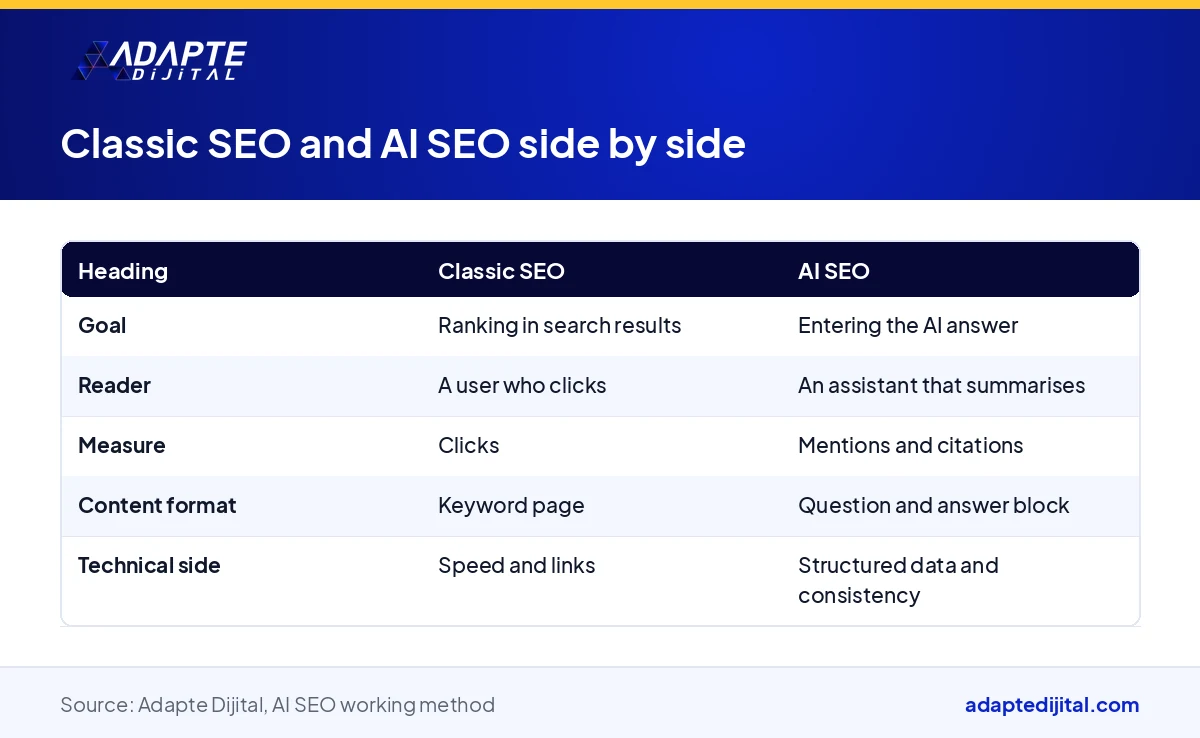
Classic SEO moves a page up the search results. AI SEO builds content so that it enters an AI answer. Both are done on the same site but written for different readers: one for a person who clicks, the other for a machine that summarises.
Ranking and entering the answer are not the same thing
A page that appears in search results is read if it is clicked. A page that enters an AI answer is cited without a click; the user sees the company name inside the answer. For that, the content must be clear enough for the assistant to quote. Long introductions, indirect wording and half sentences lose this reader.
How AI-ready content is written
Every page answers one question and gives the answer in the first paragraph. Headings are questions, paragraphs carry one idea, terms are explained in a short glossary. Frequently asked questions appear both in the text and in structured data.
An AI-ready and user-ready site is one site
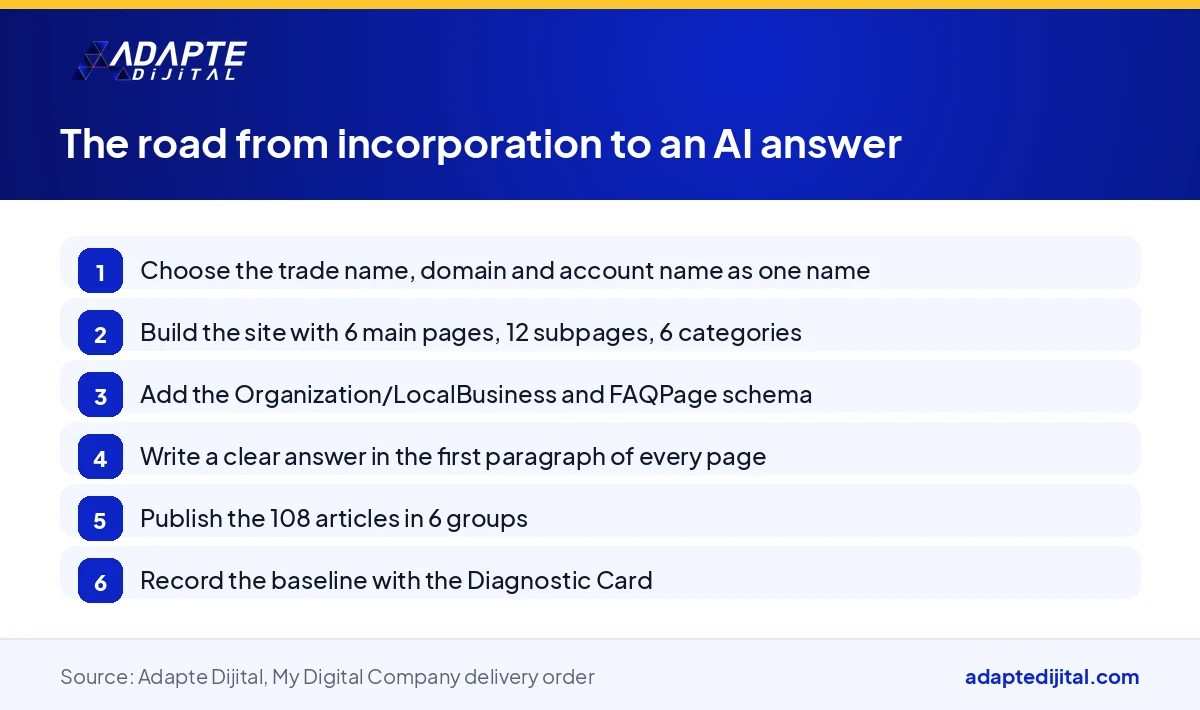
An AI-ready and user-ready site does not mean one site for machines and another for people. The same page loads fast, gives a clear answer and carries structured data. That is why the page plan is built from the start: 6 main pages, 12 subpages, 6 categories. Compatibility added later means rewriting.
Why is entity consistency the first condition, is the company name written the same everywhere?
BU BÖLÜMÜN ÖZETİ
- Trade name, domain, site name and account name in one voice
- Address, phone and region
- The company passport idea and verified information
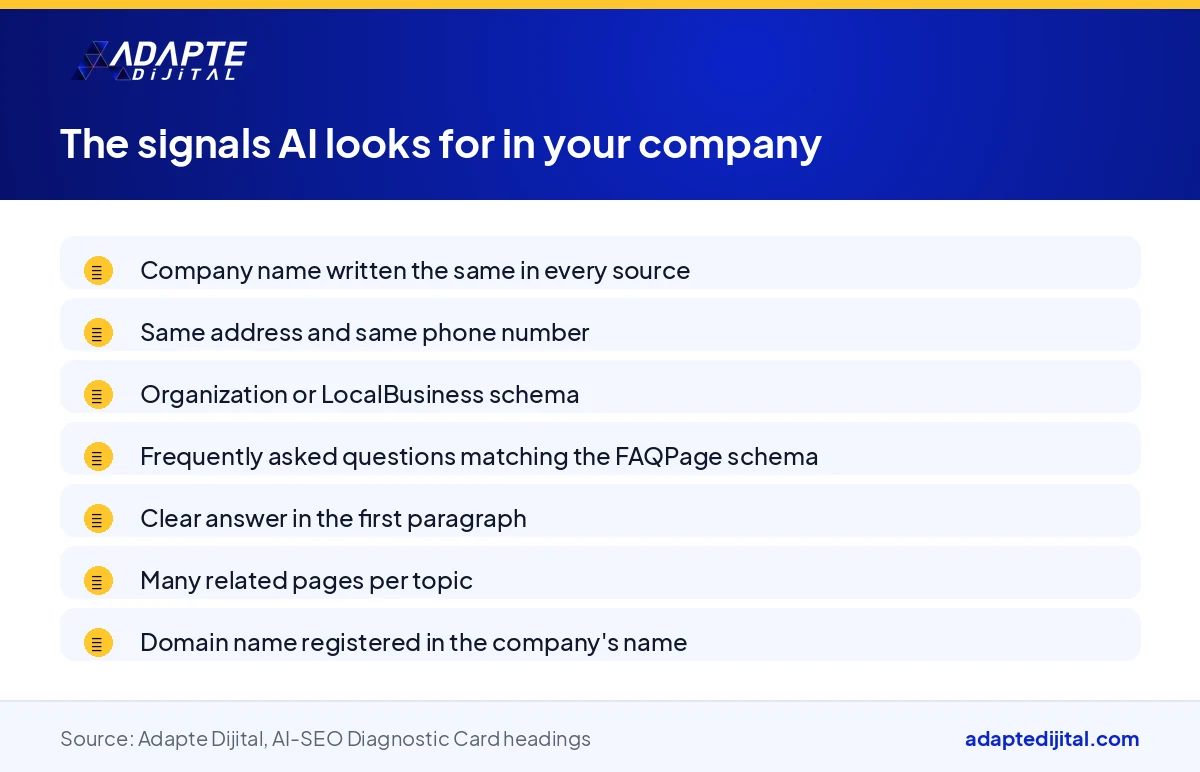
AI wants to recognise a company as a single entity: the same name, address, phone and domain. If the details conflict, the assistant does not know which to trust and does not mention the company. Consistency comes before content.
Trade name, domain, site name and account name in one voice
The trade name in the registry, the domain name, the site title and the social media usernames should carry the same name. An abbreviation, an extra word or a different spelling makes each one look like a separate entity. Our guide to matching the domain name and the trade name covers that fit.
Address, phone and region
The site’s contact page, its structured data, the WhatsApp Business account and the Google Business Profile should show the same address and number. In a company set up with a virtual office address, the service address and the service region are written separately; our guide where a virtual office company appears on the map explains the distinction.
The company passport idea and verified information
In his column in the Turkish daily Dünya on 28 September 2026, Ertan Barut proposed a company passport: verified company information shared with banks, investors and the public. That is an opinion, not an official plan. But the direction is right: one correct record, in the same form at many doors. AI expects exactly that from you.
What do structured data and answer blocks tell AI?
BU BÖLÜMÜN ÖZETİ
- Organization and LocalBusiness schema
- FAQ schema: telling the machine the question too
- Answer block: first paragraph, clear answer
Structured data introduces the company in the machine’s language, in the invisible layer of the page: this is an organisation, this is its name and address, these are its answers to these questions. Answer blocks do the same job in the visible text. The two are built together.
Organization and LocalBusiness schema
The Organization schema defines the company’s name, domain, logo and contact details. For a business that serves a specific region, the LocalBusiness schema adds the address and the service area. In the package, the schema is built to match the company’s situation and carries the same details as the site. If the schema and the page conflict, both lose value.
FAQ schema: telling the machine the question too
The frequently asked questions on a page are written into structured data with the FAQPage schema. The assistant then reads them directly instead of searching the text. The question text and the schema text must match word for word. If they differ, the machine sees two separate pieces of information and trusts both less.
Answer block: first paragraph, clear answer
The first paragraph of every page gives the answer to the question, names its source and its date. The second paragraph explains what it means for the reader. This layout puts the sentence the assistant will quote at the very top. A long introduction or a general statement delays the answer; the machine skips the page.
What do 108 articles do for AI learning about the company?
BU BÖLÜMÜN ÖZETİ
- 6 keyword groups, 6 topic authorities
- The difference between a one-page site and a 108-article site
- Why starting with incorporation saves time
A one-page site says the company’s name; 108 articles show what the company knows. When AI sees many consistent pages on one topic, it treats the site as a source. 6 keyword groups build this on six topics.
6 keyword groups, 6 topic authorities
Each group represents one family of customer questions: what the service is, how it is done, what it costs, where it is offered, how it compares and when it is needed. 18 articles in each group cover the variations. One article is an opinion; 18 articles are a source.
The difference between a one-page site and a 108-article site
A single page is found when the company’s name is searched, and in no other question. 108 articles meet the questions a customer asks without knowing the company’s name. Entering an AI answer runs through this second route; the user tells the assistant their problem, not your company’s name.
Why starting with incorporation saves time
An article does its job not on the day it is published but on the day it is crawled and read. That period differs for everyone, but it always starts on publication day. 108 articles published with incorporation are already being read while the company looks for its first customer. We explain the waiting founder’s loss in why the website should be built now while waiting for the definition.
What does the AI-SEO Diagnostic Card measure, and how is the result read?
BU BÖLÜMÜN ÖZETİ
- The four areas the card looks at
- What the baseline tells you
- What to do after reading the card
The Diagnostic Card gathers the company’s standing in the eyes of AI and search engines on a single page. It is given at delivery and becomes the baseline. In the following months the same headings are read again; the difference shows what worked.
The four areas the card looks at
The card looks at four areas: the consistency of the company identity across sources, the presence and accuracy of structured data, the answer block layout of the pages and whether the measurement tools are connected. For each area it records the status and, if something is missing, names it. The card is a checklist, not an advertising summary.
What the baseline tells you
The status the card shows on delivery day documents that the site was published in a form AI can read. There are no numbers yet; Search Console and GA4 start keeping records from day one. Our post-launch measurement guide explains which numbers to watch in the first 90 days. The baseline is the reference point for every later reading.
What to do after reading the card
If the card shows a gap, the gap is closed first: structured data is corrected, a conflicting address is brought to one spelling. If the card shows everything in place, the next step is growing the content: more articles, a competitor visibility report, advertising. We plan these steps together in our AI consultancy service. Domain name, an AI-ready and user-ready website, 108 articles, 3 accounts, measurement and the card are all set up in one package in the My Digital Company (Dijital Şirketim Olsun) campaign for TL 36,000 + VAT.
Quick Summary
- The Ministry’s digital company definition had not been published as of October 2026; it does not regulate AI visibility.
- Minister Kacır described remote incorporation and virtual offices on 27 April 2026 (Dünya/AA).
- AI assistants build their answers from content they have read; a registry entry is not a source.
- The site is built AI-ready with 6 main pages, 12 subpages, 6 categories and 108 articles.
- The AI-SEO Diagnostic Card looks at four areas: consistency, structured data, answer blocks, measurement.
Short Glossary
- Structured data
- Structured data is the code layer used to mark up the information on a page in a form machines understand.
- Entity consistency
- Entity consistency is the principle used to make sure company information is written the same way in every source.
- Answer block
- An answer block is the writing layout used to answer the question directly in the first paragraph of a page.
Frequently Asked Questions
Next Step
To make your company readable for AI from incorporation day, review the delivery list and book a discovery call on our digital company page; last day 16 November 2026.
The definition and conditions of the digital company scheme are not final yet; support amounts and conditions may change. Check the latest information with the Ministry of Industry and Technology, KOSGEB and the Official Gazette before deciding. This is not legal or financial advice.
Sources: Dünya/AA, Minister Kacır’s announcement (27 April 2026) · Vircon Legal, open legal questions (18 June 2026) · Dünya, Ertan Barut column (28 September 2026)
Updated: October 2026
Sık Sorulan Sorular
Because there is no content about you it can read, or the content conflicts. Assistants build answers from published web content; a registry entry alone is not enough. A consistent identity, structured data and pages with answer blocks close this gap.
It can, but that means rewriting. When the page plan, structured data and answer blocks are built from the start, it is one job. Added later, existing pages are reorganised and the reading period starts from zero.
It is given at delivery and becomes the baseline. The card looks at company identity consistency, structured data, answer block layout and measurement connection. In the following months the same headings are read again.