
Therapy practice Google Business Profile: category, title, address and 6 key fields
A therapy practice Google Business Profile is the small shop window where a client finds you on the map and decides. A sound setup rests on 6 fields: business name, primary category, address, opening hours, service description and photos. Filled in line with Türkiye’s health promotion rules and client confidentiality, they build trust and keep you out of trouble.
Most people never hear this: according to Google’s own help page, adding or changing a category may require you to verify your business again. So a new practice picks it right on day one. The setup steps are in how to set up a Google Business Profile; the difference lies in how a psychologist’s office fills these six fields.
Which category should a therapy practice choose on Google?
The primary category tells Google what your practice is in a single choice. For a psychologist’s office this is usually “Psychologist”; if your work is mostly psychotherapy, a matching secondary category can be added. The list belongs to Google, and you cannot invent your own. Google asks for the most specific category, not a broad one.
Primary category: one choice, the most specific
Google’s example: “Nail salon” rather than “Salon”. For you, that is the category naming your profession, not a broad health or consulting label.
Additional categories: few and real
An additional category should describe a service you genuinely offer; Google suggests a handful, not one per service. Changing categories every month is like repainting your shutters weekly: the neighbourhood stops recognising you.
Can a title or specialty go into the profile name?
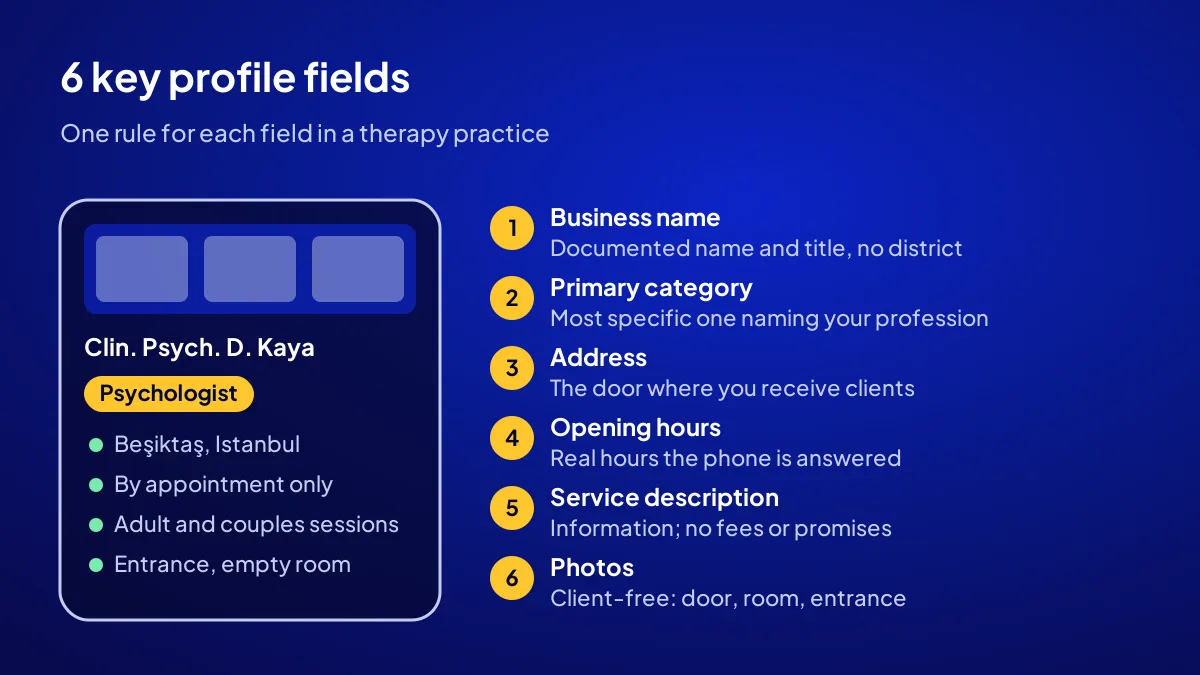
The profile name is the name on your door sign and official records. Google allows individual practitioners to include a professional title such as “Dr.” in the name, but treats unnecessary extra information as grounds for suspension. “Clin. Psych. Deniz Kaya” is an acceptable form. “Deniz Kaya Beşiktaş Anxiety Therapy” is not.
Write your title as it appears on your diploma
Additional Article 13 of Turkish Law No. 1219 defines psychology titles among the health professions. The clinical psychologist title rests on a master’s or doctorate in clinical psychology; the psychological counsellor title comes from guidance and counselling training. Use the title you hold, exactly as documented.
District and keywords stay out of the name
Words like “Kadıköy”, “couples therapy” or “online” belong in the address and description. A stuffed name risks suspension.
Home office, shared office or hourly room: how is the address entered?
BU BÖLÜMÜN ÖZETİ
- If you have your own office
- Shared office or hourly room
- If you only work online
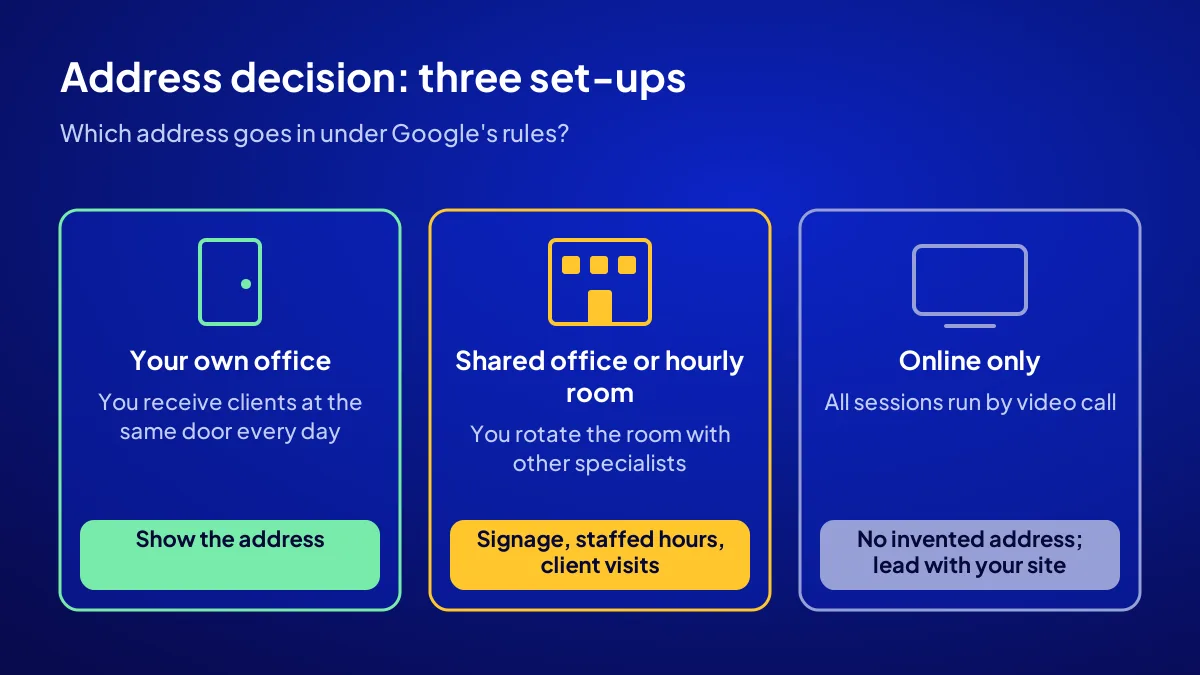
The address field shows the door a client will knock on. Under Google’s rules, a virtual office or coworking space cannot be used as an address unless staff are present during business hours and clients are received there. The hourly room rental model common among psychologists is therefore risky; check the conditions first.
If you have your own office
Show the address and put the pin at your door. In a flat in Nişantaşı or Çankaya, a small, readable name plate by the bell is enough. A selective client wants an easy-to-find door, not a flashy sign.
Shared office or hourly room
Three conditions apply together: visible signage, being there during stated hours, and receiving clients at that address. If one is missing, the profile may be suspended.
If you only work online
The map profile is built for in-person contact. If all sessions are online, do not invent an address; build visibility through your website and content.
Which rules apply to hours, services and photos?
BU BÖLÜMÜN ÖZETİ
- Hours: no one left waiting at the door
- Service description: information, not promises
- Photos: calm and client-free
These three fields are the most read part of the profile. Türkiye’s health promotion regulation of 12 November 2025 allows health professionals to share their specialties, academic titles, the times and places they see clients, and health-protective information. Fees, discounts, campaigns and satisfaction statements are banned.
| Field | What goes in | What stays out |
|---|---|---|
| Business name | Name and title as documented | District, method, “the best” |
| Primary category | The most specific category naming your profession | Broad or unrelated category |
| Address | The door where you receive clients | Virtual office, unused room |
| Opening hours | Real hours when the phone is answered | “Reach us 24/7” promise |
| Service description | Title, areas of work, method names | Fees, discounts, “it cures” claims |
| Photos | Building entrance, door, empty session room | Clients, screenshots of client reviews |
Hours: no one left waiting at the door
Profile hours are the hours your phone is answered. A client who cannot reach you rarely calls twice; the customer turns away before walking in.
Service description: information, not promises
Give facts such as “individual adult sessions, couples sessions, Turkish and English”. Do not promise outcomes like “get rid of anxiety”. Which phrases break the rules is covered in therapy practice advertising rules.
Photos: calm and client-free
A sea-view room in Mavişehir or a quiet street in Moda tells a premium client a lot. An empty armchair, soft light and the entrance are enough. A client’s face never appears.
How are client reviews handled with confidentiality?
BU BÖLÜMÜN ÖZETİ
- Never confirm the relationship in a reply
- The same line for negative reviews
- Keep reviews off your shop window
In therapy, a review also reveals that the writer is a client. Google allows asking for reviews without incentives; reviews for discounts or gifts count as fake engagement, and the regulation bans satisfaction statements as advertising. The cautious path: do not ask, and answer any review briefly without confirming a client relationship.
Never confirm the relationship in a reply
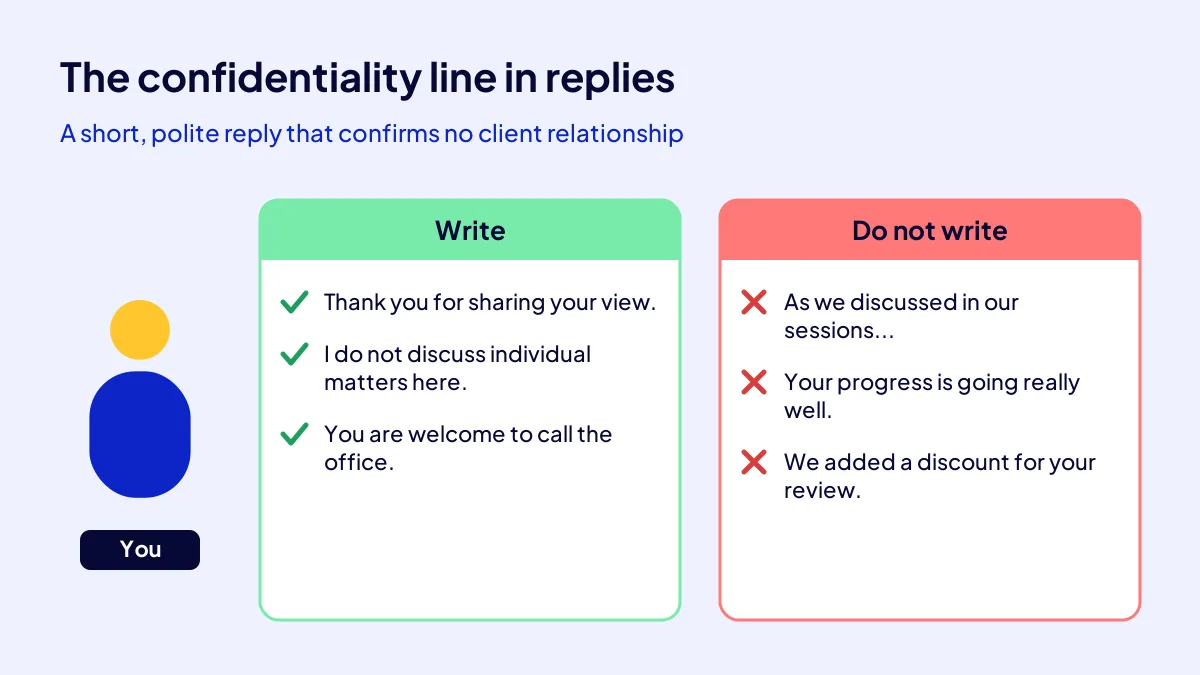
“As we discussed in our sessions” breaks confidentiality with your own hand. A sample reply: “Thank you for sharing your view. In line with my confidentiality policy, I do not discuss individual matters here; you are welcome to call the office.”
The same line for negative reviews
Fair or unfair, do not go into detail on a negative review. Breaking confidentiality while defending yourself does far more harm than the review itself.
Keep reviews off your shop window
Posting a kind review on Instagram is a shopkeeper’s favourite move. In health care it breaks the regulation. Let reviews stay on the profile.
How do AI answers read your profile?
BU BÖLÜMÜN ÖZETİ
- Name, address, phone: the same in three places
- Profile and website should confirm each other
- Building the foundation in one go
A selective client may look at the map and also ask an AI assistant for “a psychologist doing couples sessions in Kadıköy”. Assistants gather business information from several sources; when your name, title and address match everywhere, they recognise you more easily. That is no guarantee of being recommended, only a foundation for being readable.
Name, address, phone: the same in three places
Specialists call this NAP consistency: name, address and phone written identically everywhere. “Psych.” in one place and “Psychologist” in another may look like two people to a machine. Its role in district searches is covered in therapy practice visibility in affluent districts.
Profile and website should confirm each other
The website link on your profile should lead to a page with the same title and address. The broader plan for the first three months is in the first 90 days of a new therapy practice; the full promotion framework is in our new therapy practice promotion guide.
Building the foundation in one go
The AI SEO Campaign builds entity setup, structured data, brand profiles and question-led content together. Fixed TRY 36,000 + VAT, 108 articles, delivery in 30 days, 12 businesses per period; no recommendation is guaranteed. Details are on the campaign page.
Now you know: a good profile is not decorated, it is accurate. Fill six fields once, guard confidentiality in every reply.
Quick Summary
- Pick the most specific primary category; changes may trigger re-verification.
- The name field takes your documented title, not district or method.
- A shared office is an address only with signage, staffed hours and client visits.
- The description gives information; no fees, discounts or outcome promises.
- Do not ask for reviews; reply briefly without confirming a client relationship.
- Name, address and phone match across profile, website and records.
Short Glossary
Primary category: The primary category is the profile field used to tell Google what the business is with a single choice.
Practitioner profile: A practitioner profile is the profile type used for a professional who works one-to-one with their own clients under their own name.
NAP consistency: NAP consistency is the local search principle used to keep business name, address and phone identical across every source.
Next Step
To make your profile and content readable for AI, apply for the AI SEO Campaign. There is a 10% coupon; just mention the code when you apply.
Frequently Asked Questions
Source: Google Business Profile Help — Manage your business category
Sık Sorulan Sorular
Working alone, a profile in your own name is enough. If the practice has its own sign name and several specialists, open one under the practice name. Never open two profiles for the same person.
Google lets businesses serving customers at the customer’s location hide their address. If clients come to your office, show it. If you only work online, do not invent one.
Google allows asking without incentives, but in therapy a review exposes the client relationship, and the regulation bans satisfaction statements in promotion. The cautious path is not to ask.
No. No recommendation is guaranteed; a readability and recognisability foundation is built and measured. The package is a fixed TRY 36,000 + VAT; TRY 43,200 with 20 percent VAT (check the current rate on your invoice).
Updated: October 2026