
EU Adds a €3 Duty on Parcels Under €150: Which Dates Turkish E-Exporters Must Prepare For
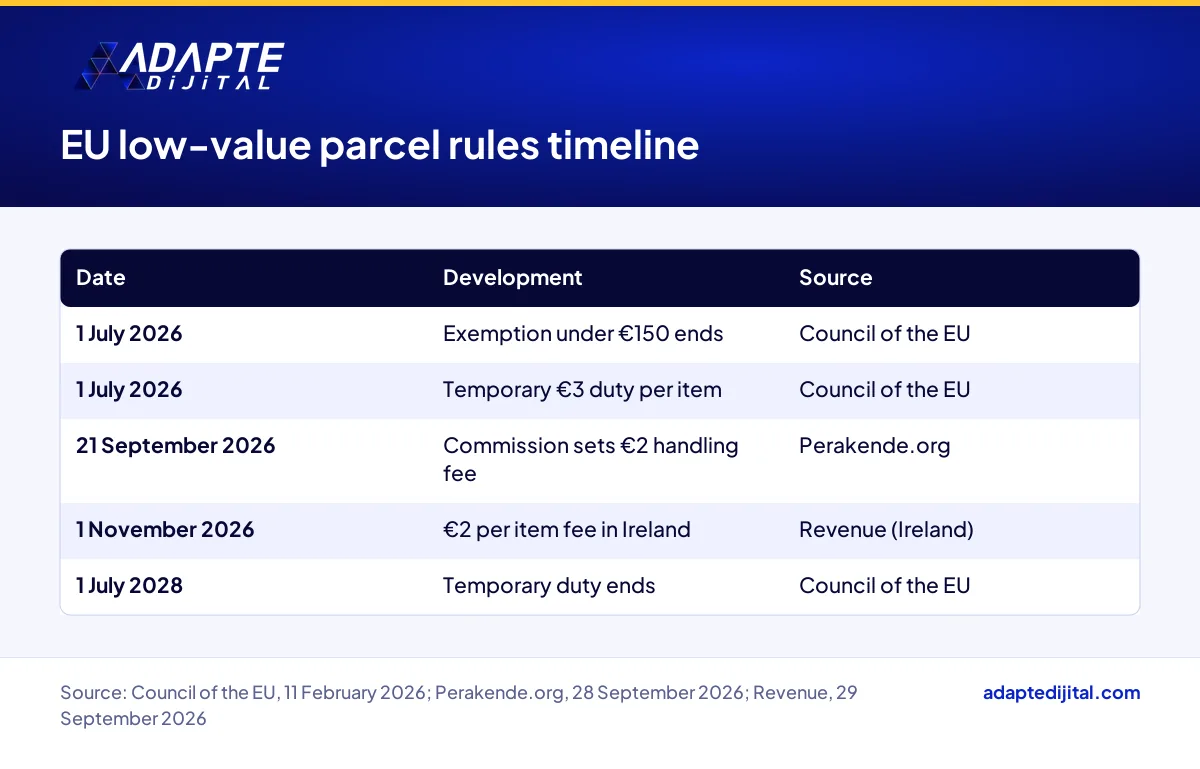
The EU’s customs duty exemption for e-commerce parcels under €150 ended on 1 July 2026, and a flat €3 duty now applies during a transition period (Perakende.org interview, 28 September 2026). According to the Council of the EU, the duty is charged not per parcel but per distinct item category inside the parcel, and it is temporary until 1 July 2028. On 21 September 2026, the European Commission also set a €2 customs handling fee per item. Ireland’s tax and customs authority, Revenue, applies this fee from 1 November 2026.
What it means for you: the unit cost of every Turkish e-exporter sending small parcels to the EU changes on three dates. The duty arrives in July 2026, the handling fee in November 2026, and standard tariffs return in 2028. Low-value orders with many different products are hit hardest. Your pricing, basket design and range decisions need to follow this calendar.
Which dates matter for the EU’s duty on parcels under €150?
BU BÖLÜMÜN ÖZETİ
- 1 July 2026: the exemption ends
- 1 November 2026: the handling fee starts
- 1 July 2028: the temporary period ends
There are four dates: on 1 July 2026 the exemption ends and the temporary €3 duty starts. On 21 September 2026 the Commission sets the €2 handling fee. On 1 November 2026 Ireland starts charging that fee. In 2028, once the EU customs data hub goes live, standard tariffs apply.
1 July 2026: the exemption ends
From this date, e-commerce shipments under €150 are no longer exempt from customs duty. During the transition period, a flat €3 duty applies to each item category. The decision was finalised in the Council of the EU’s statement of 11 February 2026.
1 November 2026: the handling fee starts
According to Perakende.org, the Commission set a €2 Union customs handling fee per item on 21 September 2026, with the fee expected to start in November 2026. Ireland’s Revenue gives the start date as 1 November 2026. We have seen no statement on whether other member states start on the same day.
1 July 2028: the temporary period ends
According to the Council, the temporary duty runs until the EU customs data hub goes live, after which standard tariffs apply. The Council also notes the period “may be extended if necessary”. So 2028 is a planned transition, not a fixed end point.
Is the EU’s €3 duty charged per parcel or per product type?
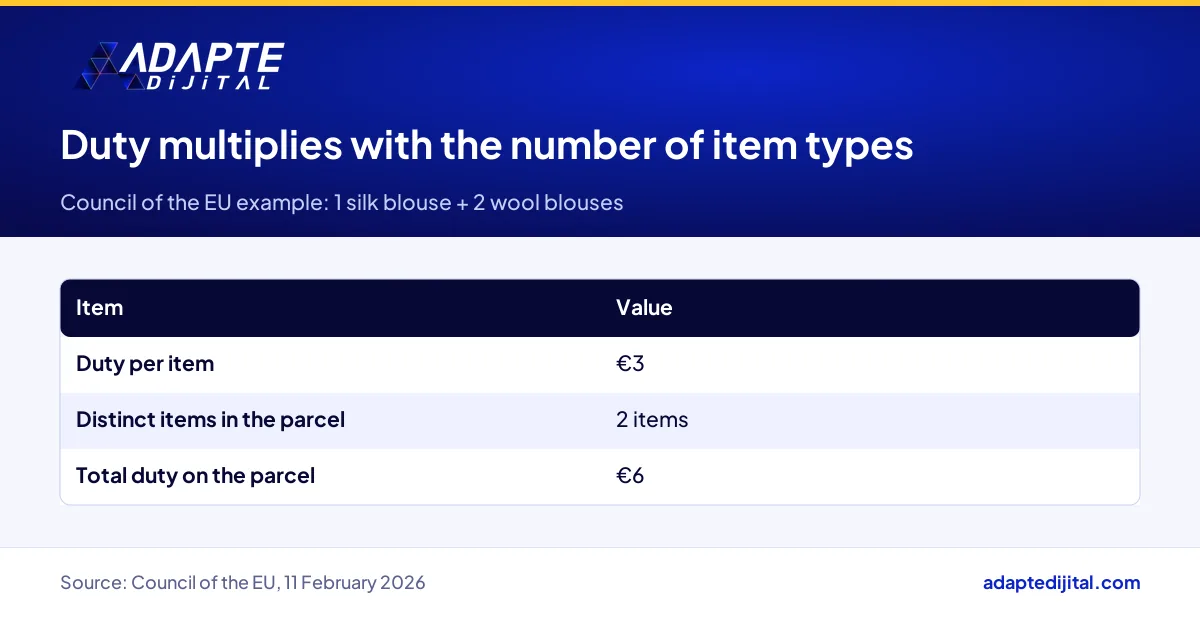
Per product type. According to the Council, the duty is charged separately for each distinct tariff subheading in the parcel. In the Council’s own example, a parcel with one silk blouse and two wool blouses counts as two items and pays €6 in duty. Two products of the same type count as one item.
What does the EU parcel duty mean for Turkish e-exporters, and who is affected how?
BU BÖLÜMÜN ÖZETİ
- Under pressure: low-priced accessory and gift sellers
- More resilient: brands with a deep range in one category
- Indirect: logistics, customs and software providers
Fixed cost per shipment goes up, and low-value orders feel it most. Arkın Obdan makes the same point in the interview. Sellers with high-value baskets in a single category hold up better. Sellers who ship cheap, mixed products one by one struggle most.
Under pressure: low-priced accessory and gift sellers
For a shop mixing items worth a few euros from different categories, duty and fees come close to the product price. Shipping and customs eat the profit, and the till stops ringing. Keeping the price list as it is no longer works for this seller.
More resilient: brands with a deep range in one category
A brand that sells only textiles or only cosmetics, where a basket holds several items of the same type, ships with fewer items per parcel. For this brand, the rule opens room for pricing that rewards bigger baskets.
Indirect: logistics, customs and software providers
Item-level calculation makes accurate tariff data a must. Obdan lists data accuracy across systems and process visibility among the deciding factors. That data work is exactly where logistics, customs and software providers sit.
Why does Arkın Obdan say customs is no longer the last step of an order?
Because cost is now set when a product is listed, not when the parcel leaves the warehouse. Arkın Obdan is general manager of Obdan Sistem and chairman of the board of Servex. In the interview, drawing on the company’s 80 years of experience, he highlights four themes: rising fixed costs, data accuracy, process visibility and supply chain flexibility.
How do the new EU rules show up on an e-exporter’s site, marketplace listings and ads?
In three places: product data, price display and basket design. As Arkın Obdan puts it, “handling technology, accurate data and operational experience together will be decisive”. The digital side is where these rules are most visible to your buyer.
Which decisions should a business shipping parcels to the EU make this week?
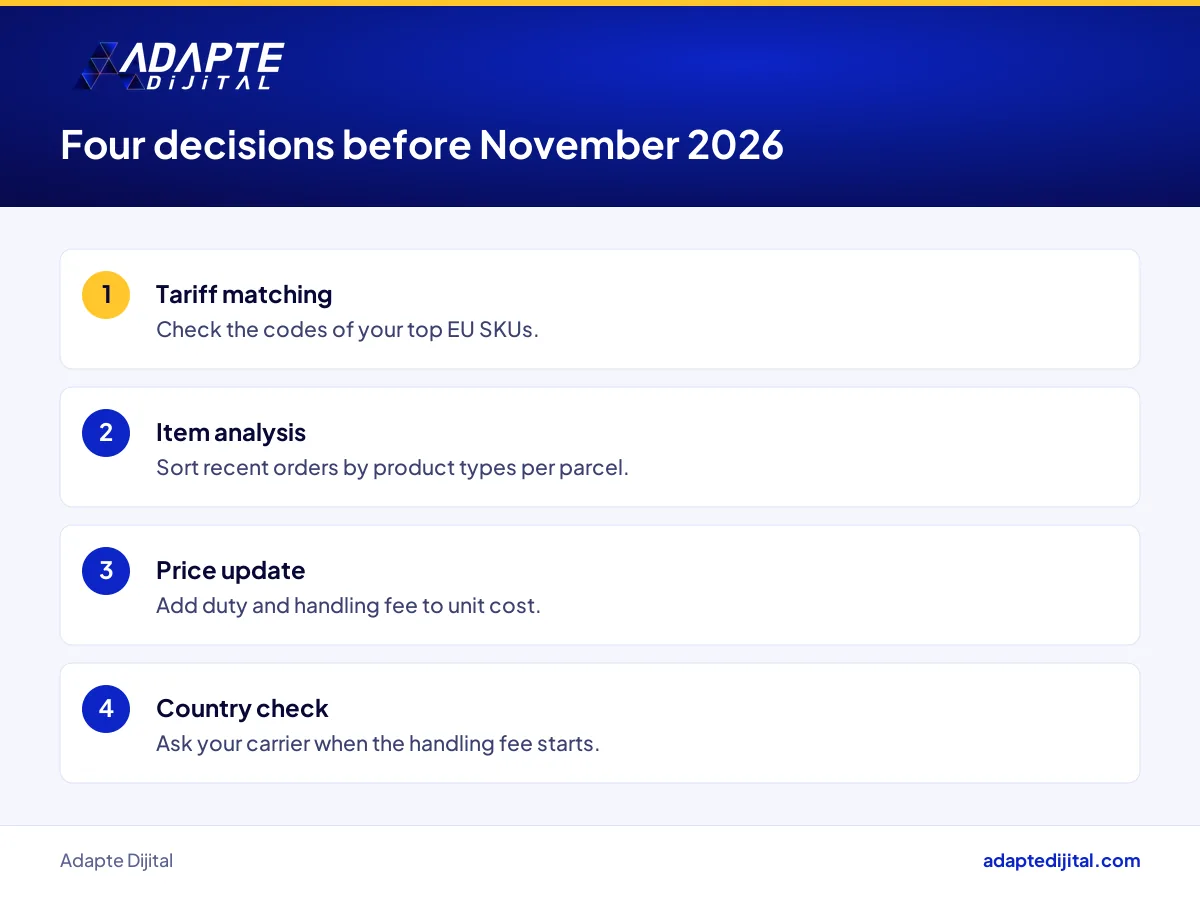
Make four decisions this week. Check tariff matching for your top EU SKUs, sort recent orders by item count, recalculate prices before November and ask your carrier when the handling fee starts in each country you ship to.
Quick Summary
- The EU customs exemption for e-commerce parcels under €150 ended on 1 July 2026 (Perakende.org, Council of the EU).
- During the transition, a €3 duty applies to each distinct item category until 1 July 2028 (Council of the EU).
- The European Commission set a €2 customs handling fee per item on 21 September 2026 (Perakende.org).
- Ireland’s Revenue applies the handling fee to each distinct item from 1 November 2026 (Revenue).
- Low-value orders with many product types are hit hardest because both charges are calculated per item.
Short Glossary
- Tariff subheading
- Tariff subheading is the term used for the code that shows where a product sits in the customs tariff.
- Handling fee
- Handling fee is the charge used to pay for customs processing of low-value parcels, kept separate from the duty.
- Customs data hub
- Customs data hub is the system the EU plans to launch in 2028, used to bring customs data into a single point.
Frequently Asked Questions
Next Step
If you want to review the item structure of your EU orders and your prices together before November, fill in the consult your expert form.
Sources: Perakende.org, 28 September 2026 · Council of the EU, 11 February 2026 · Revenue (Ireland), 29 September 2026
Updated: October 2026
Sık Sorulan Sorular
Put three products from three different categories in one parcel and the duty is charged three times. Three products from the same category count as one item. Your product mix becomes a bigger cost driver than your average order value.
No. The Council states clearly that the €3 duty is separate from the handling fee. In Ireland’s case, the handling fee is also charged for each distinct item in the parcel. So the number of product types pushes up two separate costs at once.
Our sources do not include the Commission decision number for the handling fee or its start date in every member state. The number of e-commerce parcels going from Türkiye to the EU, and the total extra cost, are also unknown. Instead of filling these gaps with guesses, ask your carrier for written information by country.
A seller who can see which customs stage a parcel is in gives the buyer accurate updates and catches return requests early. Without visibility, customer service cannot answer “where is my parcel”. That shows up directly in the review score.
Rules and fee start dates can differ from country to country. A seller tied to one carrier and one shipping model has to rebuild the whole flow when one country changes. Keeping an alternative shipping option ready reduces that risk.
Listing, pricing and shipping decisions now belong at the same table. When a category manager adds a new product to the EU storefront, they should see the tariff code and its item effect too. Customs becomes a topic for the product team, not just the warehouse.
Here’s something most people don’t know: because duty is charged per item, every SKU has to match the correct tariff subheading. If your site, marketplace and shipping software use different data, the parcel waits at customs. In physical stores, bringing till and stock data into one system takes the same discipline; our article on Beko’s cash register trade-in covers that side.
When an EU buyer sees an unexpected amount at checkout or at the door, the basket gets abandoned. Decide whether to include duty and fees in the price, and say so clearly on the product page. The price in your ads and product feed must match the page.
Ads that pull in single, low-value orders now cost you more per sale. Campaigns built around bundles, multi-buys in the same category and a free shipping threshold fit the new cost structure better.
Consider a separate product mix for the EU. Removing slow-selling variants that add an extra item to parcels lowers the item count per basket. Make this call category by category, using your own margin sheet.
Yes. The US has also suspended its low-value parcel exemption since 29 August 2025, so the two largest markets are moving the same way. We cover the US route step by step in our article on ShipEntegra’s US service.
Confirm dates and amounts with the Council of the EU and the customs authority of each destination country. Verify with the official source; this is not legal or financial advice. We build pricing, product mix and channel setup with you in our e-commerce consulting service, and our retail page tracks the Turkish retail agenda for you.
No. According to the Council of the EU, the duty is charged per distinct item category, and products in the same category count as one item.
The 1 November 2026 date comes from Ireland’s Revenue. For other countries, confirm with the customs authority of the destination country or with your carrier.
According to the Council, the temporary duty applies until 1 July 2028, after which standard tariffs apply. The Council also says the period may be extended if necessary.