
Alfemo more than doubles Q1 revenue, how does a furniture brand grow via dealers?
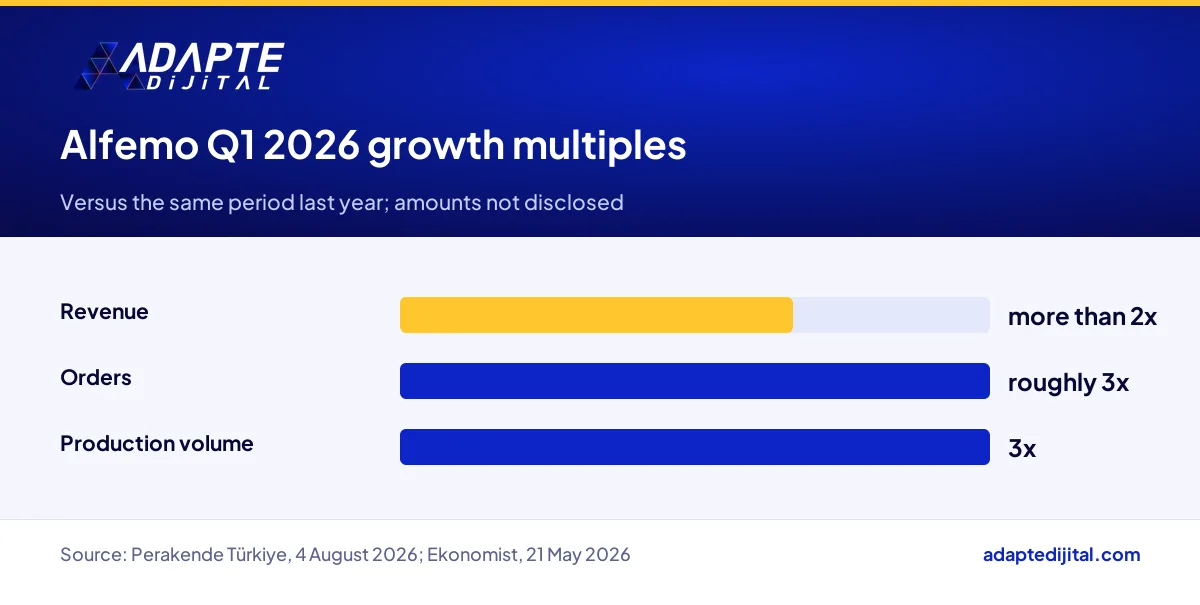
Alfemo, the furniture brand owned by Türkiye’s Zeren Group, more than doubled its revenue in the first quarter of 2026 compared with the same period last year, while orders rose roughly threefold and production volume tripled (Ekonomist, 21 May 2026; Perakende Türkiye, 4 August 2026). In the same quarter it opened 25 new sales points, and talks with 100 new dealer candidates are under way. The goal is to double the number of Alfemo stores in Türkiye.
Here is why it matters to you. If you are a manufacturer or a brand owner, you have two roads to growth: your own stores or a dealer network. Alfemo is pushing hard down the second road. No revenue figure was disclosed, only ratios, so read this news as an X-ray of a growth model rather than a scoreboard.
What is behind Alfemo’s first-quarter growth?
Three things: new collections, new sales points and more production capacity. New collections make up roughly half of total orders, with upholstery and panel furniture groups leading the way. Headcount grew by 15 percent. The announcement came from Alfemo General Manager Tolga Kaya (Perakende Türkiye).
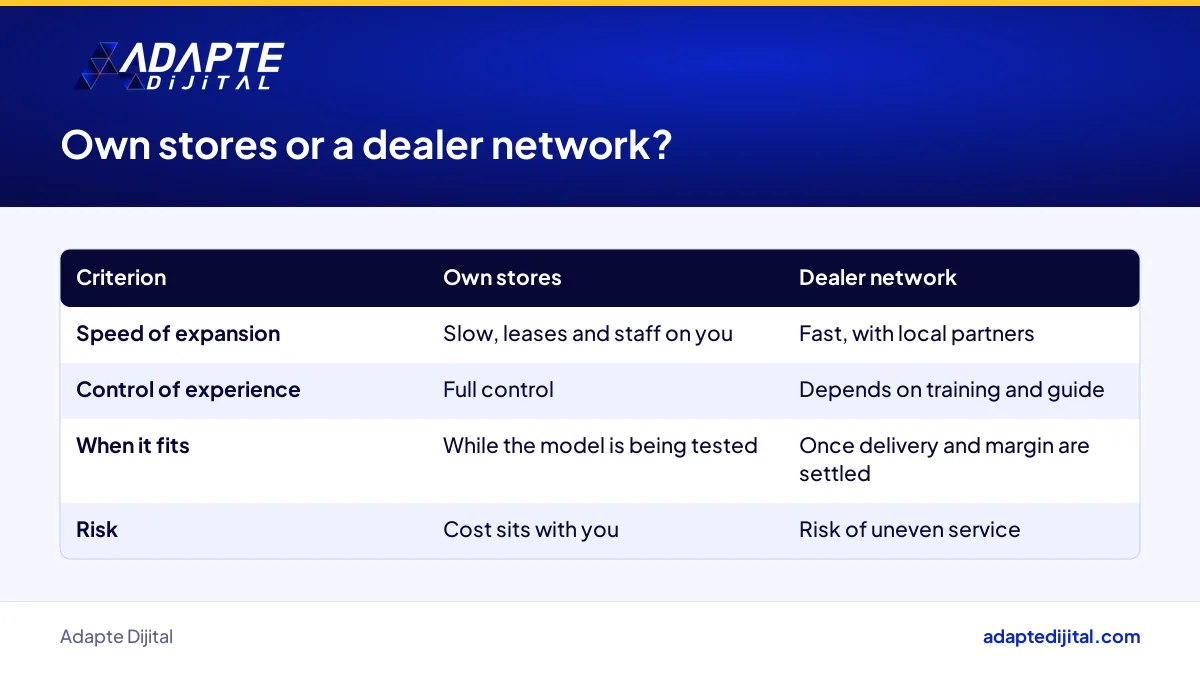
Should a furniture brand like Alfemo grow through its own stores or through dealers?
If you want to spread fast, go with dealers; if you want full control of the experience, go with your own stores. Here’s the thing, though: they are not alternatives but two steps in a sequence. First you prove your sales model in a few of your own stores, then you hand that model to dealers. In Alfemo’s news, the line between “sales point” and “dealer” is blurred, because the two sources use different terms.
Who does Alfemo’s dealer push affect, and how?
It affects local store owners weighing a furniture dealership most, along with multi-brand furniture retailers in the same cities and suppliers of upholstery and panel materials. In Türkiye in autumn 2026, an entrepreneur looking for a furniture dealership has more options on the table. Existing multi-brand dealers, on the other hand, feel more pressure from brands asking them to “go exclusive with us”.
Why should Alfemo’s doubling of revenue be read with care?
Because a ratio only means something against its base. If the period before the Zeren Group acquisition was weak, part of the doubling may be a base effect, and the news does not discuss this. The revenue amount was not disclosed either. So before you compare the figure with your own business, ask about the base.
What should a furniture brand growing through dealers like Alfemo build online?
It should build three things: a dealer locator page, a consistent local business profile for every dealer, and a flow of leads to dealers. Here’s what I’ve seen. I have been looking at furniture brands’ websites for years, and the customer they lose most often is the one who cannot find an answer to “where can I see this product?” Dealer numbers grow, but the website still shows the old list.
What should a brand owner considering dealer growth like Alfemo’s do this week?
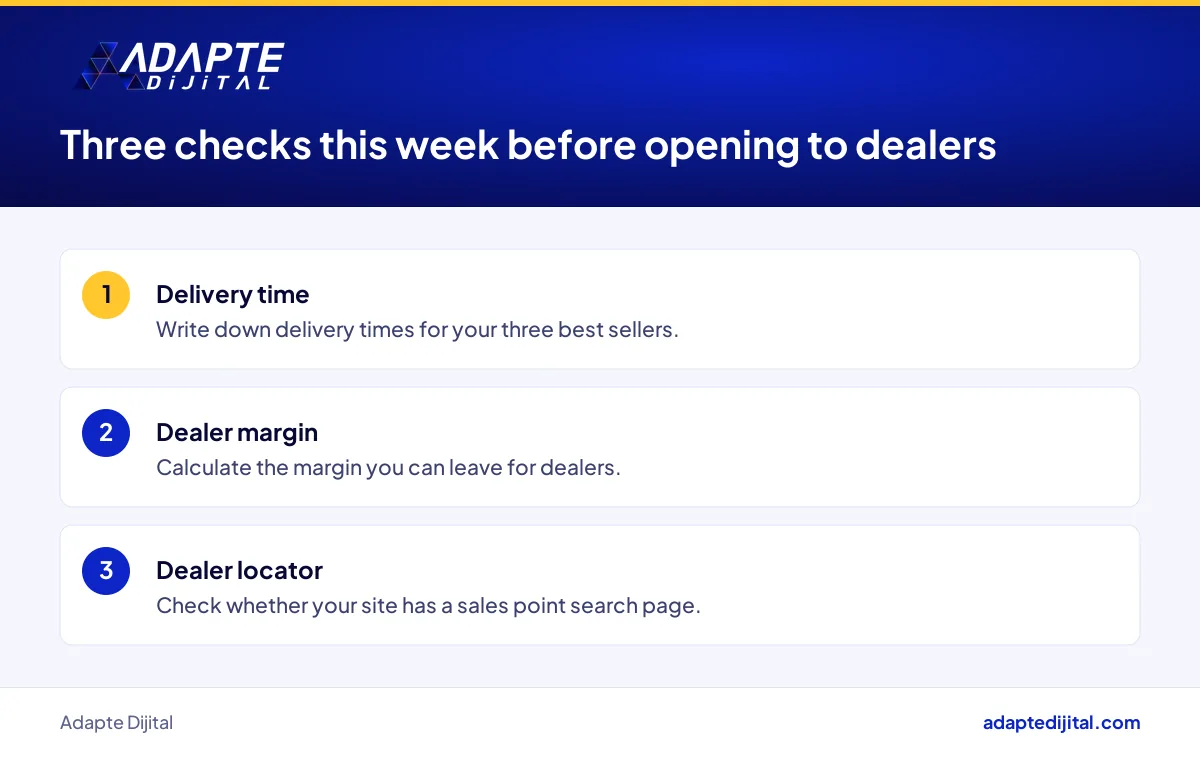
Do three things this week: write down the delivery time for your three best-selling products, calculate the margin you can leave for dealers, and check whether your site has a dealer locator. These three answers tell you whether you are ready for a dealer network. We do this work ourselves in digital consulting, building the growth model together with your digital channels.
Quick Summary
- Alfemo’s revenue more than doubled in the first quarter of 2026 compared with the same period last year (Ekonomist, 21 May 2026).
- Orders rose roughly threefold, production volume tripled and headcount grew by 15 percent (Perakende Türkiye; Ekonomist).
- Alfemo opened 25 new sales points in the first quarter and is in talks with 100 dealer candidates (Perakende Türkiye).
- New collections account for roughly half of orders (Perakende Türkiye).
- With no revenue amount disclosed, the ratio should be read together with a possible base effect.
Short Glossary
- Base effect
- Base effect is the term used to describe how a weak or strong comparison period inflates or shrinks a growth rate.
- Sales point
- Sales point is the general term used to describe any store or dealer where a brand’s products are sold to customers.
- Dealer locator
- A dealer locator is the page or tool used to help customers find the nearest sales point on a brand’s website.
Frequently Asked Questions
Next Step
If you would like to weigh up together whether to grow through your own stores or a dealer network, fill in the consult your expert form and we will talk through the first step for your product and channels.
Sources: Perakende Türkiye, 4 August 2026 · Ekonomist, 21 May 2026 · Ekonomi Gazetesi, January 2026 · Alfemo project page (linked in the text). No Alfemo press release for this news was found.
Updated: October 2026
Sık Sorulan Sorular
Look, a dealer wants something new to sell. When a brand keeps the same sofa in the window for ten years, its dealer eventually turns their attention to another brand. Half of orders coming from new collections shows that dealers have been given something to talk about.
Delivery time. In furniture, the question customers ask most is “when will it arrive?” If production cannot keep up with orders, the dealer makes the sale but the customer cools off while waiting. More capacity lets the dealer keep their word.
Using Zeren Group’s infrastructure, Alfemo also supplies project-based furniture and sleep systems to residential and hotel projects, as set out on the brand’s project page. That gives it a second sales channel alongside retail dealers.
If your product is new, your price positioning has not settled and you are still testing what to tell customers, your own stores are the better choice. When you make a mistake, you pay for it, but you also learn the lesson. You see sales per square metre, average basket and return rate with your own eyes.
If the product sells itself, your delivery times are consistent and your margin leaves room for the dealer to profit, a dealer network gives you speed. Let’s say you want to be visible in ten provinces across Anatolia. Instead of ten store leases, you get ten local partners who bring local knowledge with them.
The system I recommend is this: your own stores act as “showroom and school”, and dealers act as the “spreading network”. A new collection is tested in your own store first, the sales script gets written there, and then it reaches dealers through training. That way dealers never become your test bench.
A brand talking to 100 candidates is in a position to be selective. The candidate has bargaining power too: delivery time, display support and stock requirements should all be raised at the contract table. Dealership terms are not in the news, so you need to get them from the brand directly.
Fast-growing brands want more display space. A shop that gives half its showroom to one brand has to rebuild its relationships with the others. Sometimes the customer walks out the door, because the brand they came for is no longer in that window.
Because upholstery and panel groups are leading, fabric, foam and board suppliers see demand. As dealer numbers rise, delivery and assembly crews become part of the picture too. Local firms that handle signage and store fit-outs for new sales points also join the cycle.
According to an Ekonomi Gazetesi report from January 2026, about eight months after the acquisition the store network had grown from 55 to 75, with a year-end target of 110 stores. These figures are not in the first-quarter news; read them as a separate date and a separate source.
Let me ask you one thing: was the same quarter last year a normal quarter? If not, track the amount and the profit, not the ratio. If revenue doubles while your margin melts away, the growth ends up in the warehouse, not in the till.
With furniture, customers choose online and buy in the store after touching it. If someone likes a product on your site but cannot find the nearest dealer, they head to a competitor’s showroom. Every new sales point should go into the dealer locator on the same day it opens.
A search for “furniture store near me” lands on the dealer’s map profile. If the profile name, category, photos and opening hours follow the brand guide, customers see the same brand in every city. A dealer without a profile might as well not exist in search.
In the G-250 Youth Index (72 provinces, more than 4,800 participants), Alfemo is among the preferred brands in the furniture category (Perakende Türkiye). Who produces the index and where the brand ranks are not in the news. Still, the message is clear: young customers meet a brand on their phone first, then touch it at the dealer. Social media and search content become the ground floor of the dealer’s shop window.
Enquiries from your website should be routed automatically to the dealer in that area. Measuring which dealer turns enquiries into sales is how you manage the network. For one example of reading customer data with AI, see our piece on OBASE AIR and CRM.
A product list, delivery times, display support, a training schedule and an identity guide. While you prepare it, Bosch’s dealer standards example is a good checkpoint for keeping service the same at every outlet. Settle the contract terms with your lawyer. Verify with the official source; this is not legal or financial advice.
If you cannot hit your delivery times even in your own stores, it is too early. The dealer ends up explaining your late order to the customer. After a while, they stop picking up your calls and start picking up a competitor’s. Let me put it with a smile: dealers are patient, their customers are not.
Our retail page, where we interpret the retail agenda for you, keeps brand, dealer and store decisions in one place. My decision is clear: prove your sales model in your own store first, then multiply it through dealers.
The dealership terms, investment amount and margin are not disclosed in the news. You need to get this information directly from Alfemo; nothing here is investment advice.
No source has disclosed the revenue amount. The reports only give a ratio: in the first quarter of 2026, revenue more than doubled compared with the same period last year.
Yes, but it first needs to pin down delivery times and the margin left for dealers. A manufacturer that has proven its sales model in a few of its own stores opens up to dealers more safely.