
Cost Items in an Agent-Run Business: What the Real Cost of AI Agents Is Made Of
The cost items of an agent-run business are all the direct and indirect costs of running AI agents: subscriptions, usage-based fees, tools, security and the human time spent checking an agent’s output. The visible invoice is only part of the total cost. 💳
This article covers the cost items of an agent-run business, the invisible costs, tax and record keeping, how to track spending and common mistakes. No specific prices are given; providers keep their prices current on their own pages. The lab work in which we will show our own agent team’s real monthly bill has not been set up yet; it will be published separately once it is. Tax information is a general framework and is not legal or financial advice; consult your accountant about your own situation.
What are the direct cost items?
BU BÖLÜMÜN ÖZETİ
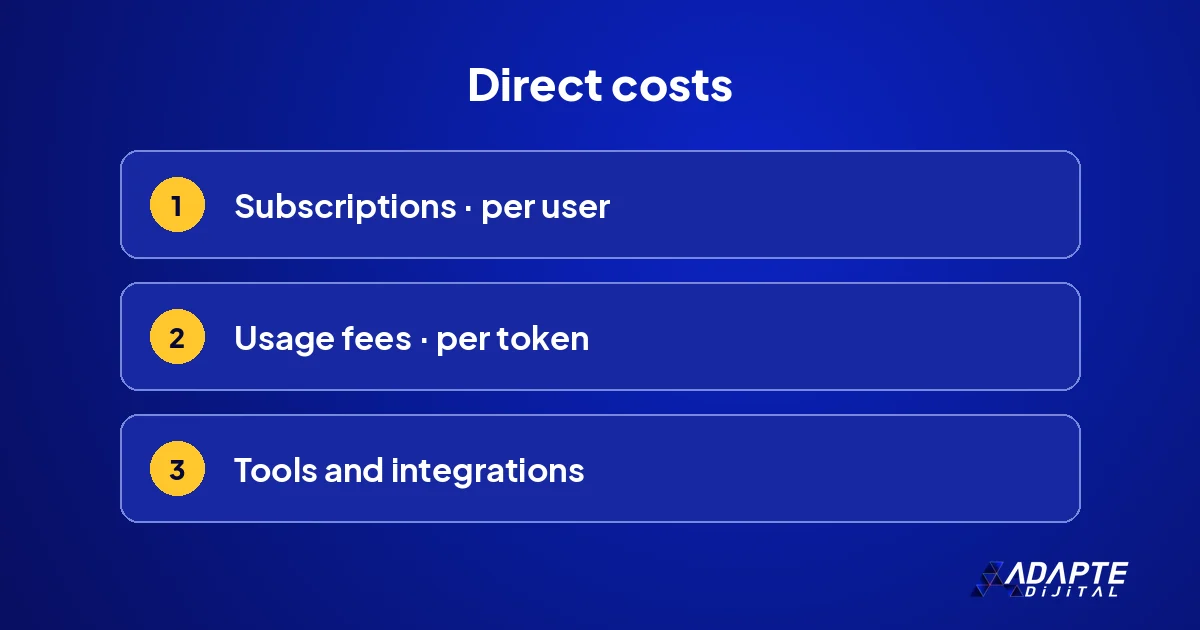
- Subscriptions
- Usage-based fees
- Tools and integrations
The costs that arrive with an invoice fall into three groups. Each is charged in a different way.
Subscriptions
Individual, team or enterprise plans for AI assistants are usually charged as a monthly or annual subscription per user. Subscription costs rise in a straight line with the number of users, so who really needs which plan is reviewed regularly. An unused seat is the easiest saving and the first place to look. Annual plans may cost less per month but tie the business in, so they are chosen once usage is clear. 📅
Usage-based fees
When agents are connected to an application or an automation, AI providers’ interfaces are usually charged by the amount of text processed, that is, per token. Providers such as OpenAI and Anthropic publish their current prices on their own pages. Usage-based fees grow with workload; setting a monthly ceiling prevents surprises. Longer instructions and documents fed to the agent also increase usage, so lean instructions save money.
Tools and integrations
Automation platforms, form and customer relationship tools, data storage and hosting are parts of the infrastructure agents run on. Each tool may look like a small monthly fee, but the total grows quickly. The list of tools, what each does and which agent job it serves is kept in one table, so tools that no longer serve a job can be spotted and cancelled. 🧰
What are the invisible costs?
BU BÖLÜMÜN ÖZETİ
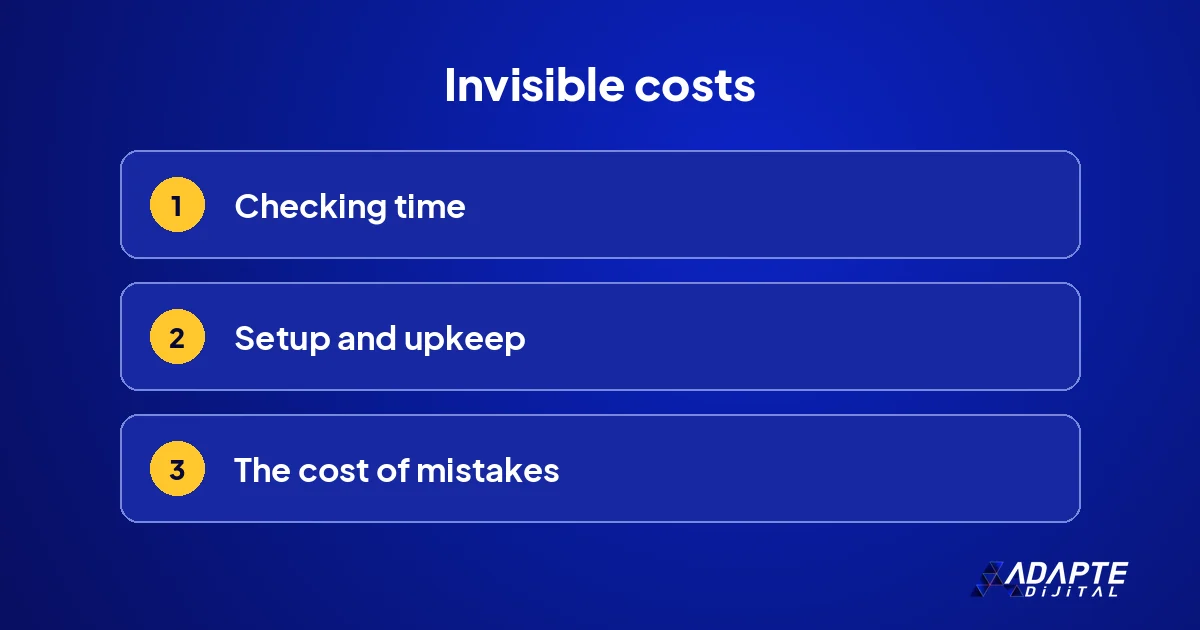
- Checking time
- Setup and upkeep
- The cost of mistakes
Costs that never arrive as an invoice make up a large part of the real cost of an agent-run business.
Checking time
The time spent by the person who reads, corrects and approves each agent output is the largest invisible cost of an agent-run business. If checking time is left out, an agent job looks cheaper than it is. As the correction rate falls, this cost shrinks, which is why investing in the rules document directly lowers cost. Recording checking time per job turns this hidden cost into a number. ⏱️
Setup and upkeep
Writing the instruction document, preparing the knowledge base and keeping it current, and moving the arrangement when tools change all take time and effort. An agent job without upkeep starts working from old information and creates the cost of mistakes. A set amount of time is reserved for upkeep each month and written into the calendar, so it does not slip behind daily work.
The cost of mistakes
An agent mistake that slips past checking comes back as a wrong quote, a lost customer or a round of corrective emails. The cost of mistakes cannot be measured directly, but it is real. An arrangement in which nothing goes out unapproved limits it a great deal; remaining mistakes are recorded and turned into rules, so each one becomes cheaper than the last. ⚠️
How are tax and records organised?
BU BÖLÜMÜN ÖZETİ
- Invoices in the business’s name
- VAT on services from abroad
- Classifying costs
Most agent costs are paid to providers abroad. That calls for care in records and tax.
Invoices in the business’s name
All subscription and usage invoices are issued with the business’s legal name and tax details and passed to the accountant every month. An invoice in a personal name makes expense records harder. A folder where invoices are saved and a monthly reminder turn this into routine and leave no missing documents at month end. 🧾
VAT on services from abroad
For services bought from a provider abroad, a VAT-registered Turkish business may need to declare that VAT itself under the reverse-charge mechanism, using VAT return No. 2, and can usually deduct it. Exchange-rate differences and the filing period are also taken into account. Because the details depend on the business, this arrangement is set up with the accountant before the first invoices arrive.
Classifying costs
If agent costs are recorded in groups such as subscriptions, usage fees, tools and services, it becomes clear what each agent job costs. Classified costs are costs that support decisions. This classification also forms the basis of the monthly cost report, which is kept short and repeatable so it is actually produced every month. 🗂️
How is spending tracked?
BU BÖLÜMÜN ÖZETİ
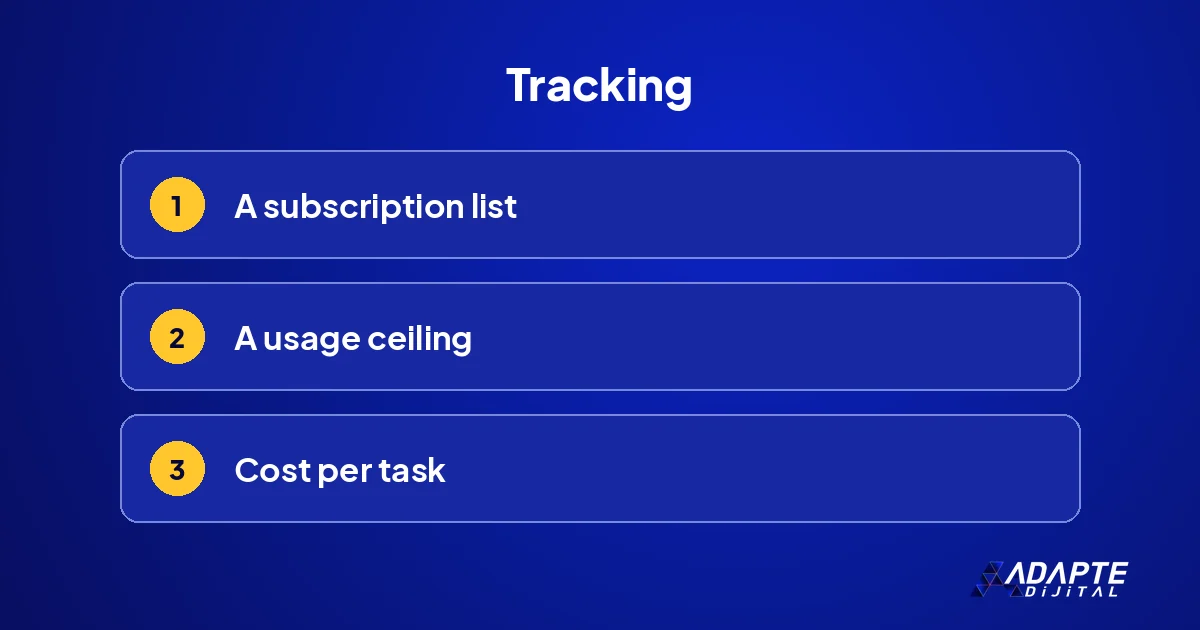
- A subscription list
- A usage ceiling
- Cost per task
Three habits are enough to keep agent costs under control.
A subscription list
Each subscription’s name, owner, number of users, monthly fee and renewal date are kept on one list. The list is reviewed once a month; unused subscriptions are cancelled and plans larger than needed are downgraded. Practical ways to keep this under control are covered in controlling subscription costs. 📋
A usage ceiling
For usage-based interfaces, a monthly spending limit and an alert threshold are set. An unexpected loop or a faulty automation can create a large bill quickly without a limit. When an alert arrives, the cause is investigated the same day, and the limit is raised deliberately as workload grows rather than removed.
Cost per task
Dividing total agent cost by the number of tasks the agent completes gives the cost per task: per quote, per reply, per piece of content. Cost per task makes comparison with human effort possible. Checking time is added to the comparison; otherwise the picture is incomplete. A broader look at what AI costs a business is in business AI cost. 📊
What are the common mistakes?
BU BÖLÜMÜN ÖZETİ
- Shadow AI
- Looking only at the invoice
- Forgetting exchange rates and price changes
Most cost mistakes come from small items piling up and invisible costs being forgotten.
Shadow AI
When employees use tools of their own choosing without the business knowing, it creates both cost and data risk. A business that does not know who uses which tool can control neither its costs nor where its data goes. The numbers behind this problem are covered in the cost of shadow AI. 👥
Looking only at the invoice
Calculating agent cost from the subscription invoice alone ignores checking and upkeep time. An incomplete calculation leads to the wrong growth decision. Total cost is thought of as the invoice plus checking time plus upkeep time, and it is recalculated every quarter as volumes change.
Forgetting exchange rates and price changes
When a foreign provider’s prices are in another currency, exchange-rate movements affect costs directly, and providers also change their prices and plans from time to time. Budgets leave room for exchange-rate and price changes. Prices are checked regularly on providers’ official pages rather than taken from memory. 💱
What does Adapte Digital do on cost tracking?
BU BÖLÜMÜN ÖZETİ
- A single delivery package
- What is delivered
- Where to start
We make your agent costs visible: a subscription list, usage limits and a cost-per-task table are set up, the arrangement your accountant needs is prepared, and everything is handed over.
A single delivery package
Adapte Digital does not charge a monthly management fee. Work starts with a single delivery package whose scope is written down in advance: 36,000 TRY + VAT. If the work grows, the new need is defined as a separate add-on package, priced by what will be delivered rather than by the hours spent. 📦
What is delivered
The output is a subscription and tool list, usage limit settings, a cost-per-task table and a monthly cost report template. How this fits wider cash planning is covered in cash flow management.
Where to start
The written scope of each package, with current pricing and capacity, is on our campaign pages. 🧭
Quick Summary
- An agent-run business’s costs come from subscriptions, usage fees and tools.
- Invisible costs: checking time, setup and upkeep, and the cost of mistakes.
- Invoices are issued to the business; VAT on services from abroad is planned with the accountant.
- Spending is tracked with a subscription list, a usage ceiling and cost per task.
- Shadow AI and looking only at the invoice are common mistakes.
Short Glossary
- Token
- A small unit of text that AI models process and that usage charges are based on.
- Cost per task
- Total agent cost divided by the number of tasks the agent completes.
- Shadow AI
- AI tools employees use without the business’s knowledge or approval.
Frequently Asked Questions
Next Step
Today, list every AI subscription you use: tool, owner, number of users, renewal date. Our campaign pages list the delivery packages that cover this work.
Sources: OpenAI — API Pricing · Anthropic — Pricing
Updated: November 2026
Sık Sorulan Sorular
There is no single figure; cost depends on the tools chosen, the number of users, usage and checking time. Calculating cost per task from your own records is the most accurate approach.
With a ceiling and an alert threshold, the risk is under control. Without a limit, a faulty automation can create an unexpected bill.
A reverse-charge declaration may apply. The details vary by business, so plan it with your accountant.