
Page One on Google, Unknown to ChatGPT: Why Wasn’t My SEO Agency Enough?
You have paid for SEO for years, and it worked. Your pages rank on page one for the searches that matter, the reports have been green, the traffic has been steady. Then one day you ask ChatGPT the same question your customers search on Google — and the answer does not mention you at all. How can a brand be on page one and invisible at the same time?
The natural suspicion falls on the agency: “Did they miss something? Were we paying for the wrong thing?” Sometimes the answer is yes. But more often the explanation is simpler and fairer: the agency won the game it was hired to play, and a second game has appeared next to it, with different rules.
This article separates the two games, draws up a fair balance sheet of your SEO agency, shows how your existing SEO becomes capital for the new work, lists what the new layer adds and explains how to run both games at the same table. The right question is not “SEO or AI?” but “the foundation is ready — who builds the roof?”
Two Games on the Same Field, With Different Rules
Understanding the difference between the games is the first step to making a fair judgement — about the agency and about what you need next.
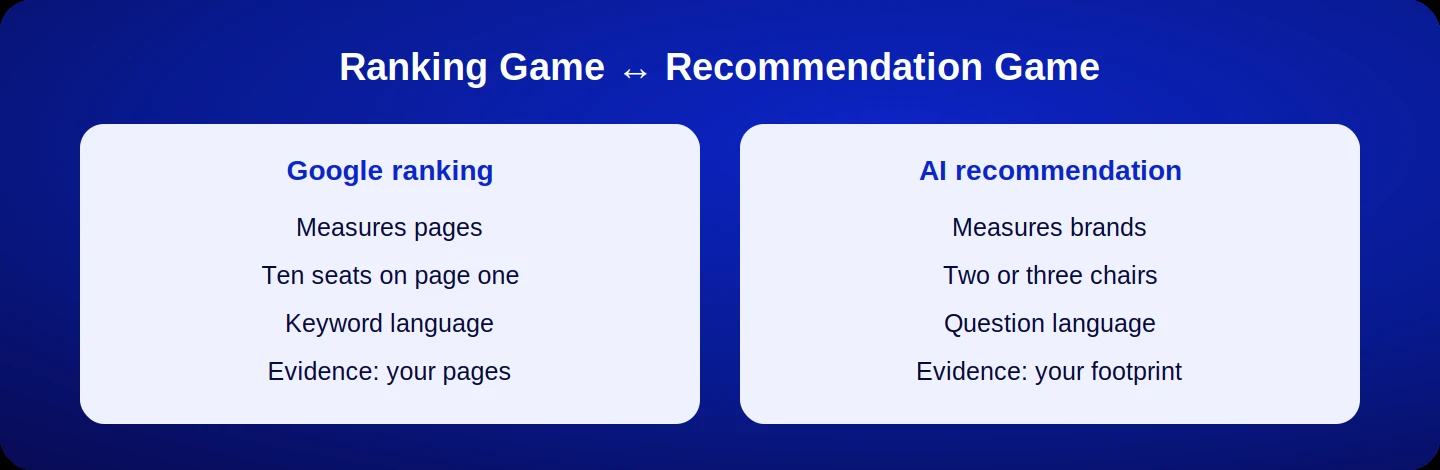
Where the rules differ:
Is Your SEO Agency to Blame? A Fair Balance Sheet
Blame is tempting but rarely useful. A fair balance sheet helps you decide what to keep, what to add and how to talk about it.
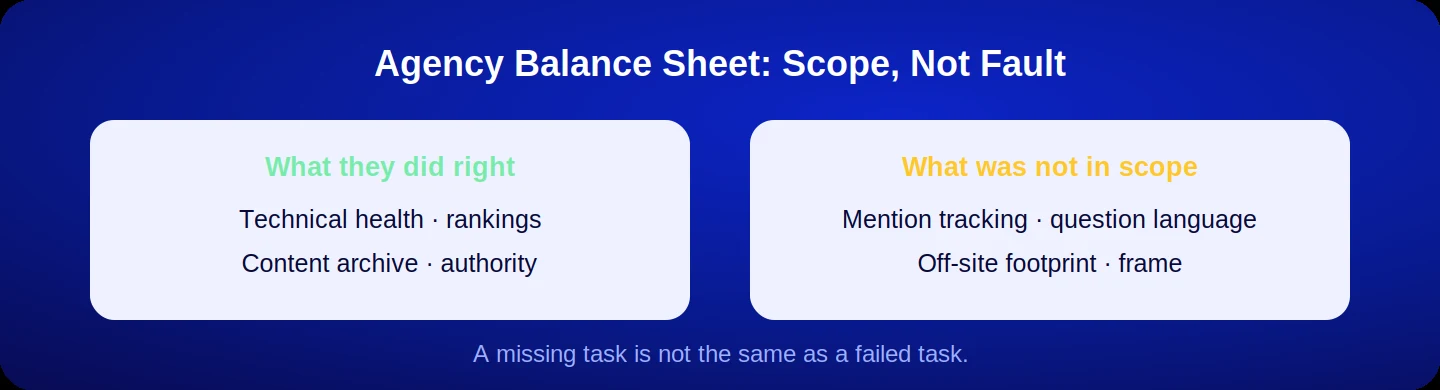
The four lines of the balance sheet:
A Roof on the Foundation: How Does Your Existing SEO Become Capital?
Here is the good news for brands with an SEO history: you do not start from zero. Four assets carry straight into the new work.
Four assets:
The Roof’s Work List: Four Items Added to SEO
With the foundation in place, the new layer consists of four items. None of them replaces SEO; all of them build on it.
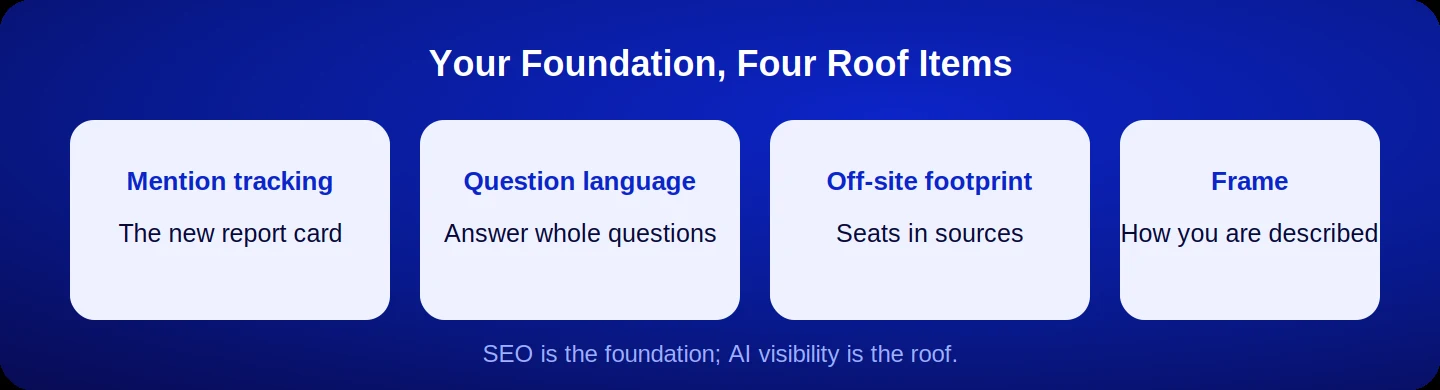
The four items:
The Transition: Running Both Games at One Table
Adding the roof does not mean pausing the foundation. For a while, both games run side by side, and that needs a little organisation.
Four organising rules:
Meeting Test and Foundation-Roof X-Ray
BU BÖLÜMÜN ÖZETİ
- “What happens to my existing SEO work?”
- “Will this work harm my Google rankings?”
- “Will I see separate reports for the two games?”
- “What do we get if we start small?”
Let us close with the rulebook. Four questions:
What good answers sound like:
“What happens to my existing SEO work?”
A good answer treats it as capital: keep what works, build on it, protect ranking pages. An answer that suggests starting over, or dismisses SEO as outdated, does not understand the foundation and will likely damage it.
“Will this work harm my Google rankings?”
A good answer describes the safeguards: additions rather than rewrites on ranking pages, review and backups, monitoring after each change. “Don’t worry, nothing will happen” is not a safeguard; it is a hope.
“Will I see separate reports for the two games?”
A good answer offers two scoreboards and one meeting. A report that blends mentions into traffic figures, or claims AI results through rankings alone, is measuring the new game with the old ruler.
“What do we get if we start small?”
A foundation-roof X-ray: an inventory of the SEO capital you already have, a multi-assistant mention snapshot, the gap between your rankings and your mentions, and a first-quarter plan that builds the roof without disturbing the foundation — fixed fee, the outputs are yours. Bring your latest SEO report to a preliminary assessment; the full scope is on our AI SEO service page. Neighbouring doors: the recommendation map and the competitor gap.
Field Notes
· The most common pattern in brands with a strong SEO history: excellent rankings for keyword searches, near-zero mentions for full customer questions. The gap between the two is the roof waiting to be built.
· Brands that bring their Search Console data to the first meeting shorten the diagnosis noticeably; the questions customers already use are hidden in that data.
· Conversations framed as “adding a floor” rather than “what went wrong” keep good agency relationships intact — and often reveal that the agency was ready for the new work all along.
Mini Glossary
Foundation–roof model: Classic SEO as the foundation; AI visibility as the layer built on top of it.
Question language: Full, contextual questions customers ask assistants — as opposed to short keywords.
Two scoreboards: Rankings and traffic on one side, mention share and frame on the other, read together.
Quick Summary
· Page one still matters, but rankings measure pages while recommendations measure brands; the second game has different rules.
· Your SEO agency most likely did not fail — the new tasks were not in its scope. Your existing SEO is capital for the new work.
· The roof adds four items: mention tracking, question language, off-site footprint and frame — run with the foundation at one table.
Your Next Step
Take your five best-ranking keywords, turn each into the full question a customer would ask an assistant, and ask it. Note where you appear and where you do not. Bring that comparison to a preliminary assessment — it is the clearest picture of how much roof your foundation is waiting for.
Frequently Asked Questions
Can I cut my SEO budget once I move to AI visibility?
Cutting it sharply is usually a mistake. Classic search is still a large channel, and SEO is the foundation that AI visibility stands on: technical health, content and authority all feed the new game. What can change is the balance — part of the content effort can shift to question-language work, and some maintenance may become lighter once the site is in good shape. Rebalance within one plan rather than switching one off to fund the other.
Google has its own AI answers too; is appearing there a separate project?
It overlaps heavily with both games. Google’s AI answers draw on content Google can find and trust, so strong SEO and clear question-language content help you appear there. The same footprint logic applies: consistent information, useful answers, recognition from other sources. Measurement should include these answers alongside other assistants, but the work itself is largely shared rather than a separate project.
Is a brand starting from zero at an advantage, or one like mine with an SEO history?
The brand with an SEO history is almost always ahead: it has a healthy site, an archive, data and authority to build on. A brand starting from zero may have one advantage — no outdated content or inconsistencies to clean up — but it must build everything the other already has. The only case where history is a burden is when it contains a lot of low-quality or inconsistent material; even then, clean-up is faster than building from scratch.
Sık Sorulan Sorular
Because the unit is different. SEO optimises individual pages for individual searches; a page that matches a search well can rank even if the brand behind it is little known. The assistant, on the other hand, recommends a business: it combines everything it knows about the brand into one judgement. You can win a page race without winning the brand race, and that is exactly the situation many successful SEO clients find themselves in.
The margin of error. On page one, being fifth still brings clicks. In a recommendation, being fourth usually means not being mentioned at all. The narrower the door, the more your total footprint matters compared with the strength of any single page. This is why strong pages with a thin brand footprint fall through the gap.
In SEO, the main evidence is on your own site — content, structure, technical health — supported by links. In recommendations, a large part of the evidence sits elsewhere: what industry sources, comparisons, reviews and news say about you. Your site remains necessary, but the assistant wants confirmation from outside, much as a person asks friends before trusting an advert.
Keywords are short and fragmented: “accountant istanbul price.” Questions to assistants are full sentences with context: “I run a small online shop and need an accountant who knows e-commerce, what should I expect to pay?” Content written to rank for the first may not answer the second. Aligning with question language does not mean abandoning keywords; it means answering the whole question, not just the phrase.
If your pages rank, your site is technically healthy, your content archive is broad and your domain has earned authority — that is real, hard-won capital. None of it is wasted in the new game; on the contrary, it is the foundation the new layer stands on. Brands starting from zero have to build all of this before the roof even begins.
Most SEO contracts were written before the recommendation game mattered: they measure rankings and traffic, not mentions; they target keywords, not questions; they focus on the site, not the brand’s wider footprint. If these were not in the scope, the agency did not fail at them — it was never asked to do them.
When the scope included the brand’s broader presence and it was neglected; when the agency was told about AI visibility concerns and dismissed them; or when an “AI SEO” label was added to the invoice while nothing changed in the work. The first two are performance questions; the third is the relabelling problem we discuss in the “can my SEO agency do it” article.
In the language of scope, not blame: “We are adding a new floor to the building; let’s talk about who builds it and how it is measured.” A good agency will either show how it can take the new work on — with measurement and a clear plan — or honestly say it is not their field. Both answers are useful. The discipline of an independent look at agency work is familiar from the umbrella series too.
Because assistants that browse the web need pages they can reach and read. A fast, well-structured, crawlable site is already accessible to them. Brands with technical problems spend the first months fixing what you already have. The details of site health belong to website consulting; for you, they are a cost already paid.
By adding rather than rewriting: pages that already rank are enriched with direct answers to customer questions — price ranges, processes, suitability — without disturbing the structure that earned their rankings. Old articles are reviewed for clarity and consistency. An archive is raw material; the new work reshapes part of it for question language.
Search Console and analytics show which questions people already ask when they find you, which pages they land on and which topics bring your best customers. This data helps build a realistic question set for mention tracking — a head start that brands without an SEO history lack. The measurement side is detailed in the measurement article.
A brand that has already been linked to, cited and covered has relationships and a reputation to build on. Industry publications and directories are more receptive to a known name. Doors that took years to open for SEO now open faster for source-building too.
Because without it you cannot know where you stand or whether anything is changing. Rankings do not show mentions; a separate measurement — a question set asked across assistants at regular intervals — is needed. A new game needs a new scoreboard, and everything else in the plan is justified by what this scoreboard shows.
Not when done carefully. Clear answers to real questions usually help classic search as well. The risk comes from rewriting pages that already rank and losing the signals that earned their position; the safe method is to add, not to replace, and to change ranking pages only with review and backups. The full risk map is in the risk article.
Months rather than weeks: seats in sources are earned through relationships, relevant contributions and patient follow-up. With an established brand the pace is faster than from zero, but it remains the slowest item. The honest timeline is in the timing article, and the budget share it takes is in the budget article.
To make sure you are mentioned with the qualities you want: specialist, reliable, premium, fast — whatever is true and strategic for you. SEO rarely addresses frame, because rankings do not carry adjectives. In recommendations they do. Defining the frame is part of brand consultancy; carrying it consistently into every source is part of AI visibility work.
The first quarter focuses on diagnosis and alignment: mention snapshot, question set, consistency repairs and enriching key pages — while regular SEO maintenance continues. From the second quarter, source-building takes a larger share. Planning both on one calendar prevents two teams from editing the same page in the same week.
With a simple rule: pages that bring ranking traffic are changed only with the agreement of both perspectives, and any change is backed up and monitored. Where the two games conflict — rare, but possible — the decision is made by you, based on business value, not by whichever team is louder.
Side by side: rankings and traffic on one side, mention share and frame on the other, with notes on what was done in each. The questions are simple: is the foundation still solid? Is the roof rising? Did anything in one game affect the other? One meeting, two scoreboards keeps the picture whole.
Ownership should be written down: who maintains technical SEO, who builds question-language content, who runs source-building, who reports mentions. It may be one agency or two, or partly your own team. What matters is that no task is ownerless. For search fundamentals, Google’s own Search Central documentation remains the shared reference both sides can agree on.