
Building a Makeup Brand: How Does the Shade Range Lock Up Your Stock?

Most people wanting to build a makeup brand arrive at the first meeting with the same enthusiasm: a lipstick line, eight or ten shades, maybe a foundation range. Then the first order does the maths — in this category the shade range locks up the brand.
Every shade is a separate stock line with its own minimum production quantity. A brand starting with ten shades keeps the money for seven unsold ones sitting on a shelf; and that money was meant to fund the second batch.
This guide covers the reality of a makeup brand: how the shade decision affects stock, category choice, notification and labelling, presentation and community, and the first 90 days’ output. Here the right decision is few shades and much repetition.
How Does the Shade Range Lock Up Stock?
This is the category’s arithmetic. Four headings:
Inside the headings:
Category Choice: Where to Start?
Makeup’s sub-categories carry different difficulties. Four headings:
Four headings:
Notification, Safety and Labelling
Cosmetic regulation is the entry condition here too. Four headings:
Inside the headings:
Differentiation, Presentation and Community
Because formulas are usually standard, differentiation comes from elsewhere. Four headings:
Four headings:
First 90 Days: Counted Output
BU BÖLÜMÜN ÖZETİ
- Month one: category, range, manufacturer
- Month two: notification, label, packaging
- Month three: small batch, one channel
The aim of the three months isn’t a collection but learning documentation and the sales spread within a narrow range.
Four headings:
Month one: category, range, manufacturer
One category, a narrow range and two manufacturer candidates. Sample shades are tested in real light and on different skin tones. A shade chosen on screen comes out different in reality.
Month two: notification, label, packaging
Notification procedures for each tone, pigment suitability, labelling and a small-packaging solution. Swatch shoots are planned the same month.
Month three: small batch, one channel
Small batch, one channel and measurement of the sales spread. Data to collect: which tone sells, return reasons, shade questions. Overall planning is done with digital consulting.
The Meeting Test and Range X-Ray
BU BÖLÜMÜN ÖZETİ
- “How many shades are you starting with?”
- “Has pigment suitability been verified?”
- “Do you have swatch images?”
- “What do we get if we start small?”
The closing ruler. Four questions:
What good answers sound like:
“How many shades are you starting with?”
A good answer gives a small number and its reasoning. A wide range means tying up money before learning which tone sells.
“Has pigment suitability been verified?”
A good answer rests on documentation from the manufacturer. “The manufacturer will know” leaves recall risk with the brand.
“Do you have swatch images?”
A good answer says real application is shown across different skin tones. Without swatches the return rate is high from the start.
“What do we get if we start small?”
A range X-ray: category and shade-count decisions, a notification and pigment checklist, a swatch and presentation plan and a price table including returns allowance — fixed fee, the documents are yours. Bring your sample to a preliminary assessment; the scope is on the brand consultancy page. Neighbouring door: the intimate care guide.
Field Notes
· In first collections opened with a wide range, sales concentrate in a few tones while the rest blocks the second batch’s capital.
· Brands sharing real swatches across different skin tones see shade-related returns drop noticeably.
· Offering the same shade in a different texture gives variety without opening a new tone and without growing the stock burden.
Mini Glossary
Dead shade: A tone that doesn’t sell and locks money in stock.
Swatch: A sample showing how a shade looks in real application.
Shade identity: The brand’s consistent palette and naming language.
Quick Summary
· Every shade is a separate stock line with its own minimum; range width is the size of the first investment.
· Category difficulty varies: lips a suitable entry, eyes formula-sensitive, complexion the highest-return group.
· Notification, pigment suitability and labelling are mandatory; differentiation comes from shade identity, texture and presentation.
Your Next Step
Make two decisions this week: which single category you’re starting with and how many shades. Then calculate how your first investment changes if you halve the shade count. Bring the figures to a preliminary assessment.
Frequently Asked Questions
Bespoke formula or ready formula?
At the start a ready formula is almost always more sensible: low cost, short lead time, reasonable minimum quantities. Developing a bespoke formula costs both money and time, and that burden is heavy on an unvalidated brand. Looking for differentiation in shade identity, texture, packaging and presentation rather than formula is more productive at this stage. Once sales are steady and a specific texture or property is in demand, moving to bespoke development is both more accurate and more profitable. As you move, remember to write formula ownership into the contract.
Do mini sizes and sets make sense?
Very much: a mini size lowers shade risk and eases the first sale while offering a trial opportunity; a set raises basket value and makes price comparison harder. The point to watch is that the set is meaningful — tones used together or complementing each other. Hiding unsold shades in a set clears stock in the short term but customers notice and trust erodes. Remember mini sizes are separate stock lines too and may affect notification obligations.
How should I manage testers and hygiene?
At physical points tester use is a hygiene matter to be managed: single-use applicators, disinfection and regular replacement. Online, mini sizes or swatch cards replace testers. In the returns policy the status of opened cosmetics must be written plainly; returns can be limited for hygiene reasons here and that limit must be communicated before purchase. Writing the rule in three places with the same wording — product page, basket, box — reduces complaints noticeably.
Sık Sorulan Sorular
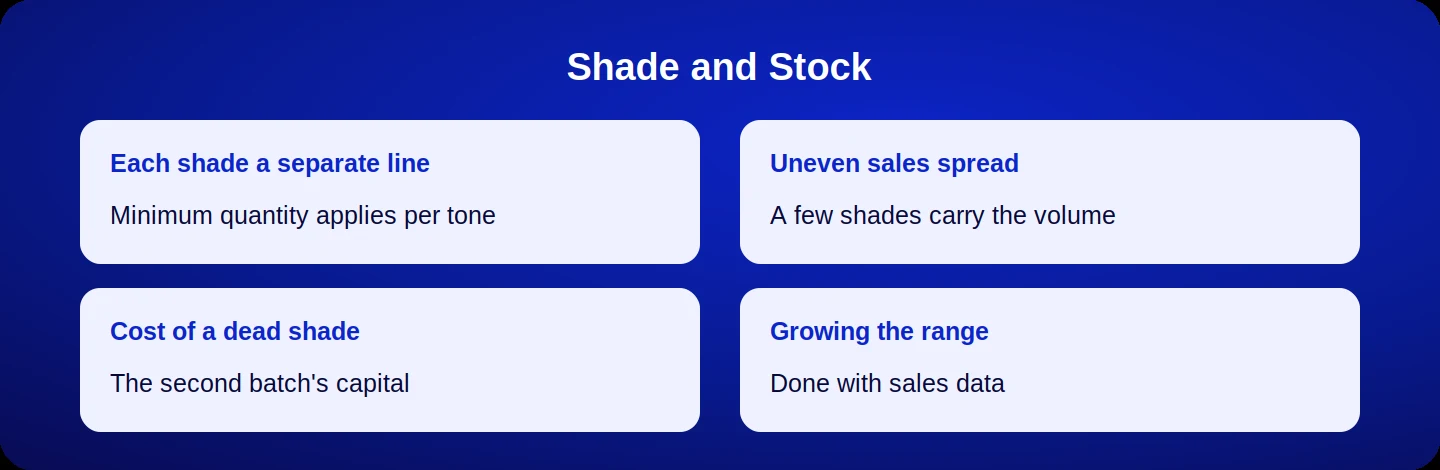
Manufacturers fill each shade separately, so minimum quantities are applied per tone. Ten shades mean ten separate minimums. Range width is directly the size of your first investment — the multiplication logic matches the underwear guide.
In any range a handful of tones carry most of the volume; the rest create a sense of collection but sell slowly. That distribution can’t be predicted in advance, but it is learned quickly with a small range.
Not just that product’s cost, but the fact the money can’t be used in the second batch. Cash flow blocks fast here. A shade waiting on a shelf is a brake on growth.
After sales data arrives and around the shades that sold out. That way each new tone is added to known demand. The range grows with sales, not with enthusiasm.
Shade preference is personal, the urge to try is high and repeat purchase is reasonable. Packaging options are plentiful and manufacturers many. It’s usually the most suitable category for starting with a narrow range.
Mascara and eyeliner reduce the shade problem — mostly a single tone — but formula sensitivity and eye-area safety come forward. Fewer shades, more formula sensitivity.
With foundation and concealer a customer who can’t find the right tone returns it; a wide tone range is needed and that enlarges stock. Complexion products are makeup’s highest-return category; it is the makeup equivalent of sizing.
No shade problem, low returns, easy to brand, but hard to differentiate and infrequent repeat purchase. They grow the basket as a secondary line. Weak as a standalone brand, valuable as support.
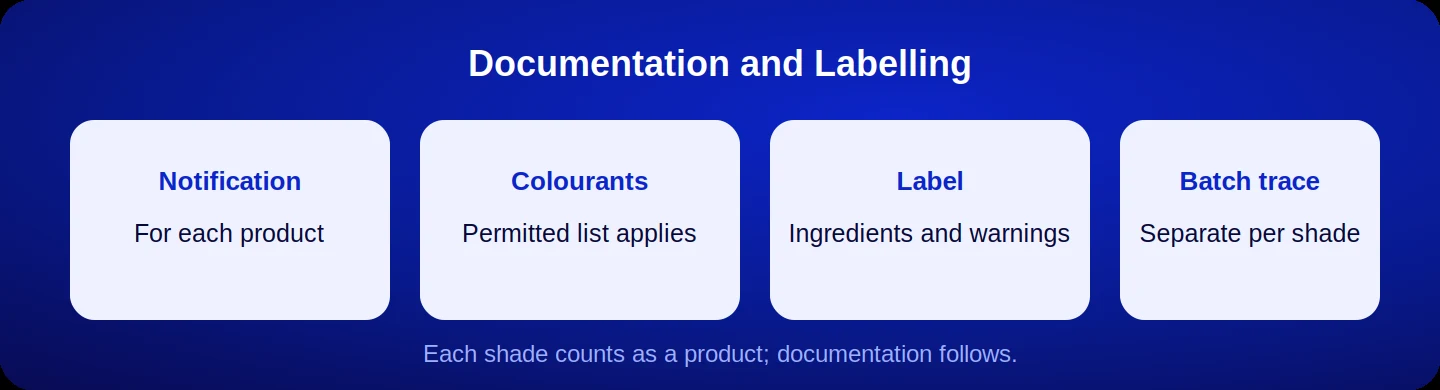
Where formula and colourants differ, the product is assessed separately, which means the range enlarges the paperwork as well as the stock. For laboratories used in analysis and testing, TÜRKAK‘s accredited body listing can be used. A wide range grows more than stock; it grows the file.
The colourants usable in cosmetics are defined and restricted by area of use (eye area, lips). The suitability of the pigments your manufacturer uses must be verified. An unpermitted pigment can get a product recalled.
Ingredient list, net quantity, usage and storage information, warnings, batch number and period information. Presenting information on small packaging is a design problem of its own. Small packaging doesn’t reduce labelling obligations.
The brand. Even in contract manufacturing the product information file and safety assessment are the brand’s responsibility — the same regime is described in the hair care guide.
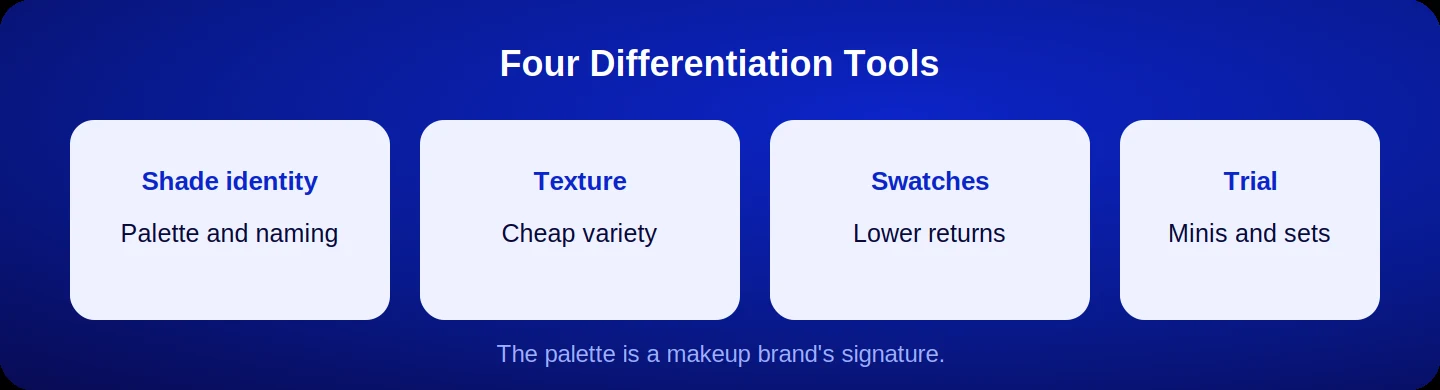
Not with random tones but with a consistent palette and naming. A recognised colour language is stronger than individually copyable shades. The palette is a makeup brand’s signature — the logic matches the design language in the bag guide.
Matte, satin, glossy — texture preference defines the audience, and the same shade in a different texture becomes a different product. Texture decisions add variety without widening the range. Texture is a cheaper variety tool than shade.
Screens mislead on colour; real application images across different skin tones directly lower return rates. A shade sold without swatches is a shade that gets returned; content is built with digital media.
In makeup, recommendation and trial are decisive; small sizes, mini sets and genuine user content accelerate sales. Channel design runs through e-commerce consulting, the site side through website consulting, the advertising measure through advertising consultancy.
Narrows the range, tests the category choice, has notification and pigment suitability verified, and builds the swatch and returns plan. A consultant doesn’t pick the shades; they stop you locking money into tones that don’t sell. Brand architecture sits with brand consultancy; category choice in the sector map and choosing a consultancy in the umbrella guide.