
From the Pharmacy to a Baby Brand: A Pharmacist Builds Her Own Baby Care Brand
A pharmacist can build her own baby care brand, and the pharmacist in this story is building one: after fourteen years behind the shelf, she is stepping in front of it. We give neither her name nor her district; we give the formula, the manufacturer, the documents, the first shelf and the first complaint. The most surprising decision comes at the end: she does not sell her product in her own pharmacy.
We tell the story in the present tense, because the brand is still running today. Where the pharmacist speaks, the words are in quotation marks; the rest is observation. At the end there are three lessons, not for pharmacists but for brands not run by one.
Fourteen years behind the shelf
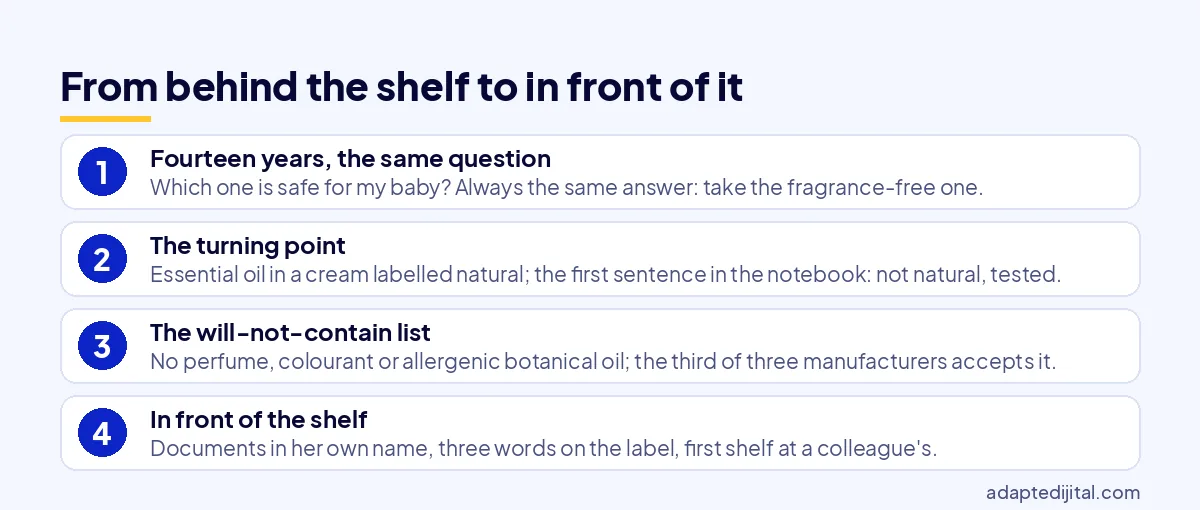
Every day the pharmacist hears the same question: which one is safe for my baby? There are six baby creams on the shelf, she knows all six, and for all six she says the same sentence: take the fragrance-free one. One day she notices: no product on the shelf says at a glance that it is fragrance-free, tested and suitable for newborns; all say it in small print.
The turning point
A mother brings a cream back; a rash. She looks at the label: a botanical essential oil in the ingredients. The mother says: but it said natural. That day she writes the first sentence in her notebook: not natural, tested.
The pharmacist’s sentence
The pharmacist puts it like this: “In fourteen years behind the shelf I saw what the product failed to explain; in front of it I wanted to write what was missing.” The terms are in the article on dermatological testing and hypoallergenic.
Formula and contract manufacturer
BU BÖLÜMÜN ÖZETİ
- The five clauses she writes into the contract
- The minimum order decision
- The surprising detail
The pharmacist does not write the formula; she writes what will not be in it. No perfume, no colourant, none of the botanical oils on the known allergen list, preservative at the lowest effective level. She takes the list to three contract manufacturers; two find it too long, the third accepts it as written and names its minimum order. She works with the third.
The five clauses she writes into the contract
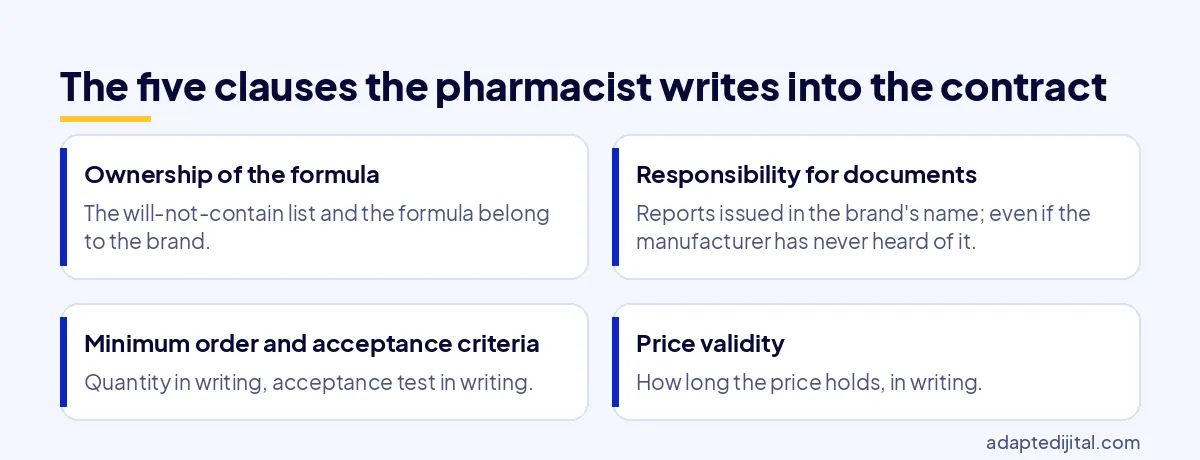
Formula ownership, document responsibility, minimum order, acceptance criteria, price validity. The pharmacist says: “A missing word on a prescription changes the medicine; a missing clause in a contract changes the brand.”
The minimum order decision
The third manufacturer’s minimum order is above her forecast for the first three months; instead of pushing the quantity down, she keeps to a single product and accepts the quantity on that one. One product finished rather than five split; the thresholds are in the cost article.
The surprising detail
The manufacturer tells her they will handle the documents; she says no, the reports will be issued in my name. The manufacturer says they have never heard this before. Why document responsibility sits with the brand is in the article on six things people get wrong.
Documents: twelve weeks
BU BÖLÜMÜN ÖZETİ
- The label decision
- The page decision
- The document calendar
The stability, microbiological and dermatological tests take twelve weeks; in those weeks she prepares the label, the product page and the shelf card. When the notification record arrives, the label is ready to print. She sums it up: a brand that waits while the tests run waits again when they are done.
The label decision
Three words on the front of the label: fragrance-free, tested, suitable for newborns. On the back, the ingredient list with a why-it-is-there note beside every item. The pharmacist says: “I wrote every question mothers ask me onto the label; not so they stop asking, but so the answer is there.”
The page decision
The product page opens with the three words from the label; the second paragraph explains the ingredients; the documents section sits mid-page, not at the bottom. The pharmacist says: “A mother looks for the documents; if she cannot find them she closes the page.”
The document calendar
How the twelve weeks are counted backwards is in the article on when to launch; the pharmacist sets the launch for winter dryness, early November.
The first shelf: not her own pharmacy
BU BÖLÜMÜN ÖZETİ
- The conversation with colleagues
- The shelf card
- The channel decision
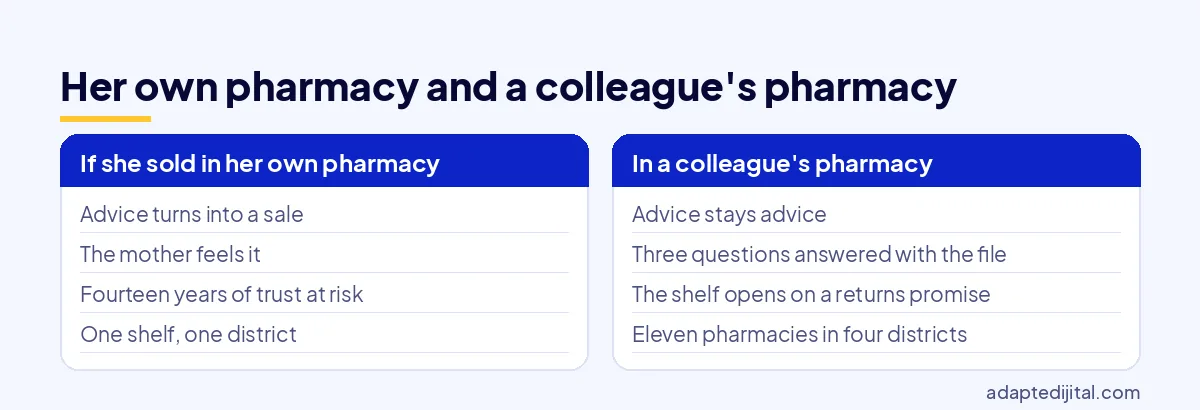
The pharmacist does not sell her own product in her own pharmacy. The reason: for a product on her own shelf, advice stops being advice and becomes a sale; the mother feels it, and fourteen years of trust end that day. The first shelf is three colleagues’ pharmacies in the neighbouring district; she goes with samples, the file and a promise to take back unsold stock.
The conversation with colleagues
The three pharmacists ask the same three things: whose name are the reports in, who do we call, what happens to what does not sell? She answers all three with the file. How a non-pharmacist brand faces the same questions is in the pharmacy shelf case.
The shelf card
Three words and one sentence: fragrance-free, tested, suitable for newborns; read on the back what is not in it. She says: “The shelf card hands the pharmacist her sentence; even when tired she says the same one.”
The channel decision
Her own site is the second channel; it goes live a month after the first shelf opens. The reasoning is in the comparison of three channels.
The first complaint and the first repeat order
In the third week a mother reports a rash. The pharmacist takes the product back, refers the mother to a paediatrician and enters the batch number in the file; the cause proves unrelated to the product, but the record is kept. The same week two colleagues’ pharmacies place repeat orders. She puts it this way: a brand that enters the complaint in its file earns the repeat order.
The mothers’ sentence
In the colleagues’ pharmacies, mothers call the product by its three words; her name is unknown, the three words are known. She sums it up: “The brand’s name is not my name; it is the answer to the question the mother asks.”
Today
The brand is in eleven pharmacies across four districts; her site carries the second purchase; no second product yet. She says: “The mothers will tell me the second product, not a catalogue.”
Three lessons from the story (for non-pharmacists)
First lesson: writing what will not be in the product comes before the formula. Second lesson: the documents are issued in the brand’s name, even if the manufacturer has never heard of that. Third lesson: not selling on the recommender’s shelf protects trust; for a non-pharmacist brand, that means opening the first shelf with a file, not in a friend’s shop.
Frequently Asked Questions
Quick Summary
- The pharmacist hears the same question for fourteen years behind the shelf, then steps in front of it.
- A will-not-contain list instead of a formula; the third of three contract manufacturers accepts it.
- Documents take twelve weeks; label, page and shelf card are prepared in that time.
- The first shelf is three colleagues’ pharmacies in the neighbouring district, not her own, with a returns promise.
- The first complaint goes in the file, the repeat order comes the same week; no second product yet.
Short Glossary
- Will-not-contain list: the list of ingredients that will not be in the product, given to the manufacturer instead of a formula
- Colleague’s pharmacy: a pharmacy other than the brand-owning pharmacist’s own, where the first shelf opens
- Batch record: the file that holds every production batch’s number, date, quality report and complaint notes
- Shelf card: the card beside the product on the shelf that hands the pharmacist the recommendation sentence ready-made
Next Step
To start your own story with a file, write through the consult your expert form; the scope is on the brand consultancy page. To return to the start of the set, I want to start a baby products brand.
Updated: October 2026
Sık Sorulan Sorular
She knows this from the pharmacy: three companies make the same active ingredient at three different prices. She looks at contract manufacturers the same way; the three-candidate rule is in the article on choosing a contract manufacturer.
The other units from that batch are tracked; nothing further comes in. That one-line job is the single answer at inspection and for the pharmacist. The batch record and the twelve points are in the checklist.
It replaces the pharmacist’s fourteen years with a file: reports in its own name, three words, a why-it-is-there column, a batch record. Bringing these together is brand consultancy work; the overall order is in the pillar article, your stage in the hub article.
The industry picture is in the baby brand industry guide; for the inspection and notification framework, TİTCK (Turkish Medicines and Medical Devices Agency) is the official source. For your own story, consult your expert.
Yes; the pharmacist in the story writes what will not be in it rather than the formula, talks to three manufacturers and has the documents issued in her name.
Advice on a product on her own shelf turns into a sale and damages the mother’s trust; the first shelf opens in colleagues’ pharmacies.
Write what will not be in it first, have the documents issued in your own name, and open the first shelf with a file rather than through a friend.