
Why People Pay for Design Sock Brands: Four Reasons and One Case
People pay for a design sock brand for four reasons: it is the easiest gift to give, it is the only visible accessory, the quality difference is felt on the foot, and the story arrives with the packaging. Price is not among the four; a design sock costs several times a basic sock, and the buyer knows it, because most of the time the buyer is not the wearer.
This article tells, in the present tense, how a corporate gift order turns an anonymous brand around: who buys, who wears, why they pay. What turns the brand around is not a new pattern but the difference between gift buyer and wearer. Four reasons, one case, one principle.
Say you are looking at a brand’s site and nothing sells
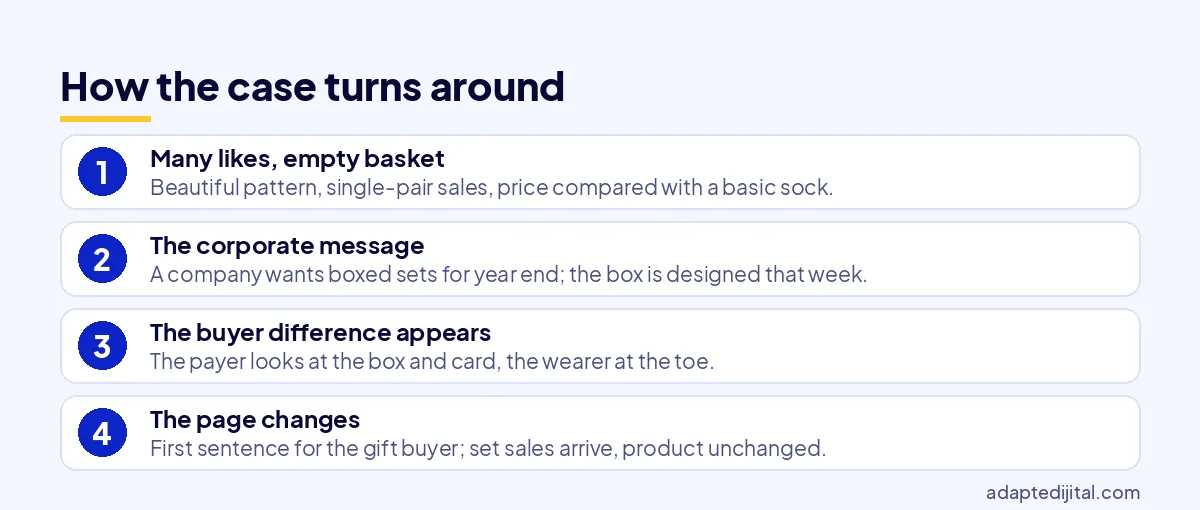
Say you are on the site of a sock brand with beautiful patterns: good photos, many likes, empty basket. As the founder considers a price cut, a company writes: they want boxed sets for their staff at year end. The founder designs the box that week and takes the order; one order changes the brand’s whole question.
The unexpected finding
After the order the founder adds boxed sets to the site; single-pair sales hold, set sales arrive. Same pattern, same price logic, different structure. Why was the basket empty? A gift buyer was being offered a single pair.
Reason one: the easiest way to give a gift
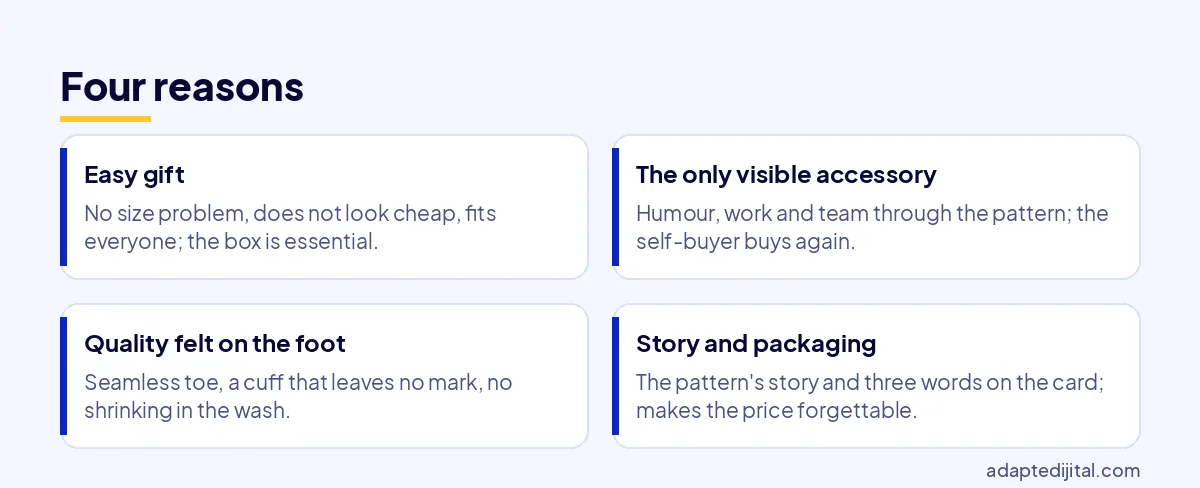
A sock is the one clothing gift with no size problem: fits everyone, does not look expensive, is not cheap. The buyer risks no wrong size and shows their taste. A design sock brand sells this ease; the pattern is the excuse, the gift is the reason. No box, no reason.
The principle for you
Single, set of three and boxed set sit on one page; the set structure is part of the product. Set architecture is in how Adapte Dijital positions a sock brand; the founder learns it from one order.
Reason two: the only visible accessory
Under a suit or in a trainer, the sock is the only visible piece of colour. The wearer shows humour, work or team through the pattern; in a corporate set, the company’s colours and joke. Self-expression buyers buy for themselves; in the case, they are the minority.
The unexpected finding
The self-buyer washes the sock before buying again; the gift buyer never washes it. Repeats come from the self-buyer, first purchases from the gift buyer.
Reason three: quality felt on the foot
The foot, not the eye, tells a design sock from a basic one: the toe seam does not dig in, the cuff leaves no mark, the length does not shrink in the wash. The gift buyer does not know this; the wearer knows it on day one. So the second order comes from the wearer: the same company calling next year.
The principle for you
Quality felt on the foot is not written, it is made felt: a close-up of the toe seam, the wash-test sentence, the fibre proportion. The gift buyer does not read, the wearer feels; two sentences for two people.
Reason four: story and packaging
The person opening the box sees the story, not the sock: who designed it, why this pattern, where it was knitted. The card and the box carry that story; a box without a story is a nice box, a box with a story is a gift. In a corporate set the story merges with the company’s own.
Why are the gift buyer and the wearer different people?
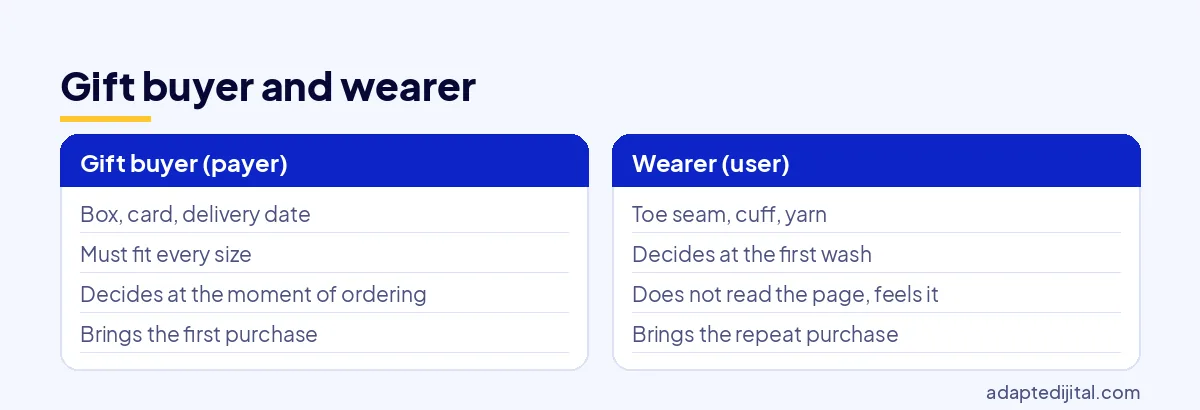
The case’s key observation: the payer does not wear, the wearer does not pay. The payer looks at box, card, delivery date and the absence of sizes; the wearer at toe, cuff and wash. The brand must say two sentences to two people on one page; say one and you lose either the basket or the repeat.
The two-person table
| Who | What they look at | When they decide | What the brand says |
|---|---|---|---|
| Gift buyer (payer) | Box, card, fits every size, delivery date | At ordering | For gifting, fits every size, boxed |
| Wearer (user) | Toe seam, cuff, wash, yarn | First wear, first wash | Seamless toe, fibre proportions, five-wash test |
| Approver (buyer, store) | Proposal file, consignment, minimum quantity | Before the season | One-page file, one-sentence card |
The unexpected finding
The founder was telling the payer the wearer’s sentence: seamless toe, yarn proportions. The payer does not read it. Change the sentence and the basket fills; the product is unchanged. Channel and buyer matching is in own site, marketplace or store for a sock brand.
One principle
People do not pay for a design sock; they pay for an easy gift with a story, and the wearer pays again for quality felt on the foot. A brand that says two sentences to those two people sells at a premium and lasts; a brand that says one keeps its empty basket.
What to do today
Write your page’s first sentence for the gift buyer and the second paragraph for the wearer. Then look at your box: is there a card inside?
Next step
The order is in I want to start a sock brand, your stage in which consulting for a sock brand, scope on the brand consultancy page; first, consult your expert. The site side of gift sales is e-commerce consulting work; for the fibre declaration, verify what the OEKO-TEX certificate is; the purchasing officer asks.
Frequently Asked Questions
Quick Summary
- Not a new pattern but the buyer difference a corporate order reveals turns the brand around.
- One: a sizeless, easy gift; two: the only visible accessory.
- Three: toe and yarn quality felt on the foot; four: the story on the card and box.
- The payer does not wear, the wearer does not pay; two sentences for two people.
- People pay for an easy gift with a story, not for a sock.
Short Glossary
- Gift buyer: the person who pays to give the product away; looks at box, card and the absence of sizes
- Wearer: the person who uses the product; looks at toe, cuff and wash, and decides the repeat purchase
- Set structure: single, set-of-three and boxed options offered on one page
- Card: the printed note in the box carrying the pattern’s story and the brand’s three words
Next Step
To write your two sentences together, write to us via the consult your expert form; scope is on the brand consultancy page. Next: 6 things people get wrong about sock brands.
Updated: October 2026
Sık Sorulan Sorular
The company is buying socks to give, not to wear. The purchasing officer asks about box, card and delivery date, not the pattern. The founder sees it for the first time: most buyers on the site are gift buyers too, being sold a single pair.
The brand spends its first year on the four causes in why a design sock brand stalls in year one: no gift logic, price compared with a basic sock, pattern invisible on the marketplace, variety without depth; the corporate order exposes all four at once.
I need to get something, I do not know their size, it must not look cheap, it must be liked. The founder writes it into the page’s first sentence: for gifting, every size, boxed.
In the Kadıköy Moda concept store, single pairs turn over; the young buyer buys for their own feet and posts about it. That crowd brings likes, not set sales; which district holds which crowd is in starting a sock brand in Istanbul.
The single pair stays in the Moda store; the site is rebuilt for sets and corporate orders. One pattern, two buyers, two channels, two structures.
The seamless toe and the yarn. The founder hits a toe problem on the first sample and changes manufacturer; otherwise the corporate order would not return. Terms in yarn count, knit density and fibre content explained.
The company has set its gift budget per person; its question is whether the box lives up to it. A mid-market price with a good toe beats a cheap price with a thick seam.
One card in the box: the pattern’s origin in three sentences, the brand’s three words underneath. The company adds its own. The employee opens the box, reads two stories and shares a photo.
A story does not explain the price, it makes the price forgettable. The card builds the face of the person opening the box. It is how you stand apart from a hundred brands off one machine; see the industry guide to starting a sock brand.
Four reasons: the easiest gift to give, the only visible accessory, quality felt on the foot, and the story that arrives with the box. Price is not a reason.
Yes, and it usually does; the payer pays for the ease of gifting and the story, the wearer for toe and yarn quality.
Two sentences on one page: box, card and every size for the payer; seamless toe, fibre proportion and wash test for the wearer.