
When Should a Sock Brand Launch? Gift Season, Production Calendar and Corporate Orders
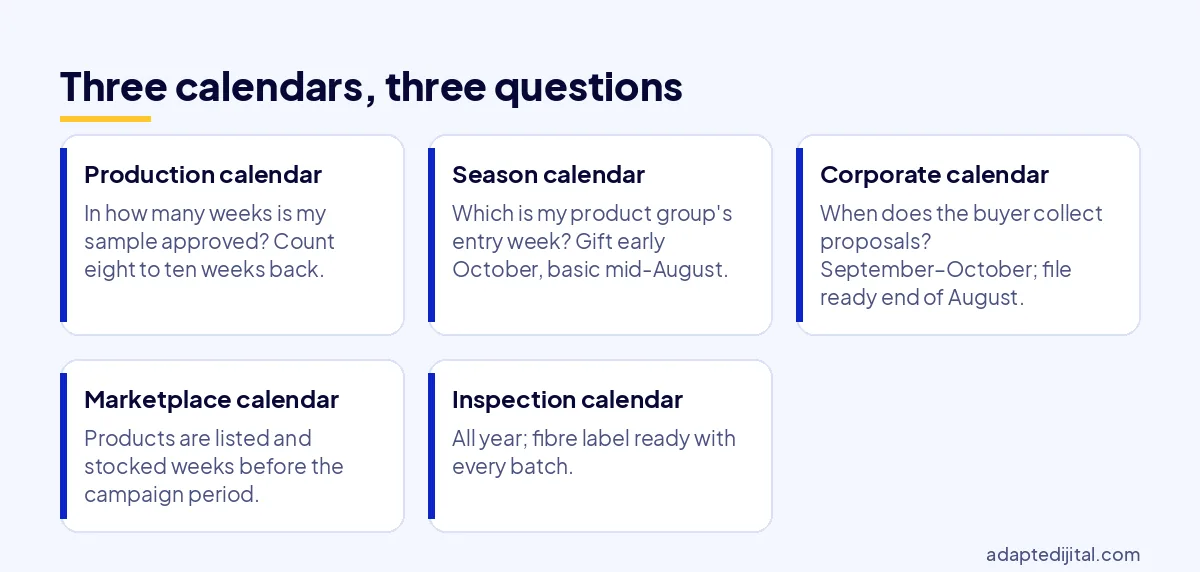
A sock brand launches in the week where three calendars overlap: the first batch leaving the manufacturer, the product group entering its season, and the corporate buyer collecting proposals. Production needs eight to ten weeks from sample to first batch; the season depends on the product group; corporate purchasing decides year-end gifts in September–October. A launch without all three has no batch, is out of season, or has missed the proposal window.
This article opens the three calendars, then lays them over each other. The answer is a method, not a month; the month follows from the product group. At the end: a table for five product groups and three worked overlaps.
First calendar: production counts backwards from sample to batch
BU BÖLÜMÜN ÖZETİ
- Why it stretches and never shrinks
- Work that runs in parallel
- Label and document lead time
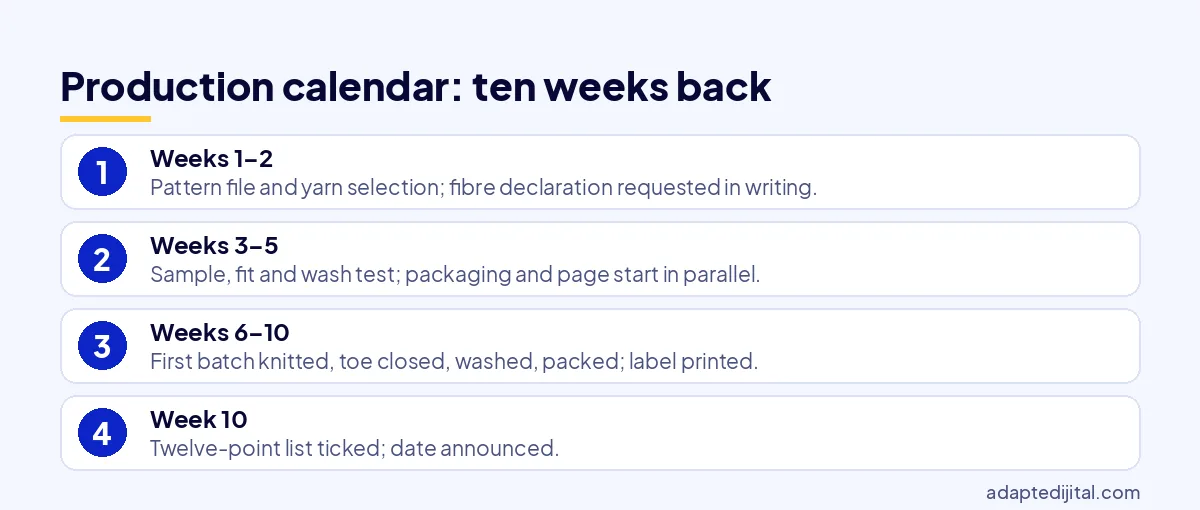
Sock production runs eight to ten weeks from sample to first batch: pattern file and yarn about two weeks, sample and fit two to three, knitting, toe closing, washing and packing four to five. In peak season the manufacturer stretches this, never shortens it. Count ten weeks back before fixing a date; anything closer is hope, not a launch.
Why it stretches and never shrinks
Sock machines fill with the big brands’ batches before year end; the small brand’s sample joins the queue. A sample requested in September gets no batch in November; the calendar says so, not the manufacturer. A calendar clause goes into the contract; see how to choose a sock manufacturer.
Work that runs in parallel
Packaging, label, product page and shelf card start the week the sample arrives. The box printer has its own calendar and usually lands after the socks; the threshold is in the cost of starting a sock brand. The twelve items due the same week are in the 12-point launch checklist.
Label and document lead time
The fibre label is printed with the batch, but its declaration is requested in writing from the yarn supplier at the sample stage; the certificate comes through the yarn and is asked for at the sample too. Rules and grounds for inspection: textile labelling rules and unsafe-product inspections.
Second calendar: the season depends on the product group
There is no single sock season; the product group sets it. Design and gift socks peak at year end, with Valentine’s and Mother’s and Father’s Day as later waves; basic socks sell at back-to-school and season changes; thick socks from November to February; sports socks in spring. A gift sock takes its calendar from the giver, not the wearer.
Product group, season and entry week
Entry week: when the product must be on the shelf before the peak; the batch is in hand before it.
| Product group | Peak period | Entry week | Main channel |
|---|---|---|---|
| Design and gift socks | November–December | Early October | Own site, concept store |
| Valentine’s, Mother’s, Father’s Day sets | Early February; May–June | Four weeks before peak | Own site |
| Basic socks | Back-to-school, season changes | Mid-August | Marketplace |
| Thick and winter socks | November–February | Mid-October | Own site, marketplace |
| Sports socks | March–May | Late February | Marketplace, own site |
The marketplace has its own calendar
Marketplace campaigns are a separate calendar inside the season; a product entering the November sale days and year-end campaign is listed, photographed and stocked weeks earlier. Rules are on the Trendyol seller panel. Gift fit and margins: the three-channel comparison.
Third calendar: corporate purchasing decides in September and October
A corporate gift order is delivered in December but decided in September and October; purchasing collects proposals then, approves samples in early November and wants delivery in early December. No proposal file in October, no order that year. This collides with production: a corporate batch knitted in November needs a sample approved in October.
Corporate outside year end
Holiday, new-hire and event gifts arrive through the year and are served from stock; there is no second corporate season, only stock and a ready file.
Three calendars on top of each other: how is the overlap week found?
BU BÖLÜMÜN ÖZETİ
- Example: design socks, own site and concept store
- Example: basic socks, marketplace
- Example: corporate set, year end
The method: open a one-year table and mark the batch week, the entry week and the corporate proposal week. The first week where all three overlap is launch week. With no overlap, production stays fixed; the season shifts to the next peak or the channel shrinks. No batch is ordered without a sample to catch a season.
Example: design socks, own site and concept store
Production ten weeks; entry early October; the concept store sets its New Year shelf in mid-October. Overlap: early October. Sample approved by late July, pattern file ready in June.
Example: basic socks, marketplace
Production eight weeks; entry mid-August; listing and photography two weeks. Overlap: mid-August. Sample approved by early June; second batch for the November campaign ordered in September.
Example: corporate set, year end
Proposal in September; sample approval in October; batch in November; delivery early December. No file in August, no corporate order this year; the channel changes, the date does not. Next year’s file is prepared in January.
What do an early and a late launch cost?
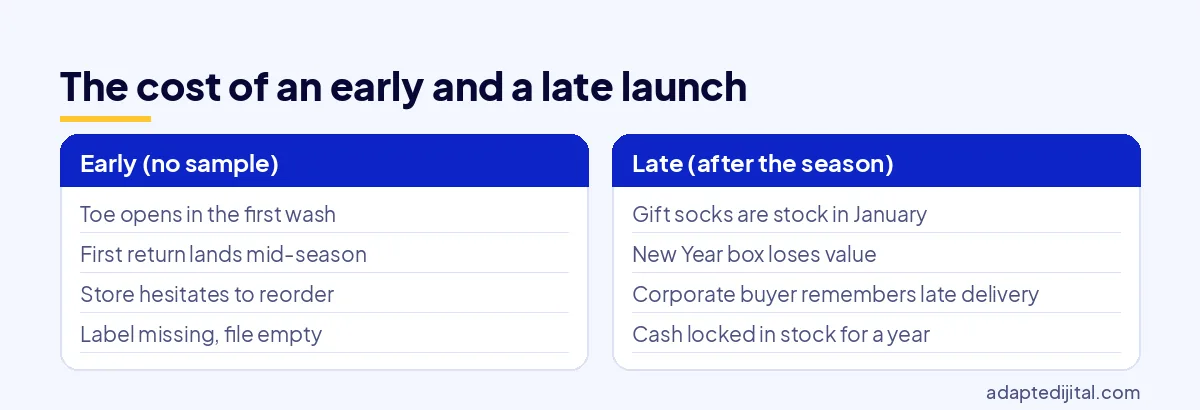
An early launch means an unverified sample: the toe seam opens in the first wash and the first return lands mid-season. A late launch means missing the season; gift socks left in January are stock until next year end. The shared cost is trust: a store rarely takes an end-of-season product twice, a corporate buyer rarely takes a late delivery twice.
The pattern does not age, the box does
In waiting stock the box loses value, not the sock; a New Year box is worthless in January. Box seasonless, card seasonal; the card changes, the box stays. The box’s share of unit cost: the cost of starting a sock brand.
What to do
If the calendar does not hold, change the channel, not the date: your own site instead of the concept store, corporate next year. Then the full channel at the next peak.
How do you build the calendar today?
BU BÖLÜMÜN ÖZETİ
- Know the inspection calendar too
- The export calendar is read separately
- Next step
Answer three questions today: in how many weeks is my sample approved, which is my next entry week, and when does the corporate buyer collect proposals? Put the answers in one table; the overlapping week is your launch date, and before it is announced the twelve-point list is ticked. Building the calendar together is brand consultancy work.
Know the inspection calendar too
The Ministry of Trade runs market surveillance all year and announces results periodically; the first-half announcement is on the Ministry of Trade page. Launch week is independent of inspections; the fibre label is ready with every batch.
The export calendar is read separately
European retail closes its year-end order earlier, at the end of summer; a brand preparing for export keeps that calendar apart. Export preparation: foreign trade consultancy.
Next step
The sequence is in the pillar article, your stage in the hub article, the industry picture in the guide to starting a sock brand. For the calendar, consult your expert.
Frequently Asked Questions
Quick Summary
- Launch in the week where production, season and corporate proposal window overlap.
- Production is eight to ten weeks from sample to batch; counted backwards, never shortened.
- Season follows product group: gift year end, basic back-to-school, winter November, sports spring.
- Corporate purchasing decides in September–October; the file is ready by end of August.
- No overlap: production stays fixed, channel or date changes; no batch without a sample.
- Box seasonless, card seasonal; in waiting stock the box ages.
Short Glossary
- Overlap week: the first week in which batch, season entry and proposal window all line up
- Entry week: the week the product must be on shelf and site before the peak
- Proposal window: the September–October period in which corporate buyers collect year-end gift proposals
- Season card: a card inside or on the box that changes with the season and keeps the box seasonless
Next Step
To lay the three calendars over your own product group, write via the consult your expert form; scope is on the brand consultancy page. Next: six changes waiting for sock brands towards 2027.
Updated: October 2026
Sık Sorulan Sorular
The wearer buys all year; the giver buys in three or four weeks of the year, and a brand that misses them waits a year. That is a design sock brand’s calendar. The giver-wearer difference is in why people pay for design sock brands.
By the end of August: set options, box visual, logo embroidery example, quantity tiers and delivery time. The price stays in the file, not on the site; the contents are in the channel group of the checklist.
The purchaser takes the sample, opens the box, checks the label and approves the budget; nobody approves without the box. That user, payer and approver differ is on the buyer card in the gift-led method. The approver looks at the box, the user at the sock.
No single month: early October for design and gift socks, mid-August for basic, mid-October for winter, late February for sports; the week overlapping production.
Eight to ten weeks from sample to first batch; it stretches in peak season, never shrinks. Packaging, label and page run in parallel.
Proposals in September and October, sample approval early November, delivery early December. The file is ready by the end of August.