
Kitchenware Brand Myths: 6 Things People Get Wrong, and Granite Pans Aren’t Granite
The six things most often misunderstood when starting a kitchenware brand: granite pans are stone, PFOA-free means PTFE-free, the maker handles the compliance paperwork, one marketplace is enough, big sets sell more, and a cheap pan is an advantage. All six sound right and all six lose money on the first set. The correction sits under each, short and reasoned.
You may not know this: the technical file of a so-called granite pan often says PTFE, the most common non-stick coating, because granite is not the name of a material but of the coating’s speckled, stone-like look. This article corrects the six myths one by one and says what each correction does to brand decisions.
Myth 1: granite pans are made of stone
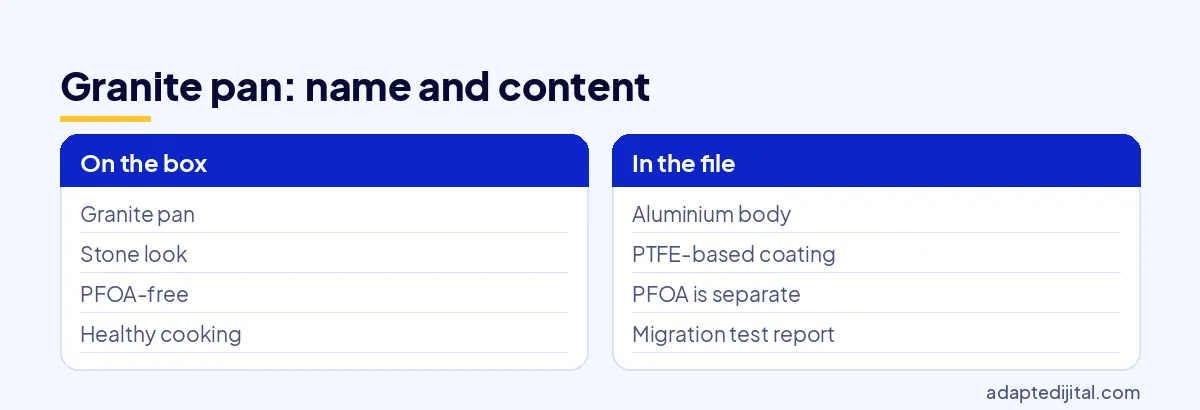
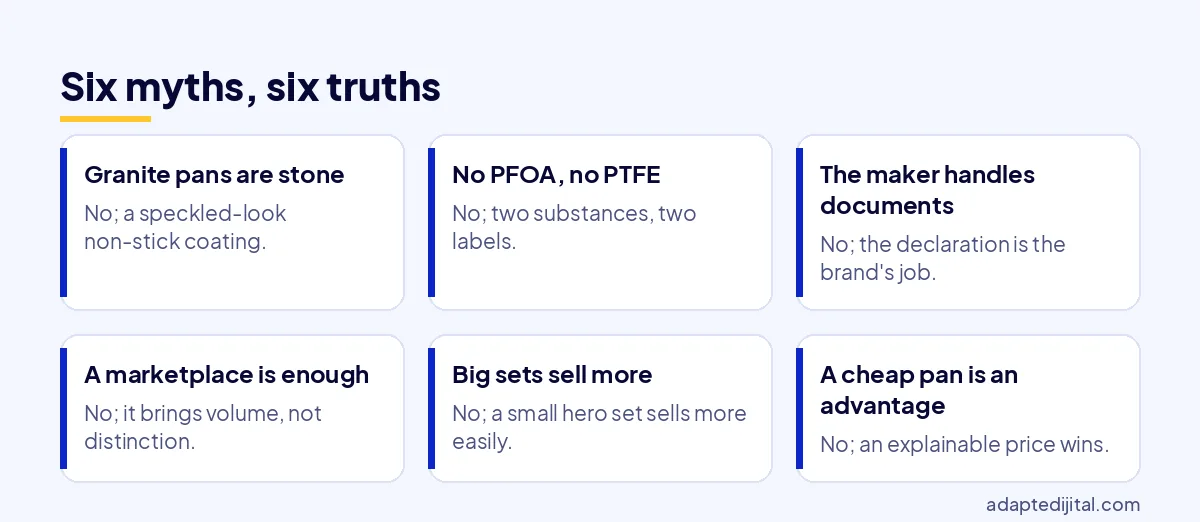
The truth: a granite pan is not stone but a speckled, stone-look non-stick coating on an aluminium or steel body, and most such coatings are PTFE-based. Granite, marble and stone are marketing names; the material name is in the technical file and the declaration of compliance. The look is one thing, the content another.
In plain words
Calling it a granite pan is like calling a biscuit a chocolate bar: you see chocolate on top, but the biscuit is not chocolate. The pan looks like stone, the body is metal, the coating is usually PTFE. All coating names are in the granite, ceramic, steel and cast iron article.
Brand decision
You may put granite in the product name, but not in the material line. Two lines on the page: product name granite pan, material aluminium body with PTFE-based non-stick coating, whichever applies. A brand that separates them is at ease both at inspection and with curious buyers.
Myth 2: PFOA-free means PTFE-free
BU BÖLÜMÜN ÖZETİ
- Why people believe it
- Brand decision
- A smile
The truth: PFOA and PTFE are different substances. PTFE is the non-stick coating itself; PFOA is a processing aid once used in some PTFE production and now restricted. A pan labelled PFOA-free usually still has a PTFE coating; the two labels do not contradict each other, they simply say different things.
Why people believe it
Both abbreviations start with P, both relate to coatings and both sit side by side on the box. Buyers read one and think they read the other, and sellers rarely correct them.
Brand decision
If the box says PFOA-free, also state on the page that the coating is PTFE-based and show which document backs the claim. What happens to unbacked claims at inspection is in the food contact material rules article.
A smile
Thinking a PFOA-free pan is PTFE-free is like thinking sugar-free gum has no gum: the word is right, but the gum is still in your mouth.
Myth 3: the maker handles the compliance paperwork
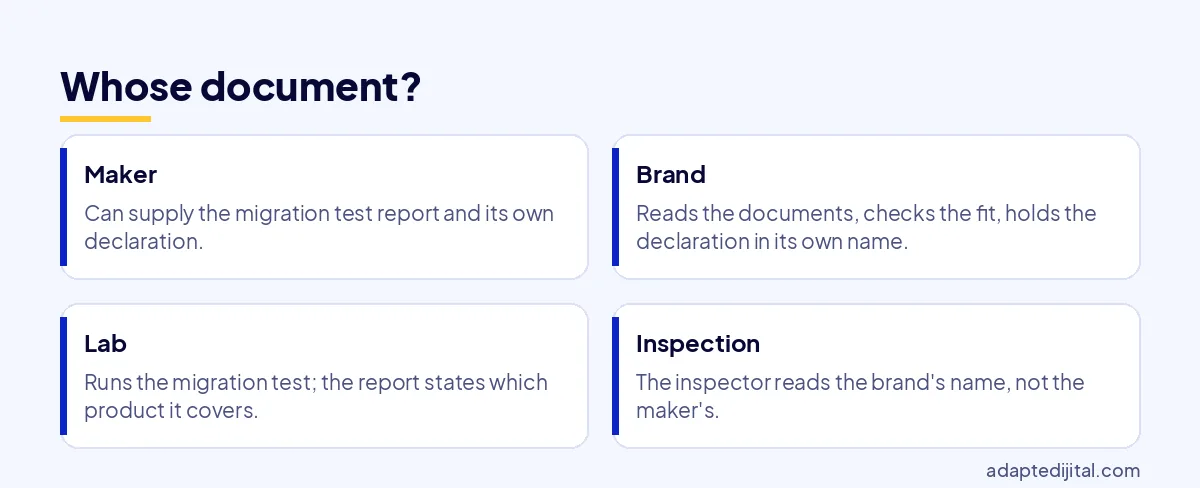
The truth: the brand that places a product on the market in its own name is responsible for the food contact declaration of compliance. The maker can supply the migration test report and its own declaration, but the brand must read them, check they fit its product and hold the declaration in its own name. The documents sit in the brand’s file with the product.
Why people believe it
Private-label goods arrive ready and the maker says everything is in order. But the inspector at the door reads the brand’s name, not the maker’s. The official framework is EU framework regulation 1935/2004; in Türkiye the relevant regulation sits under the Turkish Food Codex.
Brand decision
Ask the maker for the migration test report, which product and coating it covers and the lab’s name. If it does not cover your product, commission a new test; questions for the maker meeting are in the manufacturer selection article.
Myth 4: one marketplace is enough
BU BÖLÜMÜN ÖZETİ
- Why people believe it
- Brand decision
- A smile
The truth: a marketplace brings volume but lines up your product beside twenty rivals from the same mould and starts a price war. A kitchenware brand on one channel cannot stand out; coating documents, spare parts promises and recipe content do not fit a short product card. The marketplace is one channel, not the whole brand.
Why people believe it
Because first orders come from the marketplace, and fast. But second orders, referrals and dowry sets form on your own site, in housewares shops and dowry stores. The four causes of getting lost are in the marketplace case.
Brand decision
Open the marketplace store but do not make it your only channel; build your own site and one physical shelf alongside it. A store roadmap is in the Trendyol real-profit guide; channel comparison in the own site, marketplace and housewares comparison.
A smile
Building a kitchen brand only on a marketplace is like cooking a whole meal on one burner: it cooks, but everything comes out at once and tastes the same. More channels, more stories.
Myth 5: big sets sell more
BU BÖLÜMÜN ÖZETİ
- Why people believe it
- Brand decision
- A smile
The truth: a many-piece set looks generous in the box but raises the price, eats storage, adds breakage risk in shipping and includes pieces the buyer never uses. For a small brand, a smaller set built around a hero pan and two companions is easier to explain and easier to sell. Piece count is not value, it is load.
Why people believe it
Because in the bazaar and on the dowry shelf the most eye-catching box is the fullest one. But dowry families now ask which pieces will be used; unused pieces stay in the cupboard and remind no one of the brand.
Brand decision
Build the set from the hero product: one pan, one pot, one saucepan, plus a spare parts card for dowries. Why stock and storage thresholds come early in kitchenware is in the cost article.
A smile
Buying an eighteen-piece set is like buying a whole album for one song: two tracks you play, sixteen on the shelf.
Myth 6: a cheap pan is an advantage
The truth: a cheap pan brings the first order, but when the coating peels early it takes the reviews, the returns and the brand’s name with it. A small brand cannot win on price against big makers; trying means cutting coating and base. The advantage is a mid-market price that can be explained by coating, base and spare parts.
Why people believe it
Because marketplace ranking starts with price and the cheapest product takes the first sale. But the reviews on page two say whether the coating peeled, and the cheap pan loses there.
Brand decision
Benchmark price against the most explainable, not the cheapest; put the coating name and spare parts promise beside the price. The overall order is in the pillar article, your stage in the hub article, scope on the brand consultancy page.
Frequently Asked Questions
Quick Summary
- A granite pan is not stone; it is a speckled, usually PTFE-based non-stick coating.
- PFOA-free does not mean PTFE-free; they are separate substances.
- The brand selling in its own name is responsible for the declaration of compliance.
- A marketplace brings volume, not distinction; build your own site and a physical shelf too.
- A smaller set around a hero product is easier to explain and sell.
- A cheap pan brings the first order and takes the reviews; an explainable price wins.
Short Glossary
- PTFE: polytetrafluoroethylene; the most common non-stick pan coating
- PFOA: a processing aid once used in some PTFE production, now restricted
- Granite coating: the marketing name of a speckled, stone-look non-stick coating
- Declaration of compliance: the document in which the brand states in its own name that a food contact product meets the rules
Next Step
To correct the six myths on your own product page, write via the talk to an expert form; scope is on the brand consultancy page. Next up: when a kitchenware brand should launch.
Updated: October 2026
Sık Sorulan Sorular
Body material, coating type, hob compatibility and care warning. Ask the coating supplier for the technical file; a material line written without reading it is questioned in the first review.
No; granite is the marketing name of a speckled, stone-look non-stick coating. The body is usually aluminium and the coating usually PTFE-based.
Not necessarily; PTFE is the non-stick coating itself, while PFOA is a separate, now restricted processing aid. The two labels say different things.
The brand that sells the product in its own name; the maker can supply the migration test report, but the brand holds the declaration.