
Makeup Brand Positioning: How Adapte Dijital Builds a Shade-Led Method
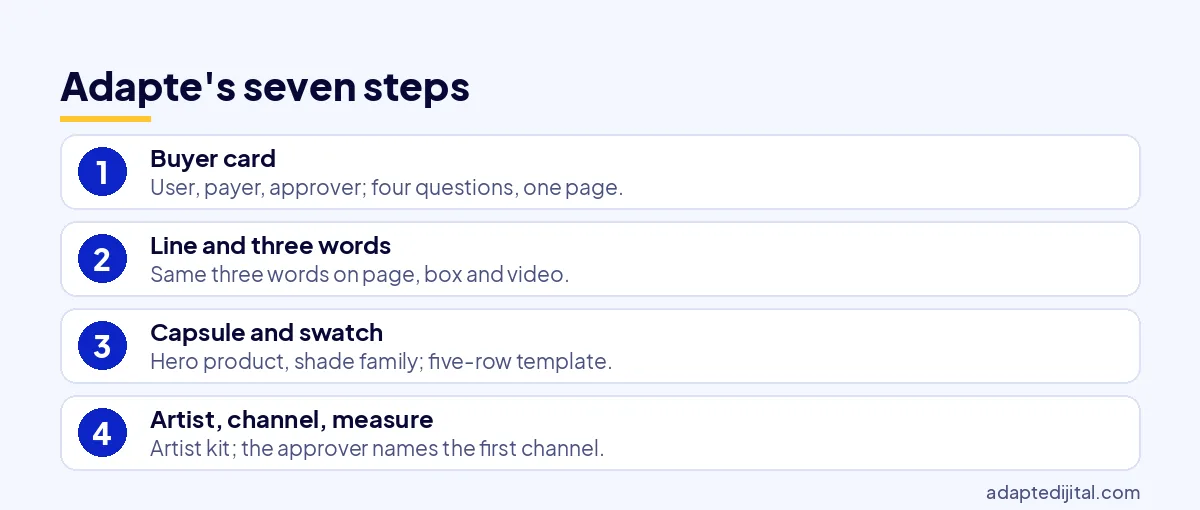
Adapte Dijital positions a makeup brand in seven shade-led steps: buyer card, positioning line, three words, capsule, swatch shooting standard, makeup artist network, and channel linked to measurement. The method is independent of the manufacturer; we set who the lipstick is sold to, in which shade and through which channel. In colour cosmetics, positioning is the shade’s position.
Each step below states its output and what is specific to makeup. We use the same skeleton in other sectors; in makeup the swatch is the shop window. No sales talk: this is how we work.
Why do we start with the buyer, not the product?
BU BÖLÜMÜN ÖZETİ
- Three people
- What is different in makeup
- Output
Because in makeup the product difference is large on the lips and small on the shade card. The same catalogue formula sells under different logos; the buyer sees the difference only on her own skin. So the first task is a buyer card, not a shade list; shade, swatch skin tones and channel all follow from it.
Three people
The user looks for a shade that suits her skin. The payer is usually her too, but someone else pays for a gift set. The approver is a makeup artist, a creator, a store adviser or a review with a swatch photo.
What is different in makeup
The approver is very strong: buyers often decide on seeing a shade on an artist’s client or in a review swatch. The card gives the approver’s question its own row.
Output
A one-page card: three people, buying moment, the approver’s question and three words. It feeds the next six steps and fills the first gap in the I want to start a makeup brand pillar.
How do you fill in the buyer card template?
BU BÖLÜMÜN ÖZETİ
- Template
- Filling rule
- Testing the card
The card has four rows and three columns: each column a person, each row a question. Who, at what moment, deciding on seeing what, wanting to hear which sentence. The brand owner fills it with us in one week; any empty cell returns as a gap later.
Template
| Question | User | Payer | Approver |
|---|---|---|---|
| Who? | Skin tone, undertone, habits | Herself or a gift buyer | Artist, creator, review |
| When? | Shade runs out, new season | Year end, weddings | Bridal makeup, filming |
| Decides on? | A swatch near her skin | Box, set, returns | Wear, shade accuracy |
| Wants to hear? | Just like the photo | She will love it | It lasted all day |
Filling rule
One sentence per cell; if two fit, there are two buyers and the card splits. Lipsticks and palettes get separate cards.
Testing the card
It is read to an artist and two buyers; unclear cells are rewritten. A stalled brand’s empty cells are in why a makeup brand stalls after its first collection.
How are the positioning line and three words chosen?
BU BÖLÜMÜN ÖZETİ
- A weak line
- A strong line
- The three-word rule
The positioning line has a fixed pattern: this brand makes for [user], which [approver] recommends with ease and [payer] pays for with confidence. Three words drawn from it repeat in the same order on page, box and swatch videos. Different words in three places look like three brands.
A weak line
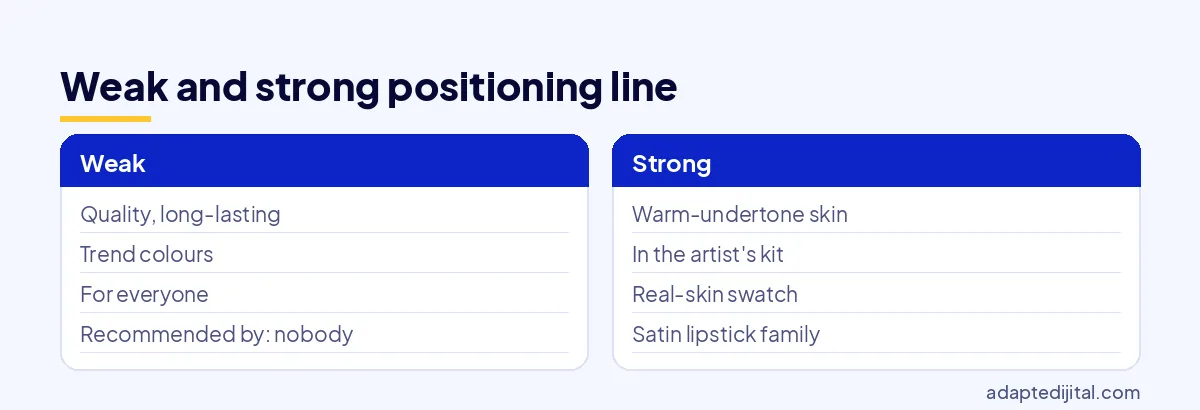
Quality, long-lasting lipsticks in trend colours. For whom, recommended by whom, why this shade: all empty. Other brands on the same card say the same.
A strong line
A satin-finish lipstick family for medium and deep skin with warm undertones, carried by bridal artists, swatched on real skin. User, approver and payer are all there.
The three-word rule
The words come from the card: warm undertone, satin finish, real-skin swatch. Next to the price, they move the comparison from cheapest to shade; see why buyers switch to small makeup brands.
Capsule structure: a hero product and a shade family
A capsule has two layers: a hero product and its shade family. The hero carries the story and swatch gallery; the family is five or six shades in the same texture and finish. The gift set is that family boxed, not a new product. Without a capsule, many shades open and none becomes a hero.
The many-shades myth
Many shades look rich on a card and become slow stock. Buyers praise their shade and criticise the missing one; see six myths about makeup brands.
How is a swatch shooting standard set?
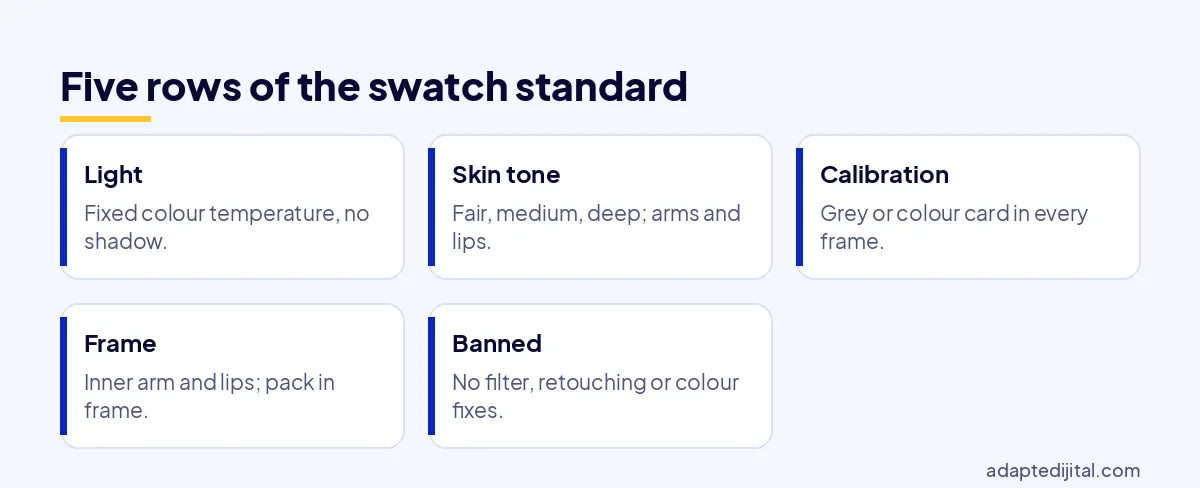
The swatch is a makeup product’s shop window, so its standard is written down. For each brand we prepare a one-page shooting template: light, skin tone, calibration, frame and bans. Founder, artist and creator use the same template; whoever shoots, the shade looks the same.
Swatch shooting standard template
| Rule | Standard | Why |
|---|---|---|
| Light | Fixed colour temperature, no shadow | No shade shift |
| Skin tone | Fair, medium, deep arms and lips | Buyers find their skin |
| Calibration | Grey or colour card | Sets white balance |
| Frame | Inner arm, lips, pack in frame | Links shade to product |
| Banned | Filters, retouching, colour fixes | Screen colour stays true |
Filling rule
Each new shade ticks all five rows; a frame missing one does not go live. Shade accuracy on the label is in pigment, shade, undertone and wear time in makeup.
How is a makeup artist network built?
An artist network is an approval channel, not advertising. If the approver is an artist, a kit is made from the shade family, sent to bridal, studio and salon artists with a short note, and feedback is collected in writing. A shade in an artist’s kit returns to the brand as a customer’s question.
Three parts of the kit
The full shade family, a one-page usage and wear note, and a feedback form. No sales copy; the artist tries it on a client and describes it in her words.
The feedback loop
Notes on shade, texture and wear feed the second capsule. A founder who mixes shades from her kit is in from makeup artist to makeup brand.
How are channel order and measurement linked?
BU BÖLÜMÜN ÖZETİ
- Matching table
- The channel side
- The data base
The approver on the card names the first channel: an artist means salons and the artist network, a creator means the own site and swatch gallery, a review means a marketplace. Each channel has one measure, and the second channel waits until that measure shows.
Matching table
| Approver | First channel | Second channel | Measure |
|---|---|---|---|
| Makeup artist | Salons, artist network | Own site | Referred customers, reorders |
| Beauty creator | Own site, swatch gallery | Salon | Swatch clicks, colour returns |
| Swatch review | Marketplace, hero shade | Own site | Review language, colour returns |
The channel side
The comparison is in own site, marketplace or beauty retailer. The colour-related return rate is the main measure, because it shows whether the swatch standard holds.
The data base
Türkiye’s place in cosmetics exports underpins the method; see TİM export data. The method builds position; it does not write formulas or choose manufacturers.
Seven steps on one page
BU BÖLÜMÜN ÖZETİ
- The seven-week calendar
- What comes next
- To start
Buyer card, positioning line, three words, capsule, swatch standard, artist network, channel and measurement: seven outputs in seven weeks. These pages feed the pre-launch checklist and the first batch decision. To apply the method to your brand, start with the buyer card; we fill it in together.
The seven-week calendar
One output a week, each ending with one page the brand owner signs.
What comes next
Then the twelve-point makeup pre-launch checklist takes over; stage order is in which consultancy a makeup brand needs.
To start
To fill in the buyer card, use the ask an expert form; scope is on the brand consultancy page.
Frequently Asked Questions
Quick Summary
- Seven steps from buyer card to channel measurement.
- In makeup, difference shows on the lips, not the card; position is built on shade.
- The approver is strong and gets its own row on the buyer card.
- Capsule: a hero product and a family of five or six.
- The swatch template fixes light, skin tone, calibration, frame and bans.
Short Glossary
- Buyer card: a page gathering user, payer and approver with buying moment
- Positioning line: one sentence joining user, approver, payer and product
- Capsule: a hero product and a shade family in one texture and finish
- Colour card: a reference card that sets white balance in a photo
Next Step
To fill in the buyer card together, write via the ask an expert form; scope is on the brand consultancy page. Next read: pigment, shade, undertone and wear time in makeup.
Updated: October 2026
Sık Sorulan Sorular
It sits on one undertone axis and covers the card’s skin tone range. If two shades are too close, one goes; a gap becomes the second capsule.
Anyone; the standard lives in the template, not the camera. Gallery distribution is in the makeup brand sector guide.
It builds the buyer card, positioning line and three words, capsule, swatch standard and artist network, and links channels to measurement; it does not write formulas or choose manufacturers.
A one-page template for shooting every shade in the same light, on three skin tones, with a colour card and no filter.
A hero product and five or six shades in the same texture and finish; the gift set is that family boxed.