
New therapy practice first clients: a 90-day opening plan that builds trust first
A new therapy practice waiting for its first clients usually needs patience, because a client looking for a therapist checks trust first and comfort second. That is why the first 90 days go into building trust, not selling the experience. The title becomes clear, the name reads the same everywhere, the location and the quiet of the practice are described openly, and calls are returned the same day.
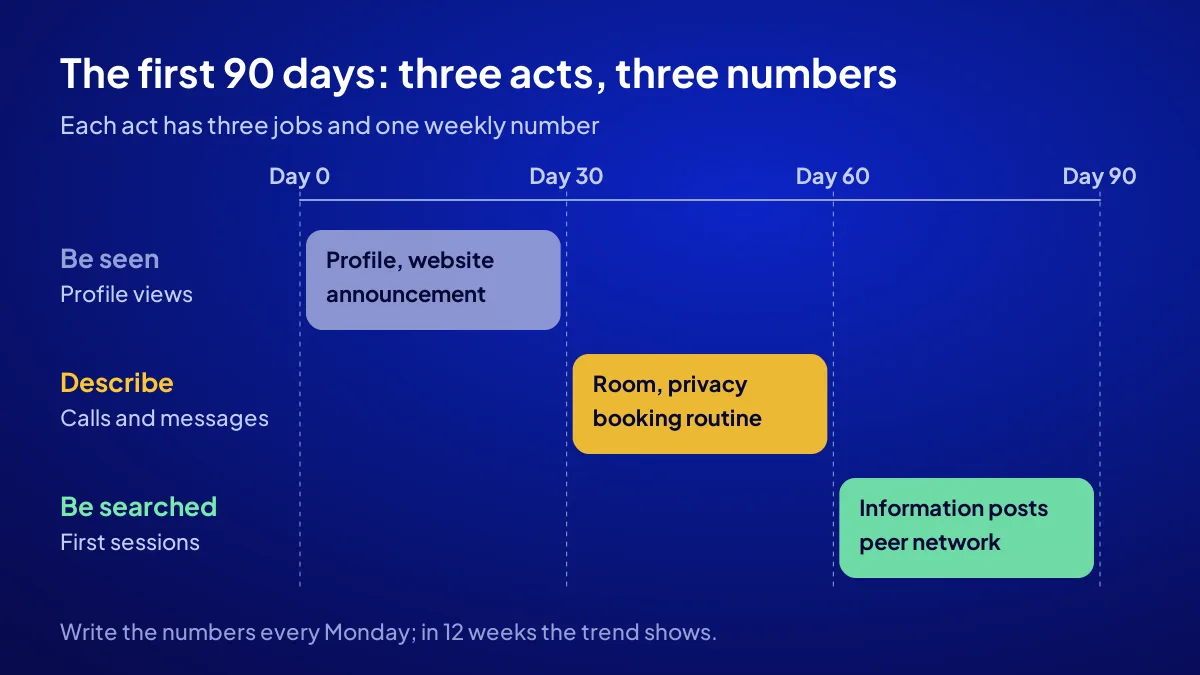
Split the plan into three acts: days 1 to 30 for being visible, days 31 to 60 for describing the experience, days 61 to 90 for your name starting to be searched. At the end of each act you look at one number. Because advertising rules in health are tight, no step of the plan relies on price, discounts or client reviews.
Why do first clients come late to a new therapy practice?
Because a client does not call on the day they find you. They search your name, check your title, read your website and may think for a week. People hesitate even to trust their hair to a new barber, so they do not rush to open their inner world to a stranger. Look, do not panic because the phone rings rarely in the first month; the till does not start ringing the day the shutters go up, least of all in this profession.
The distance between being seen and being chosen
I see this on our own site every day. Between 14 June and 13 September 2026, adaptedijital.com appears 142,296 times on Google and gets 1,699 clicks. The average click-through rate is about 1.2 percent. In other words, a hundred people see it and one clicks.
Which four parts is trust built from?
BU BÖLÜMÜN ÖZETİ
- Clarifying the title
- Describing the place
- Speeding up the response
- Finding the voice
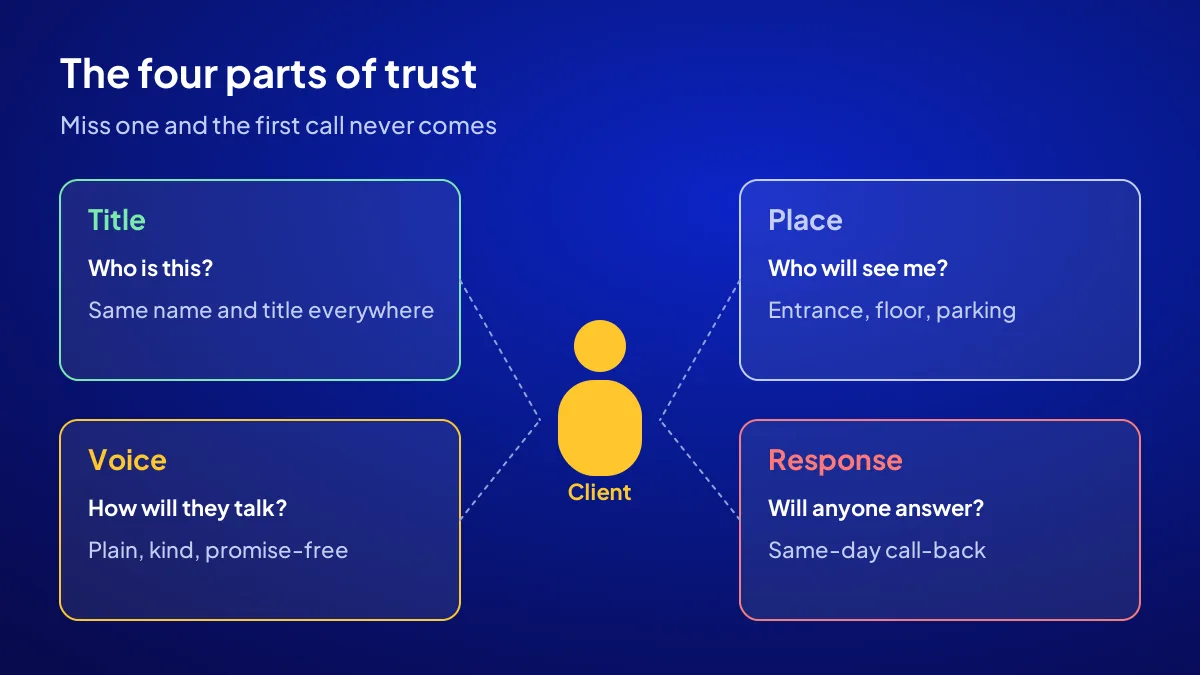
There are four parts: title, place, voice and response. The title says who you are; the place says where you are and what kind of room it is; the voice says how you speak; the response says how quickly you get back. Here is what I have seen: in a practice missing one of the four, the client does not make the first call. In a practice with all four, the first call often ends with an appointment.
| Part | The client’s question | Its digital form |
|---|---|---|
| Title | Who is this person, what can they do? | Same name and title on profile, site and sign |
| Place | Where am I going, who will see me? | Address, entrance, parking and waiting information |
| Voice | How will they talk to me? | Plain, non-judgemental, promise-free language on the site |
| Response | Will someone pick up when I call? | Same-day call-back, clear booking information |
Clarifying the title
Psychologist, clinical psychologist and psychological counsellor are different titles. Whichever you are, write that everywhere. Do not use “therapist” alone as if it were a title; it leaves a question mark in the client’s mind. The Turkish Psychological Association reports unauthorised use of the “psychologist” and “clinical psychologist” titles to the competent authorities.
Describing the place
An address alone is not enough. Write the building entrance, the floor, parking or the nearest metro stop. Someone coming for the first time in Kadıköy or Bakırköy does not want to stand at the door asking for directions on the phone; this information saves them both time and unease.
Speeding up the response
You cannot answer the phone during a session, and that is natural. So set a rule: every call and message received in working hours is answered the same day. Say in your voicemail when you will call back. An unanswered first call is often never made a second time.
Finding the voice
A selective client trusts calm clarity, not fancy sentences. Keep the language on your site as simple as “I am here with you”, never as bold as “I will change your life”.
How are the 90 days split into three acts?
Each act has three jobs and one number. The first act is being visible, the second is describing the experience, the third is your name being searched. The table shows each act’s jobs and its weekly number. For compliant opening announcement texts, see therapy practice opening announcement.
| Act | Three jobs | Number to watch |
|---|---|---|
| Days 1–30 | Profile, website, opening announcement | Weekly profile views |
| Days 31–60 | Room information, privacy page, booking routine | Weekly calls and messages |
| Days 61–90 | Information articles, peer network, measurement | Weekly first sessions |
How do you describe the experience before the client arrives?
BU BÖLÜMÜN ÖZETİ
- Writing about privacy
- Writing about time
- Writing about the office
You describe the experience with information, not photos. In districts such as Beşiktaş or Mavişehir, a selective client wants comfort, quiet and time. “A 15-minute gap is left between appointments and you will not meet anyone in the waiting room” is information, and the regulation does not ban information. A photo of a luxury armchair does not introduce the practice; it only decorates it.
Writing about privacy
Add a short “how privacy is protected” section to your site: how records are kept, the messaging channel, the entry routine. Clients tell no one they called you; they decide by reading this page.
Writing about time
The length of the first meeting, session days, how appointments are booked and the cancellation rule. For a client who wants to save time, these four facts are worth more than the fanciest sentence.
Writing about the office
Transport, parking, lift, accessibility. All plain information. For a wider look at how your website carries these jobs, see what does my website do.
How does a peer network work within the rules?
In mental health, a large share of first clients come through referral: a psychiatrist, a family doctor, a colleague. This network is not advertising; it is telling colleagues who you are and what you work on. The line is clear: no payment, commission or mutual fee in exchange for referrals. Say you are a clinical psychologist in Çankaya working with adult anxiety; a short introduction note to colleagues around you is enough.
Which habits waste the first 90 days?
The most expensive mistake is trying to break the quiet of the first month with price because clients are not walking through the door. Advertising session fees and opening discounts is banned in health and breaks trust as well. The other mistakes are quieter but end in the same place: the client moves to the next name. We look at the reasons one by one in why clients do not come to a new therapy practice.
- Announcing session fees, discounts or “first meeting free”.
- Writing your title differently on each channel.
- Returning calls and messages the next day.
- Asking clients for reviews or using incoming reviews in promotion.
- Continuing sponsored posts after day 31.
- Changing the plan on a “this is not working” feeling without writing numbers.
One rule on reviews
Reply politely to an incoming review, but do not confirm that the person is your client. Privacy comes before the review.
What is decided at the end of day 90?
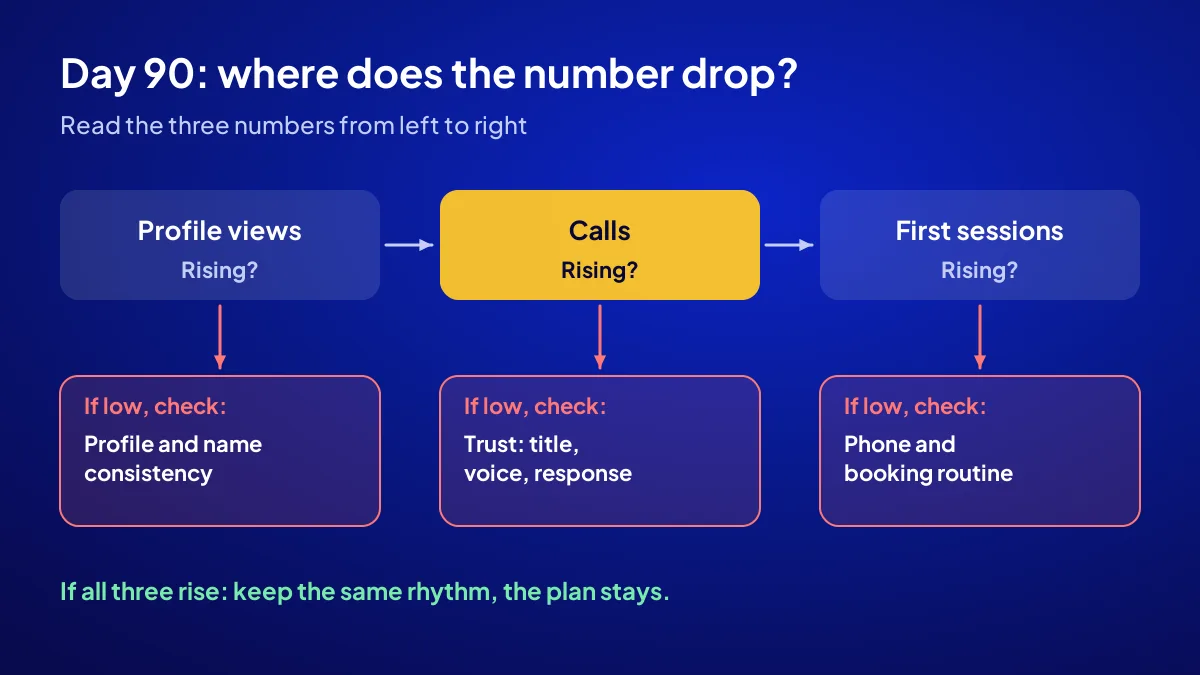
On day 90 you look for the answer to one question: are clients finding you, and do they call after finding you? If profile views rise but calls do not, the problem is trust; go back to title, voice and response. If there are calls but no first sessions, the problem is on the phone. We gave the step-by-step thresholds in numbers in finding clients for a new therapy practice.
Building the ground in one go
In a licensed unit, only your name and title go on the sign, and the digital brand is built on that name too. The naming advice in the campaign follows this rule.
The Build Your Own Digital Brand campaign sets up positioning, brand voice, a domain, 1 year of hosting, a 6-page website and 108 articles for a fixed TRY 36,000 + VAT. With 20 percent VAT that is TRY 43,200; check the current rate on your invoice. There are 12 places and the last day is 1 November 2026. Details are on the campaign page.
The big picture
You will find the full rule framework in one place in the new therapy practice promotion guide.
Let me ask you one thing: on the night a client finds you, can they find the answer they are looking for on your site? My decision is this: give the first 90 days to putting trust into words, not to showing off the experience.
Quick Summary
- The first 90 days go into building trust, not selling the experience.
- Trust is built from four parts: title, place, voice, response.
- Each act has three jobs and one weekly number.
- Comfort and privacy are described with information, not photos.
- Peer referral works without payment or commission.
- On day 90, where the number drops is where the problem is.
Short Glossary
Trust threshold: Trust threshold is the term used for the sum of information a client wants to see before deciding to call a therapist.
Click-through rate: Click-through rate is the ratio used to measure how often a page shown in search results is clicked per impression.
Referral network: A referral network is the set of professional relationships used by colleagues to send a client to the right specialist without payment.
Next Step
To build a digital identity on your own name and title in one go, apply for the Build Your Own Digital Brand campaign. Fill in the form, mention your coupon, and we start with consultancy.
Frequently Asked Questions
Source: Turkish Psychological Association — Reporting fake psychologists
Sık Sorulan Sorular
The query “google ads consultancy” gets 315 impressions for us and zero clicks. We are seen but not chosen. In a therapy practice this distance grows wider, because the cost of the choice is not a café bill but a person’s inner life.
Clarity. Writing out the title, the address, the area of work and how the first meeting goes shortens this distance. A client shies away from what they do not know and steps towards what they do.
A newly opened health facility is allowed sponsored promotion for one month after opening. If your practice is not a licensed unit, or you are unsure, ask the provincial health directorate in writing before using this window.
The first two are on the performance screen of your Google Business Profile. The third is in your appointment book. Write one line every Monday, and in 12 weeks the trend shows itself.
Name, title, area of work, address, consulting hours, and which cases you refer on to another colleague. The last item builds trust, because it shows you know your limits.
A referred client also searches your name first. If the right profile and the right site do not come up when your name is searched, the referral stalls halfway.
There is no fixed time. Before deciding, a client checks your name, title and website. Give the first 90 days to building trust and move forward with weekly numbers.
The campaign has 12 brand places and the last day is 1 November 2026. The price is a fixed TRY 36,000 + VAT, payment is upfront, and the 10 percent coupon is mentioned when you apply.
The sign of a licensed health profession service unit shows only the name and professional title. Build your digital identity according to this rule and consult the provincial health directorate about your own case.
Updated: October 2026