
AI Audit: Is Artificial Intelligence Helping or Hurting Your Company?
An AI audit is a review that shows, from records, how the artificial intelligence a company uses affects its money, its brand and its security. The black box on an aircraft is opened after the crash. An audit opens that box before anything crashes. ✈️
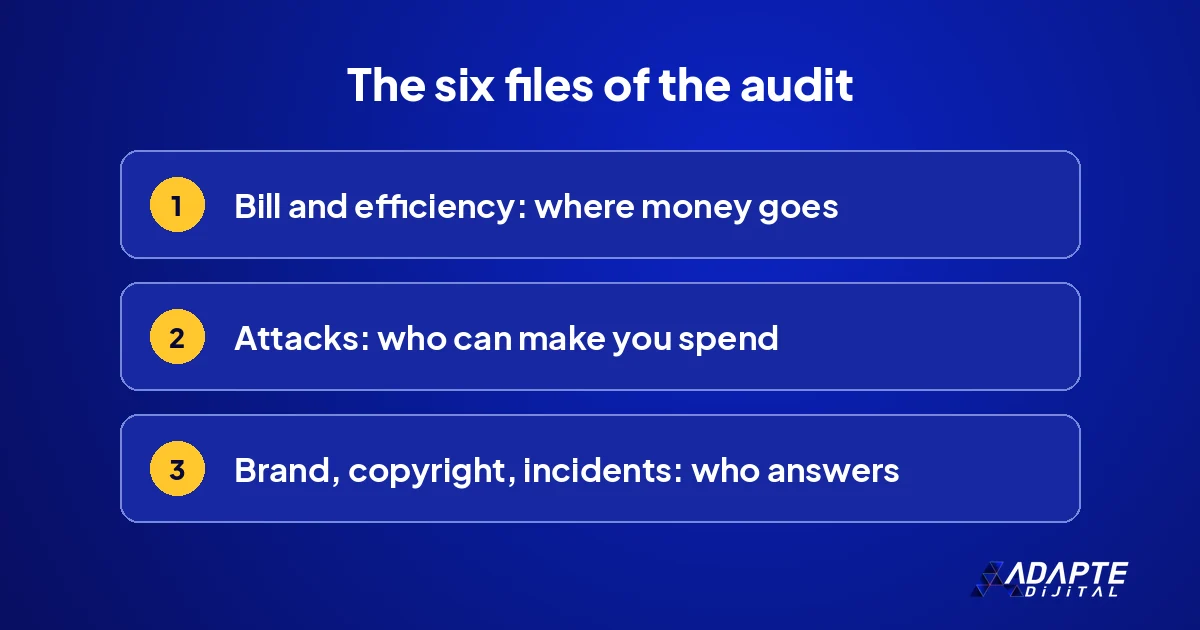
Most companies bought AI in pieces: a subscription here, a chatbot there, a few automations. Nobody looked at the whole picture. This guide puts that picture into six files: the bill, efficiency, attacks, brand, copyright and incidents. Each file follows the same order: what can happen, what it costs, and what prevents it.
This guide does not sell fear. Wherever we give a number we show the source; we did not write a number without one. Predictions are marked as forecasts. This article is for information only and is not legal advice; consult a lawyer about your own situation.
What is an AI audit, and what does it look at?
An audit is not a list of bans. It is a photograph of what the company does with AI, what that costs and where it has left a door open.
Opening the black box before the crash
In most companies AI works out of sight. The bill arrives at the end of the month, nobody reads what the chatbot said, and the automation runs at night. When something breaks, everyone asks the same question: what happened? An audit asks that question before anything breaks. Which tools exist, who uses them, which data they touch, what they cost each month, and whose approval they run on? A company that has those five things in writing gets fewer bad surprises. Where they are not written down, the first record is created together with the first problem. An audit should end with a decision list, not a report: what to switch off, what to limit and what to grow. 🗂️
How it differs from a usage audit
A usage audit looks at which tools the team uses and for what. We covered that in the business AI usage audit. The audit in this guide is wider: alongside the tools it reviews the bill, the attack surface, the brand output and the legal gap. A usage audit answers ‘who uses what’. An AI audit answers ‘what does this use earn us, what does it cost, and what does it expose us to’. One does not replace the other; the first is the opening step of the second. The two can be done at different times, but their findings belong in the same table.
Where does the money go? The bill and efficiency files
BU BÖLÜMÜN ÖZETİ
- The bill file: tokens, models and budget
- The efficiency file: agents and automations
- The cost formula
The first two files follow the money. One looks at how the bill is formed; the other asks whether the system you built spends that money efficiently.
The bill file: tokens, models and budget
An AI bill does not grow with the number of users; it grows with the amount of text processed. The unit of that amount is the token, which we explain in what is a token in AI. Three decisions set the bill: which model, how much context, and how often. Simple work done with an expensive model is the quietest leak in a budget. According to FinOps Foundation research, nearly all cost management teams now manage AI spend as well. The fact that it is a managed line elsewhere does not mean it is managed in your company. The step-by-step method is in how to audit an AI budget. 🧾
The efficiency file: agents and automations
An agent calls the model many times for a single job. On each call it re-reads all the earlier steps. That is why a badly built agent can do the same job at ten times the cost, and nobody notices. Automations fail in a different place: if the trigger is set up wrongly, the flow runs when it should not, and when it errors it retries itself. Both show the same symptom: the bill rises while the amount of work does not. The efficiency file measures cost per job and opens up the three most expensive flows one by one. It does not look for someone to blame; it looks for a way to do the same job in fewer steps with a smaller model.
The cost formula
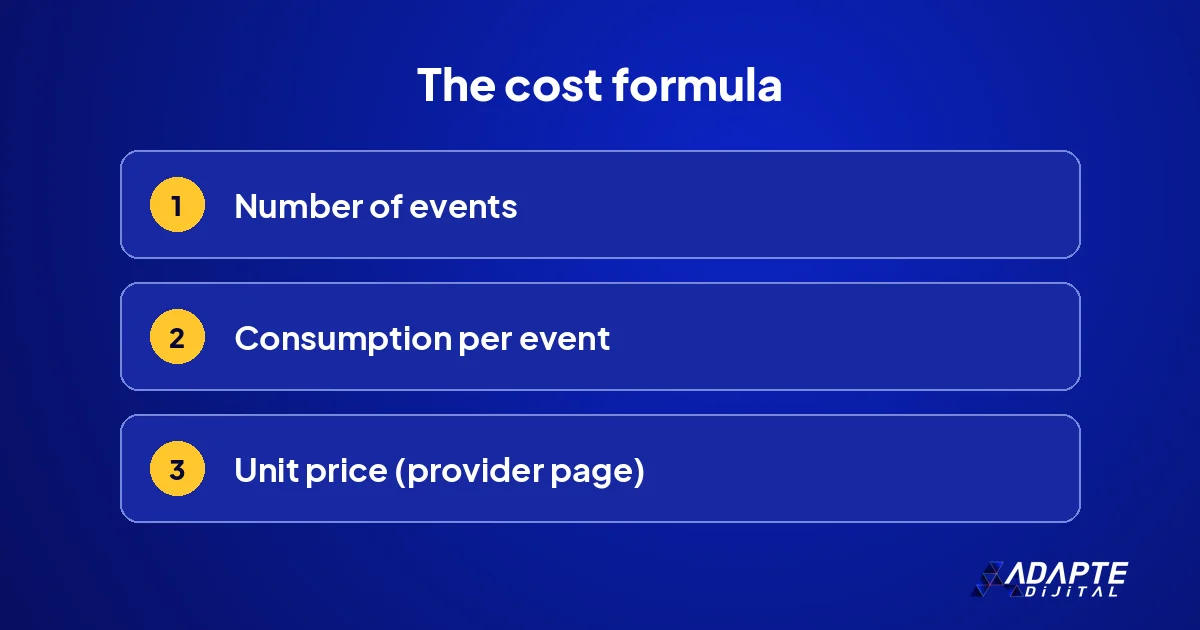
Every article in this cluster carries a cost formula. The logic is always the same: cost = number of events × consumption per event × unit price. An event can be a request, an agent task or an automation run. We do not write the unit price, because providers change it often. The right figure is on the current pricing page of the provider you use. The job of the formula is not to give a number but to show which multiplier is large in your case. A business that knows its multiplier negotiates and protects itself in the right place. ✖️
What can come from outside? The attack file
BU BÖLÜMÜN ÖZETİ
- Denial of wallet: traffic becomes a bill
- A leaked key: someone else works on your account
- Shadow tools: doors you do not know about
Every endpoint that uses AI is a door that spends money each time it is used. Someone other than you can knock on it.
Denial of wallet: traffic becomes a bill
A classic attack tries to take the site down. The newer attack leaves the site running and grows the bill. OWASP added this risk to its list under the heading ‘unbounded consumption’ and named denial of wallet as a scenario of its own. Every request to the chatbot or search box on your site is a paid model call behind the scenes. Without a request limit and a spending cap, a wave of hostile traffic is written straight onto the invoice. This is not a risk only for large companies; a single open box on a small site works the same way. We describe the scenario and the defences in the denial of wallet attack. 🛡️
A leaked key: someone else works on your account
The second route is quieter. The attacker does not enter your site but your account. In May 2024 the security company Sysdig documented an attack in which stolen cloud credentials were used to run AI models. By the company’s estimate, such use could cost the victim more than 46,000 dollars a day if it went unnoticed. The same team’s year-end report describes one victim left owing 30,000 dollars after three hours. A key can sit in a code repository, in a plugin setting or on a former employee’s laptop. Knowing where keys are kept and when they were last rotated is the first question of this file.
Shadow tools: doors you do not know about
The third gap is inside. The team pastes company data into tools you have never heard of; a tool opened with a personal account carries company work. You do not hold the key, the contract or the record for those tools. When something goes wrong, you cannot show what went where. That is why the attack file does not look only at the server. It lists the keys, the endpoints and the unregistered tools. Talking about protection before that list exists is like buying locks without knowing how many doors you have. 🚪
How does the brand look? The brand and copyright files
BU BÖLÜMÜN ÖZETİ
- Brand signal
- Images, video and voice
- The copyright file
Every text, image and answer AI produces speaks in the name of your brand. These two files look at what that speech earns you and what it may cost.
Brand signal
A customer may not know how a piece of content was made, yet still takes an impression from it. We call that the brand signal; the detail is in what is a brand signal. Research does not point one way. In a YouGov survey run in Australia in May 2026, 45 per cent of respondents said they would trust a brand less if its advertising were made mainly with AI. In another study the largest group was indifferent. The common ground is this: the problem is not that AI is used, but that it is used carelessly. That is why the brand file looks at the work that comes out, not at the tool.
Images, video and voice
A mistake in an image is spotted faster than a mistake in text. According to the Europe, Middle East and Africa edition of DoubleVerify’s 2026 report, 42 per cent of consumers feel negatively towards a brand that uses AI advertising that looks low-quality or strange. When the advertising looks polished, that reaction drops noticeably. The audit does not debate taste here. It looks at three things: is there human approval before publishing, is fit with the brand guide measured, and how is faulty content taken down? Voice and face imitation is a separate risk. One unchecked image can overshadow months of careful brand work in a day. 🎨
The copyright file
Two questions are asked together about AI-made content: does this output infringe someone else’s rights, and do we hold the rights to it? The answer to both varies by country, tool and type of use, and court cases are still running. An audit does not give a legal ruling. It checks whether records are kept: which tool, which licence terms, which source image, which human contribution. If an objection arrives, that record is the only defence you have. Keeping it is not expensive; a few lines of notes during production are enough. We list where the risk arises in copyright risk in AI output.
Who does what when something goes wrong? The incident file
BU BÖLÜMÜN ÖZETİ
- What the chatbot says, the company says
- The incident plan
- Rules and insurance
The last file is the least loved. It describes the day when not everything goes well.
What the chatbot says, the company says
In February 2024 a tribunal in Canada held Air Canada responsible for wrong information its website chatbot had given a passenger. The company had argued that the chatbot should be treated as a separate entity; the tribunal did not accept that. The lesson is plain: a customer looks at which site an answer appeared on, not at who wrote it. If your bot talks about refunds, prices or guarantees, what it says can be read as your commitment. The audit asks which topics the bot may talk about and whether its answers are logged. The ruling belongs to Canada, but the same reasoning is being argued elsewhere. ⚖️
The incident plan
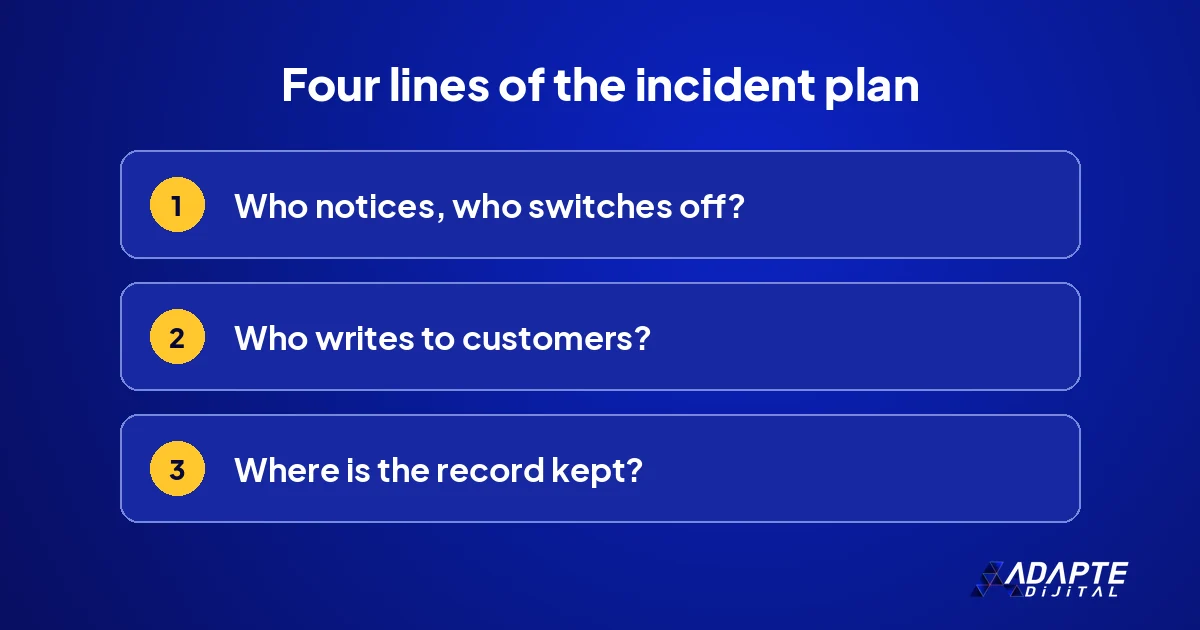
The plan is not a long document. It is four lines: who notices the problem, who switches the system off, who writes to customers, and where the record is kept. If those four lines are not written down, the first hour is spent arguing about who has authority. The authority to switch off looks like a technical detail, yet it is the most critical item. It must be clear who can stop a flow that is inflating the bill at three in the morning. The incident file also looks back: in the last six months, was there a wrong answer, a wrong send or an unexpected bill, and what changed afterwards? We describe the shutdown decision in when to shut down a chatbot.
Rules and insurance
In Europe the AI literacy obligation is in force; transparency and high-risk rules are tied to a timetable. In Türkiye, personal data and advertising rules also cover the use of AI. Forecast: within the next two years, large customers and insurers will start asking suppliers for written records of their AI use. A business with its records ready will answer that question in a day. We follow the insurance side in AI insurance. Update log. 18 November 2026: first publication. Forecasts on this page are re-read when they fall due; one that proves wrong is corrected here, not deleted.
How does Adapte Digital run an AI audit?
BU BÖLÜMÜN ÖZETİ
- A single delivery package
- What is delivered
- Where to start
We run the audit as a delivered report, not as a management subscription: six files are reviewed, findings are written down and an order of priority is set.
A single delivery package
Adapte Digital does not charge a monthly management fee. Work starts with a single delivery package whose scope is written down in advance: 36,000 TRY + VAT. If the work grows, the new need is defined as a separate add-on package, priced by what will be delivered rather than by the hours spent. 📦
What is delivered
The output is an inventory of tools and keys, a cost-per-job table, a list of gaps and a ninety-day order of fixes. Each finding is tied to a record, so you can check it yourself.
Where to start
Our current packages and capacity are listed on our campaign pages; scope and price are written there before any work starts. 🧭
Quick Summary
- An AI audit reviews money, attack exposure, brand and legal gaps from records.
- There are six files: bill, efficiency, attacks, brand, copyright and incidents.
- The cost formula: number of events × consumption per event × unit price.
- An endpoint with no request limit and no spending cap turns an attack straight into a bill.
- What a chatbot says can be treated as what the company says.
- A business that keeps records answers in a day when asked.
Short Glossary
- AI audit
- An AI audit is a review of the cost, risk and brand effect of a company’s AI use, based on records.
- Token
- A token is the small unit of text that language models use to process and bill text.
- Denial of wallet
- Denial of wallet is an attack that aims to inflate the bill of a pay-per-use AI service by sending it heavy traffic.
Frequently Asked Questions
Next Step
The first step is an inventory: write the tools, keys and monthly bills you use on one page. That page shows which of the six files to start with.
Sources: NIST — AI Risk Management Framework · OWASP Gen AI Security Project — LLM10:2025 Unbounded Consumption · EU Artificial Intelligence Act — Article 4: AI literacy · American Bar Association — BC Tribunal Confirms Companies Remain Liable for Information Provided by AI Chatbot
Updated: November 2026
Sık Sorulan Sorular
An audit is not invented from scratch. The US National Institute of Standards and Technology published a voluntary AI risk management framework in January 2023. It has four functions: govern, map, measure and manage. On the security side, OWASP maintains a list of ten risks for large language model applications. Article 4 of the EU Artificial Intelligence Act requires AI literacy among staff and has applied since 2 February 2025. A small business does not implement all of these documents; it borrows their questions. The six files in this guide are those questions, reordered in the language of a business owner. 📚
For a business with a single subscription, a short inventory is enough. If the site has a chatbot, an automation or a paid model key, an audit is needed, because spending and liability now depend on usage.
That depends on the number of tools and the state of the records. Where an inventory already exists the review is short; where there are no records, most of the work is setting them up first.
No. The aim is not to stop use but to make it measurable. Most findings are not bans; they are suggestions for limits and records.