
How is a digital company website built, what do 6 pages, 12 subpages and 6 categories do?
A digital company (dijital şirket) website is built from a page plan: 6 top pages say what the company does, 12 subpages carry the detail, and 6 categories give 108 articles a home. The plan does not come from the law; it comes from the way customers and AI systems read a site. The Ministry of Industry and Technology had not published its digital company definition as of October 2026, when this guide was updated, and KOSGEB’s announcement of 12 October 2026 sets no website requirement either. Whatever the definition says, the site is built with this plan.
What this means for you: before you build the site, you need to know which page answers which question. Once the plan is ready, the domain, hosting, pages and articles move forward in a single line. Our digital company page, where we collect every question on the topic, shows that line as a whole.
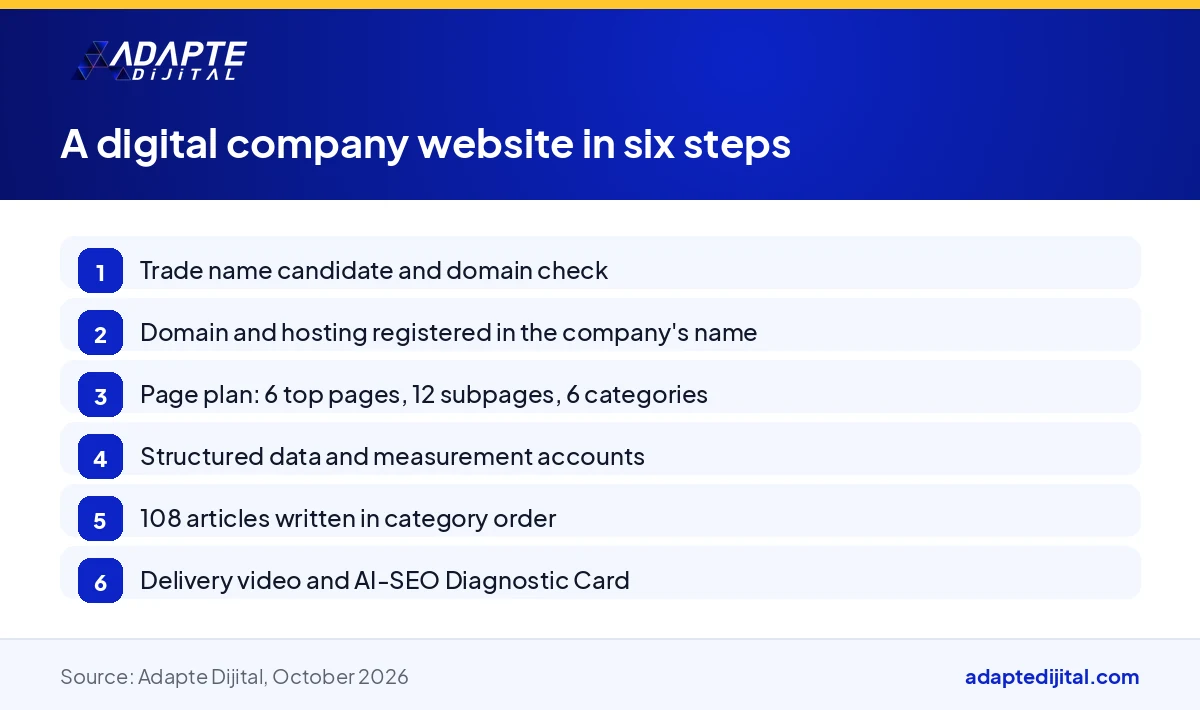
How is a digital company website built, why do the domain and page plan come first?
BU BÖLÜMÜN ÖZETİ
- The domain and hosting must be registered in the company’s name
- The page plan is written before the design
- You do not wait for the definition, you build the site
A site is built on three decisions: domain, page plan and measurement. All three come before design. A company that starts with design rebuilds it later to add pages.
The domain and hosting must be registered in the company’s name
Our guide to domain name and trade name alignment covers how the domain should match the registered name and how to choose between .com and .com.tr. For this guide one rule is enough: the domain and hosting are registered in the company’s name. All pages, articles and measurement accounts live under that domain. If the domain changes, everything starts again.
The page plan is written before the design
The plan is a list of the questions the company will answer. Each top page is one question; each subpage is one detail of that question. Colours, logo and visuals wait until the plan is finished on paper. Then no page is missing at launch and the menu does not change later.
You do not wait for the definition, you build the site
Our guide to what a digital company is explains the provisions behind the status. On the website side there is nothing to wait for: no text in force requires a website, and none prevents one. The day you incorporate, the site plan should be ready too; the two sit on the same calendar.
What do the 6 top pages cover, which question does each one answer?
BU BÖLÜMÜN ÖZETİ
- Home and About: who you are
- Service pages: what you do and who you do it for
- FAQ and Contact: what to expect, how to reach you
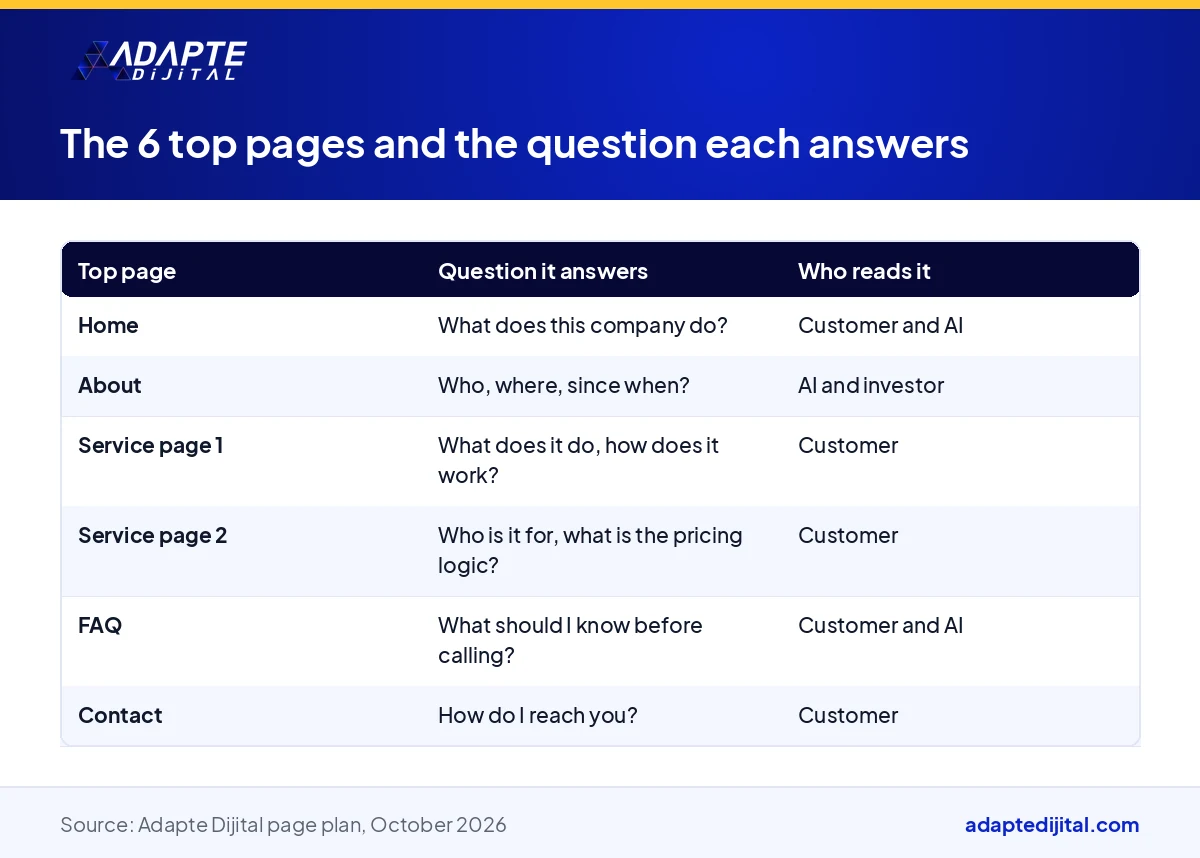
The top pages answer the six questions of a first-time visitor: who are you, what do you do, who do you do it for, how do you work, what should I expect, how do I reach you. Six pages answer these six questions in one click.
Home and About: who you are
The home page says what the company does in one sentence and points to the other pages. The About page states the trade name, the founder, the address and the year of incorporation. When an AI system identifies a company, it reads these two pages. The name here must match the name in the trade registry.
Service pages: what you do and who you do it for
Two top pages are reserved for services. Each describes one job, how the work is done and the pricing logic. A site that describes three services on one page shows up for none of them. So each service gets its own page; if a third service comes along, it goes to a subpage.
FAQ and Contact: what to expect, how to reach you
The FAQ page answers the questions a customer asks before calling. When this page is marked up with structured data, AI systems pull the answers directly. The contact page gathers phone, WhatsApp, e-mail and address on one screen. That completes the six top pages.
Why are 12 subpages needed, where does the detail go?
BU BÖLÜMÜN ÖZETİ
- Each top page opens two subpages
- What a subpage tells AI and the person searching
- A subpage is not an article
The top page answers the question; the subpage carries the detail. Each top page has two subpages beneath it, so six top pages open twelve subpages. If the detail is written on the top page, the page grows long and nobody reads it.
Each top page opens two subpages
A service page gets a process page and a case study page; About gets a team page and a service area page; Contact gets an appointment page and a quote request page. Each subpage covers one topic and links back to its top page.
What a subpage tells AI and the person searching
An AI system generating an answer looks for detail: which region, which process, which conditions. That detail lives on the subpages. The person searching sees the steps to expect on the same page. Without subpages these questions go unanswered, and the customer moves to another site.
A subpage is not an article
A subpage describes the company’s own work and rarely changes. An article answers a customer’s question and keeps multiplying. When the two are mixed, the service page turns into a blog post. This distinction keeps the site tidy over the years.
How do 6 categories work as the home of 108 articles?
BU BÖLÜMÜN ÖZETİ
- A category is the name of a keyword group
- How 18 articles fill a category
- An article leads to a service page
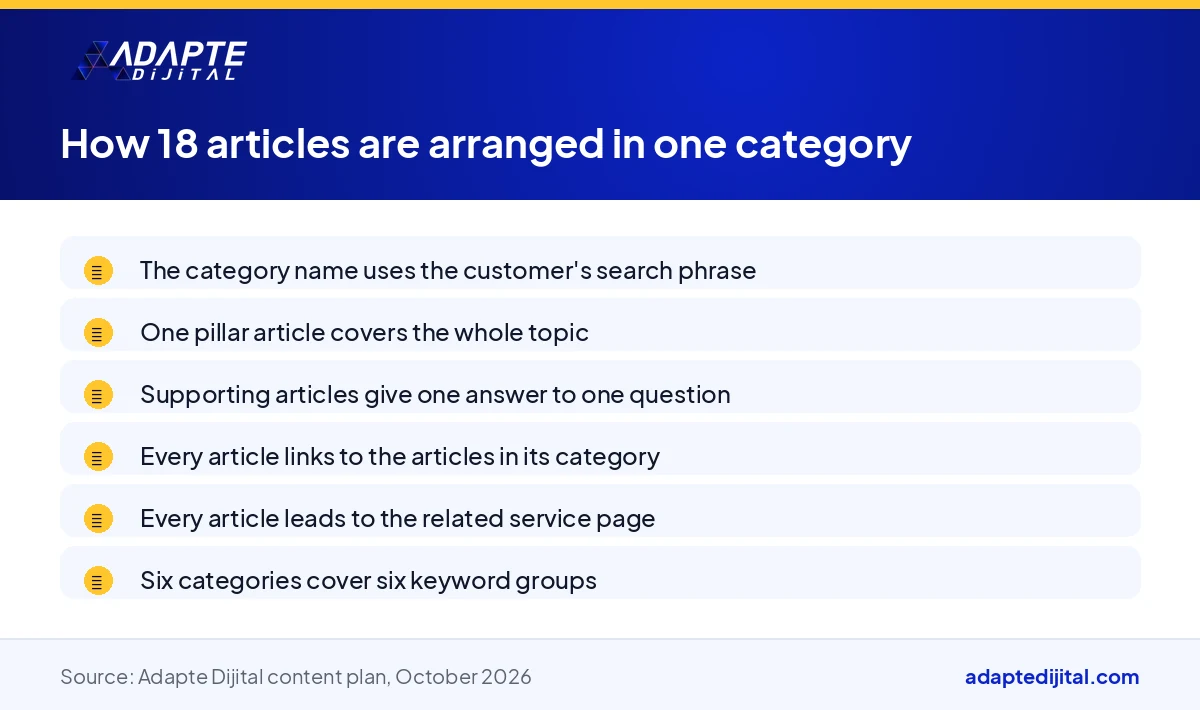
Categories are the six keyword groups the 108 articles are spread across. Each group matches a service or a customer question. Each category gets eighteen articles. Without categories, articles become a pile; with categories, every article knows its place.
A category is the name of a keyword group
The six groups come from how customers search: what, how, how much, where, who, when. Each category is given one of these questions or one service area. The category name is not a single word; it is written in the phrase the searcher uses.
How 18 articles fill a category
Each category has one pillar article and the articles that support it. The pillar covers the topic as a whole; each supporting article answers one question. The eighteen articles link to each other. That way an AI system recognises the company on a topic not from one page but from a cluster.
An article leads to a service page
Every article ends with a link to the related service page and to the contact page. The reader gets the answer and moves to the service in one click. Sales happen on this path from article to service page. The 108 AI-SEO-ready articles in 6 keyword groups are written by this rule.
What does an AI and user friendly website mean, how are two readers satisfied at once?
BU BÖLÜMÜN ÖZETİ
- For the user: speed, a short answer, one-tap contact
- For AI: structured data, a consistent entity, answer blocks
- For measurement: GA4 and Search Console from day one
The site has two readers: the person searching and the AI system. The user wants speed and a clear answer; the AI wants consistent information and structured data. An AI and user friendly site meets both demands on the same page. Choosing one loses the other.
For the user: speed, a short answer, one-tap contact
The page opens fast on a phone, answers the question on the first screen, and a WhatsApp button sits on every page. A long introduction, a pop-up window and an unreadable menu drive the user away. The site is built for someone who reads little and decides in two minutes.
For AI: structured data, a consistent entity, answer blocks
Organization schema gives the company’s name, address and contact details in a machine-readable form; FAQ schema marks the answers. Trade name, address and phone are written the same way on every page. A short answer block sits at the top of each page. Our guide on why AI SEO starts at incorporation explains why AI does not recommend a new company.
For measurement: GA4 and Search Console from day one
GA4 and Search Console are opened in the company’s name on the day the site goes live. That records the first impression, click and query. If measurement is added later, the first months stay invisible. Which numbers to watch is covered in our guide to the first 90 days after launch.
Who builds a digital company website, how does it fit the incorporation timeline?
BU BÖLÜMÜN ÖZETİ
- The accountant runs registration, the agency runs digital
- Where the site goes in the KOSGEB plan
- What you hold at delivery
The accountant handles registration; the agency builds the digital side. The two jobs run in the same weeks. Our guide to setting up with MERSİS, e-signature and KEP covers the online registration steps; the site is planned without waiting for them and goes live together with registration.
The accountant runs registration, the agency runs digital
The accountant handles the articles of association, the tax office and the ledgers. The agency sets up the domain, hosting, page plan, articles and measurement. The only point the two share is the trade name and address. This division saves the founder from learning two jobs at once.
Where the site goes in the KOSGEB plan
The programme page of KOSGEB Business Development Support (İş Geliştirme Desteği) lists software and service procurement (consulting, marketing, design) among the supported cost items; KOSGEB decides which costs are accepted. The site and content can be planned under these items. Our digital company preparation checklist gives the whole picture of pre-application preparation.
What you hold at delivery
A domain and one year of hosting in the company’s name, 6 top pages, 12 subpages, 108 articles in 6 categories, 3 social media accounts, measurement accounts and structured data. We build this whole as a single package in the My Digital Company (Dijital Şirketim Olsun) campaign for TL 36,000 + VAT. Adapting the page plan to your own company is the work of our website consulting service.
Quick Summary
- 6 top pages answer six questions, 12 subpages carry the detail, 6 categories hold 108 articles; each category gets 18 articles.
- The domain and hosting are registered in the company’s name; the page plan is written before the design.
- Organization and FAQ structured data, GA4 and Search Console are set up on the day the site goes live.
- The Business Development Support programme page lists software and service procurement among the supported items; the decision is KOSGEB’s (12 October 2026).
- The Ministry’s digital company definition had not been published as of October 2026; the site plan does not depend on it.
Short Glossary
- Top page
- Top page is the page placed in a site’s main menu and used to answer one basic question.
- Category
- Category is the section of a site used to keep the articles of one keyword group together.
- Structured data
- Structured data is the markup code used to give company information to search engines and AI systems in a machine-readable form.
Frequently Asked Questions
Next Step
If you want to plan your company’s 6 top pages, 12 subpages and 6 categories with us, review the delivery list and book a discovery call on our digital company page; 12 companies are taken in this period, and the last day is 16 November 2026.
The definition and conditions of the digital company scheme are not final yet; support amounts and conditions may change. Check the latest information with the Ministry of Industry and Technology, KOSGEB and the Official Gazette before deciding. This is not legal or financial advice.
Sources: KOSGEB, Entrepreneur Support Programme renewed (12 October 2026) · Dünya/AA, Minister Kacır’s announcement (27 April 2026) · Diken, Minister Şimşek’s statement (27 April 2026)
Updated: October 2026
Sık Sorulan Sorular
Enough to start. Six top pages cover who, what, for whom, how, what to expect and how to get in touch. The detail goes to twelve subpages and customer questions go to 108 articles; the number of top pages does not grow.
Each category covers one keyword group and takes eighteen articles. AI systems and search engines recognise a company not from a single page but from an interlinked cluster; the category builds that cluster.
The page plan and the domain check are done before registration; the domain and hosting are registered in the company’s name after it. The launch is timed to the same weeks as registration, so the address is ready on day one.