
Servizz AI puts bookings and work orders in one app, what do repair shops gain?
Servizz AI has launched an app that brings car and motorcycle owners together with service businesses on one digital platform (Perakende Türkiye, 24 September 2026). Its business panel, Servizz Business, and its payment integration, Servizz Pay, keep bookings, work orders, parts records and payments in one system. With an AI Vehicle Health Score, predictive maintenance and a digital vehicle ID, it aims to shift after-sales service from reacting to breakdowns to predicting them.
For a small repair shop, it means a driver can find you through a list filtered by location and specialty, not only through a friend’s tip. That list can bring new work. But bookings, maintenance histories and customer records also pile up on someone else’s platform, so decide which data stays with you before you sign up.
What tools does Servizz AI give a car repair business?
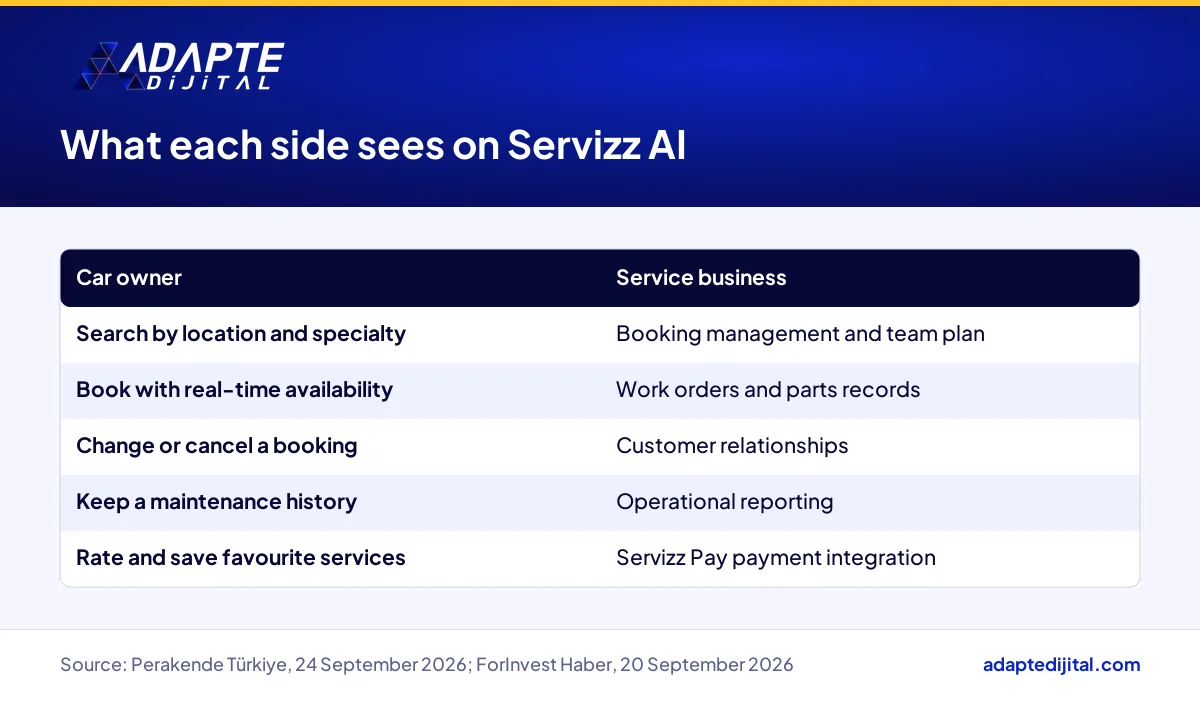
Servizz AI offers one screen for each side. The car owner searches, books and keeps a maintenance history. The business uses the Servizz Business panel for bookings, staff schedules, work orders, customer relationships, reporting and parts, all in one place. Servizz Pay handles payment, and a vehicle health score with predictive maintenance adds the forecasting layer.
Which repair shops does a platform like Servizz AI strengthen, and which does it squeeze?
The biggest winner is the independent shop that does good work but is hard to find. A specialty filter can push a small workshop that knows one brand or one type of job up the list. The shop that works without appointments and keeps its records on paper will find this harder. Parts sellers, tyre shops and car washes feel it indirectly, as digital service records can change how orders flow.
How does a repair shop’s day change when bookings and work orders move into one app?
The day starts with a calendar, not a ringing phone. Let’s say you run a two-lift shop in a sanayi sitesi in Istanbul, one of the industrial estates where Turkish repair shops cluster. In the morning, the panel already shows the day’s bookings, each car’s history and which mechanic is on which job.
Which data should a repair shop keep in its own hands when it joins Servizz AI or a similar platform?
Three kinds of data should stay with you: your customer contact list, maintenance history by vehicle and your parts usage records. A platform collects them easily; whether you can export them when you leave is a question for the contract. Servizz AI founder Serhat Güldağ describes the platform as “a next-generation technology platform that digitalises the vehicle’s life cycle.” A copy of that life cycle should live with you too.
How do repair shops stay visible in search and maps next to platform listings like Servizz AI?
A platform is a shop window, not the only one. When a driver types “car service near me”, map results and platform listings compete for the same glance. Your business profile, website and reviews should match your platform profile. Then search finds you directly, and the platform becomes an extra channel.
What should a repair shop owner do this week about platforms like Servizz AI?
Three jobs are enough this week: take stock of your current records, fix your business profile and write your question list for any platform meeting. The platform decision comes after these, not before. If you want to plan your shop’s digital shift together with your business model, digital transformation management is work we do.
Quick Summary
- Servizz AI brings car owners and service businesses together on one platform (Perakende Türkiye, 24 September 2026).
- Servizz Business keeps bookings, work orders, team plans and parts records in a single panel.
- Pricing, the payment provider and user numbers have not been disclosed.
- Türkiye had 34,911,879 registered vehicles at the end of August 2026 (TÜİK, via DHA).
- A shop’s first decision is to keep its own copy of customer and maintenance data.
Short Glossary
- Work order
- A work order is the document used to record the job to be done on a car, the mechanic, the time spent and the parts.
- Predictive maintenance
- Predictive maintenance is the data-based approach used to forecast when a vehicle needs servicing before something breaks.
- Digital vehicle ID
- A digital vehicle ID is the record used to bring a car’s maintenance and service history together in one file.
Frequently Asked Questions
Next Step
Let’s map out the order in which your shop takes bookings, work orders and customer records digital. Fill in the consult your expert form; our retail page, where we interpret the retail agenda for you, collects similar cases.
Sources: Perakende Türkiye, 24 September 2026 · ForInvest Haber, 20 September 2026 · TÜİK data, via DHA · Ministry of Trade of Türkiye, After-Sales Service Competence Certificate
Updated: October 2026
Sık Sorulan Sorular
The user filters services by location, category and specialty, checks real-time availability and books a slot. The booking can be changed or cancelled from the app. The user can also rate a service, save favourites and keep the maintenance history there.
The panel covers booking management, team planning, work orders, customer relationships and operational reporting. The parts used and the service steps are recorded digitally too. What lived in a notebook or the head mechanic’s memory moves onto one screen.
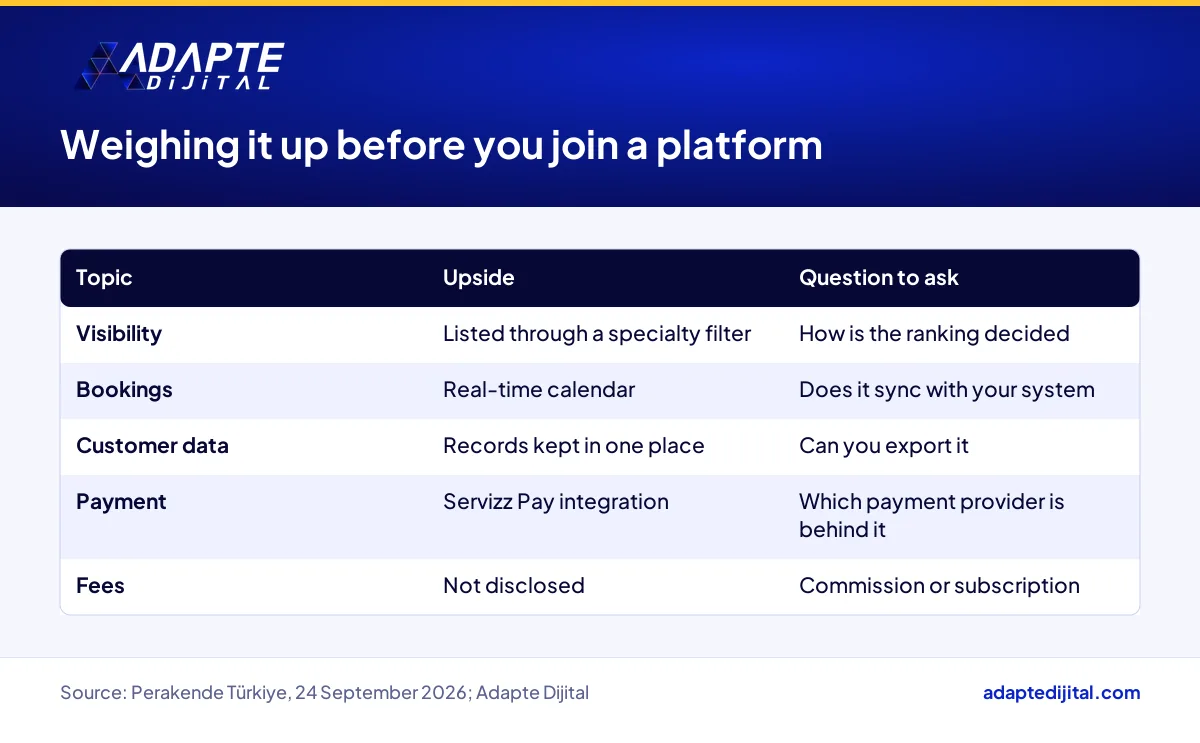
The company has not said which payment provider sits behind Servizz Pay. How the AI Vehicle Health Score is calculated, and from what data, is not known either. Pricing and the subscription model are not in the news. Ask all three in the first minute of any sales call.
A shop that depends on whoever walks through the door becomes visible on a map and in a list. Ratings and favourites reward the shop that does the job well. The goal is a mechanic with a full calendar, not one waiting at the counter.
Authorised service networks already sit inside a regulated system. According to Türkiye’s Ministry of Trade, companies that make or import goods on its list must hold an After-Sales Service Competence Certificate, set up authorised service points and register them on servis.gov.tr, the government’s service registry. The certificate is valid for two years. Verify with the official source; this is not legal or financial advice.
Each part used on a work order gets recorded. When a shop can see which parts it uses and how often, parts ordering no longer has to rest on guesswork. For a supplier, that can mean more planned orders.
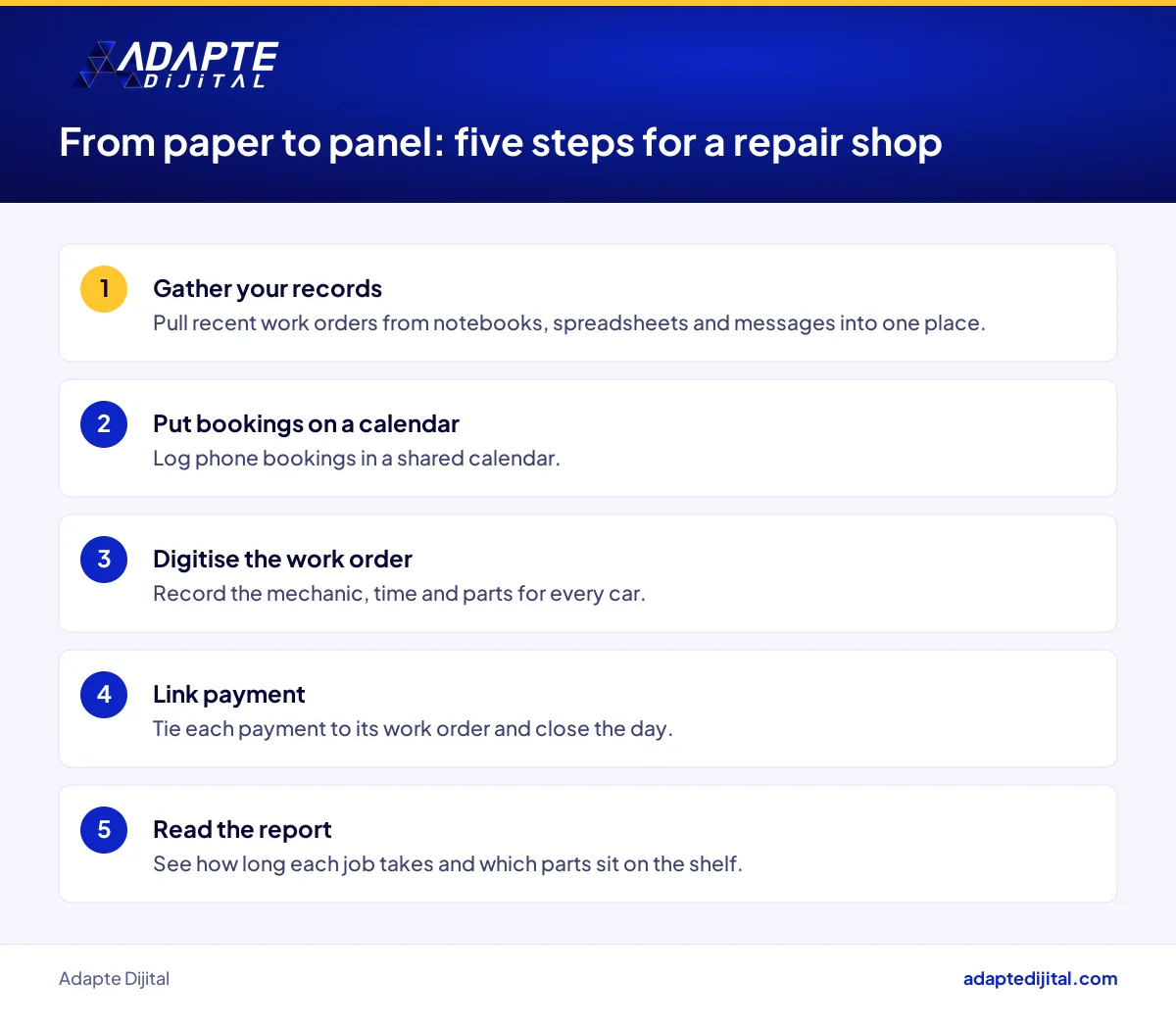
A car sits on the first lift, and its owner can’t remember the last service. You don’t have to either; the record is on the screen. The mechanic opens the work order, adds the part line, and the time spent goes straight into the report.
The real gain is in the work order, not the booking. You finally see how many hours each job takes and which parts are just sitting on the shelf. According to Güldağ, one of the biggest gaps in after-sales service is that vehicle life-cycle data stays scattered. Inside one shop, it’s the same story.
Predictive maintenance promises exactly that: seeing which car will need you, and when. Winter tyres or battery season could become periods you plan for in advance, much like a retailer building its back-to-school stock ahead of the rush.
A customer who arrives through an app can look like the platform’s customer. If that person can call you directly on the second visit, the relationship is yours. Contact details shared with consent belong in your own list.
You may want to switch platforms in a year. If you can’t take the maintenance histories with you as a file, customers walk, because the car’s memory stays behind. Ask for the export format in writing.
The logic is the same: keep critical inputs close. The question of when a food retailer should go upstream is a cousin of how much data a shop should keep.
Address, hours, specialty and phone should match everywhere. Listing “brakes and suspension” on the platform while the map says “general repairs” confuses both the search engine and the customer.
A rating inside the platform stays there. Asking happy customers for a review on your map profile too protects the visibility you own.
According to TÜİK, Türkiye’s statistics institute, 34,911,879 vehicles were registered for road use at the end of August 2026, and 51.7 percent of them were cars. New registrations in August fell 20.1 percent compared with the same month a year earlier. Fewer new cars arrive, yet the existing fleet still needs servicing; in autumn 2026, that is where repair demand across Türkiye comes from.
The notebook, the spreadsheet, the WhatsApp threads: list them all. Pulling the last three months of work orders into one table shows what is missing, and you pick a platform that fills that gap.
Ask about pricing and subscription, the payment provider, data export and the data source behind the health score. None of these four is in the news. Don’t sign anything until the answers arrive in writing.
The news mentions no such requirement. The platform targets businesses that provide after-sales service for cars and motorcycles; ask the company for its joining terms in writing.
Records build up on the platform; whether you keep a copy depends on the contract. Settle your export rights and the file format before you sign.
Pricing and the subscription model have not been announced. When you get a quote, ask separately about commission, fixed fees and payment integration costs.