
Can My Current SEO Agency Handle AI Visibility, or Do I Need a Separate AI SEO Specialist?

You have worked with your SEO agency for years. They know your site, they know your sector, you are on first-name terms. Now a new job is on the table — being mentioned in ChatGPT — and two voices are arguing inside you: “Let them do it too; I don’t need the hassle of a new agency” and “What if this isn’t their kind of work?”
Both voices may be right. Which one is right is settled by a test, not a feeling. Protecting an existing relationship has value; but handing over unmeasured work out of habit is simply the polite form of waste.
This article puts three paths on the table — your current agency, a separate AI SEO specialist and a dual model — and gives you a decision test for each. By the end, your ruler, not your gut, will tell you who to walk with.
Three Paths on the Table: See the Map First
This is not a one-question decision; each of the three paths is legitimate in some situations. Let us draw the map first, then move on to the tests.

The nature of each path:
Four Competence Tests: Invite Your Agency to the Table
Now the ruler. Before handing this work to your current agency, apply four tests — not hostilely, but openly; a good agency enjoys them.
The tests:
The Separate-Specialist Path: What You Gain, What You Manage
If the tests came out weak — or your agency honestly said “this isn’t our field”, which is a valuable kind of honesty — the separate-specialist path opens.
Four facts about this path:
The Dual-Model Specification: Foundation in One Hand, Roof in the Other
If you choose the dual model, the arrangement is built on four clauses. The clauses are short; the discipline lasts.
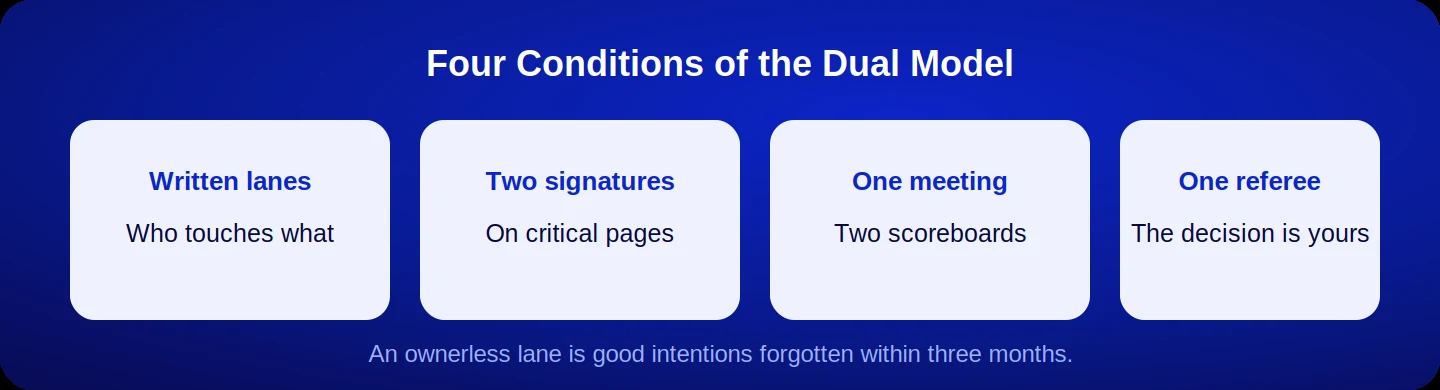
How the conditions work:
The Transition: The First Ninety Days After the Decision
Whichever path you choose, the first ninety days are a transition period, and it has its own rules.

Four transition rules:
Meeting Test and Path X-Ray
BU BÖLÜMÜN ÖZETİ
- To your current agency: “Shall we go through the four tests together?”
- To a candidate specialist: “How would you work with my current agency?”
- To yourself: “Can I carry the referee role?”
- “What do we get if we start small?”
Let us close with the gate rulebook. Four questions:
What good answers sound like:
To your current agency: “Shall we go through the four tests together?”
A good answer does not dodge the test: it produces a sample report, lists off-site items, gives examples from your site and accepts a separate scoreboard — or honestly says “we don’t carry this muscle.” A dodging answer — “trust us, we’ll handle it” — is itself a failed test.
To a candidate specialist: “How would you work with my current agency?”
A good answer knows the specification language: lane map, two signatures, one meeting — and sees the current agency as a neighbour, not an enemy. A specialist who opens with “first, get rid of them” has come to occupy, not to cooperate; keep away from a roofer who knocks down the foundation.
To yourself: “Can I carry the referee role?”
A good answer is honest: if you have time for a monthly meeting and interim decisions, the dual model is open; if not, a single-contact set-up — both lanes under one umbrella — fits your reality better. The model is not the best one on paper; it is the best one you can carry.
“What do we get if we start small?”
A path X-ray: your current agency’s four-test results, your brand’s mention snapshot and a comparison of the three paths against your own file — fixed fee, the outputs are yours, the decision is yours. Bring your agency’s last three reports to a preliminary assessment; the full scope is on our AI SEO service page. Neighbouring doors: first-meeting questions and the dependency question.
Field Notes
· The most revealing of the four tests turns out to be the measurement test: a request for a sample report says more in ten minutes than years of relationship.
· Brands that accepted “we’ll include it in the package for free” share the same sentence three months later: “we don’t know what was done.” Free work comes with a free report — that is, none.
· In every case where the dual model collapsed, the same thing was missing: a written lane map. Without the rule on paper, both sides are right in the first clash and the work belongs to no one.
Mini Glossary
Four tests: The current agency’s competence for AI work: measurement, sources, language, contract.
Lane map: One page in the dual model stating who touches what — foundation, roof, shared zone.
Two-signature rule: Any change to a ranking page requires both sides’ input.
Quick Summary
· Your current agency can take the work — if it passes four tests: measurement with a sample report, concrete off-site items, examples from your site, a contract with its own scoreboard.
· If the tests are weak, choose a separate specialist or the dual model: lane map, two signatures, one meeting, one referee — an ownerless lane is forgotten in three months.
· The worst option is indecision: while you wait with a vague “it’s included”, invoices flow, footprint does not, and the competitor pulls ahead.
Your Next Step
This week, send your agency one sentence: “How do we measure our brand’s mentions in AI assistants — let’s discuss a sample report.” Bring the answer — or the lack of one — to a preliminary assessment, and we will look at which of the three paths fits your file, ruler in hand.
Frequently Asked Questions
My agency says “we have an AI SEO certificate”; does that replace the four tests?
No; a certificate shows intent, not muscle. Because the field itself is new, the quality of training and certification varies widely — some programmes are solid, some are weekend courses. That is exactly why the tests look at behaviour: a sample report, concrete source items, an example from your site, a written scoreboard. If a certified agency passes the tests easily, there is no problem — but a certificate that cannot pass them is wall decoration.
I have an employee in-house; could I give this work to them instead of an agency?
It can be tried if three conditions are met together: the person can dedicate meaningful time each week, has or can quickly acquire the skills of setting up measurement and producing content, and has the communication skills to knock on external source doors. If one condition is missing, the work becomes a file that is “being looked after” but does not move. A hybrid formula is strong: diagnosis and plan from outside, part of the execution inside — with a handover goal. The full set-up is in the dependency article.
Won’t testing my agency damage the relationship?
Not with a good agency; it strengthens it — because the language of the tests is the language of scope, not accusation: “we are adding a new floor, let’s discuss its scoreboard.” A professional partner reads that invitation as a business opportunity. A partner who reacts with offence and treats the question as hostility has already told you something important about the relationship: hands that do not want to be measured have grown used to working without measurement.
Sık Sorulan Sorular
The attraction is real: they know your site, your sector and your past decisions; the learning cost is close to zero, and they are the long-standing keepers of the capital described in the foundation–roof model. The trap is real too: habit skips the test — “they’ll handle it” replaces none of the four tests. Attraction opens the door; the test lets you in.
When the work demands a new craft: setting up mention measurement, managing source-building, working on frame — muscles outside the routine of classic SEO. A team that does this daily is faster than one climbing the learning curve on your invoice. The price is coordination: two agencies, one website — and you set the rules.
Brands whose SEO genuinely works and must not be disturbed: the foundation lane stays with the current agency, the roof lane goes to the specialist, and both scoreboards are read in one meeting. It is the most mature set-up but also the most demanding: if the split is not written down, the two sides either collide on the same page or pass the ball back and forth. The fourth section of this article is the specification for that arrangement.
There is no fourth path, but there is a fourth state: indecision — waiting with the vague belief that “my agency must be doing something.” In this state the work has been given to no one; invoices flow, footprint does not. The period in which competitor gaps grow fastest is exactly this ownerless period — most of the tables in the competitor gap article are born this way.
A one-sentence request: “How would you measure my brand’s mentions in AI assistants — can I see a sample report?” A passing answer is concrete: question-set logic, tracking rhythm, a share table with competitors — the language of the measurement rulebook. A failing answer stretches the old ruler over the new job: “we look at traffic”, “we have visibility tools.”
The second request: “What is in the plan beyond my own site?” A passing answer speaks the language of seats: industry content, entry into comparisons, upkeep of reputation spaces — address by address. A failing answer keeps the whole plan on your own site: content, content, content. A plan without off-site items has drawn only half the roof.
The third question measures understanding, not knowledge: “What is the difference between keyword work and question-language work — can you show an example on our site?” A passing answer builds live examples from your own pages. A failing answer smells of memorisation: correct definitions, no example. Whoever cannot give an example on your site cannot apply it on your site.
The fourth request: “Let’s write this work with its own scope and its own scoreboard.” A passing answer: new items, counted outputs, a mention-report rhythm — on paper. A failing answer: “we’ll include it in the current package, no extra charge.” It sounds like a gesture; in practice it means unmeasured, ownerless work — done for free, reported on never.
Daily practice: a team that measures mentions, negotiates for sources and works on frame every day has developed the muscles before your project arrives. You are not billed for the learning curve; diagnostic patterns, seat inventories and report templates come ready. The selection ruler does not change: the six signs in the guide and the charlatan filter apply at this door too.
With written boundaries: who touches which pages, through which channel changes are announced, who decides when recommendations conflict. The most practical rule is the “two signatures on ranking pages” rule: any change to a page that brings traffic goes ahead only with both sides’ input. It looks like bureaucracy; anyone who has lived through the accident loves the rule.
Honestly: a few hours a month — one meeting where the two scoreboards are read side by side, plus running the boundary rule. If you are too busy to carry even that, consider something before the dual model: a single umbrella that manages both lanes, as in a digital consulting set-up. The load does not vanish, but it comes down to one point of contact.
A separate specialist usually looks like “extra cost” on paper; a fair calculation puts three items side by side: the specialist’s fee, the unproductive months you would pay your current agency while it learns the same work, and the cost of the competitor gap for every ownerless month. Public programmes that support consultancy spending for small businesses also exist; for the current framework, KOSGEB announcements are worth checking. Once the calculation is complete, “extra cost” often turns into cheap insurance paid early.
One page is enough: the foundation lane (technical maintenance, existing ranking pages, classic content) with the current agency; the roof lane (question set, mention measurement, alignment recommendations, off-site source-building) with the specialist; the shared zone (aligning ranking pages) under two signatures. The map is written on the first day, not on the day of the argument — after that it becomes a negotiation.
It slows a few pages a month and prevents one disaster a year: the worst scenario is a well-meant alignment knocking a traffic-bearing page out of the rankings — the lead case in the risk article. The rule brakes errors that are hard to reverse, not speed; on quiet pages there is no brake, only courage.
Three items, one hour: movement on the ranking scoreboard, movement on the mention scoreboard, and the decision list for overlapping work. Not two sides presenting reports to each other, but reading the two scoreboards together — that difference turns the meeting from blame into direction.
Because each side wants its own scoreboard to grow; when priorities clash, the owner of the business decides — you, or a single person inside your company. Handing the referee’s whistle to one of the sides turns the other lane into a guest, and a guest lane first slows down, then falls silent. With a single decision table, both lanes are at home.
The new hands — a separate specialist or your newly mandated agency — receive one file: access to search data, the list of current ranking pages, a log of customer questions, and an inventory of past content. If the file is incomplete, the first month is spent on archaeology; if it is complete, the first month is spent on diagnosis. The difference is a quarter.
Because no effort can be accounted for without a starting photo: ninety days later, the answer to “have we moved?” is given against the frame taken on day one. Work that starts without that photo is a race without a finish line — no one ever knows who is ahead.
Without burning bridges, even if you move the work entirely: orderly handover of access, delivery of the last reports, a list of open tasks — and a thank-you. The industry is small, paths cross, and you may want to give them the foundation lane again one day. A farewell protocol is insurance for a second hello.
Three signs: is the diagnosis and plan in your hands, are the first alignments live, has the second measurement frame been taken? If all three are there, the path is right — the ninety-day report card is a built engine, not the mention share itself; the timeline of the share is the subject of the timing article.