
Doğuş Çay Secures €100 Million From IFC, So How Does a Food Firm Prepare for Lenders?
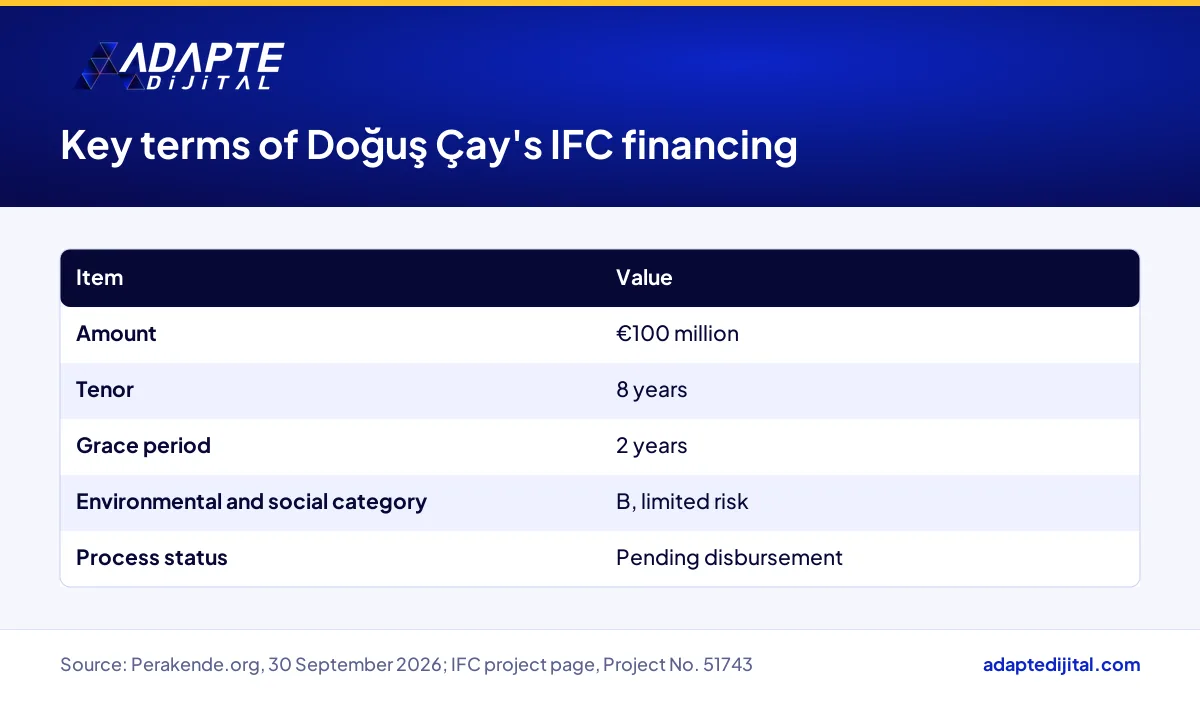
Doğuş Çay, a Turkish food and beverage producer, secures €100 million in financing from IFC, the private-sector arm of the World Bank Group (Perakende.org, 30 September 2026). The loan runs for 8 years, with a 2-year grace period on repayments. The money goes into potato chip capacity, tomato paste infrastructure, seed production and storage, and distribution and logistics.
What it means for you: development finance can look like a door open only to big groups, but preparation works the same at any size. A food firm without audited statements, a clear project file and environmental and social information never gets to discuss the amount.
What does IFC’s €100 million financing for Doğuş Çay cover?
Four areas: chip capacity, tomato paste infrastructure, seeds and storage, and logistics. The report expects around 3,400 direct and indirect jobs and income opportunities for more than 50,000 farmers, without saying over what period.
How does a development lender like IFC look at a Turkish food company?
More like a project partner than a lender. The IFC project disclosure page shows the investment scope, the environmental and social risk category and the process status on one page. Repayment matters, but so do what the money buys and its effect on workers and suppliers.
How does a Turkish food company prepare for international credit, step by step?
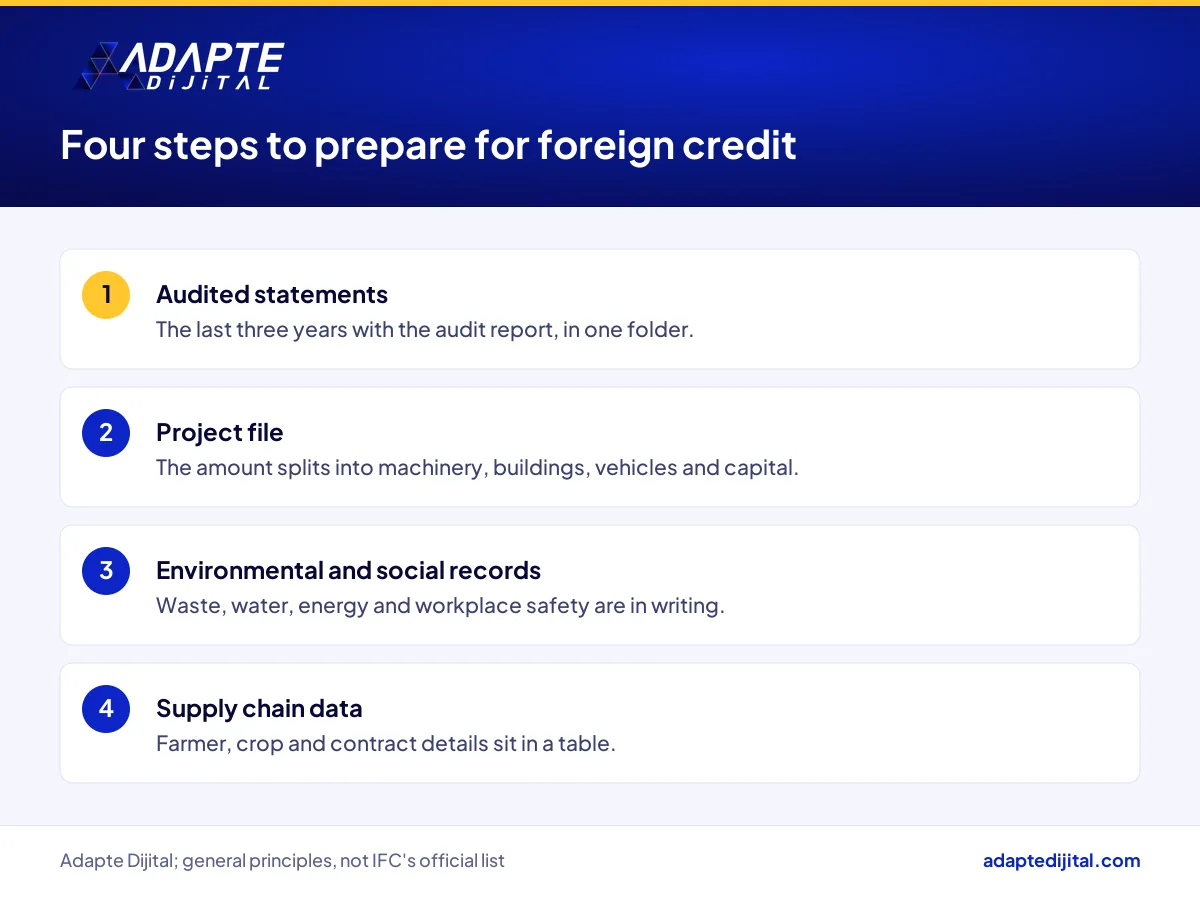
In four steps: get your financial statements ready for independent audit, break the investment down in a project file, put environmental and social information in writing, and gather supply chain data. The fact sheet gives no time or cost figures, so get your own audit and advisory quotes at each step. The order below is a general principle, not IFC’s official application list.
Which businesses does Doğuş Çay’s IFC financing affect, and how?
The direct winners are the farmers who sell potatoes and tomatoes to Doğuş Çay, plus seed and storage suppliers. Investment in distribution vehicles and logistics opens work for transport and maintenance firms. On the shelf, small chip and tomato paste brands with limited capacity in the same category feel the pressure. Retailers are affected indirectly, through product continuity.
What should a food company’s digital presence show when it seeks foreign financing?
It should make your file verifiable from the outside. A lender or partner checks your corporate website before the meeting; if facilities, products, certificates and sustainability data are missing there, the claims in your file hang in the air. An English page, a current product catalogue and measured environmental data form the digital leg of financing.
What should a food business owner do this week to prepare for financing?
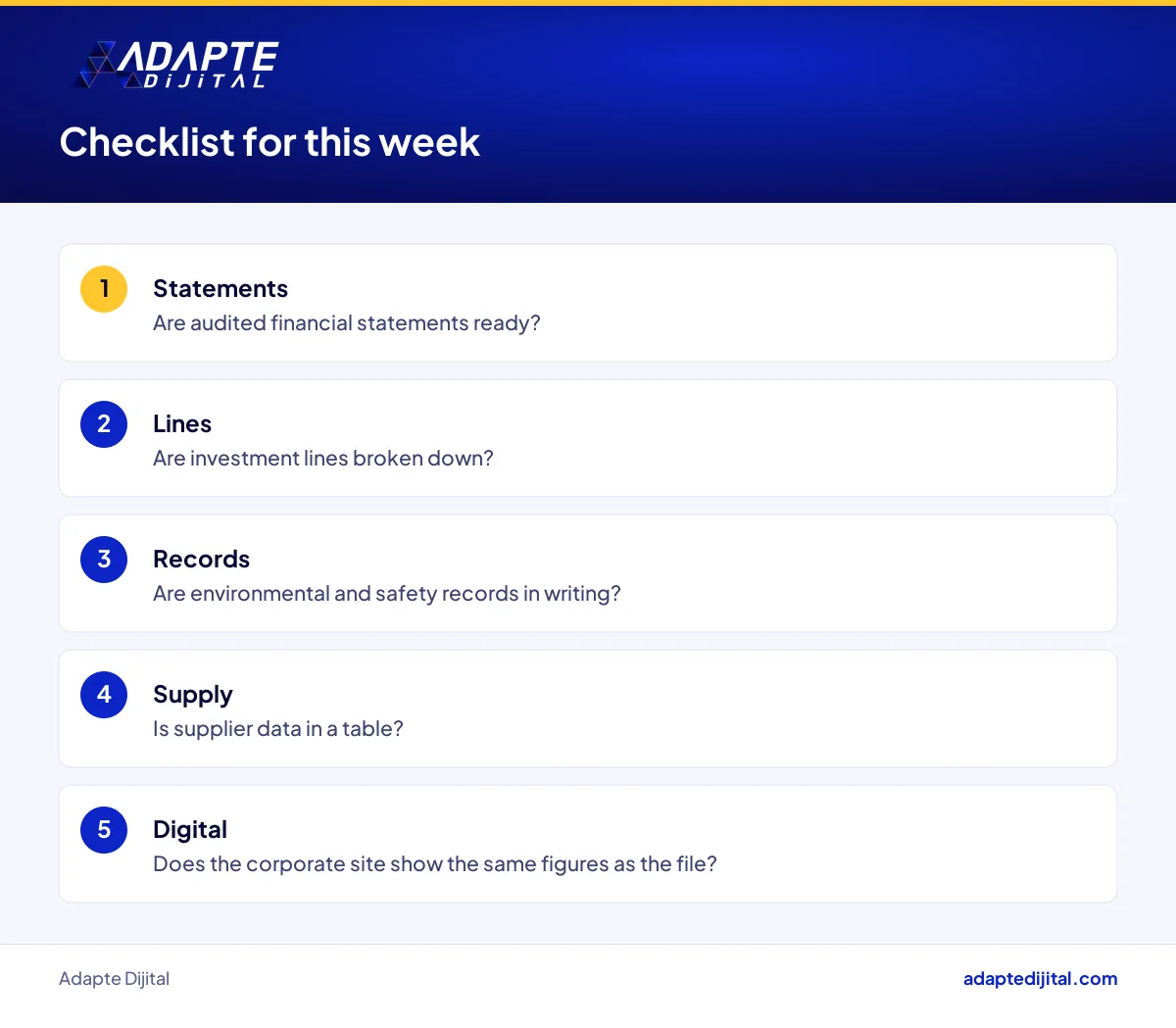
Set up a checklist this week and mark the gaps. Put the last three years of financial statements, the investment plan, your environmental and social records and your supplier list in one folder. Then ask an audit firm and your accountant for quotes. Verify with the official source; this is not legal or financial advice.
- Audited financial statements are ready.
- Investment lines are broken down.
- Environmental and workplace safety records are in writing.
- Supplier data sits in a table.
Next to each item, write the person responsible and the target week.
Quick Summary
- According to Perakende.org, Doğuş Çay secures €100 million from IFC over 8 years, with a 2-year grace period.
- The funds go to chip capacity, tomato paste infrastructure, seeds and storage, and logistics.
- According to the IFC project page, the project is in environmental and social category B and pending disbursement.
- Preparing for foreign credit starts with audited statements, a project file, environmental and social records and supply data.
- The most common mistake is fixing the amount first and filling the file afterwards.
Short Glossary
- IFC
- IFC is the abbreviation used for the International Finance Corporation, the World Bank Group member that lends directly to the private sector.
- Grace period
- Grace period is the term used for the early years of a loan when no principal is repaid.
- Environmental and social category
- Environmental and social category is the label used to classify a project by the risk level of its effects on the environment and society.
Frequently Asked Questions
Next Step
If you want your financing file, corporate website and digital visibility to tell the same story, fill in the consult your expert form.
Sources: Perakende.org, 30 September 2026 · IFC project disclosure page, Project No. 51743 (linked in the text).
Updated: October 2026
Sık Sorulan Sorular
According to IFC, Doğuş Çay was founded in 1985, makes chips, tea, sugar, tomato paste and soft drinks, and runs 15 large-scale production facilities. The project scope lists chip capacity and efficiency, tomato paste capacity and the purchase of distribution vehicles. The page places the use of funds at the company’s facilities in Türkiye.
The IFC page shows a disclosure date of 22 May 2026 and a status of pending disbursement. Interest rate, collateral and signing date are not clear, so wait for an official statement rather than guess.
That is not clear. Bilge Kaan Karakan, a board member at Doğuş Çay, says the company’s potato chip plant in Hungary will start operating in 2027. The report does not say how much of the funding, if any, goes to that project.
The Doğuş Çay project sits in category B, meaning limited risk. The label signals that the project’s effects are seen as specific and manageable. For your own project, expect to describe waste, water, energy and workplace safety in writing.
IFC projects are disclosed on disclosures.ifc.org before signing, so outsiders can read the applicant’s information. Your website and your file need to tell the same story.
Seeds, storage and farmer income are presented as part of an investment in the food supply chain. Wagner Albuquerque de Almeida, IFC Regional Director for the Middle East and Central Asia, says the investment will support the long-term growth of Türkiye’s agri-food sector. The field belongs in the file as much as the factory.
An international lender talks to audited financial statements, not tax-return figures. Put the last three years of balance sheets and income statements in one folder, with the audit report. For audit time and fees, get your own quotes from at least two audit firms.
In the Doğuş Çay case, each use is listed separately: chip capacity, paste infrastructure, seeds and storage, logistics. Your file should split the amount the same way, into machinery, buildings, vehicles and working capital. Next to each line, write the expected capacity gain and job effect.
Waste management, water and energy use, workplace safety records, headcount and contract types should sit together. If they are gathering dust in scattered spreadsheets, the file comes back at first review. If you have no sustainability data, start measuring today.
You should be able to show, in a table, how many farmers you buy from, which crops, and under which contracts. If you use contract farming, write up seeds, storage and purchase guarantees separately.
Common mistake: firms pick the amount first and try to fill the file afterwards. A lender reads the project first and the amount second. A large figure with no reasoning behind it loses credibility at the table.
A producer with more capacity offers steadier stock and wider distribution. A small brand should compete on regional taste, recipe and direct sales, not volume; otherwise the grocer stops reordering.
Capacity and logistics investment means steadier supply. A chain may see lower stock-out risk; a local grocer gets more reliable stock but must protect brand variety itself.
The report expects income opportunities for more than 50,000 farmers. For a farmer on contract production, that means knowing the buyer before sowing. Since the period is not disclosed, local impact is something to watch over time.
About, facilities, products, certificates and sustainability pages should exist in Turkish and English. Founding year, facility count and product groups must match your file exactly; one conflicting number shakes trust.
Publish what you measure, with year and unit, and leave out what you do not. A page of empty promises raises more questions than no page at all.
Foreign financing is usually read alongside a growth and export story. We cover small-scale expansion abroad in our piece on ShipEntegra’s US e-export service and how small sellers start. Your marketplace store and export page become concrete proof of that story.
Four are enough:
Job creation is a headline item, so staff costs need to be clear. We explain how benefits hit payroll in our piece on meal card versus cash and which costs an employer less. If these lines are scattered in the file, you lose control of the numbers.
We make sure your corporate site, English content and sustainability page speak the same language as your file through our digital consulting service. You can follow other food sector news on our retail page, where we interpret the retail agenda for you.
Eligibility depends on the institution and the project; check size thresholds in IFC’s official sources. The preparation logic is the same at any size: audited statements, a clear project file and environmental and social information.
The interest rate and collateral structure are not in the report. Public information is limited to the amount, tenor and grace period.
Time and fees depend on the size of the company and the state of its records. Get your own quotes from at least two independent audit firms.